Category: Church (Page 23 of 59)

We Belong To The Lord

I want to continue our important discussion here regarding the silence of Scripture and its place in our American Restoration Movement history and current beliefs and practices. As it relates to the maddening question of whether biblical silence on a particular issue is prohibitive or permissive, please check out this video clip from a Rick Atchley sermon illustration. I quoted one of my favorite Rick Atchley lines in Monday’s post, and a friend reminded me this morning of Rick’s “chair illustration.” I’ve seen Rick do this at least a couple of times. It’s a beautifully simple and strikingly clear demonstration of the absurdity of our traditional approach to the silence in Scripture. And it inarguably proves that this default approach actually prevents any type of Christian unity among our churches; it actually leads to and fosters ugly and sinful divisions.

When you have more time, you might also check out this recent 26-minute presentation by my brilliant brother, Dr. Keith Stanglin, on the fourth and fifth propositions of Thomas Campbell’s Declaration and Address. Keith argues that Campbell’s document, which most consider as the foundational document for the Restoration Movement and Churches of Christ, fundamentally rejects both the Old Testament and church history as formative and informative for our congregations. Keith makes a compelling case for paying careful attention to all of church history as we prayerfully make decisions for our own churches and denominations today. The lecture is in two parts on YouTube: click here for part one and click here for part two. (Thank you, Keith, for pointing out that the use of unleavened bread for communion is a tenth century innovation of the western church.) After watching Keith, you’ll understand why I always say I got the looks and he got the brains.

While I’ve got you here, I’ll direct you to my great friend Jim Martin’s post, written for Dan Bouchelle’s blog, on why he continues to preach.

~~~~~~~~~~
Paul’s thoughts in Romans 14:1-15:7 are summed up in a couple of places in that passage. In 14:17 he claims that “the Kingdom of God is not a matter of eating and drinking, but of righteousness, peace, and joy in the Holy Spirit.” Later, in 14:22, Paul commands “whatever you believe about these things keep between yourself and God.” The conclusion must be that it’s OK to have strong opinions and beliefs about certain things as they relate to Christ Jesus and his Kingdom, but that those opinions and practices must never be bound on other Christians.

But what about “salvation issues?” Oh, I can hear it now. In fact, I hear it quite often. What about matters of doctrine? What about the important things?

Yeah, that’s where it gets touchy. Because if two Christians are arguing about something and the argument and the feelings are such that it’s dividing them and threatening to divide their church, then, of course, one or both of them believe with all their heart that it’s a doctrinal or salvation issue. But, Paul says, that’s OK, too.

“One man considers one day more sacred than another; another man considers every day alike. Each one should be fully convinced in his own mind. He who regards one day as special, does so to the Lord. He who eats meat, does to the Lord, for he gives thanks to God; and he who abstains does so to the Lord and gives thanks to God. For none of us lives to himself alone and none of us dies to himself alone. If we live, we live to the Lord; and if we die, we die to the Lord. So, whether we live or die, we belong to the Lord.” ~Romans 14:5-8

Each of us should be fully convinced in our minds that what we’re doing is the right thing to do in the eyes of God. Yes. But don’t bind that on another brother who doesn’t feel the same way. If he practices something different, Paul assumes you’re both doing it to the Lord, before the Lord, in the presence of the Lord, to the glory of the Lord, and with a clear conscience. We assume that my sister with a different belief or a different practice is not believing or practicing arbitrarily. She’s doing it with careful study and reflection and prayer. And she’s fully convinced in her mind that she’s doing the right thing. So, everything’s fine.

But, somebody will still say, “What if we’re talking about a salvation issue?”

What in the world is a ‘salvation issue?’ Will somebody please tell me what a ‘salvation issue’ is? We get into discussions about ‘salvation issues’ and we start ranking things in order of importance to God, in terms of what’s going to save us or condemn us. And we’ll talk about baptism and church and the authority of Scripture and worship styles, but we’ll never talk about helping the poor or being kind to your enemy. Scripture says those are actually the heavier issues. They’re all salvation issues! Everything we do is a salvation issue! That’s why the heart is the most important thing. The attitude is the most important matter. For the Kingdom of God is not a matter of eating and drinking…

Paul is calling for unity in spirit, not unity in opinion, not unity in practice, not even unity in belief. And he’s dealing with what at that time in that church were huge issues. Unity comes with where your heart is, what’s your motivation, what drives you, who you are thinking about.

Paul clearly identifies himself as one of the “strong” Christians. But, again, it’s interesting to me that he doesn’t say the “weak” need to change their minds or their opinions or practices. His prayer is not that all the Christians in Rome come to the same opinions on these disputable matters. No. He’s praying that they may possess a unity of spirit that transcends their differences.

Peace,

Allan

The Silence of Scripture

When our Restoration Movement divided between Disciples of Christ and Churches of Christ at the turn of the 20th century, it was largely a result of two different interpretations of silence in Scripture. As we’ve already seen, those opposed to the use of instrumental music during congregational worship reasoned that, since the Bible didn’t specifically authorize it, it was not allowed. There were no New Testament examples, so it couldn’t be practiced. On the other hand, proponents of pianos and organs declared that silence in the Bible permitted the use of instruments — Scripture didn’t specifically prohibit or condemn it. Since there was no biblical command against it, it was OK to practice it.

The same arguments regarding the interpretation of biblical silence were used for and against the Missionary Society, for and against located preachers, for and against open and closed communion. Is scriptural silence on a particular issue prohibitive or permissive? Does silence allow or condemn? I’m afraid we still run into forms of this debate almost every day. And we ought not.

When Alexander Campbell said, “Speak where the Bible speaks and be silent where the Bible is silent,” he didn’t mean that the lack of a clear biblical directive should embolden us to scream and yell and assert our own opinions about that silence and loudly and aggressively and divisively bind those opinions on others. He meant that we could all form our own thoughts and opinions — and they could be very strong opinions and passionately held — and then keep them to ourselves. Being “silent where the Bible is silent” means, in the words of the apostle Paul, “whatever you believe about these things keep between yourself and God” (Romans 14:22).

In my view, a reading of Romans 14:1-15:7 would convict any Christian of binding his opinions on anybody.

Paul says very plainly that we have “strong” Christians and “weak” Christians. His words, not mine. The weak Christians are vegetarians; the strong believers enjoy a good steak. The weak brothers keep all the Jewish holy days; the strong brothers don’t. The weak Christians are developing all kinds of elaborate worship and lifestyle theologies and drawing lines in the sand over what’s right and what’s wrong; the strong Christians don’t have very many lines and they’re not as concerned about which worship and lifestyle practices are right or wrong. The weak are criticizing the strong for being spiritually insensitive; the strong are looking down on the weak for being spiritually immature and inferior. The strong proclaim freedom in Christ; the weak say that doesn’t mean anything goes. The weak tell the strong, “You’re wrong!” The strong tell the weak, “Grow up!”

Paul commands both of these groups of disciples not to look down on anybody. Nobody is to condemn anybody. For God has accepted him. Accepted whom? This brother or sister or this group of brothers and sisters who disagree with you on your church tradition. This other Christian or group of Christians who don’t see eye to eye with you on your disputable matter. You’re not his master, Paul says. Christ Jesus as Lord is his master. Not you. Whether this other guy stands or falls is up to the Lord. Whether he’s right or wrong is up to God, not you.

And then Paul goes ahead and makes the judgment, he makes the call. “He will stand!” Whether he agrees with you or not or whether you’re both on the same page or not, Paul says this guy will stand because he’s in Christ. So, you accept him because Jesus accepts him. Christ died for him, Paul reminds.

Why do we have such a hard time with this? Is it because there might not actually be a “right way” or a “wrong way” to do a lot of the things we do in the name of Jesus, and we can’t stand it? Could it be that if we disagree with someone over a church matter or a biblical interpretation, one of us just has to be right and one of us just has to be wrong? How else would you explain our two thousand year history of dividing and dividing and then dividing even our divisions over trivial matters such as worship practices and leadership structures, days of the week and food and drink, baptism methods and signs on the front of the church? How else would you explain Paul’s clear command to be silent about such disagreements and never to label or divide over them? And our clear disregard and disobedience to that command?

You know, in this same Romans 14 passage, Paul doesn’t tell the weak Christians to change their minds about their immature beliefs. He does not tell them to change their practices which, again, he considers “weak.” In fact, he tells them not to change a thing. Why is that? Is it because, again, there might not actually be a “right way” or a “wrong way” to do a lot of the things we do in the name of Jesus?

“Whatever you believe about these things keep between yourself and God.” ~Romans 14:22

“Speak where the Bible speaks and be silent where the Bible is silent.” ~Alexander Campbell

Peace,

Allan

The Spirit of Larimore

Rick Atchley takes a well known Restoration Movement slogan and updates it to reflect our most recent history: “We speak where the Bible speaks, and where the Bible is silent, we speak even more.” Oh, yeah, the silence of Scripture — is it permissive or prohibitive?  If we’re honest, most of us decide based on the issue of the moment and/or our own comfort zones. Strange, but that never really was a question that concerned anybody in our churches until right after the Civil War when we were looking to divide and punish, to humble others and make ourselves feel better.

The Civil War and the resulting hatred and bitterness that lingered into and through Reconstruction in the South played a critical and undeniable role in the divisions among the Stone – Campbell churches that ultimately led to the official “split” between the Disciples of Christ and the Churches of Christ. To deny this would be to ignore the evidence. Similar splits along North and South lines occurred in the Methodist, Baptist, and Presbyterian denominations at the same times. And, no, we were not immune.

As further proof, Holloway and Foster’s Renewing God’s People offers up the issues of instrumental music in corporate worship and the American Christian Missionary Society.

While the centralized missionary organization had its detractors almost as soon as it was established in 1849, the Missionary Society was not something over which anybody in a Stone-Campbell church would have fought or divided. Until after the Civil War. Following the Society’s pro-Union resolutions and its official support of the United States military, it became the firestorm issue of the Restoration Movement. To demonstrate how the War Between the States had influenced feelings and thoughts, consider that two of the Society’s most outspoken critics were former officers of the organization. Tolbert Fanning served on the board and even addressed its annual meeting in 1859. Benjamin Franklin (no, not that one) served as the Society’s secretary for thirteen years. But after the war they both repeatedly blasted the group as unbiblical in Franklin’s American Christian Review. Their main official objection was based on the “silence of Scripture.”

Since the Bible does not specifically mention anything about multi-church organizations or boards that support a combined effort among different congregations, they argued that the Missionary Society was unscriptural. Of course, those who supported and served the Society claimed that silence in Scripture is what gave them permission to do it.

The same arguments were used in debating the issue of instrumental music in our corporate worship assemblies. While the first recorded instance of an instrument used in worship in a Stone-Campbell church was in Midway, Kentucky in 1859, it really was a post-Civil War issue. The churches that brought in pianos and organs argued that, since the Bible did not prohibit it, they were permitted to use the instruments to help their singing and to appeal to the younger generations. Opposition to this “innovation” came mostly from the South, and mostly from the same “silence of Scripture” argument. The New Testament, they claimed, authorizes congregational singing, but not musical instruments. On the other hand, those who used instruments cited the same Bible verses that gave them authority to use song books and song leaders and church buildings to aid their worship: none.

The one man who might have done the most to hasten the division among the Stone-Campbell churches on these issues is Daniel Sommer who, in 1889, outlined his plan to save the Restoration Movement from “innovations and corruptions.” Unoriginally titled “An Address and Declaration,” Sommer’s paper proclaimed that if leaders and churches would not give up practices such as instrumental music, support of the Missionary Society, located preachers, and others, then “we cannot and will not regard them as brethren.”

On the other end of that attitude was a Stone-Campbell educator and preacher named T. B. Larimore. He was baptized in Kentucky in 1864 and later attended Franklin College near Nashville, studying under Fanning. This loyal son of the South was influenced and taught by some of the strongest opponents of instrumental music and the Missionary Society, but he refused to ever take sides on these issues. He never declared himself publicly. Larimore believed God’s Church should never divide over such trivial matters and, as a preacher of the Gospel, saw his duty as only to proclaim the good news of salvation from God in Christ. Larimore said he would have nothing to do with those questions over which “the wisest and best of men disagreed.”

Larimore was a highly successful and influential preacher. He baptized more than ten thousand people in his lifetime. And he would preach wherever people would listen. He was invited by both Churches of Christ and Disciples of Christ and he honored each invitation. He wrote articles and religious papers for both groups. As his popularity grew he was pressured more and more to take sides on the issues that divided the Movement, but he never did. He only spoke well of people in both camps. In his words:

“I never call Christians or others ‘anti’s,’ ‘digressives,’ ‘mossback,’ ‘tackies,’ or ‘trash.’ I concede to all, and accord to all, the same sincerity and courtesy as the Golden Rule demands.”

I’m not sure what it means to be called a “tackie” — only Doug Foster knows.  But Larimore’s legacy during one of the most contentious times in our history is that he spoke only of matters of first importance. He taught and lived, by word and deed, that the only way for God’s Church to avoid the evils of division and maintain Christ’s vision for unity was to allow freedom in matters of opinion. And he kept on preaching.

Peace,

Allan

Stone-Campbell and the Civil War

In an effort to raise our “spiritual historical consciousness,” our Sunday morning Bible classes here at Central are studying Doug Foster’s “Renewing God’s People: A Concise History of Churches of Christ.” We’re hoping this study will help us see that so much of what we believe and practice was shaped by outside factors of history and culture. The Christian faith was passed on to each of us by someone, as was our particular brand of Christian church. To acknowledge that it’s always affected by cultural and historical forces is to become more humble and less judgmental of others, to see God’s work and God’s Kingdom in much bigger and broader ways, and to rely more on his mercy and grace that saves us.

This past Sunday, we took a close look at how the Civil War divided the Stone-Campbell unity movement between churches in the North and churches in the South and, eventually, between the Disciples of Christ and the Churches of Christ. For the past hundred years, we’ve largely denied that the War Between the States had anything to do with it. We have very smugly contested that our differences are doctrinal, over right belief and correct practice, about biblical interpretations and church structures. Ah, that kind of thinking and talking is why we need these kinds of studies.

In 1860, there were about 1,200 Stone-Campbell congregations in the north and about 800 in the south. And the closer the nation came to war over the issue of slavery, the more the opinions of church leaders were expressed. Alexander Campbell detailed his position in a series of eight articles in his Millennial Harbinger. He claimed that Scripture regulated slavery, it didn’t abolish it. He wrote that the Bible did not condemn slavery as sinful or immoral. And, perhaps influenced by his fellow Virginian Thomas Jefferson, Campbell conceded that slavery just wasn’t in harmony with the spirit of the age or the advancement of society and so supported plans to end slavery gradually without disrupting business. On the other hand, Barton Stone had freed all of his slaves years earlier and was an active member of the American Colonization Society.

The Stone-Campbell churches didn’t have a national organization or governing board to approve policy and regulate disputes. But they did have the American Christian Missionary Society, headquartered in Cincinnati. Their annual meetings had always drawn church members from all over the country. But when the Civil War began, southerners were no longer able to attend. At the October 1861 meeting, a resolution was introduced calling on all the Stone-Campbell churches to support the Union:

“Resolved, that we deeply sympathize with the loyal and patriotic in our country, in the present efforts to sustain the Government of the United States. And we feel it is our duty as Christians to ask our brethren everywhere to do all in their power to sustain the proper and constitutional authorities of the Union.”

Tolbert Fanning published a strong response to the resolution in the November issue of his Nashville-based Gospel Advocate:

“Should we ever meet them in the flesh, can we fraternize with them as brethren? How can the servants of the Lord in this section ever strike hands with the men who now seek their life’s blood? We do not know how this matter appears to others, but without thorough repentance, and abundant works demonstrating it, we cannot see how we can ever regard preachers who enforce political opinions with the sword, in any other light than monsters in intention, if not in very deed. How can Christian men of the South do otherwise?”

Naturally, as tensions grew and hostilities erupted between the north and south, tensions grew and hostilities erupted between the churches in the north and south. That would just be expected, right? It’s wrong. It’s sinful. But it’s definitely the way things are. It’s the way human beings work.

As would be expected, the feelings of bitterness and anger didn’t subside with the end of the war in 1865. David Lipscomb wrote in a February 1866 Gospel Advocate article that the Missionary Society had spent the past four years “encouraging the work of Christians North robbing and slaughtering Christians South.” He accused the organization of “inducing the followers of the Prince of Peace to become men of war and blood.” With similar sentiment in the same publication the following month, Lipscomb claimed that the society “without evidence of a repentance of the wrong, should not receive the confidence of the Christian brotherhood.”

It is naive at best and dishonest at worst to claim that anyone in America before, during, and after the Civil War could have remained unaffected by it. Foster writes in Renewing God’s People:

The war created two very different moods in the country — one in the North and one in the South — that no one could escape. Northerners had won the war. There was a general sense of victory, progress, and prosperity, mixed with a desire to punish or rehabilitate the South. Southerners had been defeated. To survive, they interpreted their defeat as discipline from God to keep them from becoming like the materialistic North and to preserve their virtues as an example of God’s ideal culture. Thus, it was not just the war but its aftermath, particularly Reconstruction in the South, that broke Christian fellowship. After the war, many churches in the prosperous northern cities became successful in society. They built large buildings with expensive stained glass. They preferred educated ministers. They could even afford expensive organs for their new buildings… By contrast, Southern members faced starvation, disease, and economic ruin… To Southerners, it was inconceivable that their fellow Christians in the North could spend money on buildings and organs while their brothers and sisters in the South were struggling just to stay alive.”

Yeah, it was real.

In 1906, the official U. S. census date of the split, two-thirds of the Disciples of Christ churches were in the North and two-thirds of the Churches of Christ congregations were in the South.

Doctrinal issues are usually not just doctrinal issues. Stone-Campbell church leaders had refused to allow any differences in theology or church structure or worship practice to divide them. Though some disagreed with the need for a missionary society and some adamantly opposed it, it was never allowed to divide the churches. Until the Civil War.

The ways we think and behave, what we believe and how we practice, is passed on to us in a specific culture during a particular point in history. We’re affected by it. It shapes how we view our churches and how we view others. Can we at least acknowledge that? Then, by acknowledging it and trying to better understand it, won’t we be more humble? Won’t we be less judgmental? Won’t we be more patient and accepting, more kind and forgiving?

Peace,

Allan

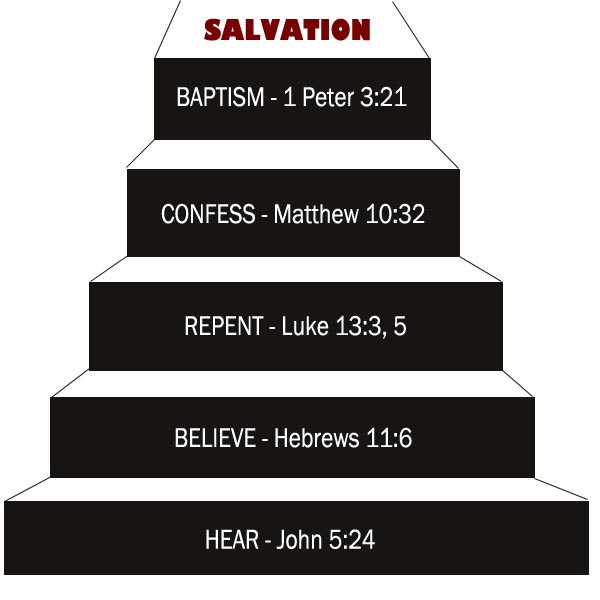
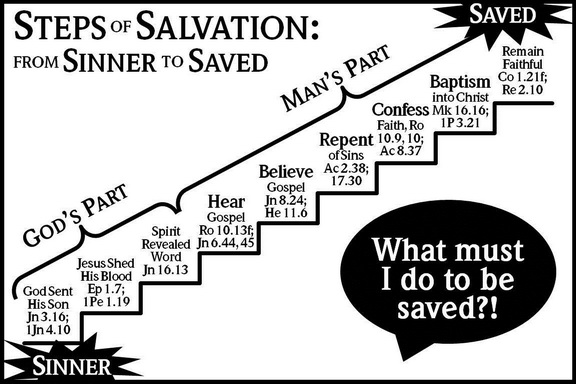
Five Steps to Salvation

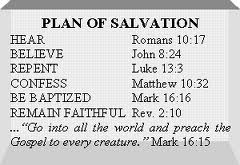
It’s just a Church of Christ thing, right? The “Plan of Salvation,” also called the “Five Steps of Salvation,” is unique to us, I think. And those of us who were raised in and by the Churches of Christ know them well: Hear, Believe, Repent, Confess, Baptism. In that order. As a kid in the ’70s, this was drilled into me by my Sunday school teachers in Bible class, by the preachers from the pulpits, by the youth ministers at the devotionals and rallies, and by the Open Bible Study my dad walked me through when I reached the “age of accountability.” The five steps were plastered on bulletin boards in the church hallways, illustrated by charts and diagrams on mimeographed handouts, and splashed across banners promoting the next Gospel meeting. These were the five steps, always accompanied by supporting verses of Scripture, that necessarily had to be followed — again, in order! — for one to be saved.

Hear. Believe. Repent. Confess. Be Baptized.

You ever wonder how that started? You ever question the validity of such a list? If you or your church were to make a list of supposed steps to salvation, what would you include? What parts of our CofC list would you leave out?

Historians point back to our movement’s focus on rational thought and enlightenment thinking that characterized the mainstream culture of America at the turn of the 19th century when Stone and Campbell and others were attempting to “restore” God’s Church. It was all about scientific reasoning and empirical evidence and deductive problem-solving. Society at this time was convinced that there were undeniable patterns, unalterable designs in nature and in the world that, if learned and applied, held the keys to everlasting peace and joy.

Alexander Campbell searched the Scriptures in this way and came up with what he called “the ancient gospel,” a pattern he believed was the divinely-ordained natural way to heaven. According to Campbell, it all boiled down to, in this order: gospel facts (death, burial, resurrection, and ascension of Christ), faith, repentance, reformation (of life), baptism, remission of sins, reception of the Holy Spirit, sanctification, resurrection of the saints, and eternal life. In that order. Campbell claimed that all Christian denominations believed in all these steps, but put them in different orders according to their own interpretations or theories of conversion.

At about the same time, Walter Scott came up with a biblical pattern and called it “the gospel restored.” He had six points originally. The first three were what humans had to do to be saved: believe, repent, and be baptized. The last three were what God promises to people who do the first three: forgiveness of sins, the gift of the Holy Spirit, and eternal life. Not too much later, Scott shortened his list to five points — one for each finger on a person’s hand, for easy remembering: faith, repentance, baptism, forgiveness of sin, and the gift of the Holy Spirit.

This method proved to be very successful on the early American frontier where most everybody had been trained in Calvinism which claimed that men and women were saved only by God’s predestination, that one couldn’t do anything to save himself, it was all up to God’s pre-ordained choosing. By telling these fiercely independent early frontier people that there really was something they could do to be saved, the Stone and Campbell churches fueled a massive rush to repentance and baptism.

As with most good things, we swung the pendulum a bit too far. Pretty soon, we were taking God’s initiative and the Holy Spirit’s active participation clear out of the conversion process. Preaching became all about proving “facts” with arguments and evidence. The Holy Spirit’s work in the past had been entered into the Biblical record and was there to be studied in a rational manner, but it wasn’t necessary for a person’s salvation. The emphasis was on logical fact-finding and step-following and persuading people to “obey the gospel.” The “gospel,” of course, being the steps.

So, at some point in the middle of the 1800s, it gets boiled down to what we have today in the five steps of salvation or the plan of salvation: hear, believe, repent, confess, be baptized. Notice how God’s divine activity is completely absent from any of the steps. Notice how this chart here to the right — all of these charts were downloaded from Church of Christ websites this morning — actually gives much more responsibility or credit to man than to God for salvation. Where is God in our “plan of salvation?”

Why is baptism the last step? Who took out “sanctification,” the guiding of the Holy Spirit, and the grace of God to continually wash our sins?

It is God who works to will and to act according to his good purpose. It is God who initiates salvation, who begins the good work and sees it through to completion. Belief and repentance and confession are salvation steps to be taken every day, not once on a ladder list of human accomplishments. Baptism is never the end of what the apostle Paul calls “being saved,” it’s the beginning. Our five steps minimize our God. Our five steps neglect a lifetime of day-by-day, hour-by-hour difficult discipleship to Jesus. And they ignore the unmerited and continuous grace of our merciful Father.

OK, maybe that’s a little harsh. Too judgmental, probably, Yes, we come by the “five-steps” thing naturally. It’s been handed down to us by faithful men and women who were doing their very best with what they had to work with during the times they lived. And I’m grateful for it. Seriously. But I’m also so glad that we’ve recognized the many shortcomings in this kind of incomplete view of salvation. I’m so glad that we’re acknowledging together the active role of God’s Spirit in the calling and saving and sanctifying of the saints. And I’m glad we can change. I’m so glad, by God’s grace, we’re allowed and even compelled to change.

Peace,

Allan

If Stone and Campbell Could Do It…

In an effort to raise our “spiritual historical consciousness,” we’re studying Foster and Holloway’s Renewing God’s People in our Sunday morning Bible classes here at Central. As a church family, we’re acknowledging that Churches of Christ have a particular history, that we’ve been shaped by cultural and historical ideas and events, and that some of the things that have marked us as a faith tradition are really wonderful and some things are a little less than wonderful. My hope is that, through the course of this study, we’ll come to realize that our beliefs and practices are continually informed and molded by the culture. Through that realization, I hope, we’ll better see that some of the things we believe are sacred really aren’t and that some of the successful ways and means of the past aren’t necessarily the way to be church or impact a community in the present. And, I pray, we’ll commit to re-claiming the very best parts of our American Restoration Movement heritage and expressing them again in faithful ways.

The most beautiful thing about the Restoration Movement and Churches of Christ is that we were founded on the Christian principle of unity. The unity of all believers is a key biblical doctrine and it was the driving force behind our movement. So much so that, despite their massive differences of theology and opinion, Barton Stone’s and Alexander Campbell’s churches united on January 1, 1832.

Consider for a moment their immense differences:

While Campbell held to the Trinitarian concept of God as one divine deity living in community as three distinct persons, Stone didn’t see it that way. He believed doctrine of the Trinity couldn’t be found in Scripture, that it belonged to the creeds from which they were trying to distance. Because of that, Stone saw Jesus as the “son” of God, but not truly God himself. Yes, Jesus is our Savior, Stone argued, and he is exalted at the right hand of the Father, but he’s not God himself. Campbell disagreed, holding to the more traditional doctrine that Jesus is God himself in the flesh.

Concerning the Holy Spirit, Stone believed God’s active and continuous work in the world was done through his Spirit. The Spirit is active in the Church, he is active in the hearts and minds of God’s people, he is active and working in all of creation for the sake of the Kingdom. On the other hand, Campbell believed that the Holy Spirit inspired the writing of the Scriptures, and then pretty much ceased operating outside of them. Campbell taught that the Spirit only spoke to man, only worked on man, only compelled and shaped man, through the reading of the Word. Therefore, Campbell believed that the visible signs of the Spirit — speaking in tongues, healings, prophesying, etc., — had ceased, whereas Stone most certainly did not.

As for mankind, Stone leaned a little Calvinistic in his belief that man was unregenerate and stained with sin at birth. Stone taught that the Holy Spirit of God is the one who convicts and converts men and women to Christ. Campbell, of course, preached and wrote that God had given man a brain and good common sense and that, when reading the Bible with an open heart and open mind, one would make the right decisions about salvation through Jesus. Campbell saw humankind in a really optimistic kind of way: with our brains and hard work, people are getting better and better and America is the Promised Land where we’re going to restore the divine ancient order. Stone: not so much. He believed humans were getting worse, not better, and that only God’s Spirit could turn a man to heaven.

Stone saw salvation as the work of God’s Holy Spirit transforming men and women into the image of Jesus. Campbell saw salvation in terms of knowledge and intellectual assent. He stressed the atonement aspects of the cross, more as an economic transaction that paid for our sins. Stone concentrated his doctrines of salvation on the love and grace of a merciful Father. Stone’s churches placed a greater emphasis on an ordained ministry while Campbell maintained that all Christians were ordained ministers of the Church. Campbell wouldn’t allow anyone in his churches who hadn’t been baptized. Stone believed baptism was essential, but he’d allow unbaptized men and women to join his churches, saying that they were all just in different places on the road to understanding. Campbell’s churches celebrated the Lord’s Supper every Sunday, Stone’s much more infrequently. Stone was a pre-millennialist, Campbell a post-millennialist.

That’s a lot of differences.

In the seven classic categories of Christian theology, Stone and Campbell disagreed on all seven. And these are big issues. We’re not talking about order of worship or women’s roles, we’re talking about the very nature of God, the salvation role of Jesus, the importance of baptism and communion, church leadership structures, and the role of the Holy Spirit.

Yet, both of these men and their dozens of churches understood that Christian unity is the holy will of God; that breaking down denominational barriers and coming together in the name of Jesus is a true expression of the Gospel; and that divisions and separations among denominations is an evil distortion of the Gospel, an insult to Christ, and sends the worst kind of message to an unbelieving world.

And they did it.

It was difficult, extremely difficult. There were bumps along the way and hurdles to overcome. But for about 65-70 years, they did it. Together.

They made the decision that what they shared in common in Christ was far more important than anything on which they might differ. They believed it was truly God’s will and best communicated to the world what God was doing in Christ. To borrow from Foster:

“Christian unity may not always mean a physical merger of congregations or movements. But when Christians are convinced of the importance of unity and are willing to put up with each others’ peculiarities in the knowledge that all are committed to knowing and doing God’s will expressed in Scripture, the kind of unity seen in our Stone and Campbell history may be the best and fullest kind there is.”

So, the question today: Is sacrificing and working for visible expressions of the unity of God’s Church as important to us today as it was to Stone and Campbell? How important is it in shaping our congregations more into the image of Christ? How important is it to testifying to the power of Jesus in our city? How far would you or your church be willing to go to make the attempt?

All of Scripture points to God’s people as being one. God’s Church is his one chosen people around his one common table. We know we’re going to be one and eternally united in heaven. What are you and your church doing to lean into that right now so that’s God will is done here just as it is there?

Peace,

Allan

« Older posts Newer posts »