Category: Church (Page 22 of 61)

Speaking Community

With great power the apostles continued to testify to the Resurrection of the Lord Jesus!” ~Acts 4:33

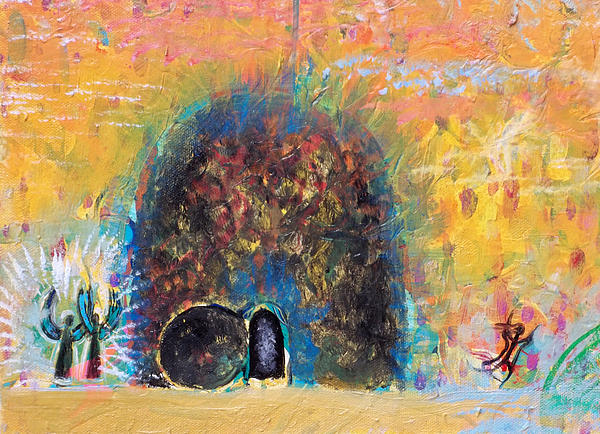
In Matthew 28, Jesus meets the women outside the empty tomb and says, “Go and tell my brothers!” Scripture says the women “ran to tell the disciples.” In Mark 16, the angel inside the tomb says, “Go and tell!” The risen Lord eats with his disciples that night and says, “Go into all the world and preach the good news to all creation!” Verse 20 says, “The disciples went out and preached everywhere, and the Lord worked with them.” Same thing in Luke 24. “When they came back from the tomb, they told all these things to the Eleven and to all the others.” When the two disciples met Jesus on the road to Emmaus, “they told what had happened.” While Jesus shares a meal with his followers that night he says, “The Christ will suffer and rise from the dead on the third day, and repentance and forgiveness of sins will be preached in his name to all nations.”

Sure enough, the resurrection community can’t keep their mouths shut. In the earliest days of the Church, according to Acts, everybody was talking. Peter and John get thrown in jail for talking about the resurrection and protest to the authorities, “We cannot help speaking about what we have seen and heard!”

When we are truly raised with Christ to walk in newness of eternal life, when we are formed and shaped by the Resurrection of Jesus, how are we not going to talk about it? The Resurrection community proclaims the good news of the resurrection and reign and return of our Lord. We can’t help it.

I would add that followers of Jesus are all about life, not death; we’re a people of hope, not despair; we’re a community of light, not darkness. And when we speak, our words should give resurrection life to others. Our speech should breathe new life into others.

In Colossians, Paul is talking about formation by resurrection when he says, “Let your conversation be always full of grace.” We’re told in Ephesians 4 to speak the truth in love. In Acts 20, we’re told that everywhere Paul went he spoke words of encouragement.

All the words that come out of our mouths should be words that restore and renew, never words that tear down or destroy. When we speak, our words should point others to the resurrection life that’s forming us.

Peace,

Allan

Together Community

“God made us alive together with Christ!” ~Ephesians 2:5

I realize the phrase “Together Community” comes from the Department of Redundancy Department. The word “community” means “tgogether,” right? Good. Because we are all raised with Christ Jesus to be together.

When considering the resurrection stories in the Gospels, please notice that not one person experienced the power, the hope, and the mystery of the empty tomb alone. Nobody encountered the risen Lord by themselves. The people who saw the empty grave and the angels, the ones who ate dinner with Jesus that night, they were all with their friends. Most of them, we know their names. We know their stories. We know their relationships with one another. And what a mixed bag of people. What a weird collection of folks.

Jesus’ mother and a radical anti-government conspirator. The wealthy Jewess Mary Magdalene and the turncoat tax collector. Cursing fishermen and gentle women. Big city boys and sons of country farmers. Resurrection is experienced in a complex network of personal relationships. Men and women just like us: puzzled, bewildered, confused, questioning, doubting. And, yes, singing and believing and praying and obeying. Together.

The Resurrection of Jesus creates togetherness. It creates relationships. It forms us together today as one people just like it did then. Just glance at Acts 2 and look at the Resurrection community. People from all walks of life — rich and poor, Jew and Gentile, men and women, educated and ignorant, powerful and marginal — all brought together by the Holy Spirit of the risen Savior to live together and act like family. They didn’t have a whole lot in common other than the resurrection. But they acted like a family. Every day. In each other’s homes. Loving each other. Ministering to one another. Taking care of each other. Eating and praying together. Singing and serving together. They devoted themselves to the community and had all things in common.

The resurrection community is like a neighborhood, but it’s more personal. It’s like a family, only more diverse. It can be like a football team or a civic club, but it’s much stronger. I like to think of our resurrection community at Central like an army platoon. We’re brought together by something much bigger than ourselves, united by a shared purpose, and made stronger under pressure and difficulty. Together. We are a group of brothers and sisters who live in sacred covenant with one another in order to serve the Kingdom for which our Lord died and was raised to eternal life. It’s about something that really, really matters.

We need each other. None of us can do this by ourselves. It’s impossible. We’re not intended to. We were raised with Christ to be together.

I need you. And whether you admit it or not — whether you like it or not — you need me, too. You need me to love you and I need you to encourage me. You need me to challenge you and I need you to correct me. I need your strength when I’m tired and you need my support when you’re down. I need your patience when you have none and you need my joy when you have none. We all need to remind each other about the Resurrection and our parts in it. We all need to be able to regularly look around and see clearly that we are not in this thing by ourselves.

Peace,

Allan

Through the Church

“His intent was that now, through the Church, the manifold wisdom of God should be made known to the rulers and authorities in the heavenly realms, according to his eternal purpose which he accomplished in Christ Jesus our Lord.” ~Ephesians 3:10-11

I’m struck by the lofty vision Paul has of the Church. According to the apostle, the Almighty Creator of Heaven and Earth is today using the Church to proclaim to all the powers and authorities above and below what he has done and is doing in Jesus. Paul says the Church — the Church, for crying out loud! — is the vehicle God is using to communicate to the world what his salvation plan is all about.

Most of us just view Church as a place that puts on services.

No, Scripture tells us that the Church is God’s megaphone to the planet and beyond. The ways we live in the Church, the ways we talk as Church, the ways we mourn and rejoice, the ways we weep and laugh, the ways we sacrifice and serve and heal and restore is the way our Father proclaims and demonstrates his holy plan for saving and reconciling the world.

Boy, that puts an unparalleled importance on the Church.

According to Paul, the ways we treat one another and interact with the community around us causes the beam of his eternal glory to burst right out of our church buildings. That light, so obvious to anybody who comes in contact with us, declares with unmistakable force that God is sovereign here, the Jesus is Lord here, that the Holy Spirit works here, and that the powers of darkness are in big trouble!

God’s purposes have already been accomplished in Christ. What remains is the unfolding of what’s been established. And the Bible says God is doing that through us.

Peace,

Allan

Sinners Behaving Politically

I’m returning one more time to the interview in Christian Century with Jennifer McBride, the author of a soon-to-be-released book on the role of God’s Church in the world. The book is called “The Church for the World: A Theology of Public Witness.” McBride tackles the question of the Church’s grand mission and the misunderstandings about the methods for achieving the divine task. It seems to be mainly about rejecting the ways of the world and embracing the ways of our Lord.

Toward the end of the interview, David Heim asks McBride her views on the American church’s involvement in state and national politics. Some critics have pointed out recently that the Church has lost its Christian witness to our culture because our increasing identity as a political movement or a political organization affiliated with one particular party is turning off a lot of people. I, for one, would agree with a lot of that criticism. I always cringe when Christians are all lumped in together with a certain political group whose views and methods might actually contradict the clear teachings of Scripture. As would be expected by now, McBride says she’s not so much concerned with the Church having a political voice, but with how the Church exercises that voice:

“Christian faith is inherently public or political because it concerns how we order our lives in relation to the good of others — in relation to neighbors, strangers, and enemies. Discipleship is about following Jesus, who embodies the reign of God; it is about living into God’s social order ‘on earth as it is in heaven.'”

Part of the problem, according to McBride, is that our churches are too preoccupied with the Sunday morning worship hour instead of how they are engaging those around them with the Gospel. “The identity and function of congregations,” she says, “traditionally revolves around what seems to me to be a narrow understanding of worship, the worship itself or a particular worship style.” A church full of continuously confessing and repenting sinners will, instead, take more seriously its identity and mission as the Body of Christ in the world.

And, she brings up Bonhoeffer again. McBride points to Bonhoeffer’s understanding that the Gospel of Jesus is to be lived out in our communities in concrete ways. Christology and Ecclesiology should not be abstract or unapproachable to the average Christian. But at the same time, a lot of social justice efforts and political movements completely ignore the rich resources of thinking theologically about the Church’s role in the world as the embodiment of Christ Jesus and the proclamation of his Kingdom come. That flattens our Christian faith and reduces feeding the poor and digging wells to nothing more than good deeds. When the faith of the Church is narrowed down to merely ethics like this, it is violently stripped of its power to transform lives.

Yes, the Church is a political organization. But its polity is modeled on the Kingdom of God, its citizens belong to heaven, and its Lord is King Jesus. Yes, we engage the world and its own political beliefs and systems and practices. But we do it in ways that reflect our Lord’s life and his direction for ours. We don’t hate or insult or do anything by force; we love and encourage and humbly invite. But, we do engage. We do act. We do care.

As McBride says in her book, true Christianity “encourages and fosters love for this life in all its complexity. Christians cannot offer a redemptive public witness if they don’t genuinely love living in this world with all its joy and sorrow.” To quote Bonhoeffer one last time: “It is only when one loves life and the earth so much that without them everything seems to be over that one may believe in the resurrection and the new world.”

Peace,

Allan

Flesh and Blood

“For our struggle is not against flesh and blood, but against the rulers, against the authorities, against the powers of this dark world and against the spiritual forces of evil in the heavenly realms.” ~Ephesians 6:12

To me, flesh and blood means people. Flesh and blood is a person. It’s a man or a woman. Skin and corpuscles. Tissue and cells. Epidermis and marrow. Mortal. Humankind. People.

Our struggle is not against people.

Our struggle is not against people across the street, people in other countries, or people in other churches. Our battle is not against preachers or politicians or pundits. Our fight is not against family members, our employers, or our persecutors. It’s not against actors, authors, or athletes. It’s not against political parties or social organizations or even your country’s enemies. Our struggle is not against our elders or ministers or the people who sit three pews over.

Our struggle is not against people.

Our struggle is against Satan and the demons of hell. Our battle is against the kingdom of darkness. Our common enemy is the prince of liars who convinces us to fight against one another while he advances unchecked against our families and our churches and the rest of God’s magnificent creation.

Taking our stand against the devil’s schemes means refusing to struggle against people. It means declining to engage in division. It means we never fight each other or our neighbors. It means having no enemies other than the enemies of Christ Jesus, our risen and coming Lord.

Grace & Peace,

Allan

Bruised, Hurting, and Dirty

“I prefer a church which is bruised, hurting, and dirty because it has been out on the streets, rather than a church which is unhealthy from being confined and from clinging to its own security.”

~Pope Francis, from Evangelii Gaudium

« Older posts Newer posts »