Category: Church (Page 25 of 59)

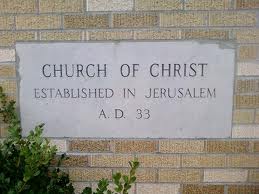
Do We Have a History?

“Every renewal of the church, every great age in its history, has been grounded on a renewed reading of history.” ~Justo Gonzalez

You know the familiar quotes and the wisdom behind them: Those who cannot learn from history are doomed to repeat it; Whoever wishes to foresee the future must consult the past; History cannot give us a program for the future, but it can give us a fuller understanding of ourselves so that we can better face the future.

We’re taking the advice to heart with our current Sunday morning adult Bible class series here at Central. Our curiculum is based on Gary Holloway and Doug Foster’s book “Renewing God’s People: A Concise History of Churches of Christ.” With this book as our guide, we’re considering our past, contemplating its relationship to Scripture, and having conversation about the paths ahead. The hope is that we can raise our “historical spiritual consciousness” by gaining a better understanding of how our faith and our churches have been shaped by inside and outside forces we may have never even considered.

In doing so, our aim is to collectively come to a better understanding of the vision and the call that resulted in the beginning of the American Restoration Movement, of which Churches of Christ are a part. They had a dream, right? There’s a reason Stone and Campbell and those founding fathers left their churches to begin our movement, right? Well, what in the world was it? What was so compelling that they left their own faith traditions and family stories?

Secondly, we want to see just where, why, and how we drifted so far away from that initial dream. What happened? What were the influences that got us off track? What role did culture play? History? The American Revolution? The Civil War?

Next, we need to determine if those original dreams and vision were right. Were those ideals on which our movement was founded faithful to the Gospel and to God’s mission for his Church? And, if so, how do we recover the best parts of those ideals for Central today? How do we reclaim the best parts of the Restoration heritage in our local context and setting, time and place?

We started yesterday by discussing the things that make the Churches of Christ different from the rest. What sets us apart? What makes us unique? The response from our class — a diverse group of people who range in age from late 20s to late 70s, some CofC lifers and a couple of people who were just baptized two months ago — was fairly typical. We ran down the list pretty fast: acappella worship, weekly communion, autonomous congregations led by a plurality of elders, believer’s baptism by full immersion, limited role for women, and a high regard for the authority of the Bible and personal knowledge of the Scriptures. After that came the slogans: Speak where the Bible speaks and be silent where the Bible is silent; We do Bible things in Bible ways and call Bible things by Bible names; etc., And then came a little honesty: Somebody mentioned that we’re perceived as thinking we’re the only ones going to heaven, and one of our brand new Christians confessed rather sheepishly that her mom had always told her the Church of Christ was a cult.

For the most part, these distinctives are dearly held by those of us in the Churches of Christ. For a lot of us, these are red flag issues. It’s emotional. Just mention a buzz word or a key phrase related to any one of these things around most of us and you’ll receive an impassioned plea touting the merits of such a practice or belief. Or a fight.

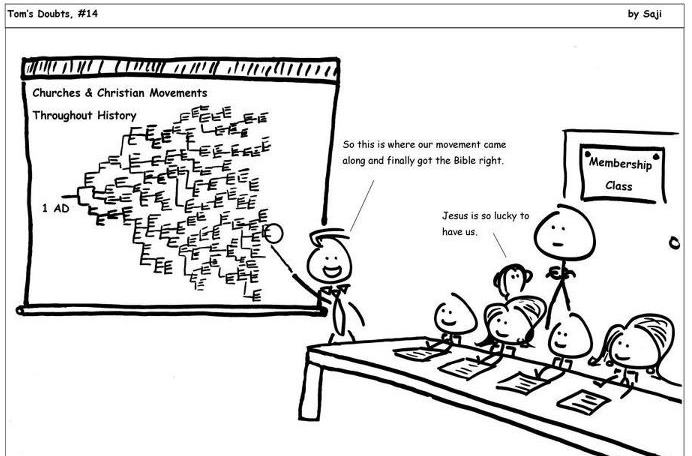
What we learn when we look at church history is that those things are not that unique to us. We didn’t come up with this stuff. It was all handed down to us by the Christians who went before. Martin Luther is the one who pushed for the authority of Scripture alone. John Calvin is the one who caused us to pay more attention to the sovereignty of God. The “anabaptists” of that same era were persecuted and mercilessly killed for their move to believer’s baptism by full immersion. John Knox and the Presbyterians pushed for the autonomy of local congregations led by a plurality of presbyters, or elders.

Any of that sound familiar?

Would it surprise you to learn that a whole mess of these faithful Christians came to America in the 18th century from Germany and Switzerland and Geneva and England and Scotland and brought their peculiar Christian beliefs and practices with them? And that Barton Stone and Alexander Campbell were among them?

We can find traces of us, Churches of Christ, in almost every strand of Christianity. They are our spiritual ancestors, too. They faithfully did the best with what they had at the time and diligently moved the Gospel story forward. We are not the first Christians. Or the only Christians. And we won’t be the last.

Our God is faithful; and very, very good.

Peace,

Allan
Peterson on Community

God meets us in community. Jesus saves us in community. The Holy Spirit transforms us in community. The individualism of our culture is a lie devised by the Father of Lies to isolate us and divide us so that we don’t mature into the image of God with which we were created to bear. The more buds we stick in our ears, the more screens we stick in our faces, the more technology moves us away from face-to-face life together, the less likely we are to “attain to the whole measure of the fullness of Christ.” Skipping small groups Sunday night to finish that work project for Monday morning does you more harm than good. Postponing that lunch with a friend to watch a DVR’ed TV show isn’t the healthiest thing for you. You’re better off waiting in line with people to hand your money to a real live cashier than zipping through a self-checkout station to swipe your card by yourself. Saying ‘no’ to the church potluck in order to eat your own style of food in your own kitchen on your own time is saying ‘no’ to God’s holy design.

I like Eugene Peterson’s angle on Christian community in his book Christ Plays in Ten Thousand Places:

Christ plays in the community of people with whom we live, and we want to get in on the play. We see what Christ does in creation and history and we want in on it, firsthand with our families and friends and neighbors.

But difficulties arise. Sooner or later those of us who follow Jesus find ourselves in the company of men and women who also want to get in on it. It doesn’t take us long to realize that many of these fellow volunteers and workers aren’t much to our liking, and some of them we actively dislike — a mixed bag of saints and sinners, the saints sometimes harder to put up with than the sinners. Jesus doesn’t seem to be very discriminating in the children he lets into his kitchen to help with the cooking.

I didn’t come to the conviction easily, but finally there was no getting around it: there can be no maturity in the spiritual life, no obedience in following Jesus, no wholeness in the Christian life apart from an immersion and embrace of community. I am not myself by myself. Community, not the highly vaunted individualism of our culture, is the setting in which Christ is at play.

Living together in community forces a person to sacrifice, to compromise, to give in. It teaches one to share, to serve, to submit to the whole. Life with others encourages a person to think about others, to see somebody else’s point of view, to consider other possibilities. See, community makes us more like Jesus.

I’m pretty sure that’s by design.

Peace,

Allan

Better Safe Than Sorry

“Better safe than sorry” is probably a good philosophy if you’re a sky-diver or you make your living dismantling bombs. When wiring a house or feeding a lion or crossing a busy street, “better safe than sorry” makes perfect sense.

But “better safe than sorry” is no way to live in relationship with God and with God’s people. Unless we’re all very clear with exactly what it means to act “safely” according to God’s economy.

When we discuss divorce and remarriage or worship practices or church structures or any other “hot button” issue or topic, “better safe than sorry” usually means everybody freeze! Nobody do anything! Everybody step back! And then we draw lines and develop boundaries and devise rules and make judgments. Our philosophy dictates that we be triple-extra careful not to offend God’s holy will and risk being condemned to hell.

Acting “safely,” according to our heavenly Father, means giving more grace and mercy, not writing more rules and regulations. It means more acceptance and less judgment. It means forgiveness and compassion, not lines and boundaries. If you want to be “better safe than sorry” with God, you’ll exercise more patience and understanding with your Christian brothers and sisters and do away with all prejudice and pride. Being “safe” with God means showing more love to the people you meet in the world and less attitude.

It means being like our Christ.

Making up more rules is something else entirely.

Peace,

Allan

Be Filled with the Spirit

“Be filled with the Spirit. Speak to one another with psalms, hymns, and spiritual songs. Sing and make music in your heart to the Lord, always giving thanks to God the Father for everything, in the name of our Lord Jesus Christ. Submit to one another out of reverence for Christ.” ~Ephesians 5:18-21

We worship in the Spirit. We submit to one another and sing and speak to one another in the Spirit. The Holy Spirit of God is who gives the Christian life its energy and enthusiasm. Its endurance. And power!

Be filled with the Spirit.

This is an imperative. It’s a command. So we do take some responsibility here. This singing together and submitting to one another is either the means by which we pursue this filling of the Spirit or the result of being filled with the Spirit. Or both. Either way, Paul says when we sing together, when we pray together, when we really belong to one another, we are filled with the Spirit.

And that tells me that God is not a spectator when we gather for worship. Audience of one? No way! God is not the audience of our worship. Our God is an active participant with us — inside us — when we worship together. God is not just sitting on his throne in heaven soaking up all the hallelujahs and amens. No. Through the Spirit, the Father and Son are engaged with us. Communing with us. Eating and drinking with us. Rejoicing with us. Transforming us. Changing us. Growing us. Shaping us more into the image of our Christ.

Be filled with the Spirit.

Encountering God together — in our Sunday morning assemblies, in our Wednesday night Bible classes, in our living rooms on Sunday evenings — being in the presence of God together allows us to recognize our own sinfulness and shortcomings. And that always leads to an acute recognition of his marvelous grace. And the power of God’s grace is not just forgiveness, it’s also transformation. New creature. New creation. Christ formed in you. Being saved. It’s a communal sanctification event that we participate in and experience together when we are filled with the Spirit.

Peace,

Allan

Life Together: Last Thing

Why devote our lives to one another in brotherly love? Why sacrifice for and serve one another in genuine Christian community? What’s the result of living our lives together the way Scripture calls us to? Does it matter whether we go through life as an individual follower of Jesus or as a fully involved member of a Jesus-following church?

Yeah, it matters a lot.

One, it brings glory and praise to God. Paul says we should accept one another just as Christ accepted us in order to bring praise to God (Romans 15;7). Loving and serving one another in Jesus’ name makes God’s love complete. The Christ himself says the selfless deeds done for others in his name causes the world to praise our heavenly Father. He tells his disciples in John 13 that if you love one another as I have loved you, everybody will know you’re mine. Everyone will know this is real. Our Christian fellowship marked by genuine love and service fulfills the very reason God created us and sent his Son here to save us.

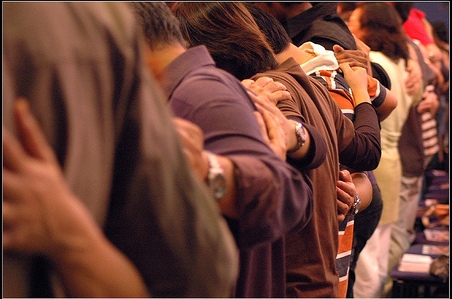
It also reveals God’s power. Our God is strong when we’re weak; his power is made perfect in our weakness. And the more we open up with one another, the more of our lives we share with one another, the stronger and more powerful our God becomes. The sharing of our struggles and our weaknesses, the mutual bearing of one another’s burdens, opens our eyes to see more clearly what God is doing. I’d like us to demonstrate more of that even in our Sunday morning worship assemblies. The open and honest sharing of our lives and our struggles together should be a regular thing, not a rare thing. When somebody walks to the front to confess a sin or to repent from a wrong or to ask for prayers, there should be 20 or 30 brothers and sisters rushing to the front to be with him. Dozens of brothers and sisters should meet him or her right there on the spot, ready and eager to hug him and pray with him and confess with him, to encourage him and support him and lift him up. Our Christian community, our church, should be the safe place, not the last place, to share our struggles.

And we might say, but what will the visitors think? If we start doing this every Sunday, what will the visitors think?

Are you kidding me?!? Our God is at his strongest and most obvious in the humble recognition of our weakness. God works amazing wonders when we declare our dependence on him instead of ourselves. What will the visitor think? The visitor thinks, “Hey, I can really fit in with this church. These people have lots of problems, but they have God. And they have each other. They’re not pretending. They’re not playing. They’re not just doing church, they are being church.”

And that’s powerful.

Lastly, our Christian lives together, loving and serving each other in Christian community, is part of the salvation process. It’s part of what Paul calls “being saved.” We selflessly love and serve, we bear one another’s burdens the way Jesus does, and our thoughts become words. Our words become actions. Our actions turn into habits. Our habits become our character. And our character becomes our destiny. Life together is a significant part of being transformed into the image of our Savior. The more we serve, the more like Jesus we become. The more we love, the more burdens we bear, the more we consider the needs of others more important than our own, the more like our Lord we become. That’s sanctification. That’s preparation for living forever in the face-to-face presence of God. And that’s our salvation.

Again, our Christian friendships should be treasured, never assumed. Our time together should be cherished, never avoided. Opportunities to be together should be seized, never scorned.

Peace,

Allan

« Older posts Newer posts »