Category: Mark (Page 11 of 15)

Take Courage! It is I!

I’m teaching some of the broad themes of the Gospel of Mark in our Wednesday night class. You can find our outlines and articles and, eventually, the audio from the classes by jumping to the Central Church of Christ website here. Tonight we’re focusing on the great contrast between fear and faith.

(It’s appropriate to be considering this together on the same night the Rangers open the World Series. Rangers fans know all too well the mighty struggle between fear and faith, between despair and belief.)

Everybody in Mark is afraid. Everybody. Jesus calms the storm, delivers his apostles from the sea, and he turns to them and asks, “Why are you so afraid?” Jesus delivers the demon-possessed man from the devils that have enslaved him and the townspeople react in fear. The bleeding woman trembles in fear. Jesus tells Jairus not to be afraid. The apostles are terrified when Jesus walks on the water. They’re afraid to ask the Lord what he means when he predicts his death. Those following Jesus “on the way” are said to be afraid. The religious leaders in Mark are afraid: they fear Jesus, they fear the people, and they’re afraid of the crowds.

Everybody’s afraid in Mark. They’re terrified by Jesus’ power over nature, by his power over hell; they’re frightened by the images of persecution and suffering and death he predicts; they’re scared by what it means to follow him. And Mark does not want us to miss this. In fact, this fear factor as a theme is so important to Mark it’s the very last thought, the last word literally, in his Gospel. In Chapter 16 the angel at the empty tomb commands the women, “Go, tell his disciples and Peter.” But “they were afraid.”

If fear is the opposite of faith — and I’m convinced it is — fear paralyzes us while faith liberates us. Fear looks at me and the world while faith sees me and God. And Jesus longs for us to have faith. His desire is to drive away our fears. So he comes to us. He reveals himself to us. He shows us who he is and what he’s all about.
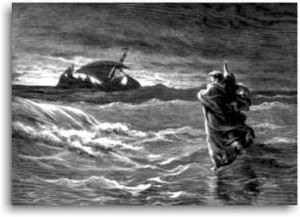
He comes to us, walking on the uncertain waters of the storms all around us. He comes as the One who is sovereign over those waters that threaten to do us in. He controls them. He does what only God, the divine Creator of heaven and earth can do. He walks on the water to us and says, “Take Courage! It is I! Don’t be afraid.”

To all the people in Mark who are afraid, the message from our Lord is the same: Don’t be. He tells the disciples to have faith. He informs the woman that her faith has healed her. He tells Jairus to believe. He teaches them (us) in patience and love. He leads them (us) by his perfect example. And he rescues them (us) and delivers them (us) again and again and again.

~~~~~~~~~~~

I feel a million miles away from my Rangers. Saturday’s pennant clincher was thrilling, but there was no mad late-night dash to Academy to celebrate with the throngs and purchase the official T-shirt like last year. I had called the Academy Saturday afternoon just to see if they might, by some chance, have the shirts stashed away in boxes, ready to be unveiled and made available as soon as Feliz recorded the last out. Alas, the poor young man on the other end of the line had no idea what I was talking about.

Oi.

The shirts just made it to Academy up here yesterday. Whitney and I quietly and anticlimactically got our shirts after school. We’re wearing them today. But I haven’t seen them on anybody else.

The Amarillo Globe-News only had two stories about the Rangers in their whole newspaper today: an AP wire story about C. J.’s freeze chamber (boring) and a local column about long-suffering Rangers fans (already lived it).

Oi, vey.

For big regular season games and every single postseason game, I have my text conversations with my die-hard Rangers friends. From Fort Worth and Amarillo to Arkansas and East Texas, we watch the games “together” and make “interesting comments” (as George Costanza says) and wise cracks about team strategy, booth announcing, and critical plays. Not tonight, though. It’s a church night. It’s also an elders meeting night. And I’ve left my DVR in North Richland Hills. If I’m lucky, I’ll get home in time to catch the last inning or two.

Hopefully, Chris Carpenter will be long gone by then. And Alexi will be dealing with a lead.

Let’s Go Rangers! (clap, clap, clap, clap, clap)

Allan
Do You See Anything?

Yesterday’s Skip-shot in this space has started something. I received a text from Byrnes very early this morning that said:

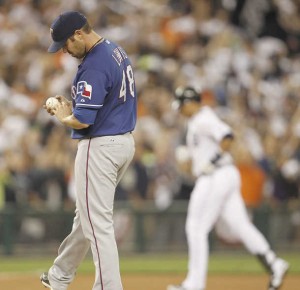
 “Rangers Subdued by Iron Fister.”

I countered with:

“Colby Serves Up the Cheese in Rangers Loss.”

If you’d like to add a corny headline about last night’s game before this afternoon’s begins, jump in.

~~~~~~~~~

We’re conditioned by our world — actually it’s in our nature and then reinforced by the world — to see the things we want to see and hear the things we want to hear. Anybody with a spouse or any children know this first hand. I’ll tell the girls “maybe” and they run to Carrie-Anne and say, “Dad said we could!” As a preacher, sometimes this works in my favor. Somebody will tell me how wonderful it was when I said such-and-such and I have no idea what she’s talking about. What this lady heard is nowhere near what I was preaching. But it meant something to her. And I still take credit for it. Of course, it certainly can work the other way, too.

In the Gospel of Mark, Jesus keeps asking people if they’re seeing correctly. Jesus asks the blind guy in Mark 8, “Do you see anything?” Same chapter, in the boat before Jesus and his apostles reach Bethsaida, he asks them, “Do you still not see?”

The blind guy in Mark 8 whose vision is blurry, whose eyesight is not perfectly clear, who sees something but not everything, represents everybody in the Gospel. And most everybody we encounter today. We see Jesus. But we don’t see all of him. We only see what we want. We embrace the Jesus who heals and forgives and feeds and loves and accepts and saves. We want to follow Jesus and live like that Jesus. But a Jesus who suffers and dies? Peter refused to see it. Most everybody did. Sometimes we don’t see it. And our picture of the Messiah is woefully incomplete. The Savior we teach is less than whole. The Gospel we preach is only partial truth.

We don’t see Jesus completely until we see his suffering and death. To see Jesus die is to understand who he really is and what he really came to do.

There are only two people in the entire Gospel of Mark who are said to “see.” One is Bartimaeus, the only other blind guy in the whole book, in Mark 10. This is Jesus’ final miracle, his last healing, as he enters Jerusalem to die. Bartimaeus calls out to Jesus, “Son of David!” That’s the Messianic title. The blind guy is the only one who sees. Jesus asks him, “What do you want me to do for you?” And Bartimaeus answers, “I want to see.” And the text tells us that “immediately he received his sight and followed Jesus.” To the cross. To his death.

The other one is the Roman Centurion. At the cross. At Jesus’ death. The crowds were shouting, “Come down from the cross that we may see and believe!” When the soldier “saw how he died,” he confessed Jesus as the Son of God.

If you tell Jesus “I want to see,” what you’ll see is a commitment to trials and ridicule and persecution and suffering. You’ll see a road, a way, that leads to your death. What you’re promised is the same exaltation and glory that he now has as the resurrected Lord reigning at the right hand of the Father in heaven.

Peace,

Allan

Faithful Among the Stumps

Of all the really cool stuff in Isaiah — the servant songs, the allusions to Christ, the prophesies about the Messiah, the comfort passages — the words at the end of chapter six about preaching to people who refuse to listen are the most quoted in the New Testament.

Jesus uses Isaiah’s words in Matthew 13 after telling the parable of the four soils. Same thing in Mark 4 and Luke 8. Jesus says, man, this is how Isaiah must have felt.

In John 12, right after Jesus predicts his death, God’s voice thunders down from heaven for the benefit of the people in the crowds. But they’re not listening. They don’t understand. They refuse to change. And, again, Jesus uses the Isaiah 6 passage to account for the blind eyes and stubborn hearts.

Paul’s near the end of his life in Acts 28, under house arrest in Rome. And he’s failed to make a dent in the sight or the hearing or the hearts of the religious leaders who’ve come to hear him preach. Nothing. And he quotes the Isaiah 6 passage. Same thing in Romans 11. “It’s still happening!” Paul says, “To this very day!” Paul’s a failed preacher in pretty good company.

The point of the last half of Isaiah 6, and the reason the passage is repeated so many times in the early history of God’s Church, is that we are called to be faithful to our Father and to his mission, regardless of where it takes us. No matter how bad it gets, no matter how many people reject the truth, we are called to keep preaching the truth.

The point of Isaiah 6:8-13 is that if we trust God, if we’ll remain faithful to him, he’ll do something with those closed eyes and plugged up ears. Those stumps (Isaiah 6:13). Isaiah and Jesus and the apostles are reminding us that God does his best work in the middle of a desolate field of worthless stumps.

God created the universe out of nothing. He raised a mighty nation out of a 90-year-old barren womb. He pulled a young boy from the bottom of a well and made him a powerful ruler of the most important nation in the world. He uses the death of a preacher and the persecution of his Church to spread the Good News of salvation from Jerusalem to Judea and Samaria and to the ends of the earth. He delivered forgiveness and righteousness to all mankind through a cruel wooden cross.

There’s more happening in horrible situations than we ever realize. These awful circumstances are holy. God does holy things with faithful people in a field full of stumps.

“The holy seed is its stump.” ~Isaiah 6:13

Peace,

Allan

Upholding the Ideal

Our holy Scriptures are full of lofty ideals. We listen to Jesus say, “Love your enemies,” and we realize, “Wait a second, I don’t even like my friends!” Give to everyone who asks. Never lust. Always forgive. Rejoice in persecution. Put the needs of others ahead of your own. Our Lord calls for a single-minded fidelity to following him without reservation. And it’s demanding. Impossibly so. Yes, the Holy Spirit of God empowers us to do what Christ is calling us to do. But we don’t always do it. We mess up. We sin. We fall.

To borrow from Yancey, I find that, personally, I talk and write about spiritual disciplines far better than I practice them.

How about you?

Yeah, I know.

But we keep trying, right?

We never put our feet on the floor in the morning and allow that, “I’m human so I’m going to sin today. There’s no way I’m going to be perfect today. I’m going to mess up. I’m human.” No! God forbid! We strive with everything in our power and by the strength of the Spirit to pledge that, today, I’m going to be like my Lord! We don’t ever give in to the world’s conclusion that we cannot possibly be like Christ. We keep trying.

Scripture paints a beautiful picture of the Kingdom of God and the coming wedding feast of the Lamb. It’s a gathering of “every tribe and language and people and nation.” We find “the poor, the crippled, the blind and the lame” around the table. Paul makes it clear that, in Christ, there is “neither Jew nor Greek, slave nor free, male nor female.”

I believe the very core of the Gospel of Jesus is that our Christ died and rose again in order to destroy completely and eternally all the barriers that exist between God and man and man and one another. Social distinctions. Cultural differences. Language obstacles. Socio-economic disparity. Zip codes and tax brackets. None of these things register as even a blip on our fellowship radar. These differences don’t even exist in Christ.

But we have black churches. And white churches. And hispanic churches. And rich churches. And poor churches. And somehow we’ve fooled ourselves into thinking that’s OK. We have begun to believe the lie that church has always been this way and it will always be this way. The cultural differences are too great. The language difficulties are too much. We’ve tried to integrate, we’ve tried to come together, but it’s just never worked. And it never will work.

So, why try?

Because there is honor in the trying. Trying is an act of faith. Our Father wants us to engage that struggle and try. He wants us to try.

Scripture gives us a crystal-clear mandate. It tells us in no uncertain terms that the table of Christ and the house of God is to be enjoyed by all. Together. United as one. Everybody equal. Everybody just as wretched and lost and condemned to death without Jesus and everybody just as holy and saved and righteous because of Jesus. Together. We uphold the ideals we find in Scripture. We lift up those ideals and we try with everything we have to bring heaven to earth, to practice God’s will on earth just as it is in heaven.

And we slip. And we fall. And fail. And do really stupid things. But we never give up. We never give in to the world’s conclusions that division along racial and economic and language lines is necessary. We keep trying. And we trust that Jesus, our King, is watching even as we are “straining at the oars.” He’s interceding for us as he watches. And he’s proud of us. He’s pleased with us as we keep trying.

Peace,

Allan

A Den of Robbers

“Is it not written, ‘My house will be called a house of prayer for all nations’? But you have made it ‘a den of robbers.'” ~Mark 11:17

What made Jesus so mad that day at the temple? What riled him to the point of flipping tables and scattering coins and driving out doves and sheep? We generally speculate that pilgrims and travelers were being ripped off. Religious officials were probably cheating worshipers on the exchange rate between their Roman coins and the temple-approved currency. Sellers of cattle and sheep were overcharging and taking advantage of those who had come so far to sacrifice and whose animals had been harmed or blemished in some way along the journey.

Those things may very well be true. And if they were, that would surely upset our Lord. The only problem is that none of those things are attested to in Scripture. We have no scriptural evidence that anybody was being cheated out of money. The Gospels don’t speak or even hint at any economic wrongdoing.

We get the idea, I think, from Jesus’ statement about the temple being turned in to a “den of robbers.” But I believe we’ve missed the point. Jesus is not talking about money or possessions here. He’s quoting the Prophets. And if we go to the passages he quotes, it’s pretty clear what’s got him so angry.

Isaiah 56 is about God’s holy provision for those outside the nation of Israel. God loves the whole world, not just the Jews. And he’s going to take care of them, too. Isaiah 56 promises the “foreigner who has bound himself to the Lord” that he will never be excluded from God’s people. Eunuchs who keep God’s commands will always have a place “within my temple and its walls.” All foreigners who love the Lord:

“these will I bring to my holy mountain
and give them joy in my house of prayer.
Their burnt offerings and sacrifices
will be accepted on my altar;
for my house will be called
a house of prayer for all nations.” ~Isaiah 56:7

God has provided a place at his temple for Gentiles to gather and worship. God has promised covenant to these Gentiles and has sanctified a place for them to participate in the community life of God’s people. Gentiles, too, can experience the glory of God. Gentiles, too, can make sacrifices to God in faith that he will accept the offerings and forgive them of their sins. Gentiles, too, have a place in the Kingdom of God.

But it’s in these very temple courts — the Gentile courts, the Court of the Gentiles — where religious leaders are setting up shop and selling animals. They would never allow the inner parts of God’s temple to be turned in to a noisy, smelly, chaotic mess. They would never do anything to disrupt the expressions of praise and sacrifice from their own people in their special places. But these Gentiles? Yeah, let’s sell the animals there.

They are interfering with the divine provision of God. They are compromising God’s promises to the world. They’re messing with God’s plan. They’re depriving people of the space God has given them in which to worship. It’s a house of prayer for all nations, not just for people who look like me and talk like me and dress like me and behave like me. It’s not just for people who worship and sing and pray just exactly like us. It’s for everybody!

No wonder Jesus was so angry.

So, what’s it like at your church? Are the Hispanics relegated to an upstairs classroom in the back of the building? And is that classroom cluttered with leftover chairs and three ice chests from the youth trip? Where do the deaf worship in your church? Is it just understood that the homeless and the jobless and the “unchurched” won’t fit in? So nobody really tries?

Forget about the actual physical space for a minute. Do the ones who are not just like us — the new members, the move-ins, the poor, the young people, the old people, the divorced, the minorities — have a forum in your church to express their praise to God? Are they stared at, talked about, isolated, and discouraged from worshiping God? Or are they smiled at, hugged on, sung with, and encouraged to worship? Sometimes our haughtiness and complaints, our snide comments and dirty looks, our letters and threats rob our own brothers and sisters in Christ of their God-sanctioned forum and venue for giving him thanksgiving and praise. As Jesus says in John 2:16, “How dare you!”

“Accept one another, then, just as Christ accepted you, in order to bring praise to God.” ~Romans 15:7

Peace,

Allan

Watch and Pray

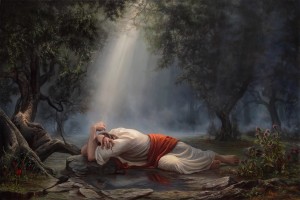
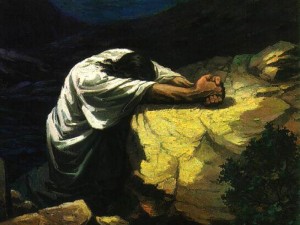
What does Christ want us to see in the Garden of Gethsemane? Why did he tell his disciples to watch and pray? Why did he take them with him that night? Why was it so important that they stay awake?

Jesus makes it very clear that night in the garden: he does not want to die. Jesus is sorrowful and troubled. He’s distressed. He’s in agony. He’s facing the most severe test of his life. God is handing him the cup of suffering and death and asking him to drink it. And Jesus doesn’t want to. He shudders in horror at the mission before him. He dreads all of it. His Father is in the process of making him who had no sin to be sin for us. Jesus is walking through the valley of the shadow of death. And he wants another way. And he asks for it.

What an amazing scene. Jesus is in great agony. He cries out to his God, “Deliver me!” He prays out loud to his Father, “Rescue me!” He begs, “Save me from this horrible assignment. Let’s do this another way.”

No dove descends. No thunderous voice from heaven assures, “This is my Son.” Only silence. Silence. God has already spoken. Now it’s up to the Son to obey.

And he does. “Not my will, but yours be done.” Jesus overcomes the silence, he fights off the temptation to do what he wants and, through open and honest prayer, he obeys his Father.

“Watch and pray.” “Stay here and keep watch with me.”

Jesus tells his disciples, “Do this with me. Experience this with me. Watch me. If you’re really going to follow me, you’re going to need to know how to do this.”

Jesus wants us to be awake and present and obedient to the way of the Son and the will of the Father. He wants us to accept trial. He wants us to undergo testing. He wants us to say “no” to the temptations to abandon the cross aspects of our calling. Afterall, it’s so much easier to turn our backs on the crown of thorns and just go to church. It’s so much easier to just settle into our pews and into the comforts of our status quo and potlucks and baby blessings.

If we’re going to follow Jesus as his loyal subjects — and we are! — then we’re going to follow him into the garden. It’s in the garden with Jesus, praying these agonizing prayers, where we really express our trust in God. We trust God in the darkness of our sufferings because God walked through the darkness himself.

God wants us to be in fellowship with the sufferings of his Son and the sufferings of his world. Fervent and faithful prayer is where God equips us and empowers us to do it. A stiff upper lip isn’t going to do it. A fierce resolve won’t cut it. New Year’s resolutions won’t work. It happens through open and honest prayer; raw, from the heart, transparent communication with the Father.

After a night of agonizing prayer, Jesus is ready. “Shall I not drink the cup the Father has given me?”

Watch and pray.

Peace,

Allan

« Older posts Newer posts »