Category: Luke (Page 19 of 24)

Faithful Among the Stumps

Of all the really cool stuff in Isaiah — the servant songs, the allusions to Christ, the prophesies about the Messiah, the comfort passages — the words at the end of chapter six about preaching to people who refuse to listen are the most quoted in the New Testament.

Jesus uses Isaiah’s words in Matthew 13 after telling the parable of the four soils. Same thing in Mark 4 and Luke 8. Jesus says, man, this is how Isaiah must have felt.

In John 12, right after Jesus predicts his death, God’s voice thunders down from heaven for the benefit of the people in the crowds. But they’re not listening. They don’t understand. They refuse to change. And, again, Jesus uses the Isaiah 6 passage to account for the blind eyes and stubborn hearts.

Paul’s near the end of his life in Acts 28, under house arrest in Rome. And he’s failed to make a dent in the sight or the hearing or the hearts of the religious leaders who’ve come to hear him preach. Nothing. And he quotes the Isaiah 6 passage. Same thing in Romans 11. “It’s still happening!” Paul says, “To this very day!” Paul’s a failed preacher in pretty good company.

The point of the last half of Isaiah 6, and the reason the passage is repeated so many times in the early history of God’s Church, is that we are called to be faithful to our Father and to his mission, regardless of where it takes us. No matter how bad it gets, no matter how many people reject the truth, we are called to keep preaching the truth.

The point of Isaiah 6:8-13 is that if we trust God, if we’ll remain faithful to him, he’ll do something with those closed eyes and plugged up ears. Those stumps (Isaiah 6:13). Isaiah and Jesus and the apostles are reminding us that God does his best work in the middle of a desolate field of worthless stumps.

God created the universe out of nothing. He raised a mighty nation out of a 90-year-old barren womb. He pulled a young boy from the bottom of a well and made him a powerful ruler of the most important nation in the world. He uses the death of a preacher and the persecution of his Church to spread the Good News of salvation from Jerusalem to Judea and Samaria and to the ends of the earth. He delivered forgiveness and righteousness to all mankind through a cruel wooden cross.

There’s more happening in horrible situations than we ever realize. These awful circumstances are holy. God does holy things with faithful people in a field full of stumps.

“The holy seed is its stump.” ~Isaiah 6:13

Peace,

Allan

Upholding the Ideal

Our holy Scriptures are full of lofty ideals. We listen to Jesus say, “Love your enemies,” and we realize, “Wait a second, I don’t even like my friends!” Give to everyone who asks. Never lust. Always forgive. Rejoice in persecution. Put the needs of others ahead of your own. Our Lord calls for a single-minded fidelity to following him without reservation. And it’s demanding. Impossibly so. Yes, the Holy Spirit of God empowers us to do what Christ is calling us to do. But we don’t always do it. We mess up. We sin. We fall.

To borrow from Yancey, I find that, personally, I talk and write about spiritual disciplines far better than I practice them.

How about you?

Yeah, I know.

But we keep trying, right?

We never put our feet on the floor in the morning and allow that, “I’m human so I’m going to sin today. There’s no way I’m going to be perfect today. I’m going to mess up. I’m human.” No! God forbid! We strive with everything in our power and by the strength of the Spirit to pledge that, today, I’m going to be like my Lord! We don’t ever give in to the world’s conclusion that we cannot possibly be like Christ. We keep trying.

Scripture paints a beautiful picture of the Kingdom of God and the coming wedding feast of the Lamb. It’s a gathering of “every tribe and language and people and nation.” We find “the poor, the crippled, the blind and the lame” around the table. Paul makes it clear that, in Christ, there is “neither Jew nor Greek, slave nor free, male nor female.”

I believe the very core of the Gospel of Jesus is that our Christ died and rose again in order to destroy completely and eternally all the barriers that exist between God and man and man and one another. Social distinctions. Cultural differences. Language obstacles. Socio-economic disparity. Zip codes and tax brackets. None of these things register as even a blip on our fellowship radar. These differences don’t even exist in Christ.

But we have black churches. And white churches. And hispanic churches. And rich churches. And poor churches. And somehow we’ve fooled ourselves into thinking that’s OK. We have begun to believe the lie that church has always been this way and it will always be this way. The cultural differences are too great. The language difficulties are too much. We’ve tried to integrate, we’ve tried to come together, but it’s just never worked. And it never will work.

So, why try?

Because there is honor in the trying. Trying is an act of faith. Our Father wants us to engage that struggle and try. He wants us to try.

Scripture gives us a crystal-clear mandate. It tells us in no uncertain terms that the table of Christ and the house of God is to be enjoyed by all. Together. United as one. Everybody equal. Everybody just as wretched and lost and condemned to death without Jesus and everybody just as holy and saved and righteous because of Jesus. Together. We uphold the ideals we find in Scripture. We lift up those ideals and we try with everything we have to bring heaven to earth, to practice God’s will on earth just as it is in heaven.

And we slip. And we fall. And fail. And do really stupid things. But we never give up. We never give in to the world’s conclusions that division along racial and economic and language lines is necessary. We keep trying. And we trust that Jesus, our King, is watching even as we are “straining at the oars.” He’s interceding for us as he watches. And he’s proud of us. He’s pleased with us as we keep trying.

Peace,

Allan

Consider the Lilies

Emily Dickinson once wrote that “Consider the lilies of the field” is the only commandment she never broke. I’m trying to do better and better about keeping that command.

This huge big sky in Amarillo makes the sunrises and sunsets seem so much more dramatic, more beautiful, than I remember. This sky with all its brilliant colors and shades that seems to go on forever was created by my Father to remind me of the boundless nature of his love. That love also manifests itself in many forms and hues and, like the expanse above me, has no end.

The butterfly that Carley can’t quite catch is sent by my God to make me smile. The chimpanzees at the zoo that make Valerie laugh are evidence of our Maker’s sense of humor. The thunder and lightning that make Whitney jump in my lap are proof of his great power.

Bluebonnets in the spring witness to God’s eye for beauty. An overdue rain shower in August testifies to his faithfulness. Falling leaves in October speak to our Father’s sovereignty. Little squirrels eating stored up nuts in the dead of winter remind us of God’s great provision. His concern for his creation. His care for the things and people he loves.

Even the wildfires that are ravaging parts of the state I love and profoundly impacting people I love remind me that our God is sovereign over his creation. He cleanses and restores, he purges and purifies. He destroys and makes new again. He does it to his world. And he does it in me.

Slow down. Look around. Spend some time today considering the lilies and the trees and the prarie dogs. Even the weeds growing up through the cracks in the sidewalk have something to say about the determination of our God to give life to what is dead, to bring light out of darkness.

I’m beginning to question the leadership capabilities of the shepherds here at Central. Why in the world would they schedule Jerry Taylor to preach here for a full month and a half before my first sermon? I told Jerry three weeks ago that if he really wanted to help me out, he could deliver a couple of real clunkers in his last few visits. Throwing out a real stink-o would be his last gracious act to me as Central’s new preacher. I’m afraid I’m going to get up there this Sunday and, after just five minutes or so, most of the church will be wondering, “When is Jerry coming back?”

My great friend David Byrnes emailed me this morning and, among other things, said, “May the Lord bless those poor people at Central this Sunday who will have to endure a preacher who’s been bottled up for over a month!”

I’ll be sure to include a couple of intermissions.

Peace,

Allan

Party Practice

Jesus is at a fancy dinner party in Luke 14. He’s dining in the home of a “prominent Pharisee.” Fancy people in their fancy clothes telling fancy stories about their sophisticated lives. Scripture says Jesus is “being carefully watched.” Jesus notices and heals a sick man. Then he uses the sick man as sort of a sermon illustration:

“When you give a luncheon or dinner, do not invite your friends, your brothers or relatives, or your rich neighbors; if you do, they may invite you back and so you will be repaid. But when you give a banquet, invite the poor, the crippled, the lame, the blind, and you will be blessed.”

And then, I’m assuming, there was a long period of some really awkward silence. You don’t just walk into a fancy dinner party with lots of fancy people and tell the host and the guests that they’re doing it all wrong. “Why would Jesus tell us to invite losers to our parties?” You can almost hear a nervous cough. Imagine the sound of a lonely fork scraping against a dinner plate. Things are really awkward.

Finally, in order the break the tense silence, some guy blurts out, “Blessed is the man who will eat at the feast in the Kingdom of God!”

And Jesus immediately begins telling another story about another feast, but with the same guest list: the poor, crippled, blind, and lame.

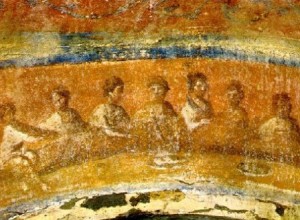
Jesus is making the point — and he made this same point every day of his ministry — that the Kingdom of God is a big party with a bunch of losers you wouldn’t be caught dead with on a Saturday night. This is God’s idea of a great time. God takes a bunch of losers, he fixes them, and then he breaks out the roast beef and wine. Revelation says we’re all going to eat and drink with Jesus forever. We’re going to take our places around the table with him at the wedding supper of the Lamb.

What we do when we come together on Sundays is a warm up. It’s party practice. It’s like the chips and hot sauce before the fajitas and enchiladas. It’s at these dinner parties in the Gospels where Jesus shows us what the world looks like when it’s fully healed. When everything is finished, when the Kingdom has finally come in all its fullness, when all of creation is finally redeemed and restored to its original Garden of Eden intentions, it’ll be like this. Our Christian gatherings on Sundays anticipate that huge wedding bash. We’re getting ready for the massive celebration, not just on Sundays, but for all eternity. For all of us.

Isn’t it cool that the Church’s number-one liturgical act is practiced around a supper table? The Lord’s Supper. His meal. And we’re all invited. All us losers have a seat at the head table with the risen Lord of the Universe. A salvation party with a bunch of sickos. Again, that’s God’s idea of a really good time. And Jesus showed it to us all the time.

Peace,

Allan

The Death of the Wicked

“As surely as I live,” declares the Sovereign Lord, “I take no pleasure in the death of the wicked, but rather that they turn from their ways and live.” ~Ezekiel 33:11

I knew it the moment I watched the first images late last night of the crowds in front of the White House and in Times Square boisterously celebrating the death of Osama bin Laden. I knew it this morning when the news programs showed us image after image of young men and women waving flags and singing songs on their city streets and campus squares. I knew it when I drove my girls to school and listened to the talk show hosts discussing what they would have done to bin Laden’s body had they been in charge. And I realized it when I started seeing the forwarded emails. From Christians.

I’ve known all day today that this is not how Christians behave. We do not celebrate the death of a human being made in the image of God and loved by our Father. No matter how ruthless and vile Bin Laden may be, we love our enemies. We pray for our enemies and their families. We do good things for our enemies.

“You have heard that it was said, ‘Love your neighbor and hate your enemy.’ But I tell you love your enemies, and pray for those who persecute you, that you may be children of your Father in heaven.” ~Matthew 5:43-45

God’s children do not dance and rejoice in the death of anyone. It’s decidedly un-Christ-like. To join in the worldly celebration of the death of a man who did not know our God is to deny our Christ and his Gospel. After all, our Lord died for us (you and me) while we (you and me) were his enemies. That’s the part I’ve not been able to understand today: doesn’t whooping and hollering and taking great joy and pleasure in the death of another human being deny just about everything Scripture teaches us about the nature and the will of our Father? Does it not oppose the clear commands from our Lord?

“Love your enemies, do good to those who hate you, bless those who curse you, pray for those who mistreat you.” ~Luke 6:27-28

It is good today to grieve anew with the families of those who lost dear friends and relatives in the violent attacks orchestrated by this man. It is proper to mourn the loss of soldiers and civilians who’ve been trapped in the middle of the on-going conflict. It’s OK to acknowledge God’s sovereign use of nations and armies to enact his justice. It is right today to join the faithful lament of the prophets and the groaning of the martyred souls under the altar and cry out to our God, “How long?!? How much longer are you going to allow this to continue?!? When will you finally put all things to right?!?” Today is a day for prayer. Reflection. Meditation. Thanksgiving. Mixed feelings. It’s not a day for dancing in the streets.

I’ve known all along  that if I were to blog today about the way I’m feeling, I would be criticized. I’ve known that if I preach this Sunday on what the Scriptures say about the death of this terrorist, I might be fired. So, instead, I chose this morning to blog about God expecting more out of the people he’s blessed with his good gifts and matchless grace; about God requiring more out of his children; about God demanding more from the people he’s saved; about how that verse in Luke 12:48 is the very thing that pushed me over the top and compelled me to ditch sports radio and start preaching the Good News.

Please forgive me. I, too, have denied my Lord today.

Peace (not as the world gives peace),

Allan

Much Will Be Demanded

“From everyone who has been given much, much will be demanded.” ~Luke 12:48

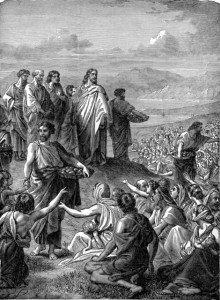
Jesus fed the five thousand with some rolls and a couple of fish. Scripture tells us he gave the food to his disciples and they, in turn, passed it on to the crowds. But what if the disciples had just held on to the food?

“Hey, thanks for the lunch, Jesus.”

Then Jesus hands them more. “Oh! OK. Thanks for the dinner, too, Jesus.”

Then Jesus gives them more. “Wow! Allright! Thank you, Jesus.” What if the disciples started looking around for some to-go boxes? What if they began trying to figure out how to get all this food home? What if Jesus’ followers had just held onto the food for themselves when their Lord was giving them more than enough to share with everyone in the crowds who had need?

Along with God’s great gifts comes great responsibility.

I never could shake those words of Jesus at the end of Luke 12. They didn’t really give me a guilt trip; they didn’t knock me down every time I read them or thought about them. It was more like a heavy burden that followed me everywhere I went. Because I’ve been given much. Materially, financially, physically, I am blessed. I’m rich. More than that, God has completely forgiven me of every one of the horrible sins I’ve ever committed in my life. He’s totally restored me to a perfectly righteous relationship with him. By the death and resurrection of Christ Jesus, I am eternally wealthy. I’m Bill Gates and Donald Trump combined. With a great haircut and 50 lawyers! And because of his great gifts and his matchless grace, it is demanded of me that I use the abilities and talents and opportunities he gives me, not to talk about the Cowboys and Rangers and Mavs, but to boldly proclaim salvation from God in Christ! It’s required of me to declare his love and mercy that are available to all mankind and his will and his plan to redeem and restore all of creation forever.

After many years of dealing with Luke 12:48 — alternately ignoring it, wrestling with it, praying about it, trying to shake it — I finally got up the faith or the guts (or both) to act on what God was demanding of me. And I will never look back.

The truth is that when my crucified and risen Lord returns, I couldn’t bear the thought of explaining to him the way I used his gifts and grace for all of my adult life: camped out in press boxes and locked up in studios talking about and obsessing about things that don’t matter.

He is coming back. Right? Yes, you know that.

Peace,

Allan

« Older posts Newer posts »