“These commandments that I give you today are to be upon your hearts. Impress them on your children. Talk about them when you sit at home and when you walk along the road, when you lie down and when you get up.” ~Deuteronomy 6:6-7
 Sometimes I hear myself thinking / saying / observing / complaining that the kids are always right in the middle of everything. And a quick glance through Scripture shows me that’s exactly where God puts them. Throughout the Bible, the children are never on the edges; they’re not peripheral participants in the community of faith. They are critical components. They are integral to God’s plan for his people.
In Exodus 10:1-2 God explains why he’s bringing the plagues on the Egyptians: “that you may know that I am the Lord” and “that you may tell your children and grandchildren.”
God explains the Passover ritual in Exodus 12 and instructs in v.26: “when your children ask you ‘What does this ceremony mean to you?’ then tell them…”
In Exodus 13 God is describing the feasts surrounding the ceremony of the consecration of the first born male. “Tell your son,” God says in v.8, “I do this because of what the Lord did for me.” Six verses later God repeats the familiar formula: “When your son asks you, ‘What does this mean?’ say to him…”
The whole book of Deuteronomy is like this. “Teach them to your children and to their children after them.” (4:9) “…teach them to their children.” (4:10) “…you, your children, and their children after them may fear the Lord your God.” (6:2) “When your son asks you ‘What is the meaning of the stipulations, decrees, and laws the Lord our God has commanded you? tell him…” (6:20) “Choose life so that you and your children may live.” (30:19)
And even into Joshua at the crossing of the Jordan River into the Promised Land, the pattern continues. God commands the stones to be stacked as a memorial and instructs the people in Joshua 4:6, “When your children ask you ‘What do these stones mean? tell them…”
Impress them on your children.
Over and over again, God provides the ceremony and the ritual and the memorial as a way for parents and grandparents to facilitate the sharing of the stories with the children and grandchildren. It’s not an accident. It’s the divine design. In the middle of this ceremony when your children ask you… In the middle of this ritual when your children ask you… When they see that pile of rocks… Tell them the story. Tell them your story. Tell them your story in light of, and as a part of, the larger story of salvation from the Lord our God.
It’s important that we tell our salvation stories to our kids. And our rituals and our ceremonies are the God-ordained times to do that. Just like the Passover and the Consecration Feasts and the standing stones were intended by God as a venue for this passing on of the stories and the faith, our communion time together on Sundays around our Lord’s table is the perfect time to tell these stories.
And we don’t take full advantage of that time to do what our God intends for us to do.
Those mysterious communion trays with the crackers and those tiny little cups pass right by in front of our kids and we don’t talk about it. And if they want to talk about it, we hush them. “Shhhh! It’s the Lord’s Supper!” So over time, our children have learned to observe the Lord’s Supper the same way their parents do: heads down, eyes closed, not making eye contact with anybody, and certainly not talking to anybody. And during communion our kids keep their heads down, coloring or drawing or reading or sleeping, while the trays and the bread and the cup and THE STORY pass right by them!
We talked about this yesterday during our sermon here at Legacy. We acknowledged that, while our kids may catch bits and pieces from the pulpit about the meaning of our weekly ritual, they may never have actually heard if from us, in story form, as it relates to our salvation on purely personal levels. So yesterday we took a small step in changing that. We asked our parents and grandparents and all the adults in our assembly to, during the Lord’s Supper, share their story with their children or with the child sitting in front of them or behind them or across the aisle.
And it was wonderful.
Communion was truly communion here at Legacy yesterday. Interaction. Sharing. Koinonia. Fellowship.
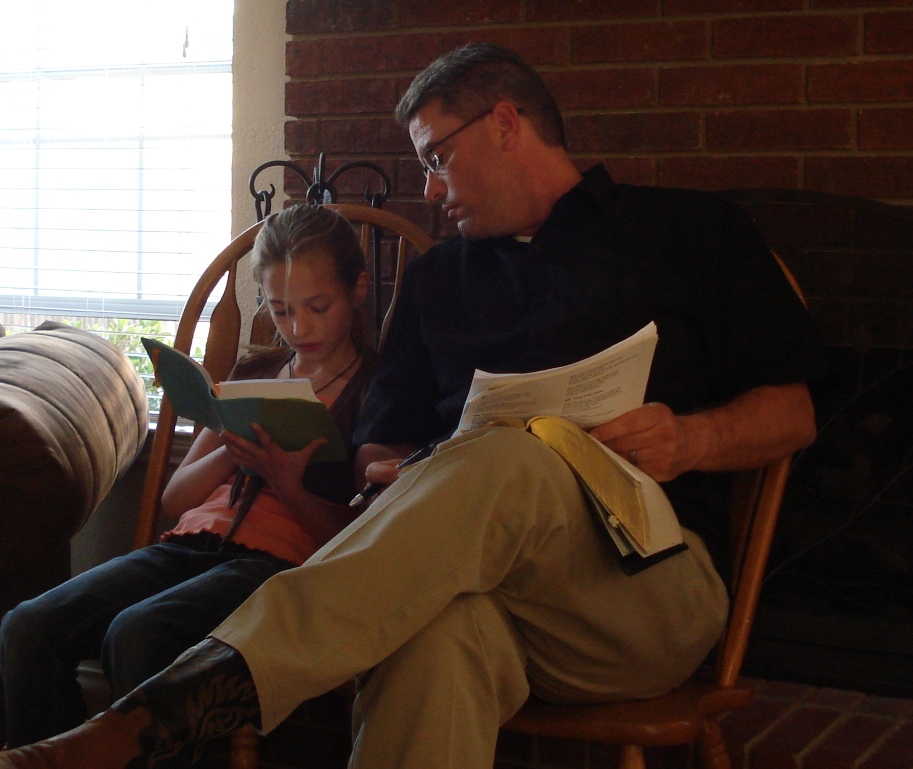
Carrie-Anne and I huddled with our girls as we ate the bread and drank the cup. We shared how the meal reminds us of how God saved us by the life and death and resurrection of Jesus. We talked about how the cup reminds us that the blood of Jesus continually washes away our sins and keeps us holy and righteous in God’s eyes, even though we’re sinful and weak and selfish and do stupid things and hurt people. And we told them how thankful we are that God does that for us and that he also does that for them.
And we had that same kind of thing happening all over our worship center. Parents and grandparents and little children. Two and three generations of families in some cases. Across seats and across aisles. Prayers and hugs and stories and tears and smiles and pats on the back and hands held.
Impress them on your children.
There are times in our corporate assemblies for personal reflection and introspection and quiet thought. There are times to put our heads down. Communion time with God’s family around his table is not one of those times. Especially when we’re surrounded by hundreds of little children who need to be told the stories.
~~~~~~~~~~~~~~~~~~~~~~~~~~~~~~~~~~~~~~~~~~~~~~~~~~~~~~~~~~~~~~~~~~~~~~~~~~~~~~~~~~~~~~
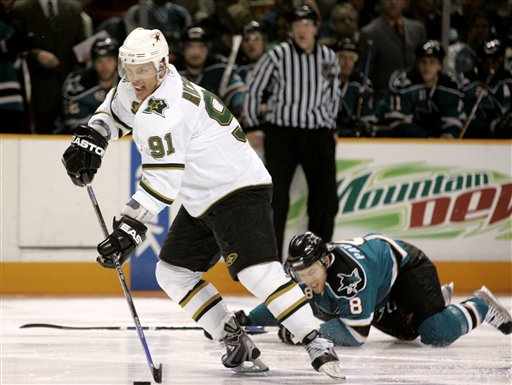
 I’m not apologizing any more. It’s a fact and it can’t be denied. I’m not going to shy away from it anymore. I’ve hedged and explained before. But I’m through hiding. Overtime playoff hockey in the NHL is better than football.
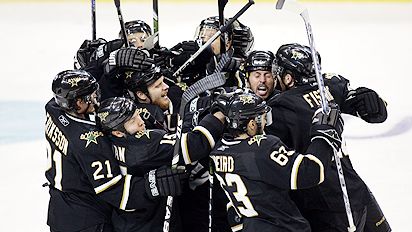
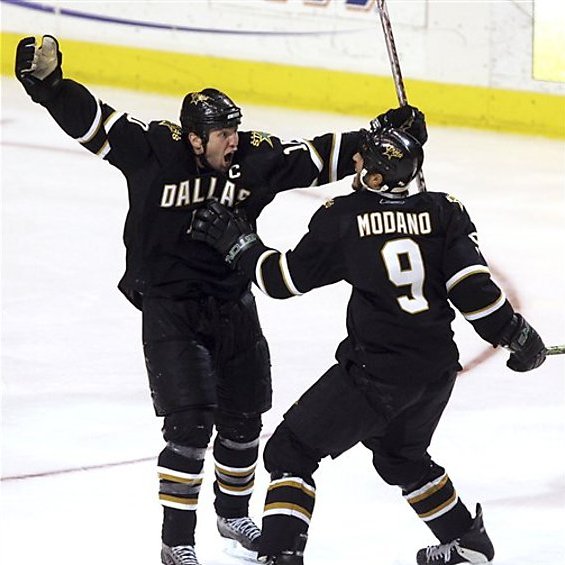
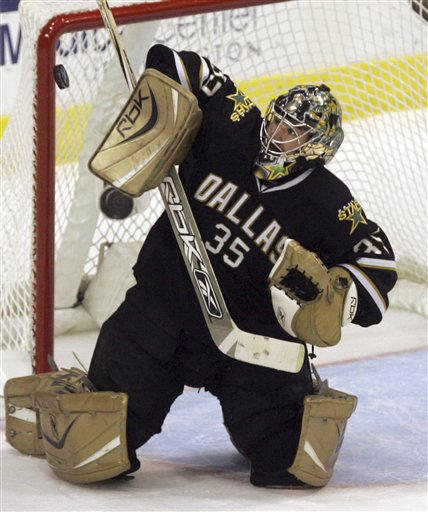
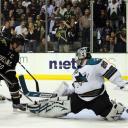 Brenden Morrow finally put the biscuit in the basket 9:03 into the 4th overtime period to put the Stars into the Western Conference Finals for the first time in eight years.
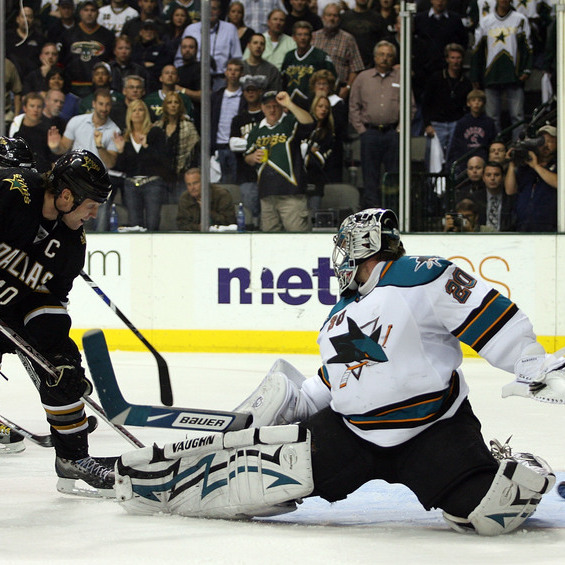
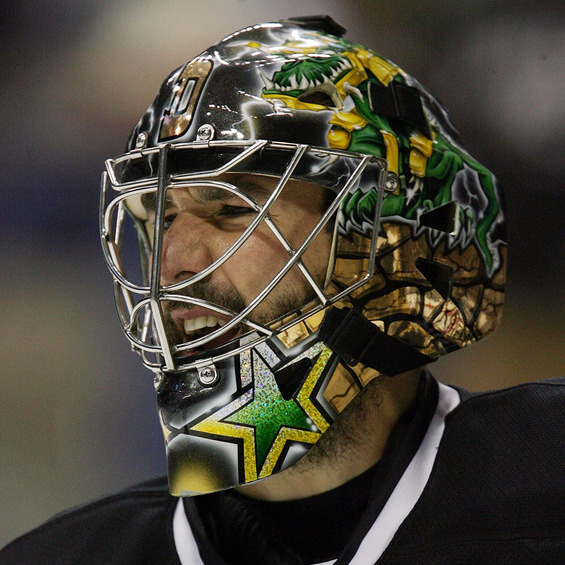
What an amazing game. What a fantastic series. Four overtime games in this second-round series. Five games decided by one goal. 117 shots on goal last night. The two goalies, Marty Turko and Evgeni  Nabokov, were unyielding, refusing to flinch. Turko was Belfour-esque last night, stopping a Stars record 61 shots. He looked so much like Eddie the Eagle of old, standing on his head to make save after save after save, I wouldn’t be shocked to see Turko show up on my TV this summer being released from the city jail wearing a FuBu shirt. He was that good. Quite a display of “substantial net-minding,” according to Strangis. Razor admitted last night (or was it this morning?) to “running out of superlatives” to describe the two goalies.
The greatest thing about overtime playoff hockey is that it really is the only true sudden death in sports. Forget baseball  where the home team always gets the last at bat. Forget basketball with its timed extra period. Even football, which calls its overtime “sudden death,” generally ends with a field goal that you see coming for at least four or five minutes. In hockey, “sudden death” comes swiftly and unexpectedly. In the blink of an eye. It’s so wonderful.
Another wonderful thing about overtime hockey is that the referees totally swallow their whistles. You could murder a guy at center ice and leave him there — they could Zamboni around the guy for two intermissions — and you won’t get a penalty. They don’t want these important postseason games, especially the elimination games, to be determined on a power play. Although, last night’s (this morning’s) was. Brian Campbell’s tripping of Loui Eriksson was egregious enough to be whistled. And Morrow pushed the puck through on the ensuing power play at 1:24 this morning.
 It’s the 8th longest game in NHL history, the third longest in Stars history. I was at the longest Stars game ever, in 2003, when Dallas lost in five overtimes to the Ducks. And I was reminded again last night about what makes overtime playoff hockey the greatest event in sports. The desperation. The tension. The drama. The dread. The hope. Having absolutely no idea, no inkling at all, how it’s going to end.
On to Detroit for Game One of the Western Conference Finals Thursday.
Go Stars.
Allan








Recent Comments