Category: Church (Page 38 of 61)

This Is Not God’s Way

Winston Churchill told a story about a little boy who was playing on a pier and tumbled over into the water. The boy couldn’t swim and began to cry out for help. A soldier working at a nearby dock heard the desperate screams and dove into the sea. This brave young man swam out to the child, put him on his back, and brought him safely back to shore and into the loving and nurturing arms of the cheering crowd. The next day, the little boy’s mother came back to the docks looking for the courageous soldier. When the pier workers pointed her toward her child’s rescuer, she walked right up to him and asked, “Young man, are you the one who saved my little boy?”

The soldier stood up. His chest began to swell and a smile broke out on his face as he answered her, “Yes, ma’am, I am.”

The woman leaned in and looked right into his eyes, “Where’s his cap?!?”

We preachers and ministers and elders and other church staff believe we are called by God. We believe we are charged by God to do the things we do in the name of his Son. It’s a high calling. It’s a noble vocation. It’s not a nine-to-five gig. It’s an all-consuming passion that compels us to preach and teach and pray and serve.

So when we answer that call from our Lord and move into the ministry, we all believe we’re entering a holy, God-sanctified realm. But the reality for most of us is that we’ve entered a system, a man-created and human-perpetuated system that grinds up and spits out preachers and elders. Broken preachers and elders are all around us. A lot of them are still working. A lot of them are not. Burned out. Trashed. Used. Abused. Walked all over. Stomped on. Chewed up and spit out like the gunk on the floor of a major league dugout.

The expectations we place on preachers and elders, the ways we treat them, the things we say to them and about them — behind their backs and even to their faces! — the things we demand of them, the attitudes of ownership and entitlement that guide our interactions with them, none of that is from God. We’ve been a part of this sick system for so long, we think it’s God’s way. But it’s not. It’s the human way. It’s the world’s way. The way we generally treat preachers and elders is not God’s way.

The reason wives and families of ministers and elders resent the church, the reason so many of our best and strongest and most faithful men refuse to serve when the church calls, the reason so few of our most gifted young people are interested in the call to preach and minister is that they all know they’re not entering into a holy partnership with God and his people as much as they’re entering into a life-sucking, soul-robbing, energy-draining system.

It’s not supposed to be this way. It doesn’t have to be this way.

It needs to change. We can do better. And we should.

The call from our God is for us to live in mutually-encouraging relationships in Christ. We are to “fan into flame” the gifts from God we see in our preachers and elders, not explode all over them with soaking wet, white fire extinguisher foam.

We are all holy people, set apart by our God to serve his holy purposes. Our interactions with one another should also be holy. They should encourage and inspire, not discourage and depress. We should express gratitude, not attitude. Instead of arguing and complaining and criticizing, our words and actions toward those who serve us should be motivated by the Spirit who lives inside us, the Spirit of love, joy, peace, patience, kindness, goodness, faithfulness, gentleness, and self-control. Against such things there is no law. And no system.

Peace,

Allan

That They May Be Saved

We had just an incredible Give Away Day at Siempre Familia on Saturday. We experienced forgiveness here at Legacy on Sunday in ways that only the Holy Spirit can cause. And I think Jerry Wayne is firing Wade Phillips even as I’m writing this post.

I’ll get to all of that tomorrow. Today, I want to make good on finishing up my thoughts on Knowledge Puffs Up.

~~~~~~~~~~~~~~~~~~~~~~~

In 1 Corinthians 8-10, Paul is addressing the single most volatile, divisive issue in the early Church. This is the issue that threatens to split God’s Church right in half. This is the thing that is polarizing the disciples of Jesus. It’s a “salvation issue.” It’s causing division, pitting Christians of one viewpoint and one mindset against Christians with different backgrounds and understandings. This is women’s roles and leadership structures and instrumental praise and worship teams and pantsuits and kitchens and divorce and multiple cups and missionary societies and R-rated movies all rolled up into one explosive church issue.

And here’s what the inspired apostle Paul has to say about it:

“Knowledge puffs up, but love builds up” (8:1).
“We put up with anything rather than hinder the Gospel of Christ” (9:12).
“I make myself a slave to everyone to win as many as possible” (9:19).
“I have become all things to all men so that by all possible means I might save some” (9:22)
Everything is permissible” (10:23).
“Nobody should seek his own good, but the good of others” (10:24).
“I am not seeking my own good but the good of many, so that they may be saved” (10:33).

A careful reading of 10:25-30 shows us that, in matters of controversy, Paul clearly favors freedom over abstinence. If it’s true that the strong Christians should not act in ways that harm the weak — and it is! — it’s also true that the weak should not accuse the strong of sin. It’s a two way street when it comes to disciples of Jesus in God’s Church.

But please note that his many instructions to this strife-torn congregation in Corinth share a common theme: in order that those on the outside, those without Christ, would come to know and receive salvation from God.

Paul refuses to engage in anything that may “hinder the Gospel of Christ.” His ultimate goal is to “win as many as possible.” His mission is to “save some.” He seeks the good of others “that they may be saved.”

I really believe that Paul knows, no matter what he does, he’s going to offend some people. You ever feel like that? No matter what you do, somebody’s not going to like it? Somebody’s going to complain? Somebody’s going to be offended? I know preachers feel that way. So do most elders I know. I really believe that Paul’s conclusion is that he would much rather offend a fellow Christian who’s already secure in Christ than an unbeliever who might turn away from the Gospel for unnecessary reasons.

The Gospel message already contains a few major stumbling blocks. There’s that whole idea of a crucified Savior. Hard to swallow. The call to die to ourselves and give everything to Christ. The imperative to sacrifice and give to others. Those are tough hurdles standing between the lost and a full acceptance of salvation from God in Christ. But those obstacles can never be taken away. Those things are the very essence of Christian discipleship. What we don’t need is a legalistic mindset that depicts Christianity as submission to a long list of dos and don’ts and conforming to a bunch of man-made rules. That’s the unnecessary hindrance to the faith that Paul, I believe, wants to abolish forever.

Me, too.

Peace,

Allan

Knowledge Puffs Up

The Church of God, in its present state on this earth, is not perfect. It’s not perfect. It’s made up of sinful, but redeemed people. Christ followers who make up Jesus’ Church are living in this in-between state of having been already adopted by God yet still awaiting that final adoption and redemption of our bodies. So, too, the Church lives in the tension of the Kingdom come, yet, “Lord, come quickly.” So, naturally, the Church is going to have its problems.

We’re going to disagree. We’re going to differ. We’re going to see some things differently than others. And that’s OK. Our diversity in the Church is God-created and God-ordained.

We’re going to fuss and argue and bicker and complain. We’re going to fight. And that’s not OK. Our line-drawing and boundary-making in the Church is certainly not God-ordained.

It’s sinful.

When the apostle Paul deals with the most explosive “salvation issue” being argued in the Church during his day, he instructs congregations to chunk their knowledge out the window. Everybody has knowledge, he says in 1 Corinthians 8:1. “We know that we all possess knowledge.” But that has no value in settling church disputes. Knowledge has no place in deciding on church issues and deciding between church members.

The answer is Love.

Love builds up. Knowledge puffs up. Knowledge causes us to bow up and dig in. Love causes us to bow down and give in. Knowledge moves us to defend and debate. Love moves us to open up and agree. Knowledge leads to suspicion and judgment. Love leads to trust and acceptance. Knowledge is the way of the World. Love is the way of the Christ.

And, shouldn’t the older, more mature Christians among us be the ones to lead the way in love over knowledge? Shouldn’t our older brothers and sisters know this and practice this and model this for the rest of us? Paul says, “The man who thinks he knows something does not yet know as he ought to know. But the man who loves God is known by God” (1 Corinthians 8:2-3). If we can’t look to our older members to exhibit Christ’s love and grace and sacrifice in all situations — especially church situations! — to whom should we look?

When it comes to clapping during a Sunday morning assembly (let’s just cut to the chase and make it practical in an overly obvious way, shall we?), you can do one of two things. You can complain about it and tell people not to clap; or you can smile and join them in their clapping. Which one builds up? Which one puffs up?

When it comes to raising hands during worship you can do one of two things. You can complain about it and tell people not to raise their hands (or not to raise their hands too high); or you can grin through it and then compliment that person for the joy they bring to the assembly. Which one encourages? Which one discourages?

I want you to seriously consider your reaction to anything your congregation may or may not be doing that causes you a little discomfort or even full-blown heartburn. Think about your response to your own brothers and sisters who may be expressing themselves in worship to God in ways that you don’t personally embrace. Are you going to bless those people or curse them? Will you tear them down with your knowledge or build them up with your love?

I am weary of these conversations. We ought to know better.

~~~~~~~~~~~~~~~~~~~~~~~~~~~~~~~~~~~~~~~~

David and Olivia Nelson are back in town! Our precious Legacy to the World missionaries in Kharkov, Ukraine arrived at DFW late yesterday afternoon and joined us for Bible classes here last night. They’re going to be here with us for the whole month of November. What a blessing! What an encouragement to have these two — no, THREE! — here among us again.

Carrie-Anne and I were so blessed to live with them in Kharkov for almost two weeks this past June. We went over there to help them and encourage them. But they wound up helping us and encouraging us even more.

If you’re looking to succeed in business or politics, you’re told to surround yourself with people who are smarter than you. Hang out with people who know more than you. Hire people who will challenge you and push you. Limiting your personal interactions to folks who aren’t quite up to speed won’t get you where you want to be. I think the same is true in our personal walks with Christ. In order to be the best kinds of disciples we can be, in order to live up and into the p0tential God created in us, we should surround ourselves with people who are closer to God than we are. We should continually interact with men and women who are more spiritually minded, more sacrificial and servant-hearted, more prayerful, more committed than we are.

I think that’s why I really love hanging out with David and Olivia.

Their commitment to the Kingdom pushes me. Their unshakeable faith in God challenges me. Their big-picture views of Christ’s salvation work in the world humbles me. Their willingness — no, eagerness! — to give up everything for the sake of the cross inspires me.

We’ll take them to Abuelo’s so they can enjoy real Tex-Mex for the first time in two years. We’ll bring them over to the house a couple of times for some of Carrie-Anne’s home cooking and long games of Phase 10. We’ll be at Caleb’s baby shower Sunday afternoon. We’ll take care of them and encourage them as much as we can during this month at Legacy. But I’m really looking forward to the ways they’re going to encourage and grow me.

Peace,

Allan

Doing Church

Announcements? Really?I’m holding it in my hands right now. It’s a brochure published by one of our larger Church of Christ universities promoting their on-line Bible courses. Each course is 13-weeks, perfect for the quarterly Bible school cycle of most of our congregations. One of the classes is “Christian Leadership Training.” Here’s the course description:

A plan for teaching a men’s or young men’s training class. Specific instructions on how to lead in various aspects of worship, from making announcements to leading in singing and making talks. Also has a section on doing personal work. Even includes critique sheets for in-class presentations.

It’s official. Announcements are now one of the five acts of worship. Which one did we take out?

~~~~~~~~~~~

In his book Forgotten Ways, Alan Hirsch contrasts the differences between what he calls Church as an “organic missional movement” and Church as “institutional religion.” I would classify it as the difference between “being church” and “doing church.” Same thing.

I can’t duplicate his chart on this blog. I don’t know how. (Help me, John!) So, I’ll have to do this in a linear way.

~According to Hirsch, an organic missional movement has pioneering missional leadership as its central role while institutional religion avoids leadership based on personality and is often led by an aristocratic class who inherit leadership based on loyalty.
~A missional movement seeks to embody the way of life of the Founder; institutional religion represents a more codified belief system.
~Missional movements are based on internal operational principles; institutional religion is based increasingly on external legislating policies and governance.
~Missional movements have a cause; institutional religion is the cause.
~With a missional movement, the goal is to change the future; institutional religion seeks to preserve the past.
~Missional movements tend to be mobile and dynamic while institutional religion tends to be more static and fixed.
~Missional movements are decentralized networks built on relationships; institutional religion is characterized by a centralized organization built on loyalty.
~The movement appeals to the common man as opposed to religion which tends to become more and more elitist and therefore exclusive.
~With missional movements, spiritual authority is the primary basis of influence, unlike religion which leans to institutional authorizing as the primary basis of influence.
~It’s being a people of the Way versus being a people of the Book.

I find these descriptions interesting. And provocative. And accurate. How about you?

~~~~~~~~~~~~~~~~~~~~~

The game-breaking homer that wrecked the RaysSome people say it’s better to be lucky than good. I’ll say it’s even better to be both. Yes, in their first two ALDS games in Florida, the Rangers have benefitted from two judgment calls at home plate that could easily have gone the other way. Carlos Pena thought he had a 3-1 count with the bases loaded against Cliff Lee in Game One and James Shields thought he had struck out Michael Young with two on yesterday in Game Two. The thing that makes the calls important is that Lee The Worthy Face of the Franchisewent on to strike out Pena and Young went on to blast a game-breaking three-run homer into centerfield.

Evan Grant has written a beautiful piece in today’s Dallas Morning News about Young. Click here to read it.

Michael Young is one of the things that makes it so easy to root for the Rangers. There are many others. C. J. ‘s determination. Antlers and claws. Hamilton ignoring his broken ribs to crash into the wall. Again. Nolan and Ruth Ryan in the owner’s box. A leadoff batter named Elvis. Who bunts for singles. Kinsler’s smile. Feliz’s fastball. Darren Oliver going 2-1/3 innings at 40 years old. Moreland’s dives into foul territory. The perfect blend of youth and innocence and age and wisdom.

I’m still embarrassed by Ron Washington’s horrible grammar. I cringe with every sentence out of the skipper’s mouth.

But this team’s headed to the American League Championship Series against the Yankees next week. And, man, are they fun to watch.

Peace,

Allan

Faithfulness, Not Fickleness

The Rangers’ magic number is 10!Stolen bases. Bunts for singles. Manufactured runs. Claws and antlers. Speed and defense. Two-out hits. Chip away theories. What heat? Dugout hugs. Brooms in the stands. Nolan and Sunny in the front office. I get the feeling that right now, today, the Twins, Rays, and Yankees would rather face each other in the ALDS than these Rangers.

~~~~~~~~~~~~~~~~~

God is FaithfulThat church in Corinth was so messed up. I mean really, really, really. They had their issues. Remember? Paul pointed out their divisions and quarrels. He said they were acting more like the world than the Spirit. Those Christians in Corinth couldn’t agree on anything. They divided between rich and poor, Jew and Gentile, slave and free. They chose sides based economic, cultural, geographical, and class dinstinctions. They bragged about who baptized them. They judged one another’s spiritual gifts. There were culture wars and theological wars within this church.

It was so messed up.

So how can Paul remain so positive about this group? How can he address them as “those sanctified in Christ Jesus” and “holy?” How can he tell them with a straight face, “I always thank God for you?” Paul begins his letter by declaring how wonderful they are. “You have been enriched in every way — in all your speaking and in all your knowledge…you do not lack any spiritual gift.”

How can he do this? Seriously!

Because our God, by his nature, through his character, because of his loyalty, for his name’s sake, has given this church — he’s given every church! — a guarantee:

“He will keep you strong to the end, so that you will be blameless on the day of our Lord Jesus Christ. God, who has called you into fellowship with his Son Jesus Christ our Lord, is faithful.” ~1 Corinthians 1:8-9

God will remain faithful to his promises to ultimately perfect his people. No matter how immature they — we! — act at times, God is faithful to deliver. I’m so thankful that Paul focuses on the faithfulness of God instead of the fickleness of the people.

That should be our focus, too.

Peace,

Allan

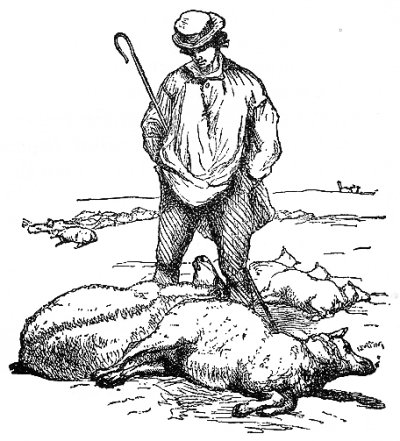
Lousy Leaders and Sorry Sheep

(You’ve got to read Ezekiel 34 — the whole chapter — before you read this post.)

Ezekiel 34 troubles me. Just exactly like the rest of this book of prophesy, it’s strong. Bold. In-your-face. It pulls no punches. It’s convicting. Condemning, even. Powerful. You never have to wonder what God is thinking when he speaks through Ezekiel. And that’s true with chapter 34. I’m troubled because so much of this chapter seems to be speaking so directly to our churches today.

Lousy LeadersGod rips into the bad shepherds because they’re ignoring the fat sheep who are oppressing the other sheep. And I see us. Sometimes. Sometimes elders don’t want to challenge the church bullies because they don’t want to stir up any conflict. They want to keep the peace. And, sometimes, the fattest sheep are the biggest givers. Sometimes preachers hold back on what God’s telling them to preach because they don’t want to offend anybody. They don’t want to answer the phone calls and emails Monday morning. They don’t want anybody to leave. They don’t want the emergency meeting with the elders.

Elders and ministers don’t always take care of the weak sheep like we should. Taking care of sheep is hard. It’s painful. Time-consuming. It’s work. And, sometimes, church leaders do crave the attention. Some of are tempted by the spotlight. Sometimes we really do just want our own way. Sometimes we do only act in an effort to save our own necks. And our selfishness and inconsistencies can drive the sheep away.

God help us.

Sorry SheepWe can also — all of us — sometimes be really sorry sheep. We can be territorial about our ministries or areas of service. Or our pews. We don’t let anybody in. We can shove brothers and sisters out the door by being dogmatic and unyielding about our own personal preferences. We can push people to the curb by insisting they believe and think and worship and sing and dress and pray just like me. We’re so good at it, so oblivious to it, that sometimes we can actually take the official position of a weak sheep and use it like an 18-pound sledgehammer to bully and head-butt and ram other sheep into my comfort zone and my lines and boundaries.

There are sheep in our flocks who’ve been in our flocks for years and who’ve never been invited to anyone’s house for dinner. They’ve never been asked to go out to eat. There are sheep in our churches who feel like they don’t matter because we have absolutely run them over on our way to the next committee meeting or service project.

God help us.

God says, “No, I’m just going to do it myself.”

“I myself will shepherd my sheep”

Jesus says, “I am the good shepherd.”

“I myself will be their shepherd!” Ezekiel 34 and John 10Jesus knows how to afflict the comfortable and comfort the afflicted. To those who relied on their own righteousness, Jesus ripped away all their excuses and forced them to see their deep need for his grace. To those who were burdened and marginalized, Jesus drew them to God. He showed them that God did not delight in their death but was begging them to come to him so he could give them eternal life. They needed to know there was a place in God’s flock for the weak and the sinful.

The Lord Jesus Christ is our great shepherd. He’s bold and courageous and single-minded in his mission to seek and save the lost, to restore the lost sheep of Israel. And he’s so committed to it — he’s so committed to us, his sheep — that he lays down his life for us. He dies for us. He stands in the gate — he says in John 10 he IS the gate! — between us and the ravenous wolves and the muderous robbers who would kill us and eat us. He’s unwilling to sacrifice even one of us to the enemy. He’d rather die first.

And he did.

God’s people are scattered. We’re all over the map. We bicker and argue. We’re lost and injured and sick. And God through Christ keeps his promises to search and bring back and strengthen. The Good Shepherd makes us one. And he gives us peace.

~~~~~~~~~~~~~~~~~~~~~~~~~~~~~~

The Rangers’ magic number for clinching the division title is 19!The Rangers are 2-5 right now on this ten game road trip. They’ve gone oh-fer on the season in the Twin Cities. They’ve lost four straight. Josh and Lee are both out indefinitely. Just a little speed bump, right?

Peace,

Allan

« Older posts Newer posts »