“You can never make everybody happy unless you’re doing things that are disingenuous.”
~C. J. Wilson
AllanStanglin.com
“You can never make everybody happy unless you’re doing things that are disingenuous.”
~C. J. Wilson
 The apostle Paul tells us in Romans four that Abraham never wavered in his faith regarding the promise of a son and countless descendents. He never wavered. Yet, I seem to recall a situation or two with laughter. And Hagar. And Ishmael. Never wavered?
Scripture makes it clear that King David was a man after God’s own heart. Really? What about Bathsheba? Didn’t David go out of his way to premeditate and plan to break six or seven of the ten commandments in one weekend? Didn’t he lie and cheat and steal with his band of strong men in the wilderness? A man after God’s own heart?
We tell our little kids the story of Samson. We use flannelgraph and puppets and color sheets to tell them all about this hero of the faith. But when’s the last time you really read his whole story? You don’t tell the kids about the women and the sex and the lying and the breaking of his holy vows and his selfish pride and lust for violence and revenge.
Why not?
Because that’s the bad stuff.
Exactly.
The heroes in the Bible are more like us than we think. In a lot of ways, they are exactly like you. And me. A mixture of good and evil. A mess of noble intentions and horrible choices. A fluid cocktail of loyalty and rebellion. A patchwork of ultimate highs and miserable lows.
Our God has always chosen to do his greatest work through people exactly like you. And me. People just like the ones in your church. “Elijah was a man just like us…” Yeah, he was. So was Peter and Jacob and John and Joshua and Mary and Ruth.
Just like us.
~~~~~~~~~~~~~~~~~~
For Legacy members only!!!
It’s crazy — absolutely crazy — that Carrie-Anne and I are the only ones from our congregation who make the trip north of the border to the Tulsa Workshop. Crazy! Next year, if I must, I’m planning our Legacy church trip to Tulsa. I’ll handle the hotel reservations, plan the caravan, and pick out all the restaurants. You’ll be encouraged, uplifted, inspired, equipped, empowered, enlightened, and educated. You’ll sing at the top of your lungs, you’ll ‘amen’ some of the greatest preachers in the faith, and you’ll be transformed. You’ll grow. God will change you.
And you will thank me.
Hold me to it.
~~~~~~~~~~~~~~~~~~~~~~~
Check out this blog post from a theology professor at SMU’s Perkins School of Theology. The man’s name is Ted Campbell. He’s a Methodist — a “heart-core Methodist, — who recently attended a Sunday worship assembly at Preston Road Church of Christ in Dallas. And in his review of the experience , Campbell concludes that “the Churches of Christ were right after all.” It’s a good read from an outsider’s perspective. And I only mean “outsider” as not an official member of our little stream of the Christian faith. Click here to read his article.
Peace,
Allan
I’m glad Jesus is your Savior. But is he your Lord?
Is he?
Does Christ compel your every thought and deed? Does Jesus inform your every decision? Do you seek to honor him with every word and action? Is Jesus the Lord of your church life and your work life and your family life and your recreation life and your social life? Do you give Jesus the final say on every second of your every minute or do you hold out on him? Does he have some of your day, but not all of it? Does he control some of your life, but not all of it? Does he get the final vote on everything you do, or just on some of the things you do?
Is he your Lord? Or is he just your Savior?
It’s high time, isn’t it, for the lordship of Jesus Christ to move past Sunday mornings and past our churches and past our religious ceremonies and programs and into our whole world. All of it. “Jesus is Lord!” That was the confession of the early Church. Jesus is Lord. That means Caeser is not. Your corporate president is not. Your nation’s president is not. Neither is your boss or your teacher or your neighbor or your client or your child or your coach. Or your culture. Jesus is Lord.
God is bigger than we’ve ever imagined. And he wants all of us.
For some reason, we’ve allowed God to only have dominion over the things we can’t really explain. We’ll give God the Bible and Church and heaven and hell. He can rule over life and death. He can make all the decisions about salvation and judgment. But that’s an abbreviated God. That’s a “God of the gaps” who just fills in the blanks. The God of Holy Scripture is Lord over everything. He’s not just Lord over what we don’t know, but over every single thing we know and over all the things we’re just now learning. He is Lord. We must stop pretending that our God only wants to dwell in the little religious corners we’ve reserved for him.
 “It always seems to me that we are trying anxiously to reserve some space for God; I should like to speak of God not on the boundaries but at the centre; not in weaknesses but in strength… The Church stands not at the boundaries where human powers give out, but in the middle of the village.” ~Dietrich Bonhoeffer, 1944
Resolve right now, by the grace of God and the power of his Spirit, to put Christ at the very center of your world. Declare Jesus to be your “all and in all.” Give him, finally, your whole life; stop holding back. He’s not the last resort when you’ve run out of options; he’s not the religious specialist who only deals with spirituality; he’s not a comfort blanket when you’re hurting or an AK-47 when you’re in trouble.
He is Lord. Right smack dab in the middle of your village.
Peace,
Allan
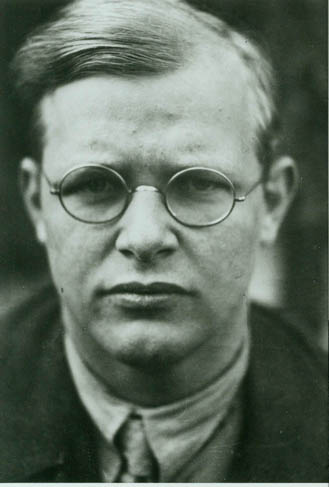 Dietrich Bonhoeffer inspires me. I’ve been fascinated by Bonhoeffer since the day Michael Weed introduced me to the Christian author, theologian, and martyr in a theology class at Austin Grad a little over five years ago. Bonhoeffer moves me. Not just because he wrote about true discipleship to Jesus, not just because he preached against the cheap grace he saw accepted and practiced in the Church, and not just because he talked all the time about the ultimate lordship and reign of Christ. Bonhoeffer moves me because he so truly lived it. He embodied it. He gave his life for it.
So I pay attention to Bonhoeffer. He was real. He put his very life on the line for what he preached and wrote about commitment to Jesus and God’s salvation mission in the world. As Paschal once noted, “I tend to believe the witnesses who get their throats cut.” Me, too.
It’s been almost three weeks since I finished reading Eric Metaxas’ hefty biography, Bonhoeffer: Pastor, Martyr, Prophet, Spy. I’ve spent several hours since going back over the things I’ve highlighted, re-reading the pages I’ve marked up, trying desperately to will the words and the passion of this great man into my very soul.
There’s so much I want to share with you from this book. His writings about the Church sound as if they were penned yesterday. His understanding of the Gospel is as clear as if he were at those resurrection meals with Jesus. His call for true discipleship to our Lord is challenging. Convicting.
Personal.
Allow me to give you a taste.
Bonhoeffer was greatly troubled by the secularization he saw in the Church. The focus, as he saw it, wasn’t as much on the central Christian doctrines of forgiveness and grace, sanctification and discipleship, resurrection and justice as it was on progress and success, relevancy and status. Note how his observations about the big churches in New York City, written when he was at Union Theological Seminary in 1930, ring just as true today.
“In the place of the church as the congregation of believers in Christ there stands the church as a social corporation. Anyone who has seen the weekly program of one of the large New York churches, with their daily, indeed almost hourly events, teas, lectures, concerts, charity events, opportunities for sports, games, bowling, dancing for every age group, anyone who has heard how they try to persuade a new resident to join the church, insisting that you’ll get into society quite differently by doing so, anyone who has become acquainted with the embarrassing nervousness with which the pastor lobbies for membership — that person can well assess the character of such a church. All these things, of course, take place with varying degrees of tactfulness, taste, and seriousness; some churches are basically ‘charitable’ churches; others have primarily a social identity. One cannot avoid the impression, however, that in both cases they have forgotten what the real point is.”
Ah, the point. What is the point? What is God’s mission for his Church? What do we aim for? What do we live for? What’s the goal? What’s the point?
To seek and to save the lost. To bind up the injured and strengthen the weak. To release the captives and set the prisoners free. To proclaim and to live in the truth that God in Christ has defeated the dark forces of sin and death and Satan and is right now making his dwelling place among us, renewing and restoring all of creation, reconciling the world to himself in righteous relationship so that we will be his people and he will eternally be our God.
It’s hard work. It’s dirty work. It’s grimy and messy. It requires muscle and sweat and blood and tears. It takes great sacrifice. It takes every ounce of everything you’ve got.
But that is the point. Let’s not ever forget the point.
~~~~~~~~~~~~~~~~~
 Today is my great friend Dan Miller’s 50th birthday. In honor of Dan, let’s all repair our cars with duct tape and twistie ties and order extra cheese. On everything.
Happy birthday, Dan. I love you, brother. You mean the world to me.
Allan

As you can imagine, I have a stack of articles and papers in my study here that I intend to write about in this space. As you also know, that stack tends to pile up and grow as other things press in on me and immediate concerns crowd into my blog posts. Near the bottom of this pile is something from the Spring/Summer 2010 issue of ACU Today. It’s a list of bullet points from a 1993 speech made by then university president Dr. Royse Money.
At the beginning of the speech, Money declares, “I come to you tonight with a heavy burden on my heart for the Church. As we seek to be the Church that belongs to Jesus Christ, I see hindrances along our way that impede our progress. I want to be honest with you tonight and discuss some issues and problems and challenges we face in our fellowship (Church of Christ) that are not easy or pleasant to discuss. But we must.”
This month at Legacy we’re talking about what’s NEXT. What’s NEXT in your walk with Jesus? What’s NEXT for our congregation? What is God calling you to NEXT? Where is Christ leading us NEXT? We’re looking at Peter’s “add to your faith…” We’re considering Paul’s call to “attain to the whole measure of the fullness of Christ” and “straining toward what is ahead,” and “pressing on.”
Legacy’s elders and ministers are gearing up for our annual retreat together tonight and tomorrow at Camp Carter on the other side of Fort Worth. In the midst of our prayers and planning and reflections heading into this weekend, Money’s bullet points are worth considering. For Legacy. For your church. For your congregation’s leaders. For you as a child of God and a disciple of his Christ.
~We must realize that unity does not mean uniformity of belief.
~We must determine the essentials of faith apart from traditions, customs, comfort and personal preference.
~We must realize in dealing with those who differ with us, both within our fellowship and beyond, that tolerance and a certain level of fellowship is not the same as total endorsement of another’s views.
~We must learn to handle diversity in a charitable way.
~We must mark those who cause division among us.
~We must rediscover that in our allegiance to Christ, the bride wears the name of the Groom.
~We must realize that the enemy is Satan and not each other.
~We must determine what the real issues are regarding the role of women in the Church.
~We must decide on the way Scripture should be interpreted.
~We must realize the powerful dynamics of change.
~We must rededicate ourselves to search relentlessly for truth as it’s revealed in the Scriptures.
To Money’s excellent observations and clarion call for action, I would add a couple of my own:
~We must shift our focus from pastoring the saved inside our walls to saving the lost outside our walls.
~We must be motivated by Christ’s love instead of by a driving desire to be right.
~We must relax and stop taking ourselves so seriously as we realize we live under and in the grace of God.
We ignore these things at our own peril. Just talking about them and feeling like we’ve done something isn’t enough. Action must be taken. Hearts must soften. Lives must change. Leaders must lead. Pro-active instead of reactive. Just holding our own isn’t cutting it. Christ’s compelling love wasn’t given freely to us so we can huddle up and play church and avoid doing anything wrong. His sacrifice on the cross and the Holy Spirit’s powerful work at the garden tomb is a call to action. Holy action. Christian leadership. The Kingdom of God is “forcefully advancing, and forceful men lay hold of it!”
May our merciful Father bless us with wisdom and vision. May he graciously overcome our staggering incapabilities to lead his people forward in his eternal Kingdom.
Peace,
Allan
 “The psalm blended all voices together, and caused one single fully harmonious chant to arise; young and old, rich and poor, women and men, slaves and free, all sang one single melody… All the inequalities of social life are here banished. Together we make up a single choir in perfect equality of rights and of expression whereby earth imitates heaven.” ~Ignatius, 110 AD
I had the most wonderful weekend singing with God’s children. You can’t believe all the singing.
Friday night and all day Saturday I was blessed to be able to sing praises to our Father with more than two thousand teenagers at WinterFest at the Arlington Convention Center. Over two thousand kids! Singing. Praising. Clapping. Stomping. Dancing. Twirling. Hand motions. Loud. Energetic. Enthusiastic. Singing of the very best kind. True offerings from the soul. Genuine praise and thanksgiving from the heart. The kind of singing that fosters Christian unity. The kind of singing that strengthens Christian bonds. The kind of singing that ushers one directly to the throne room of God.
I’ll bet we sang over a hundred different songs together at WinterFest Friday and Saturday. And not one of them — I promise — was written before 1980.
Sunday night, I was blessed to be able to sing praises to our Father with about two dozen of my Legacy brothers and  sisters and another two dozen or so residents of the Sterling House Nursing Home in Richland Hills. As part of the NEXT challenge, our Small Group has teamed up with another to spend an hour with those sweet people at least once a month. About forty of us total Sunday evening. Singing. Praising. Toe tapping. Smiling. Head nodding. Amen-ing. Four part harmonies. Not too fast, not too slow. Just right. Singing of the very best kind. True offerings from the soul. Genuine praise and thanksgiving from the heart. The kind of singing that fosters Christian unity. The kind of singing that strengthens Christian bonds. The kind of singing that ushers one directly to the throne room of God.
I’ll bet we sang 25 different songs together at Sterling House Sunday night. And not one of them — I promise — was written after the Depression.
I want my children to take very seriously the words of Paul in Romans 12: In Christ, we who are many form one body, and each member belongs to all the others. That’s why our girls were right there with Carrie-Anne and me all weekend, with the crazy teenagers at WinterFest and with the sweet old people at Sterling House. I want my kids to see what I see, I want them to feel what I feel, to truly know what I know: that The Old Rugged Cross means as much to that older woman in the wheelchair as You Have Turned (my mourning into dancing, whoop! whoop!) means to that 12-year-old-girl clapping in the aisle. That it is critically important for the younger people to join in the congregational singing of Blessed Assurance and Anywhere with Jesus. And that it is just as important for the older people to join in the congregational singing of Days of Elijah and Lord, I Lift Your Name on High.
Why do the teens at WinterFest smile? Why do they sing? Because they’re expressing themselves to God — they’re declaring his praises and experiencing his grace — in their own style, in their own language, in their native tongue. They are free.
Why do the older people at Sterling House smile? Why do they sing? Same reason.
Now, does it give you joy to encourage a teenager in the faith? Does it bring you godly pleasure to tell a child he is important to you or that she is vital to your church family? Then why don’t you unfold your arms and wipe off that scowl and join them with gusto the next time your worship leader starts Blessed Be Your Name! Or is it only about you?
Teenaged brother or sister in Christ, does it make you feel good to encourage an older person? Does it lift your spirits to tell a senior citizen that she is vital to your church family? That he matters to you? Then why don’t you put down the iPhone and wipe the frown off your face and join them with gusto the next time your worship leader starts How Great Thou Art! Or is it only about you?
A gathering of God’s people all truly giving themselves to God in song really is incredible. But it only imitates heaven when the congregants are giving themselves to each other as well. The greatest joy I received and the greatest blessing I encountered over this wonderful weekend was in watching a couple of people almost twice my age shout out Couldn’t Keep It To Myself Friday night and watching the teens in our Small Groups sing A Wonderful Saviour Sunday night.
Earth really imitating heaven.
Peace,
Allan
© 2026 The Kingdom, The Kids, & The Cowboys
Theme by Anders Noren — Up ↑
Recent Comments