Category: Church (Page 21 of 59)

Sinners Behaving Politically

I’m returning one more time to the interview in Christian Century with Jennifer McBride, the author of a soon-to-be-released book on the role of God’s Church in the world. The book is called “The Church for the World: A Theology of Public Witness.” McBride tackles the question of the Church’s grand mission and the misunderstandings about the methods for achieving the divine task. It seems to be mainly about rejecting the ways of the world and embracing the ways of our Lord.

Toward the end of the interview, David Heim asks McBride her views on the American church’s involvement in state and national politics. Some critics have pointed out recently that the Church has lost its Christian witness to our culture because our increasing identity as a political movement or a political organization affiliated with one particular party is turning off a lot of people. I, for one, would agree with a lot of that criticism. I always cringe when Christians are all lumped in together with a certain political group whose views and methods might actually contradict the clear teachings of Scripture. As would be expected by now, McBride says she’s not so much concerned with the Church having a political voice, but with how the Church exercises that voice:

“Christian faith is inherently public or political because it concerns how we order our lives in relation to the good of others — in relation to neighbors, strangers, and enemies. Discipleship is about following Jesus, who embodies the reign of God; it is about living into God’s social order ‘on earth as it is in heaven.'”

Part of the problem, according to McBride, is that our churches are too preoccupied with the Sunday morning worship hour instead of how they are engaging those around them with the Gospel. “The identity and function of congregations,” she says, “traditionally revolves around what seems to me to be a narrow understanding of worship, the worship itself or a particular worship style.” A church full of continuously confessing and repenting sinners will, instead, take more seriously its identity and mission as the Body of Christ in the world.

And, she brings up Bonhoeffer again. McBride points to Bonhoeffer’s understanding that the Gospel of Jesus is to be lived out in our communities in concrete ways. Christology and Ecclesiology should not be abstract or unapproachable to the average Christian. But at the same time, a lot of social justice efforts and political movements completely ignore the rich resources of thinking theologically about the Church’s role in the world as the embodiment of Christ Jesus and the proclamation of his Kingdom come. That flattens our Christian faith and reduces feeding the poor and digging wells to nothing more than good deeds. When the faith of the Church is narrowed down to merely ethics like this, it is violently stripped of its power to transform lives.

Yes, the Church is a political organization. But its polity is modeled on the Kingdom of God, its citizens belong to heaven, and its Lord is King Jesus. Yes, we engage the world and its own political beliefs and systems and practices. But we do it in ways that reflect our Lord’s life and his direction for ours. We don’t hate or insult or do anything by force; we love and encourage and humbly invite. But, we do engage. We do act. We do care.

As McBride says in her book, true Christianity “encourages and fosters love for this life in all its complexity. Christians cannot offer a redemptive public witness if they don’t genuinely love living in this world with all its joy and sorrow.” To quote Bonhoeffer one last time: “It is only when one loves life and the earth so much that without them everything seems to be over that one may believe in the resurrection and the new world.”

Peace,

Allan

Flesh and Blood

“For our struggle is not against flesh and blood, but against the rulers, against the authorities, against the powers of this dark world and against the spiritual forces of evil in the heavenly realms.” ~Ephesians 6:12

To me, flesh and blood means people. Flesh and blood is a person. It’s a man or a woman. Skin and corpuscles. Tissue and cells. Epidermis and marrow. Mortal. Humankind. People.

Our struggle is not against people.

Our struggle is not against people across the street, people in other countries, or people in other churches. Our battle is not against preachers or politicians or pundits. Our fight is not against family members, our employers, or our persecutors. It’s not against actors, authors, or athletes. It’s not against political parties or social organizations or even your country’s enemies. Our struggle is not against our elders or ministers or the people who sit three pews over.

Our struggle is not against people.

Our struggle is against Satan and the demons of hell. Our battle is against the kingdom of darkness. Our common enemy is the prince of liars who convinces us to fight against one another while he advances unchecked against our families and our churches and the rest of God’s magnificent creation.

Taking our stand against the devil’s schemes means refusing to struggle against people. It means declining to engage in division. It means we never fight each other or our neighbors. It means having no enemies other than the enemies of Christ Jesus, our risen and coming Lord.

Grace & Peace,

Allan

Bruised, Hurting, and Dirty

“I prefer a church which is bruised, hurting, and dirty because it has been out on the streets, rather than a church which is unhealthy from being confined and from clinging to its own security.”

~Pope Francis, from Evangelii Gaudium

Around the Table: Part 8b

“Therefore, whoever eats the bread or drinks the cup of the Lord in an unworthy manner will be guilty of sinning against the body and blood of the Lord. A man ought to examine himself before he eats of the bread and drinks of the cup. For anyone who eats and drinks without recognizing the body [of the Lord] eats and drinks judgment on himself.” ~1 Corinthians 11:27-29

I’m trying to keep these Around the Table posts from being too long. So allow me today to clean up a little bit from yesterday’s observations from Paul’s Lord’s Supper correctives in 1 Corinthians 11.

A lot of our distorted communion theology comes from the misunderstanding and misapplication of two key phrases in these three verses. These two phrases, as we’ll see more clearly in future posts, have been used and misused in all the worst ways to shift the Lord’s Supper over the centuries from the celebratory communal meal as it was originally intended to today’s solemn introspective snack.

Eating in a Worthy Manner

The word Paul uses here is not an adjective, it’s an adverb. It’s anaxios, which could be translated as “unworthily” or “unworthy manner.” The word describes the way one eats and drinks, not whether one is worthy to eat or drink in the first place. None of us is worthy to eat and drink in righteous relationship at the same table as our God. Or, put another way, all of us, by the grace of God and the blood of his Son, are worthy to share a meal at the Lord’s feast. Our worthiness to be at the table is not in question; that was settled at the cross of Christ. Praise God! What’s in question is how we eat when we’re gathered at our Lord’s Meal with other Christian brothers and sisters. According to the particular situation that Paul’s addressing there in Corinth, eating in an unworthy manner means eating in a way that only concerns yourself or your peers. It means eating in a selfish way that erects barriers between people and groups of people. It means drawing lines at the table between people of different backgrounds, different life circumstances, or different color, language, or race. Eating in a worthy manner is not about silently meditating on the cross of Jesus or reflecting on one’s own sins committed during the previous week. It’s not about quickly judging yourself and deciding you’d better not take a cracker crumb this week or, yeah, I’m good enough to participate today. It’s not private introspection; it’s public action. Worthy manner means considering the needs of others around the table more important than your own. It means sharing. It means paying attention to the people around you. Which leads us to…

Recognizing the Body:

First, it’s not “recognizing the body of the Lord.” The earliest original Greek language manuscripts do not contain “of the Lord.” Those three words were added to the text somewhere along the way, probably several centuries later, undoubtedly to help shift the mood of the Supper to one of quiet reflection. (There was a reason for that. Again, we’ll see it more clearly and explore it more thoroughly in upcoming posts.) Everyone at the table, in Paul’s words, must recognize the body while they eat and drink. Recognize the body? How can that possibly mean anything other than the Church?

Earlier, in the same conversation, Paul has used “body” to describe the church: “Because there is one loaf, we, who are many, are one body, for we all partake of the one loaf” (1 Corinthians 10:17). Later, in the same letter, he leaves no doubt as to what he means when he uses the word “body” at least 17 times in 16 verses to mean “church” (1 Corinthians 12:12-27). This is just the way Paul writes; he loves to refer to the gathered saints as “the body.”

“…for the sake of his body, which is the Church.” ~Colossians 1:24

“…to be head over everything for the Church, which is his body.” ~Ephesians 1:23

“For we are all members of one body.” ~Ephesians 4:25

“…just as Christ does the Church — for we are members of his body.” ~Ephesians 5:30

To recognize the body at the Lord’s Supper is to recognize God’s Church as a united community. This is about acknowledging the communal meaning of the Meal. The Lord’s Supper is a powerful witness to unity, it’s a strong testimony to a tangible fellowship that transcends all barriers. Especially in the context of the particular issues in Corinth, Paul’s command to recognize the body can only mean to recognize all the people around the table together. This is not about concentrating on the battered body of Jesus hanging on the cross. It’s not about tuning out distractions, not making eye contact with anybody, being super quiet, so as individuals we can focus on the death of our Lord. It’s just the opposite; it’s exactly the opposite! It’s explicitly about tuning in to everybody and everything around us, about making eye contact and physical contact with our brothers and sisters, it’s a command to talk and visit and smile and chat and welcome and serve, to focus on the resurrection community we’re blessed by God to share together.

You know, the communion meal is genius. It really is. God knew what he was doing when he gave us this Supper. Because you can’t do communion by yourself. You can’t do communion on TV, you can’t order it on-line, and you don’t get communion at a drive-thru. In order to do communion, you have to be within arm’s reach of other people. You must be within touching distance of other Christians. You have to share a loaf, you have to serve a cup, you have to look at each other. Doing it by yourself is not communion. Doing it by yourself even in a room full of hundreds of people is not communion. Distorting these two key phrases in 1 Corinthians 11 has profoundly damaged our Lord’s Supper. Expressing the intended communal aspects of the meal is what’s required. It’s what must be recovered.

Peace,

Allan

Members of God’s House

People are looking for a connection. We have a human need to belong to something, to be a part of something, to be a part of some group. We get our identity, in large part, from the groups to which we belong. And that something, or some group, should be successful and popular. Even if it’s only a sports team, that drive to identify with something is enormous.

So we buy the jerseys. We refer to “our” teams as “we” and “us.” We have a need to belong, to connect, to have some sense of fitting in this world. And it’s from this sense of belonging — at work, at school, at the club, at the football stadium — that gives us the confidence and ability to relate and accomplish things. Our own families, of course, are foundational in giving us a true sense of belonging.

“You are no longer foreigners and aliens, but fellow citizens with God’s people and members of God’s household, built on the foundation of the apostles and prophets, with Christ Jesus himself as the chief cornerstone.” ~Ephesians 2:19-20

We do belong. We belong to God and to God’s family. That’s our connection.

Christ has brought us home to God. We live in God’s house as his much-loved sons and daughters. We belong with God and are involved in what he is doing. The other people in the house are family with us. This home defines us. Christ gives us a place in this world. And from that connection, that sense of belonging, we grow in our abilities to relate to each other and accomplish great things for the Kingdom.

Remember where home is. Remember who’s your family.

~~~~~~~~~~~~~~~~~~~~~~~~~~~~~~~~~

The “4 Amarillo” cooperative coalition among the four downtown Amarillo churches made the list of the year’s top “headliners” in the local Amarillo Globe News. You can read the article in yesterday’s paper by clicking here.

Peace,

Allan

Thanksgiving 4 Sunday

“I have given them the glory that you gave me, that they may be one as we are one.” ~John 17:22

We’ve been given a profound intimacy with the Father and Son that changes all of human life. It’s a unity that encompasses the Father with the Son, all disciples with them both, and all disciples, in turn, with one another. This is the gift of Jesus’ prayer. It’s not what we have to do or maintain; it’s what God through Christ has already given us and continues to maintain through the power of his Holy Spirit. It’s just a matter of whether we recognize it or not.

This Sunday, we are set to gather in gratitude to give thanksgiving to our God for the gracious gift of this unity. We will acknowledge the fellowship we share with the other Christian congregations in downtown Amarillo on this day of worship and praise and thanksgiving. Together.

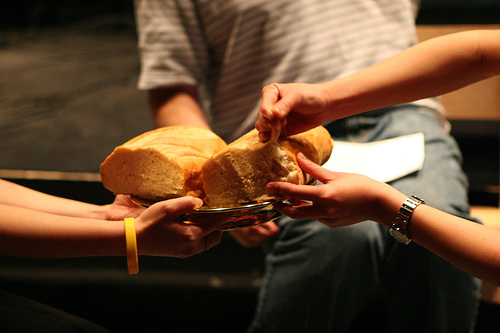
Our guest preacher here at Central on Sunday is Howard Griffin, my good friend and the senior pastor at First Presbyterian Church. As has become our custom on the Sunday before Thanksgiving, we will share a special time of communion around several tables in the worship center piled high with a wide assortment of breads, representing the divinely-ordained diversity in Christ’s Body, his Church. Then at 6:00 Sunday evening, all four churches are meeting at First Baptist for the first ever “4 Amarillo” Thanksgiving service.

As God’s children, unity is our nature. This is who we are: One with Christ and one with his followers everywhere. What that means is that there is very little, if anything, outside of denying Jesus as Lord in word or deed that can separate us. If that’s the case — and it is! — then our diversity and our differences are not just tolerated, they’re embraced and appreciated. Even celebrated. Thanksgiving seems like a perfect time for just such a celebration.

Peace,

Allan

« Older posts Newer posts »