Category: Church (Page 16 of 59)

Nothing Not as Old as the NT

“Nothing ought to be received into the faith or worship of the church; or be made a term of communion amongst Christians, that is not as old as the New Testament.” ~Declaration and Address, Thomas Campbell, 1809

ChurchFathers

Our Stone-Campbell Movement was motivated by the desire to unite all Christians around the Bible only. The belief was that if we put aside all human doctrines and all human creeds and traditions and focused only as the Scriptures as our model and guide, all followers of Jesus would come together in one unified body. The ideal was to “restore” the New Testament church and for all of us to be New Testament Christians. One of the unfortunate consequences of this powerful vision has been our reluctance to embrace any church history or tradition before 1809. We ignore church history. We resist it, reject it.

My brother, Dr. Keith Stanglin, wrote an insightful article for the Christian Studies theological journal a couple of years ago that outlined a couple of key consequences that have resulted from our faithful pursuit of a New Testament Church ideal. The article is titled “Restorationism and Church History: Strange Bedfellows?” and you can read it in its entirety by clicking here. I’ll be using his article as a guide for this discussion that may take us through the remainder of this week.

The italicized statement at the top of this post is from the founding document of our Restoration Movement, Thomas Campbell’s Declaration and Address. This is proposition five, stated right after proposition four which said only the commands and ordinances of the New Testament will be binding on the church. Just as proposition four marginalizes the Old Testament, this proposition five marginalizes all church history. As Keith writes (or am I supposed to say, “as Stanglin writes?” This is kinda weird), “According to this rule, just as we should not consult Mosaic faith or tabernacle worship in the restoration project, neither should we consult Nicene faith or its liturgy.”

OK. Clearly, there’s a lot to consider here. Let’s just take this one step, one day, at a time.

“Nothing not as old as the New Testament” is a problem.

First, let’s consider what Keith calls the problem of logic. Receiving nothing into the church that is not as old as the New Testament is a self-contradictory statement. The rule doesn’t even meet its own criterion. People say things like this all the time: “There is no such thing as absolute truth” and “You should only believe statements that can be empirically proven.” Each of those statements fails to stand up to its own requirements. The same thing is true for Campbell’s rule that has had, and continues to have, a powerful influence on our Stone-Campbell churches. The statement itself is not as old as the New Testament!

There is also the problem of definition. What does Campbell mean when he says “the New Testament”? If he means the standardized list of 27 New Testament books, the earliest we can date that is toward the end of the fourth century. So, does Campbell mean “nothing not as old as the fourth century”? No, that’s probably not what Campbell meant. He certainly meant the time period in which the New Testament books were written. He’s talking about the first century. So, does Campbell mean “nothing ought to be received into the faith or worship of the church that was not believed or practiced in the first century?” Well, maybe. But then that gets complicated because the 27-book collection of the New Testament was not even thought of by the end of the first century. If our Bible is going to be the Bible of the first century church, then it must be the 39-books of the Old Testament. Only.

See where this takes us? The whole thing is a consistency issue. We can’t hold to Campbell’s rule, we certainly can’t impose it on our churches, if we’re going to use a 66-book canon of Scripture as our rule and guide. As Keith writes, “It is for similar reasons that we also cannot give anything more than passing consideration to slogans such as ‘No creed but Christ,’ and ‘No creed but the Bible.’ Whatever these slogans and the [statement] possess in rhetorical force they lack in coherence and meaning.”

I say all this to just lay a foundation for the discussion that will follow tomorrow and the next day or days. We’re not making any conclusions here yet. I’m certainly not disparaging Campbell’s inspiring and God-ordained vision for uniting all disciples of Jesus together as one universal body of believers. It’s not only a noble ideal, it’s the will of our crucified and risen Lord. The suggestion is this: maybe our churches should at least listen to the wisdom of the Christian believers through the ages. I’m not saying we should blindly adhere to everything that’s gone before. I’m not suggesting we ought to swallow everything that’s been believed before and obey everything that’s been practiced before. But I believe we should probably let the “church fathers and mothers, the medieval scholastics and mystics, the reformers and restorers all have a seat at the table. It means hearing the voice of the past with discernment. It means having a ‘critical reverence’ for the historic Christian tradition.”

We have traditionally ignored or flat-out rejected most church history as formative for us in any way. We typically view all church history before 1809 as corrupt men and women practicing faithless apostasy and dividing Christ’s body with scandalous squabbles over insignificant issues. As Keith observes, whether we invite them to the table or not, we are all strongly influenced and shaped by ancient church tradition and history. Whether we acknowledge it or not.

Stay tuned.

Peace,

Allan

The Gospel is Not Old News

NoTalkingBar

“Trembling and bewildered, the women went out and fled from the tomb. They said nothing to anyone, because they were afraid.” ~Mark 16:8

If it’s real, I have to tell. If Jesus really is the risen Messiah, if he really was raised from the grave, and if we really are forgiven and restored and righteous because Christ Jesus is crucified and resurrected, then we have to tell. But we’re so reluctant to tell. For some reason we run and hide

It’s not because we’re bashful. We’re not shy. If I find a new restaurant or a new album or a new soap, I’m telling people about it. “It smells great and it doesn’t dry out my skin!” Come on, we all do that. “That Longhorn Steakhouse on I-40, you’ve got to try it!” “Tom Petty’s new album, you’ve got to get it!” “That Cloverfield movie, you’ve got to see it! It’ll mess you up!” We all do this. When something brand new impacts me, I want other people to experience it, too. And I’m talking about it all the time.

“They said nothing to anyone, because they were afraid.”

Are we afraid? Is that why we don’t tell? We’re probably not afraid of being persecuted or killed if we tell. What are we afraid of? Are we afraid that maybe the Gospel is old news?

NoTalkingBarFullI wonder if we define the Gospel as the death, burial, and resurrection of Jesus that happened almost two-thousand years ago? If so, it’s not really news. It’s not right now. And I was saved a long time ago. I was buried with Christ in baptism almost 40 years ago. I was raised with Christ, I put on Christ decades ago. Is that why we don’t tell? Because it doesn’t feel fresh? Is it not much more than the memory of something you obeyed a long time ago and you’re glad you did? Are we afraid the Gospel is irrelevant? Maybe it’s historical and theological and religious and good — but it’s not going to be super helpful or practical for my friends. Not like a new toothpaste or a place that serves really awesome bread sticks.

Let me challenge your thinking on this: the Gospel is not a point in history. The Gospel is not an event in time. The Gospel is what God is doing, what God has always been doing, and what God will continue to do in the future. The Gospel, the good news of salvation from God, is not limited to the first four books of the New Testament. The Gospel is what God has been doing since time began and what he keeps doing until the end.

When God doesn’t destroy Adam and Eve, that’s the Gospel. When God delivers the Israelites from Egyptian slavery, that’s the Gospel. When God forgives David, when he rescues Daniel, that’s the Gospel. It’s ongoing, continuous, and relevant to every human need. You name any need, you define any problem, and the Gospel is the answer. Jesus showed us.

Jesus shows us a man who’s been beaten up, lying in a ditch. I’ve got good news for that man: he’s going to get picked up! He shows us a rebellious son who runs home to his father smelling like a pig pen. I’ve got good news for that son: he’s going to get hugged! The man falls on his knees in front of Jesus and says, “Heal my child if you’re willing.” “I’ve got good news for you,” Jesus says, “I am willing!”

That’s the Gospel, today, yesterday, and tomorrow. God is involved and things are changing. The Kingdom of God has broken in. Jesus is risen and Jesus is Lord! That is very much today and very fresh and very right now. Jesus is Lord and he is fixing everything and he wants everybody to get in on it!

So I can’t just be a shopkeeper. Our churches can’t just hold religious services. We can’t just mark time.

It’s not old or irrelevant. His mercies are new every morning. We are being renewed by his Spirit day by day.

And we should probably stop saying the phrase “1st Century Church.” That’s not helping. We’re not the 1st Century Church. We can never be the 1st Century Church even if we wanted to be the 1st Century Church. And who would want to be? The Gospel demands that we be a 21st Century Church doing 21st Century things in 21st Century ways right now today in our 21st Century world. The death, burial, and resurrection of Jesus is not a moment, it’s a movement! It’s fresh. It’s new. It’s very relevant.

When you tell a dying man that God will take care of his family, you’re telling the Gospel. When you tell a lonely woman that she’s invited to a feast and to join a family, you’re telling the Gospel. When you cry and pray with the parents of a gay son or a lesbian daughter and you tell them God loves you and God loves your child and this thing’s not over yet, you’re proclaiming the Gospel. You’re sharing the good news, even with people who are already saved.

“The Word is near you; it is in your mouth and in your heart.” ~Romans 10:8

Peace,

Allan

CenterPeace at Central

SallyGaryApril2016I sincerely appreciate the sensibilities of our leadership group at Central. Truth and grace is not just something Jesus said, it really is a guiding principle for us here. In fact, our elders and ministers are more likely to argue with each other about whether we’re showing enough grace than about anything else. We’ll delay and delay and delay and talk and pray and pray some more to insure we’re expressing enough compassion. We’d much rather risk being wrong about something than to write a rule about it.

And I love that. Not all churches are like this. Not all leadership groups act this way. We’re all very blessed by the merciful and gracious sensibilities of our leaders at Central. Our church is blessed and I believe our city and God’s world is ultimately blessed by the Christ-like attitudes of our leaders.

And lately we’ve been praying and talking together about same-sex attraction and homosexuality. Since June last year. In our staff gatherings and elders meetings. On Wednesday nights and Saturday mornings. We’re committed to having the conversations. We’re committed to talking about this difficult topic. And we’re committed to showing the love and grace of our Lord to all men and women, just like he did.

We’re also dead set on working harder to make Central a safe place to have these conversations. One thing the Supreme Court decision legalizing gay marriage did was force us to start talking about something we should have been talking about 40 years ago. We’re so far behind on this deal. We’ve put our heads in the sand for too long, rationalizing our refusal to engage the issue because “nobody here is dealing with it.”

Well, those days are over. More and more people are struggling with same-sex attraction issues themselves and within their families. And we must be able to talk openly about it at church. The world is certainly ready to talk about it. We can’t keep ignoring it and acting like nothing’s going on. Following that Supreme Court decision last summer, lots of churches just added two new sentences to their wedding policies and moved on to something else. And we’ve decided we can’t do that. There has to be Christian ministry. There has to be prayer. There has to be loving engagement with the hurting.

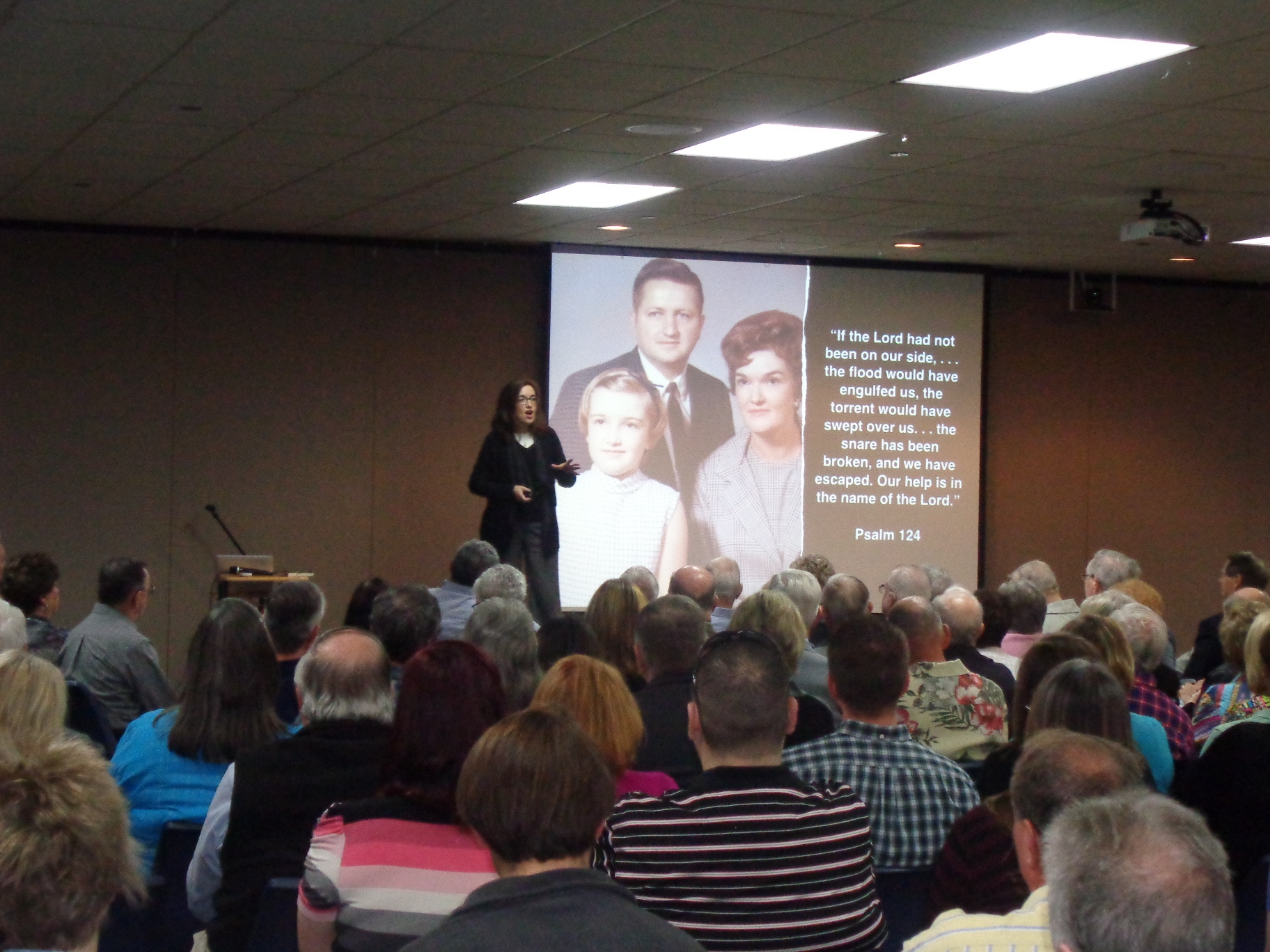
SallyGaryMugSally Gary, the founder and director of CenterPeace, was kind enough to give up her weekend to spend parts of three days with our church family here in Amarillo. Sally’s ministry is devoted to making churches and families safe places to have these conversations about homosexuality. And having her here to talk to and to process with was a terrific help. Sally spent three hours Friday night with some of our leadership and five Central couples who are dealing with same-sex issues in their families. Blessing them. Listening to them. Loving them. Encouraging them. And showing us how to do it. She spent nearly four hours with our entire leadership Saturday morning walking us through her story, challenging us to “keep the conversation going,” to “keep the doors of communication open,” and to remind people that God loves them. Then today she spoke to nearly 500 members of our church, imploring us to make Central a safe place to talk, reminding us that there are people in our congregation, young people probably, who have questions, who are struggling, who desperately need somebody to talk to. Again, the world is ready to talk. God’s Church needs to be just as ready.

It’s very, very easy for me to get to a place pretty quickly where I’ve got everything figured out. I have all the information, I know what we’re supposed to do, I know the strategy and the course of action, and here we go. And then I have a two hour lunch with a young person struggling with sexual identity or a long phone conversation with a friend whose daughter has come out as gay or a weekend with Sally Gary. And I don’t know what to do. I don’t know what God wants us to do. I don’t have any answers really at all. I’m only convinced for sure that all men and women are created by God in his holy image, that he loves them dearly, and that Jesus died for them all and was raised for them all. And that I’m supposed to love all people. I’m supposed to engage all people with his mercy and grace. His Church is called to show his love to all people. And church should be a safe place for us to talk about anything. We ought to be able to talk and pray together about difficult things and still feel very protected and very safe. And deeply loved. Those are the things I know. And that’s about all I know for sure.

I’m grateful to Sally for the weekend we’ve just had at Central. We all pray for her God’s richest blessings of boldness and courage, strength and peace. And I’m grateful to God for our elders and ministers at Central who are leading us through this conversation. May God’s holy will be done in and through this church just as it is in heaven. And may we be faithful to him, may we reflect his glory, as we pursue the conversation.

Peace,

Allan

Happy 180th!

TexasFlagDetailBetterOn March 2, 1836 — that’s 180 years ago today — fifty-nine courageous pioneers signed the Texas Declaration of Independence, forming forever the great Republic of Texas. I’d like to invite you to celebrate this Texas Independence Day with your favorite plate of barbecue or tacos, listen to your favorite Willie Nelson or ZZ Top album, and praise God you weren’t born in Arkansas or West Virginia or some other awful place like Oklahoma.

I’d also like to ask you a question: Do you know our state song? Do you know the title? Do you know the lyrics?

If you immediately answered “Texas, Our Texas,” give yourself a pat on the back. If you can sing the song with all the right words in the right order, then give yourself a standing ovation and use what’s left of your lunch hour to design and print an official-looking certificate to honor your achievement. Up until last weekend, I wouldn’t have thought that knowing and being able to sing on demand our official state song was any kind of special accomplishment for anyone born and raised in our great state. But a troubling article in the current Texas Monthly brought that assumption into serious doubt.

TexasOurTexasChristian Wallace has written an informative and highly entertaining piece on the colorful history of our state song. His premise is a provocative one: our state song is a terrible song. No one knows it, no one remembers it, and no one ever sings it. Our state is too great to have such an awful state song. While Wallace makes a decent argument, I was most struck by his initial evidentiary proof. He claims to have conducted many informal surveys among friends and neighbors, passersby and strangers, and the overwhelming majority of them are unable to name our state song. Nobody can sing it.

I was offended by the very notion. Why, we sang it regularly in elementary school choirs and special programs and learned it again in 7th grade Texas History class. It’s our song! While driving back and forth across the Red River for a variety of reasons during my teenage years, I never failed to turn the radio down so I could belt out “Texas, Our Texas” as I crossed the border. “All hail the mighty state! So wonderful, so great!” Didn’t everybody do this?

Apparently not. I’ve conducted my own informal surveys this week with friends and co-workers, cashiers and waiters and passersby. Nobody knows our state song. A lot of people guess “Yellow Rose of Texas.” One lady argued with me about “The Eyes of Texas.” Some folks wrinkled up their faces and said, “We have a state song?” It pains me to say that Wallace is on to something.

I highly recommend his article. You can get to it by clicking here.

~~~~~~~~~~~~~~~~~~~~~~~~~~~

KeithSermonSeminar2013Today is also my brother Keith’s birthday. He’s not 180. And I don’t think he has his own song. If he does, it might be “The Rover” from Led Zeppelin’s Physical Graffiti. If you wanted to celebrate his birthday, you might watch Naked Gun tonight, careful to skip past the scene on the ledge and to watch the balls and strikes scene at least twice.

Keith is an outstanding theological thinker, faithful follower of our Lord, and devoted servant of God’s Church. His article “Restorationism and Church History: Strange Bedfellows?” from the Christian Studies journal he edits is a classic work on the complicated relationship between Churches of Christ and the whole of pre-restoration church history. I highly recommend it, too. He takes head-on our Cambellite creed of “nothing not as old as the New Testament” and introduces us to the concept of “retrieval theology” that seems very helpful:

“This is not a call to re-create or ape the faith and practice of a specific time or place from the past; not every thought or practice in church history is equally good or relevant for us. It means learning from the wisdom of our ancestors and appropriating the best that it has to offer for the sake of the church today.”

You can get to it by clicking here: KeithStanglinRestorationism

Happy Birthday, Keith. I’m very proud of you and very honored to be your brother.

Peace,

Allan

Repent and Believe the Gospel

AshWednesdayThis post is mainly for all of us Church of Christ lifers. We know “separate and apart,” we know Acts 2:38, we know “the church is not the building, it’s the people,” we know 728B. We’ve got the stamp on our heels. Three songs and a prayer. “Guide, guard, and direct us.” We know who we are.

And we’re uncomfortable with liturgy.

It’s nothing to be ashamed of. We come by it naturally. Our movement has traditionally and, largely, uncritically rejected almost all forms of Christian liturgy as symbols of religious excess and tools for clerical abuse. As non-scriptural innovations. As rote formulas and meaningless ritual. Most of us can’t help the way a memorized creed or a written prayer makes us feel. We were raised to believe it wasn’t real, it didn’t come from the heart, unless you made it up on the spot.

Let me invite you to participate in an Ash Wednesday service somewhere today.

Ash Wednesday marks the first day of Lent, the season of repentance and prayer and fasting before Easter. In the early decades of Christianity, this 40-day period was observed by candidates for baptism, which was typically reserved for Easter Sunday. In the third and fourth centuries, people who were separated from the Church because of their sin observed a season of Lent as they were restored to fellowship. Then, over time, the Church recognized that it would be good for all Christians to enter a time of repentance and prayer and fasting. All Christians need to be reminded that repentance is a daily exercise, not a one time event. All Christians need the assurance of the forgiveness and salvation that is promised in the Good News, that was accomplished in the life, death, and resurrection of our Lord Jesus.

So, I would encourage you to find an Ash Wednesday service somewhere today and go.

It might be a brand new thing for you. It might be a little strange. It might be really beautiful. You might learn something, you might see something, you might hear something or experience something that might really bless you and increase your faith.

The ashes on your forehead are a physical reminder of the Gospel: God created us out of his great love, we have sinned and fallen short of his glory, we are in desperate need of forgiveness and salvation, he forgives us and restores us through Christ Jesus our Lord. The ashes remind us that we are human — we are made of dust and to dust we will return — and that we need God. They also serve as a symbol of sorrow for sin and repentance. And they acknowledge that the once-for-all sacrifice of Christ Jesus surpasses in glory the burnt offerings made by the priests. That’s why when the pastor puts the ashes on your forehead he says, “Repent and believe the Gospel.”

Go find an Ash Wednesday service. Go with a group of people so you can process it together afterward. Ask God to speak to you during that service, to reveal himself to you, to grow your faith in him, and to strengthen the bond you have with all disciples of Christ throughout all Christian denominations. As you leave the assembly in silence, be resolved to remain in the Word, to continually self-reflect, and to be in constant prayer.

Nothing will be off the cuff. It will all be carefully scripted. And maybe, just maybe, by God’s grace and the power of his Spirit, it might be exactly what you need.

Peace,

Allan

« Older posts Newer posts »