Category: Bible (Page 2 of 10)

Bible Reading Plan

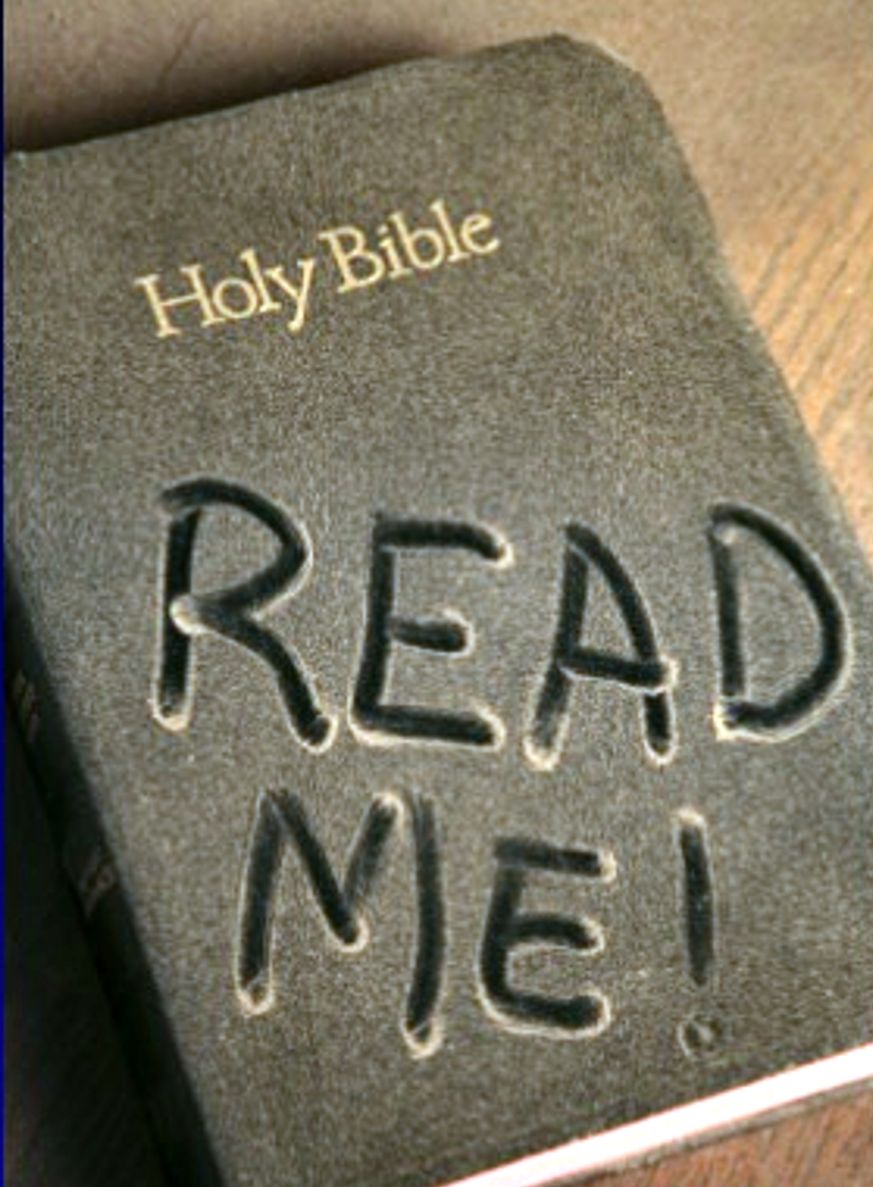
I’m convinced most of us don’t read our Bibles. I think we believe the Bible is God’s Word, I think we believe the Bible is our authority, I think we believe our lives are better when we read the Bible, but I don’t think we really read it. I think it just sits there.

Am I wrong? Man, I hope I’m wrong.

Let’s say you are reading your Bible. Everybody’s reading the Bible.

I’m reading the Bible every day. I’ve got this plan.
I read the whole Bible every year, front to back. I follow this program.

Most of us can read the Bible. It’s not that hard. If you don’t have a Bible and you can’t afford to buy one, you can get a free one at any hotel or hospital. I can’t speak for the Gideons as an organization, but I don’t think they care–just take it! Also, anybody at any church will happily give you a Bible.

It’s not that we don’t own Bibles. It’s not even that we don’t read our Bibles. It’s not that we don’t believe the Bible is the holy Word of God–we do! The problem is that we don’t read the Bible formatively. We don’t read the Bible in order to live. We mostly read it for information instead of transformation.

We are surrounded by words. Our society is drenched in words. We are word-saturated. But most of the words we read morning, noon, and night have no impact on our lives. They don’t change anything. Grocery lists, newspapers, energy prices, text books, Facebook and Twitter, novels and magazines, owners manuals, menus and billboards and the continual crawl at the bottom of the screen–we’re constantly reading. But whether it’s a Texas meme or a Washington tweet or a story about a kidnapping in Wyoming, it doesn’t really change our day-to-day lives.

There’s a temptation to read the Bible the same way you read an email from work. Especially when you download the Bible onto your phone, there’s a real danger to read the Bible like you read the internet. We read it for information, to gain knowledge. We read it for entertainment, to laugh or to kill time. We read it for inspiration, to find something to get me through a tough spot or encourage me to achieve my goals. We read it out of desperation, when we’ve got nowhere else to turn. Or we read it out of determination, to check that box on my Christian disciplines or New Year’s resolution list. We can’t read the Bible the same way we read a cookbook or a James Patterson novel. It’s different.

What if, in 2025, instead of reading the whole Bible from Genesis through Revelation, you hunkered down in ten core passages? What if you identified ten foundational Scriptures that speak to the most important things: the nature of our God, his mission, your holy purpose, God’s grace, Christ’s love, the Holy Spirit’s power, the ways we should treat each other and think about the world. What if you camped out on those ten passages for the whole year and really got them inside your soul? Memorize them, meditate on them, pray them, journal them, recite them out loud. Instead of every word of the Bible rushing by you this year, what if you dug down deep into ten core passages until they became a part of you?

What would those ten passages be? How would you identify them? How might our God change you this year if you committed to this very different way of engaging his Word?

~~~~~~~~~~

IF Texas commits zero turnovers…

IF the Longhorns commit fewer than six penalties…

IF Texas scores first…

IF Wisner and Blue combine for 130+ yards rushing…

IF the ‘Horns defense holds Jeremiah Smith to under 110 yards receiving…

THEN Texas will beat Ohio State tonight and advance to the national championship game.

I really believe all five of those things must happen if the Longhorns are going to hang with the Buckeyes tonight. If even one of those five things doesn’t happen, they’re toast. That means not one single fumble or interception, and no turning the ball over on downs, going for it on fourth down and not making it–that counts as a turnover. It means Quinn Ewers can’t throw the ball 35 times; Texas must control things in the trenches with the run. That means the ‘Horns must play a perfect game, the best and most complete game from start to finish they’ve played all season.

Hook ‘Em!

Allan

No End in Sight

“Happy Holy Week! Let’s make America pray again!”

I suppose I’ll never get numb to it. I’ll never cease to be amazed by it. My stomach will continue to drop into my socks in despair every time. Over and over and over again.

When Donald Trump declared eight years ago that his supporters were so loyal to him that he could murder a man in cold blood in broad daylight in the middle of 5th Avenue and not lose a single vote, he was right. Amazingly, he was right. So incredibly insightful. He knew.

That single theory has been tested time and time again to the point that now it is absolute and undeniable truth. There is nothing that man can do–no crime he can commit, no person or group of people he can insult, no lie he can tell–that would cause his supporters to abandon him. If he shot a man in the middle of New York City’s busiest street, his supporters would claim political persecution and rise to his defense. That much we know. It’s been proven.

The fact that the overwhelming majority of his supporters are Christians is what I still cannot believe. I’m still surprised every time. I’m baffled by it. And dismayed.

Today, the cash-strapped ex-President is selling the “God Bless America” Bible for $59.99 plus shipping and handling. The Bible is a King James Version copy of our Holy Scriptures that comes complete with the United States Constitution, the United States Declaration of Independence, the U.S. Bill of Rights, and the Pledge of Allegiance. The holy words of our God and our Lord Jesus sandwiched in-between the founding documents of a worldly nation. The Bill of Rights literally bound together with Christ’s denial of his own rights. Jesus’ statement that his Kingdom is not of this world in the same book now as a pledge of allegiance to a rival kingdom. The Church’s Scriptures literally wrapped in a brown leather American flag.

We are told on the website: “This is the only Bible endorsed by President Trump!”

We crossed the line a long time ago and now there is no end in site. The fact that there is a market for this Bible is deeply disturbing to me. We have compromised our Christian principles, diluted our Christian doctrines, and sacrificed our Christian witness for worldly power and control.

Lord, have mercy on us.

Allan

Take and Read

According to American Bible Society surveys, the number of Americans who read their Bibles is dropping dramatically. From 2011 to 2021, roughly 50-percent of Americans reported opening Scripture at least three times a year every year during that period. But, last year that number dropped to 39-percent. In other words, in the middle of domestic threats to this country’s democracy, threats of nuclear war in the Russia-Ukraine conflict, record inflation, and unprecedented gun violence, about 26-million Americans stopped reading the Bible.

Of the 39-percent who reported reading the Bible at least three times last year, only 27-percent read the Bible in print — a real Bible with two covers and paper pages that turn and crinkle. Nineteen-percent reported reading the Bible on an app on their phones, 18-percent online, and the other 11-percent listen to the Word on a podcast.

I find that data to be disturbing.

I’m also troubled to see new Ipsos research that shows Christians don’t know the teachings of our Lord. In response to the question, “Did Jesus teach people to turn the other cheek?” less than half of those who claim to follow Jesus said, “Yes.”

Evangelicals – 49%
Catholics – 29%
Mainline Protestants – 40%
Other Protestants – 51%

Those of us in the Churches of Christ would fit into that “other protestants” category so, yay, we win with just barely half of us knowing one of our Lord’s most fundamental teachings.

Please read the Bible. Please schedule the time every single day to read God’s Word. Please read it out loud in your home with your children and grandchildren. Be transformed by the holy words of Scripture. Let the ancient words sink into your soul and become a part of you. We are rapidly becoming biblically and doctrinally illiterate. We’re not sure what we believe and we certainly don’t know how to articulate it. Our God has saved us in Christ Jesus and called us to obey all that he commanded and to teach others all that he commanded. How are we going to live into that when we don’t read the Bible?

~~~~~~~~~~~~~~~~~~

The waterfall at Eagle Creek has evidently dried up for the season. My two mile hike to the site and back wasn’t without its pleasures — a mama deer and her two little spotted fawns, dozens of tiny and very colorful song birds whipping through the trees and brush, squirrels and some kind of chipmunk-ish things scurrying around. But I wanted to see the waterfall. Another time, maybe.

Today, I’m reading the Gospel of John out loud and trying to finish a manuscript I’ve been working on for almost four years. I had intended to also read Timothy Keller’s “Forgive” while I was in Ruidoso this week, but I’m not sure I’m going to get to it.

Peace,

Allan

Read Your Bible

You know how the COVID pandemic didn’t cause race relations to deteriorate or Christians to stop going to church or this nation’s politics to irreversibly polarize or the culture to sink into depression or the world to go off the rails, it just sped up the process of what was already happening? It’s happened with our Bible reading, too. Or, I should say, it’s happening. It’s been happening consistently for quite some time. And now it’s happened even faster.

According to the American Bible Society, roughly 50-percent of all American adults reported opening Scripture at least three times a year every single year between 2011 and 2021. Half the country’s population was reading the Bible at least three times a year. For more than a decade, that number didn’t really fluctuate. Until 2022. The number dropped dramatically last year to 39-percent.

That means about 26-million Americans who had always read their Bibles stopped reading the Bible last year.

According to the same research, more than half of all U.S. residents say they wish they read the Bible more. If you are one of those people who don’t read the Bible anymore, may I encourage you to pick it up? Today?

The Bible is the one true eternal Story of God through which we view the untruths of the culture and the world that’s eating us up alive. The Bible reminds us of who we are and to whom we belong, who’s really in control, and where all this is ultimately headed. Spending time in the Story, hearing the Voice, ingesting the Way, the Truth, and the Life into our hearts and minds and souls, helps us keep things straight.

Start with a Gospel and read it out loud. I would suggest beginning with Mark or John. Read it out loud between now and Sunday. Two or three times each day, two or three chapters out loud each time, so that you’ve read one  of the Gospels out loud before the end of the week. Do that with all four Gospels over the next month and feel God’s Spirit changing you. Hear the Voice of the Lord speaking directly into your heart. Experience the Truth getting inside your blood and bones. Embrace the peace that surpasses all understanding.

Read your Bible. I know you want to. So just do it.

Peace,

Allan

Accurate Interpretation

I need to offer a disclaimer as we make this shift from viewing the Bible primarily as a collection of God’s commands to reading and understanding the Bible more as the Story of God. This narrative lens is not going to suddenly give us easy answers to all the issues. We’ll actually find there are fewer rules, the lines are not as black and white, and it leads to more questions and more wrestling and more reflection. It’s not a system. It’s not an owners manual. It’s much more art than science. It can be messy. But I believe understanding the Scriptures as a broad, sweeping, epic story of who God is and what he is doing will help us better connect the dots in the Bible, make us better able to see ourselves in the drama so we can play our parts and say our lines, and enable us to more accurately interpret God’s will.

“All Scripture is God-breathed and is useful for teaching, rebuking, correcting, and training in righteousness, so that the child of God may be thoroughly equipped for every good work.” ~2 Timothy 3:16-17

A lot of us have taken passages like the above and developed a theology about the Bible, but not a biblical theology.

We’ll read Jonah and spend four weeks researching whether a human can live inside a fish for three days and never once think about God. The story is about God and what he is doing, not about the whale and what he or she can or cannot do.

We’ll argue about Paul’s words concerning divorce and remarriage and look for legal loopholes instead of dwelling on the covenant loyalty of our God who intends our marriages to reflect and witness to his perfect love and faithfulness.

Esther is not about “you need to be more courageous.” If that’s the point of Esther, it may as well be “you need to be prettier,” too. The point of Esther is that our God is at work to redeem everything and he uses every opportunity – even our darkest moments in exile when we feel weak and powerless and trapped in circumstances beyond our control – to save us and redeem us. We are not forgotten. We are never out of God’s reach or too far away from his salvation. That’s the story.

For a long time, we have read and studied the Bible looking for commands, examples, and necessary inferences. We no longer assume that this method works consistently, if at all, or if it’s even healthy. Does anybody really believe that in the grand, sweeping narrative of Scripture, the strange fire of Nadab and Abihu belongs in a central and controlling place? Reading the Bible as a book of laws to be obeyed or as a constitution to be defended is what led to some Christians affirming that slavery must be okay because the Bible doesn’t explicitly prohibit it.

Reading the Bible as a system of laws, people take every single verse that mentions slavery and notice that none of the verses condemns slavery as sinful or prohibitive. God didn’t say it’s a sin, so it must be alright as long as you don’t violate your conscience. Yes, Christians have done this in the past, and some Christians still do. Yes.

Reading the Bible as the story of who God is and what he’s  doing in Jesus Christ makes it obviously clear that all women and men are created equal in the image of God and that all people belong to each other as complete equals. Slavery is a result of the Fall; it’s sin. Jesus destroyed all the barriers between people at the cross. In Christ, there is no slave or free, male or female, Jew or Greek – we are one and slavery is a reprehensible evil.

That’s the difference. What’s the story?

The beatitudes are not telling us to be better peacemakers or to grow in humility. It’s not that you have to develop these virtues in order to receive the blessings. Why do we try to make mourning/weeping sound good or desirable? Well, it’s mourning over sin, right? I don’t know, the text doesn’t say that. The point of the beatitudes is to express how radically present the Kingdom of God is, even and especially among those who are grieving. People in their brokenness and grief often feel like they’re left out of God’s blessings. But Jesus is telling us, “No! God’s Kingdom is bigger and better than we ever dreamed. And it’s here right now!”

What God is doing is a story. It’s a narrative. When we see the pattern of God’s Kingdom in Creation and how it went wrong, when we understand how everything God is doing through Jesus Christ is to restore our righteous relationships with him, with one another, and with all of nature, we can much more easily, consistently, and accurately interpret his will and purposes for us.

Peace,

Allan

Identity

According to the Bible, knowledge means knowing who God is and what he is doing through Jesus Christ. That knowledge, according to the Bible, leads to relationship, transformation, and mission. But most of the time, we’re primarily reading the Bible for information. We study words and the original languages behind them, we consult sources and resources for understanding the historical context, we dive deep into a fragment of a sentence and don’t come up for air until we’ve discerned the color of ink Luke used when he wrote Acts. And we don’t consider relationship, transformation, or mission.

Understanding the Bible as the Story of God will help us better connect the dots in Scripture, as observed in our last post. And it’ll  help us more easily identify with and see ourselves in the narrative.

Seeing the Scriptures as one grand, sweeping, epic story makes it easier to see ourselves in the narrative. We’re better able to place ourselves in the plot and play our parts and say our lines. We get this from inside the Bible itself, from the rich heritage of God’s people who lived and wrote and faithfully passed on the holy Scriptures.

Twelve generations after the crossing of the Red Sea, God’s people are saying, “Lord, you brought us out of Egypt!” Well, no, your grandparents and great-grandparents weren’t even alive when that happened. You never crossed the Red Sea. Oh, yes, we did; we did cross the Red Sea. We’re in this story.

In Daniel 9, the prophet is confessing sins that his ancestors committed decades before he was born. “We have sinned and done wrong; we have been wicked and rebelled!” No, Daniel, that wasn’t you. You don’t need to confess sins for which you are not personally responsible. Wrong answer. It is me. I did commit these sins. I’m in this story.

This is what the Bible does. It invites you to see yourself. It puts you in the Story.

“We thank God for you, brothers and sisters loved by the Lord, because God chose you as firstfruits to be saved through the sanctifying work of the Spirit and through belief in the truth. He called you to this through the Gospel, that you might share in the glory of our Lord Jesus Christ.” ~2 Thessalonians 2:13-14

The way you see other people and the way you understand the world and respond to what’s happening around you depends on the story you’re living.

You can go to a high school football game and sit by five people on the same bleacher and hear five different views of the same game depending on the role they play in the story they’re living. A scout looking at next week’s opponent says, “We’ve got to play zone against these guys; they’re fast.” A member of the board that owns the stadium thinks, “Four thousand people here, ten dollars per ticket, nachos are six bucks and Cokes are three dollars – we’ve got to figure out how to host a couple of playoff games when the season’s over.” The running back’s mom groans, “Don’t give him the ball; I don’t want him to get hurt.” The running back’s dad says, “Give him the ball! He needs more carries or he’s going to wind up at Texas A&M Commerce!” The running back’s English teacher marvels, “How can that kid memorize an 85-page playbook, yet forget to turn in his essay?”

Knowing the Story and understanding who you are in the Story informs and shapes how you see the game, how you respond to what’s happening on the field, and how you might act or speak to move the plot along and accomplish the purpose of the drama. Your identity is forged by the Story you live and the part you see yourself playing. God’s great Story is our Story.

Jesus says, “You didn’t choose me; I chose you.” The Bible says, “You are no longer foreigners and aliens, but fellow citizens of God’s people and members of God’s household.”

“You are a chosen people, a royal priesthood, a holy nation, God’s special possession, that you may declare the praises of him who called you out of darkness and into his wonderful light. Once you were not a people; but now you are the people of God!” ~1 Peter 2:9-10

Understanding the Story of God helps us bring more purpose and order to our lives and experiences. What is God doing in the world? Where is all this headed? And where are we – where am I – in this Story? Well, you are the light of the world. You bear the holy image of the Lord. You are ambassadors for Christ.

A system of laws and commands compels us to obey and comply. A Story invites us into relationship and mission. Reading the Bible primarily as lists and rules doesn’t foster the intent of God’s revelation in Scripture: to draw us into loving community and partnership with him. Viewing the Bible as God’s Story invites us to join.

Peace,

Allan

« Older posts Newer posts »