Category: Psalms (Page 7 of 14)

Very Good

CreationGodWe’ve spent this week looking at the inspiring beauty of Act One of the Story of God, the Pattern of the Kingdom the Creator establishes: God and mankind living in perfect harmony together, ruling and reigning together over a perfectly wonderful heavens and earth. Act One is good. It is “very good.” It’s an eternal blueprint for everything God is doing.

Now, today we don’t live in Act One. It’s long past. But what Act One tells us has important meaning for all people right now. In the beginning God created. That doesn’t just mean back there and back then. The Story says not only that God was Creator but that God is Creator! God’s creative activity is not limited to the distant past. It’s not like a long time ago God did everything he planned to do and then retreated from the scene to let the world run by itself.

Romans 4 tells us that even now, today, our God gives life to the dead and calls things into existence that do not exist. 2 Corinthians 5 declares that right now, today, we are a new creation in Christ Jesus our Lord. When we confess that God is the Creator, we are saying that God is continuously making new beginnings, opening up new possibilities, initiating new events. God is our Creator. And he is doing new things in our lives.

The psalmist did not say, “God created Adam and Eve a long time ago and we’re all descended from them.” He said, “You knit me together in my mother’s womb.” Read that again. You’ve heard it dozens of times. Read it again.

“You knit me together in my mother’s womb.”

We know the facts of life. We know where babies come from. But we also know that the process of procreation and gestation and giving birth don’t tell us the whole truth about where we came from, who we are, and where we’re going. We believe that God the Creator stands at the beginning of every single human life and goes with us on every single step of our own ways.

Your life might be formless and empty. Chaos. Darkness. Void. It can be obvious darkness and chaos like addiction or abuse or violence or disease. Or it could be a chaos underneath the surface, a chaos of the heart that’s hidden from almost everybody.

Jeremiah 31 says, “The Lord will create a new thing!” Our God, the Creator of “very good” things, can speak light and life into that darkness and void. He made you in his image. He made you “very good.” And his desire to live in a righteous relationship with you means he came here in Christ Jesus to make it happen. He’s committed to it. Your story, whatever it looks like to this point, is being written by a powerful and loving Creator who is devoted to your “very good.”

“Be glad and rejoice forever in what I will create!” ~Isaiah 65:18

Peace,

Allan

God Wants to Live with Us

CreationGod

In the Creation accounts, we see God forming a “very good” environment for the people he’s creating and for himself. He creates the heavens and the earth, he furnishes it, he puts people in it, and then God rests.

“By the seventh day God had finished the work he had been doing; so on the seventh day he rested from all his work.” ~Genesis 2:2

God establishes the heavens and the earth, his creation, as his holy dwelling place.

“This is what the Lord says: ‘Heaven is my throne, and the earth is my footstool… Where will my resting place be? Has not my hand made all these things, and so they came into being?’ declares the Lord.” ~Isaiah 66:1-2

Notice the “resting place,” the place where God “rests.” It’s the same language as in Genesis. The heavens and the earth is where God lives and where he rules. And where he rests.

“He stretches out the heavens like a tent and lays the beams of his upper chambers on their waters.” ~Psalm 104:2-3

God rests, he settles among his creation. When the Old Testament speaks about God’s resting place, it uses the earth and the temple interchangeably.

“He built his sanctuary like the heights, like the earth that he established forever.” ~Psalm 78:69

“This is my resting place for ever and ever; here I will sit enthroned, for I have desired it.” ~Psalm 132:14

God wants to live on this earth with us. That’s the pattern of his Kingdom.

Come into this world I created, come into the place where I live and reign and rule. Come live with me. Reign with me. Let’s dwell together in mutual free-will relationships of love and life. Let’s oversee this “very good” place together. Let’s live in the face-to-face presence of one another forever.

God is not in conflict with humans. Act One shows us God linking arms and linking futures with men and women. He and the human image-bearers are in perfect harmony. That’s the way it was established in the beginning.

Notice the six days of creation all have an evening and a morning. Those days all have an ending. But not the seventh day. The day God takes up residency in his created world with his created people, that day never ends. It’s still going. God with us. It doesn’t end. He designed all of it so we would live together forever.

That’s the pattern for the Kingdom. And it’s good. It’s “very good.” It’s the eternal blueprint for everything that God is doing. Creation makes everything else in the Story make sense.

Peace,

Allan

All of Creation is Good

CreationBeginning2“God saw all that he had made, and it was very good.” ~Genesis 1:31

We look around today and a lot of us say, “The world now is worse than it’s ever been.” And I want to say, “What’s your frame of reference? What’s your standard? Ever heard of the Middle Ages? Today is not that bad.”

It is true that we rebel against our Creator and we misuse God’s Creation and we make ourselves and others around us miserable because of our rebellion. But there is nothing in the Story and nothing in our theology that says God’s Creation has become a bad Creation. The evil that invades God’s Creation is not stronger than the Creator. It can never change the essential goodness of what God created. Despite everything that spoils and corrupts it, we live in a very good world and it is very good to be alive today in it.

We affirm the goodness of the world, not because we’re optimistic about people or because we’re ignoring all the injustice and suffering. We are well aware that because of human wisdom we endure wave after wave of hopelessness and despair. What humans consider progress has resulted in the brutality of modern wars, the suffering and oppression of minorities, the ever-widening gap between the few rich and comfortable and the many poor and helpless. But we don’t give up on it. We don’t withdraw from it. We’re not trying to leave it. We affirm the world because God created it and he says “Yes” to it.

“The earth is the Lord’s, and everything in it, the world, and all who live in it.” ~Psalm 24:1

The Creation belongs to God. It’s his. He made it and he owns it. All of it. It’s his property. That’s why when evil comes in and seems to take over, God doesn’t abandon the world and turn away from it. He comes here in flesh and blood to suffer with it and for it. It’s good, it’s all good; and he’s committed to it. In the death and resurrection of Jesus, God reclaims what’s always belonged to him and asserts forever his powerful and loving lordship over the world, for the sake of the world.

To try to escape this world or our worldly responsibilities would be to try to escape from God. Focusing on some kind of future in the sky and not paying attention to our present and future world is not living in step with the Story. God promises not only a new heaven, but a new earth.

All of Creation is good. Right now. Today and forever.

We look around and say, “I don’t know…” and we wring our hands. God looks around and says, “I do know!” And we align our minds and our wills to his.

Peace,

Allan

Confession at the Cross

Beware of exploring the spiritual disciplines. Practicing the traditional disciplines will force you to confront your sins. I know this first hand. Silence before God or a prolonged meditation on a Psalm tends to bring out the honest truth of your relationship with the Father. Fair warning. There’s no hiding it when you’re in that place with our God.

Yesterday at Central, we explored a few of the historic spiritual disciplines together. We began with our middle school and high school students reciting a prayer of invocation written by Walter Brueggemann in 1996 and ended with a benediction penned by John Newton in 1779. We prayed the Lord’s Prayer together at the table and we observed two moments of silence around Psalm 32. And we confessed.

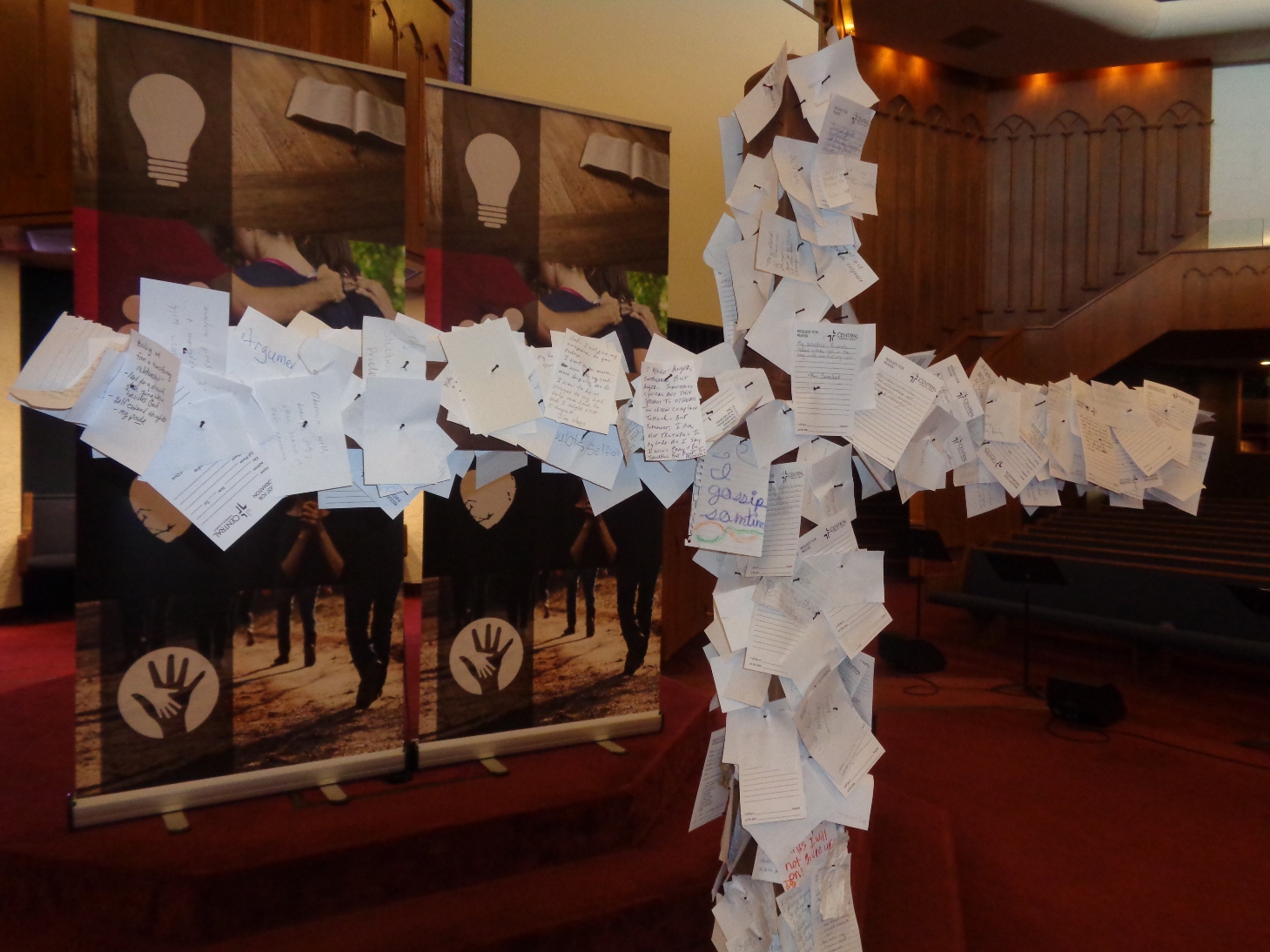
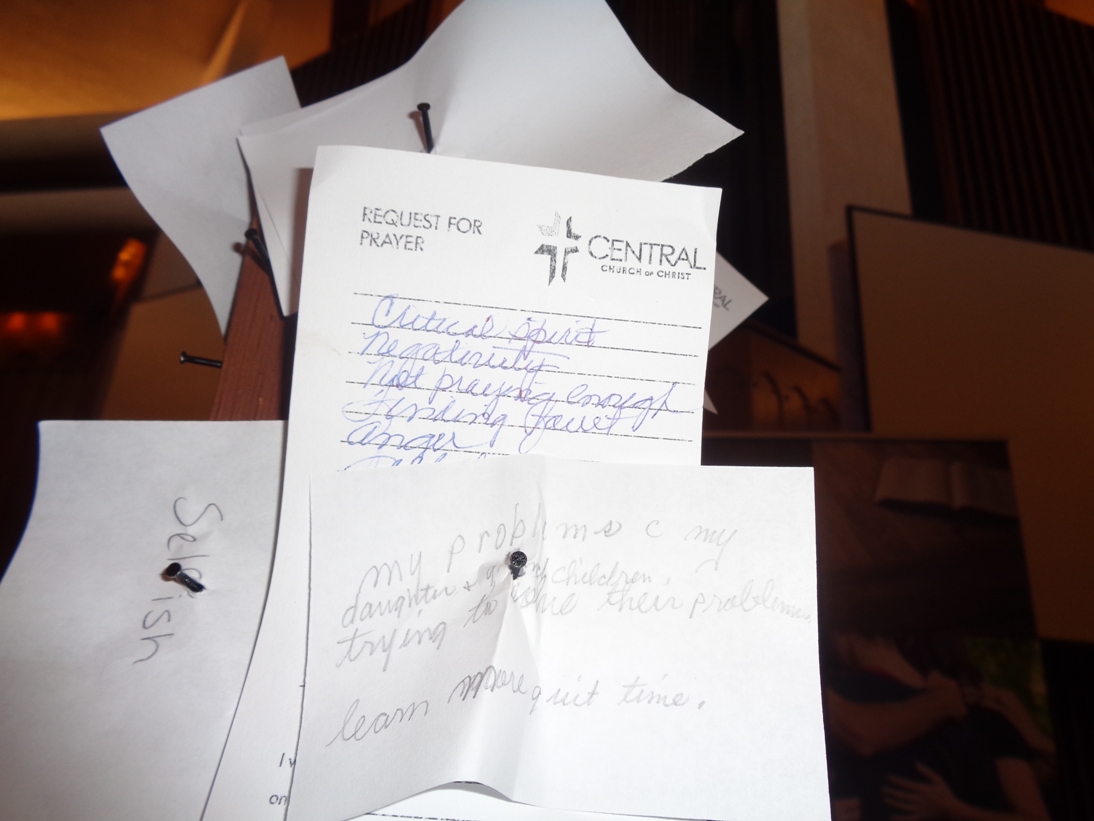
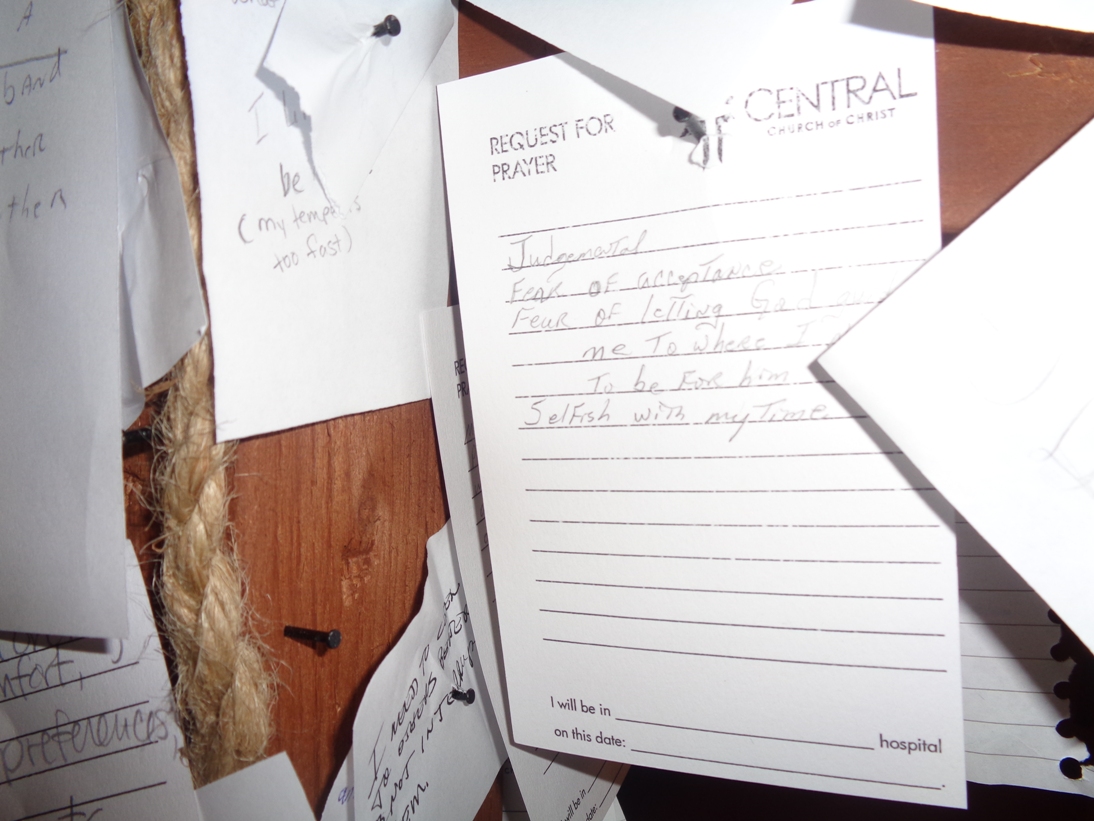
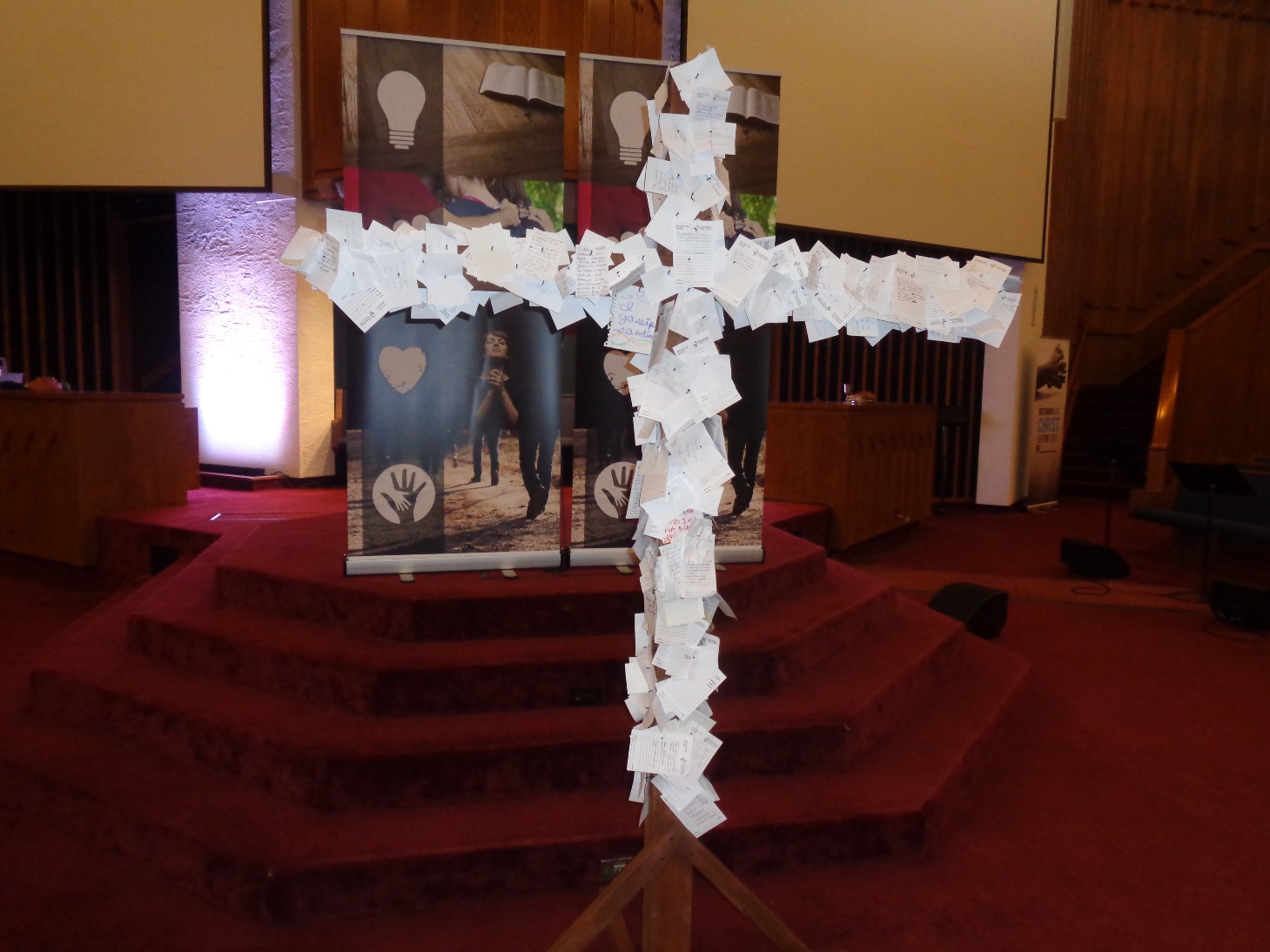
The inner life is about being in a place with God where he can work on you. And as we commit as a church family to pursuing a more holistic discipleship, which includes the traditional disciplines, confession just seemed like a good thing to do. If we’re going to be in that place with God, we’ve got to be up front with him about our sins. So we wrote down on pieces of paper the things that are wrong in our lives that need to be fixed by God, the attitudes of our hearts that need to be redeemed by God, and the situations in our lives that need to be given completely to him. And then we placed them on a large wooden cross at the front of our worship center.


The cross of Christ represents forgiveness and restoration and new life. It stands for a trust in God that he is bringing to completion that thing he has started in us. It reminds us that our Father has promised to make all things right — if things aren’t right in my life, it means that God’s not finished yet, he’s still working. So, after dwelling in Psalm 32 (“I acknowledged my sin to you and did not cover up my iniquity. I said, ‘I will confess my transgressions to the Lord’ – and you forgave the guilt of my sin.”) we brought our sins and our attitudes and our lives to the cross and left them there.

And they’re still in there.


I’ve walked in to our worship center twice already today to spend some time at that cross. I read the confessions, I see the lists of sins and attitudes that plague our people, and I can relate to a bunch of them. Reading the words on that cross today, praying for the people who wrote those words and placed them on the nails on the cross, brings to light sins and attitudes in my own life that I haven’t written down or even acknowledged yet that need to be forgiven and transformed by God.

I don’t ever want us to come into the worship center on a Sunday morning Just As I Am and leave an hour-and-a-half  later Just As I Was. Part of that corporate assembly experience is to be changed by God. Confession is good. Silence is good. Embracing a contemplative posture in the holy presence of God is good. You can’t hide anything when you get into that place with God. And it’s impossible to stay the same.

Peace,

Allan

Knowledge is Yummy

If knowledge is understanding what God is doing, then one of the primary ways we receive this knowledge is through the written Word, the Scriptures. And, according to the Bible itself, that kind of knowledge is delicious.

“How sweet are your words to my taste, sweeter than honey to my mouth!” ~Psalm 119:103

I think the Message translates this, “The Word of the Lord is better than the hot sauce at Abuelo’s!”

So, what do the words of God taste like? Have you ever eaten the Word?

“When your words came, I ate them; they were my joy and my heart’s delight.” ~Jeremiah 15:16

What happens when you eat something? It becomes a part of you. You assimilate it. “You are what you eat” is exactly right. And we know this. If a nursing mother eats fajitas for lunch with jalapenos and pico de gallo and onions and hot sauce, she’s going to be up all night — not because she’s sick, but because her baby is sick! The fajitas have become a part of the mom and so impact what she is delivering to others. You are what you eat. I look in the mirror and I can see the Whataburgers and the cheese tots and potato chips. They’ve become a part of me. The biggest part! Jeremiah says, “When your words came, I ate them. I digested them. I assimilated them. I made them a part of me.”

“‘Eat this scroll I am giving you and fill your stomach with it.’ So I ate it, and it tasted as sweet as honey in my mouth.” ~Ezekiel 3:3

Ezekiel is being called into God’s service. Speak for me to Israel, God says. Tell them my plans. Tell them what I’m doing. Teach my people. Be an example to my people. Here, eat this scroll. My holy will, eat it. Make it a part of you. Be one with it. Fill your belly. Take it all in.

“I took the scroll from the angel’s hand and ate it. It tasted as sweet as honey in my mouth.” ~Revelation 10:10

The apostle John is on the island of Patmos on the Lord’s Day when he sees the giant angel. As the angel begins to speak, John begins taking notes. It’s just like something we would do, right? He wants to get it all down. Information. Content. I want to get this right. And the angel says, “No, don’t write it down. Eat it!”

The words of Scripture are written by the Holy Spirit in a way to get inside us. They’re intended to become a part of us. We don’t learn Scripture. We don’t use the Bible. We eat it. We ingest it. We take it into our lives in such a way that it metabolizes into acts of love, cups of cold water, hospital and prison visits, casseroles and cakes, groceries delivered, comfort and encouragement and evangelism and justice all done in the knowledge of God.

Isaiah says when the Kingdom is finally perfected, when God’s holy will has all been finally fulfilled, there will be righteousness and justice and peace because “the whole world will be full of the knowledge of the Lord” (Isaiah 11:9). The knowledge of God changes us. It changes the world. It changes everything.

When’s the last time you opened up to Deuteronomy or Joshua or Mark or Philippians and your mouth started to water? Do you ever eat the Word? Not for information, but for transformation!

~~~~~~~~~~~~~

It’s a business, that’s all it is. I’ve been convinced for more than 20 years now, the NFL and all its teams are only entities in a vast entertainment enterprise. And I’m as fine with that as I am with the reality of gravity: I know it and I don’t argue about it. Watching a Cowboys game is the same thing as watching a movie. Yes, it’s thousands of times better in a million different ways, but it’s much more like watching a great movie than it is like watching a regional group with all of your same passions and loyalties, your interests and values, compete against another group from somewhere else that represents that region’s people and culture. Yeah, you have a desire for one particular team to defeat the other, but you don’t root so hard as to be ridiculous, right? It’s a TV show! Grown men and women who are affected much more during and after a Cowboys game than they are during and after McFarland USA or Shark Tank seem a bit out of touch to me.

I’m not sure what I would do if I were DeMarco Murray. The NFL’s leading rusher and total yards from scrimmage leader last year is officially now this afternoon signing a free agent contract with the Eagles. I totally understand more money. I get Murray wanting the league-wide respect that apparently comes with the long-term lucrative deal.

But, he’s going from running the ball 25 times per game behind arguably the best and youngest offensive line in the NFL to a place where LeSean McCoy carried only 19 times per game behind a mostly shaky offensive front. Murray will wind up with 90 fewer carries next year behind an inferior line. He won’t get nearly as many opportunities in Chip Kelly’s spread offense — those guys are throwing the ball as soon as they step off the bus. And, besides all that, Murray’s going to have to pay a state income tax up there. Plus, it’s cold in Philadelphia. And the people aren’t nearly as nice as they are down here (mainly because they’re so cold). Is all of that really going to be worth it or is this a really short-sighted move?

Of course, I have no way to know what Jerry Wayne is offering to pay Murray. It may be insulting.

But the first plot line has been written today in the story of the Cowboys 2015 season in the NFC East. We’re off to an entertaining start.

Peace,

Allan

Delight in the Law of the Lord

“Blessed is the man who does not walk in the counsel of the wicked
or stand in the way of sinners
or sit in the seat of mockers.
But his delight is in the law of the Lord,
and on his law he meditates day and night…
For the Lord watches over the way of the righteous,
but the way of the wicked will perish.”
~Psalm 1

The first psalm asserts that how one responds to Scripture, how a person responds to the revelation of God in Torah, will determine that person’s ultimate destiny. When it comes to the Law of the Lord there are two choices, two paths. Moses gives us two paths in his farewell sermon on the mountain and says, “Choose life.” Jesus gives us two paths in his sermon on the mountain and says, “Choose the straight and narrow.” And the psalmist does a similar thing.

By using both positive and negative examples, the psalm encourages us to adopt the fruitful and satisfying life that’s characterized by complete immersion in God and his Word. So immersed in the Word of God, so focuses on the Law of the Lord, that it shapes and dominates your worldview. This is the way of the righteous. And God watches those who walk in that way. By contrast, the one who does not delight in the Law of the Lord is shaped by the counsel of the wicked. He is formed in the way of sinners. Those who walk in this way will perish.

It’s a choice.

God speaks. God reveals. He calls. God makes his holy character and perfect will known through Torah, and what we do with that word is everything. It’s the difference between growing as a fruitful tree and fading away as useless chaff. It’s the difference between well-watered and well-nourished stability and dry, dusty, windblown impermanence. Two choices: the way of the righteous that God oversees and the way of wickedness that leads to destruction. It’s the wise man and the foolish man building their houses in Matthew 7. The only difference between the two men is attention to and obedience to the teachings of Jesus, hearing the Word of the Lord and putting it into practice.

Our God does not reveal himself to be catalogued and studied; he reveals himself to be followed. Our God does not speak to be heard; he speaks to be obeyed.

You ask your daughter to fold the clean towels and put them away in the cabinet (this is purely a hypothetical situation). You come back in twenty minutes and the towels are still in a wad on the couch and the same daughter is sitting in the same spot watching the same TV, only now she’s eating a Pop Tart. And you say to your daughter, “Did you hear me?!?” By that, you don’t mean, “Did the sound waves caused by the vibrations in my tongue and throat penetrate your ear canals to be carried to your brain where they are deciphered into understandable language?” When you say, “Did you hear me?” you’re actually saying, “Why didn’t you obey me?”

To delight in the Law of the Lord, to meditate on it day and night, is to do it. Hearing is doing. Faith is acting.

The Word of God is powerful. It changes lives. It alters destinies. In 1 Thessalonians, Paul acknowledges the Word of God that “is at work in you.” In 2 Timothy, he claims that Scripture equips a man for every good work. Not doctrinal perfection. Not knowledge about facts and patterns. Paul says it leads to action. Hearing is doing. The righteous one delights in the Law of the Lord and meditates on it day and night not to know more. To become more. We don’t learn or study Scripture as much as we ingest it. We assimilate it. We take it into our lives in such a way that it becomes a part of us and it metabolizes into this fruit: acts of love, cups of cold water, prison and hospital visits, cakes baked, groceries delivered, comfort and encouragement, evangelism and justice.

When Samuel was confronted with God’s voice, he replied, “Speak, for your servant is listening.” James says to not just hear the Word, but to do it.

“I desire to do your will, O my God; your law is within my heart.” ~Psalm 40:8

Peace,

Allan

« Older posts Newer posts »