Category: Prayer (Page 19 of 29)

Gratitude For The Day

Things are busy. Good gravy, things are busy. We’re flying in and out of Amarillo every week. Looking for and not finding our house up here. Worried about not selling our house in NRH. Registering the kids in their new schools. Packing. Planning. Phone calls. Meetings. Losing things. Oh, my word, our grass is going to die! Cell phones are not allowed at Amarillo High School?!?! Hooray!!! Which mission trip are the girls on this week? What time was I supposed to pick up Carley? Why won’t anybody buy our house?

It’s super easy to lose track of the day. To miss the blessings. In the midst of my busy-ness, it’s easy to be oblivious to the constant and eternal grace of our Father.

G. K. Chesterton’s little poem of gratitude is keeping me grounded at the end of every one of these busy days:

Here dies another day
During which I have had eyes, ears, hands
And the great world round me;
And with tomorrow begins another.
Why am I allowed two?

Be thankful for the day. And keep reminding me, too.

Peace,

Allan

“A Fork in the Road”

Lord, I don’t want to be a mile-marker on the road of life, that as people pass me by, maybe they notice, maybe they don’t. It doesn’t matter. They continue on in the same direction as before.

But I want to be a fork in the road.

So that when people meet me they must decide which way to go. Because when they meet me, they don’t just meet me. They meet the Christ who lives in me.

~Jim Eliot, from The Shadow of the Almighty, 1956

A Den of Robbers

“Is it not written, ‘My house will be called a house of prayer for all nations’? But you have made it ‘a den of robbers.'” ~Mark 11:17

What made Jesus so mad that day at the temple? What riled him to the point of flipping tables and scattering coins and driving out doves and sheep? We generally speculate that pilgrims and travelers were being ripped off. Religious officials were probably cheating worshipers on the exchange rate between their Roman coins and the temple-approved currency. Sellers of cattle and sheep were overcharging and taking advantage of those who had come so far to sacrifice and whose animals had been harmed or blemished in some way along the journey.

Those things may very well be true. And if they were, that would surely upset our Lord. The only problem is that none of those things are attested to in Scripture. We have no scriptural evidence that anybody was being cheated out of money. The Gospels don’t speak or even hint at any economic wrongdoing.

We get the idea, I think, from Jesus’ statement about the temple being turned in to a “den of robbers.” But I believe we’ve missed the point. Jesus is not talking about money or possessions here. He’s quoting the Prophets. And if we go to the passages he quotes, it’s pretty clear what’s got him so angry.

Isaiah 56 is about God’s holy provision for those outside the nation of Israel. God loves the whole world, not just the Jews. And he’s going to take care of them, too. Isaiah 56 promises the “foreigner who has bound himself to the Lord” that he will never be excluded from God’s people. Eunuchs who keep God’s commands will always have a place “within my temple and its walls.” All foreigners who love the Lord:

“these will I bring to my holy mountain
and give them joy in my house of prayer.
Their burnt offerings and sacrifices
will be accepted on my altar;
for my house will be called
a house of prayer for all nations.” ~Isaiah 56:7

God has provided a place at his temple for Gentiles to gather and worship. God has promised covenant to these Gentiles and has sanctified a place for them to participate in the community life of God’s people. Gentiles, too, can experience the glory of God. Gentiles, too, can make sacrifices to God in faith that he will accept the offerings and forgive them of their sins. Gentiles, too, have a place in the Kingdom of God.

But it’s in these very temple courts — the Gentile courts, the Court of the Gentiles — where religious leaders are setting up shop and selling animals. They would never allow the inner parts of God’s temple to be turned in to a noisy, smelly, chaotic mess. They would never do anything to disrupt the expressions of praise and sacrifice from their own people in their special places. But these Gentiles? Yeah, let’s sell the animals there.

They are interfering with the divine provision of God. They are compromising God’s promises to the world. They’re messing with God’s plan. They’re depriving people of the space God has given them in which to worship. It’s a house of prayer for all nations, not just for people who look like me and talk like me and dress like me and behave like me. It’s not just for people who worship and sing and pray just exactly like us. It’s for everybody!

No wonder Jesus was so angry.

So, what’s it like at your church? Are the Hispanics relegated to an upstairs classroom in the back of the building? And is that classroom cluttered with leftover chairs and three ice chests from the youth trip? Where do the deaf worship in your church? Is it just understood that the homeless and the jobless and the “unchurched” won’t fit in? So nobody really tries?

Forget about the actual physical space for a minute. Do the ones who are not just like us — the new members, the move-ins, the poor, the young people, the old people, the divorced, the minorities — have a forum in your church to express their praise to God? Are they stared at, talked about, isolated, and discouraged from worshiping God? Or are they smiled at, hugged on, sung with, and encouraged to worship? Sometimes our haughtiness and complaints, our snide comments and dirty looks, our letters and threats rob our own brothers and sisters in Christ of their God-sanctioned forum and venue for giving him thanksgiving and praise. As Jesus says in John 2:16, “How dare you!”

“Accept one another, then, just as Christ accepted you, in order to bring praise to God.” ~Romans 15:7

Peace,

Allan

Renew Them In Our Day

“Lord, I have heard of your fame;
I stand in awe of your deeds, O Lord.
Renew them in our day,
in our time make them known.” ~Habakkuk 3:2

I’m still learning how to pray. I read the psalms and I read the prayers of the prophets and I realize I have such a long way to go. In order to pray with the mind of Christ, I must pray the will of the Father. But during my moments of most honest reflection, I admit, I’m usually praying for the will of the preacher.

Habakkuk prays that God’s deeds, not his own deeds or desires, might be renewed. Usually, I’m sorry to say, I’m talking to God about some specific project or idea or initiative and asking him to renew my work. I’m cruising along preaching and ministering and administrating and doing what a good preacher in a good church is supposed to do and everything’s great. But as soon as somebody bumps the table, as soon as there’s a little mess, suddenly prayer becomes very, very important to me. Now I’m really alert to prayer and the deep need for prayer and my intense dependence on prayer.

And I beg God to renew my work. God, fix my preaching. Lord, help our Small Groups. God, would you please revive my Bible class? Lord, build my ministry back up. If I’m not careful, my interest is really on what I’m building and not really on what God may actually want. It’s humbling to admit, and a tough lesson to learn, that quite possibly God’s not nearly as interested in my little stacks of programs and sermons as I am.

God, renew your deeds. Revive your work.

Do a new work, Lord. Don’t just refurbish or clean up what I’m doing. God, create something brand new here, something I haven’t even thought about. Do something I would never dream of, Lord. For your purposes. To your eternal glory, God. May your will be done in my preaching, not mine. May your will be done at Legacy, not mine. Lord, may your will be done in our Small Groups, in our elders’ meetings, and in this community, just like it is in heaven.

Renew your deeds, God. Not mine.

~~~~~~~~~~~~~~~~~~~~~~~~~~~

I’ve added a new link to the list there on the right. This is a blog I read regularly and have been meaning to include on my site for quite a while. I’ve just not taken the time.

John Mark Hicks’ blog, John Mark Hicks Ministries, is a wonderful source for Restoration and Church of Christ history and perspective. John Mark’s is a prophetic voice, speaking God’s Word into the culture and into our churches with spirit and truth. And, as regular readers to my blog know, I’m a huge fan of his research and writings on the Lord’s Supper, baptism, and our corporate worship assemblies. His trilogy of books on those three “sacraments” are among the best written on the topics in decades. “Come to the Table” is arguably the greatest work on communion ever produced by a C of C scholar. OK, I know. All that sounds a little over the top. Sorry. Hicks is good. You’ll like his blog.

Peace,

Allan

After Lent

God’s Church has always observed a period of fasting and prayer in preparation for the celebration of Christ’s Resurrection at Easter. Christian writings from the early third century refer to the mandatory, though not uniform, participation in these spiritual disciplines and place the origins of the practice back to “our forefathers.” Eusebius and others refer to Lent in their fourth century writings. The church councils of that age point to Lent as being established by the Apostles.

The practice of Lent itself cannot be found in the Bible, although Holy Scripture does command and assume regular times of fasting and prayer. So, I can honestly affirm Lent as a noble and faithful and Christian thing to do. Absolutely. No doubt. Some of you reading this blog annually observe Lent. You give up a bad habit, put away a certain vice, abstain from a particular pleasure in order to bring your mind and body into a fuller communion with our Lord.

Praise God! That’s fantastic!

But if Lent is a time to give things up, Easter is the time to take things up.

If Calvary means putting to death things in your life that need killing off so you can flourish as a Christian and as a God-created human being in his image, then Easter should mean planting and watering and training up new things in your life so you can grow in your sacred relationships with God and man. Yes, you have to weed the garden from time to time. We all do. Sometimes that ground cover or those stumps need some serious digging to be eliminated. That’s Lent. But you don’t want to just turn your garden into a neat little bed of blank dirt. Easter is the time to sow new seeds and plant a few bulbs. Resurrection Day is the time to start something new, something that will blossom and fill your world with color and perfume and righteous fruit.

As we celebrate Easter together this Sunday, why don’t you take up something new? Tackle a new task. Enter into a new venture. Start something, commit to something wholesome and fruitful and outgoing and self-giving. You may only be able to do it for 40-days, just like you may only be able to give up Dr Pepper and Little Debbies for the six weeks of Lent. But if you really make a start on it, it might give you a sniff of new possibilities, new hopes, new potentials you never dreamed of.

It might help you wake up in a whole new way. And that’s what Easter is all about.

Peace,

Allan

Watch and Pray

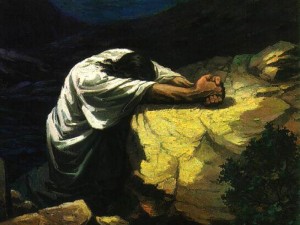
What does Christ want us to see in the Garden of Gethsemane? Why did he tell his disciples to watch and pray? Why did he take them with him that night? Why was it so important that they stay awake?

Jesus makes it very clear that night in the garden: he does not want to die. Jesus is sorrowful and troubled. He’s distressed. He’s in agony. He’s facing the most severe test of his life. God is handing him the cup of suffering and death and asking him to drink it. And Jesus doesn’t want to. He shudders in horror at the mission before him. He dreads all of it. His Father is in the process of making him who had no sin to be sin for us. Jesus is walking through the valley of the shadow of death. And he wants another way. And he asks for it.

What an amazing scene. Jesus is in great agony. He cries out to his God, “Deliver me!” He prays out loud to his Father, “Rescue me!” He begs, “Save me from this horrible assignment. Let’s do this another way.”

No dove descends. No thunderous voice from heaven assures, “This is my Son.” Only silence. Silence. God has already spoken. Now it’s up to the Son to obey.

And he does. “Not my will, but yours be done.” Jesus overcomes the silence, he fights off the temptation to do what he wants and, through open and honest prayer, he obeys his Father.

“Watch and pray.” “Stay here and keep watch with me.”

Jesus tells his disciples, “Do this with me. Experience this with me. Watch me. If you’re really going to follow me, you’re going to need to know how to do this.”

Jesus wants us to be awake and present and obedient to the way of the Son and the will of the Father. He wants us to accept trial. He wants us to undergo testing. He wants us to say “no” to the temptations to abandon the cross aspects of our calling. Afterall, it’s so much easier to turn our backs on the crown of thorns and just go to church. It’s so much easier to just settle into our pews and into the comforts of our status quo and potlucks and baby blessings.

If we’re going to follow Jesus as his loyal subjects — and we are! — then we’re going to follow him into the garden. It’s in the garden with Jesus, praying these agonizing prayers, where we really express our trust in God. We trust God in the darkness of our sufferings because God walked through the darkness himself.

God wants us to be in fellowship with the sufferings of his Son and the sufferings of his world. Fervent and faithful prayer is where God equips us and empowers us to do it. A stiff upper lip isn’t going to do it. A fierce resolve won’t cut it. New Year’s resolutions won’t work. It happens through open and honest prayer; raw, from the heart, transparent communication with the Father.

After a night of agonizing prayer, Jesus is ready. “Shall I not drink the cup the Father has given me?”

Watch and pray.

Peace,

Allan

« Older posts Newer posts »