Category: Matthew (Page 16 of 24)

The Leader as Pauper

I’m re-reading several parts of Norman Shawchuck and Roger Heuser’s book, Leading the Congregation, in advance of our elders / ministers retreat this weekend. I’m especially interested in chapter two: The Interior Attitudes of the Leader. A couple of days ago, I wrote a little bit about childlikeness in our spiritual leaders. Today, let’s consider the church leader as a pauper. A poor person.

“Blessed are the poor in spirit, for theirs is the Kingdom of Heaven.” ~Matthew 5:3

This is the first of the Beatitudes, those ideas and promises at the beginning of Jesus’ “Sermon on the Mount” that are intended to shape our thoughts and lives. Bonhoeffer says it’s not the actual poverty that is the virtue — there’s nothing good about being poor. Instead, it’s the willingness to be poor, it’s the desire to follow Christ at the risk of becoming poor, it’s embracing the call of Jesus knowing that you may very well lose everything. I’m obviously paraphrasing here. But, that’s the virtue. That’s the blessing.

Shawchuck and Heuser put another twist on it. They say that church leaders go into their roles, they accept their mantels of leadership, from a position of poverty. We know that when it comes to leading God’s people, we have nothing. We’re wholly inadequate. We can’t do this; and we know it. Inherent in our call to ministry is the realization that we are not by nature equipped to bear this burden of leadership that God has dropped in our laps. We always embrace our calling as paupers.

Now, personally, this one’s easy for me. I feel completely inadequate every single time I jump in the pulpit to preach. I’m terrified every single Sunday morning. Scared to death. The words of God are too powerful for me. Knowledge of him and his great love for us is too lofty for me to attain. I rarely ever feel like I’ve done our holy God justice. In the words of Augustine, I am saddened that my tongue cannot live up to my heart.

I’m not smart enough to teach these classes I’m supposed to teach. I’m not trained to counsel these brothers and sisters in Christ through their marital problems and addictions and depression. I’m not equipped at all to visit with parents who just lost their teenage daughter to cancer. I’m not able to adequately lead this church staff. I’m not prepared for any of this.

I know what that means to entirely lean on God for my ministry. It’s his; it’s not mine. I couldn’t even begin to do any of this without his power, his strength, his pushing and guiding and equipping. I have no competence on my own; it all belongs to and comes from God. I get that part of it. I understand fully that the apostle is staring right at me when he says, “Consider your own call… not many were wise by human standards, not many were powerful, not many were of noble birth (sorry, dad). But God chose what is foolish… what is weak. God chose what is low and despised in the world” (1 Corinthians 1:26-31).

Humility? Yeah, I guess. It’s the same; but different.

The authors move on to say that being a pauper, being poor in spirit as a church leader, means to actually desire this poor position. To be a faithful leader of God’s people means, in their view, to seek this poverty. Because that’s what our Lord did.

“It is hard to desire littleness and nothingness, obscurity and benign respect, in a world obsessed with possessions and positions. It is hard to choose a pauper’s station when everyone around us is scrambling for upward mobility. The temptation that afflicts us as leaders is not that of monetary wealth. Only a fool would choose a profession in the church if the goal were to become rich. Indeed, the ‘to be rich’ temptations among most clergy are not for money but for admiration, respect, adulation, prestige, and power. These are the riches that must be guarded against, if ever we are to experience the freedom of being poor in spirit. God means this poverty as a gift and blessing, not as a practical joke upon those whom God has chosen as leaders in the church.”

Downward mobility. (Did Nouwen coin that term?) The way of the cross is downward mobility. We empty ourselves of all desire for gain — monetary or otherwise — just like Jesus in order to take on the role of a lowly servant. Like our Lord, we move down to the bottom of the ladder, down the depth chart, giving up all power and position and prestige to seek the good of others.

This world draws hard lines between the winners and losers. We label everything as failure or success. No middle ground. What a difference is God’s way for us! His Word came down to us and lived among us in order to serve us. He became poor so that we, through his poverty, might become rich.

Bishop Walpole is credited with saying to a friend who was considering a call to ministry, “If you are uncertain of which two paths to take, choose the one on which the shadow of the cross falls.” That’s the way and the spirit of poverty, to which our Christ calls every Christian leader.

Peace,

Allan

The Leader as a Little Child

While preparing for our upcoming elders/ministers retreat, I’ve read and re-read several parts of Leading the Congregation by Norman Shawchuck and Roger Heuser. I’m particularly interested in chapter two: The Interior Attitudes of the Leader. I’d like to take the next few days exploring their ideas and reflecting out loud here on what it means for me, personally, and for our churches.

“Truly I tell you, unless you change and become like little children, you will never enter the Kingdom of Heaven. Whoever becomes humble like this child is the greatest in the Kingdom of Heaven.” ~Matthew 18:3-4

Shawchuck and Heuser claim the first and foremost quality of religious or church leadership is childlikeness. The disciples were sincere when they asked their Lord who would be the greatest when the Kingdom was finally realized. Their teaching and learning had, for generations, conditioned them to expect a hierarchy within this new Kingdom structure. The hearts of these disciples were filled with ambition; they wanted a Kingdom that would bring them privilege and honor.

In actuality, Jesus came to usher in an eternal Kingdom in which there is no hierarchy and no superiority. No chain of command, no flow chart, no levels of authority or power. And I’ve got to think this not only surprised the apostles, it probably disappointed them, too. They asked Jesus all the time about their particular ranking in the system. “Who’s the greatest? Who’s going to be in charge?” They couldn’t stop talking about it even during the meal that last night in the upper room. It was there that Jesus proclaimed “You are not to be like that! Instead, the greatest among you should be like the youngest, and the one who rules like the one who serves… I am among you as one who serves” (Luke 22:25-28)

They asked the same question over and over again. And every single time Jesus gave them the same answer: The greatest will be as the youngest, and the leader as a servant.

Shawchuck and Heuser say that childlikeness as the model for church leadership should be received as good news, not bad news. It simply means leading the congregation with an attitude similar to a child’s: “…one who opens the self to this reality as a gift, and one who lives and ministers as the least in service to all. This is childlike spirituality and authentic leadership within the Kingdom.”

Just like the aspiring disciples, I sometimes take myself way too seriously. Honestly, I have a real tendency to be devastated by the slightest criticism. I worry if people aren’t taking me as seriously as I think they should. Are they listening to me? Are they taking my suggestions and advice? Are they paying attention to me? Do they like me? Am I important here? That’s insecurity, I guess. It’s definitely not humility or Christlikeness. It exposes a preoccupation with myself and my own status over the needs of the ones to whom God calls me to minister. It’s silly and shallow. Rather immature.

Just the opposite of the childlikeness Christ envisions for his church leaders.

Children take their play seriously, but not themselves. They are transparent without shame. God wants us all to be like youngsters.

Michael Quoist, in his book Prayers for Life, speaks for God on this subject:

I don’t like old people unless they are still children.
I want only children in my Kingdom.
Youngsters — twisted, humped, wrinkled, white-bearded — all kinds of youngsters, but youngsters.
I like children because my likeness has not yet been dulled in them.
They have not botched my likeness.
I like them because they are still growing, they are still improving.
They are on the road, they are on their way.
But with grown-ups there is nothing to expect anymore.
They will no longer grow, no longer improve.
They have come to a full stop.
It is disastrous — grown-ups think they have arrived.

Jesus calls us as church leaders to childlikeness so we will learn to let God carry us as we lead; to let God teach us what we need to learn. All our skills and talents and abilities, all our plans and visions and dreams, none of it really matters. The plan is in our Father’s hand. And we (I) need to run to him like a little child; seeking his love and approval; living to please him not others; giving to serve others, never myself.

Peace,

Allan

Be Careful What You Ask For

“Be careful what you ask for…”

You’ve heard that before, right? Maybe you’ve even said it before. “Be careful what you ask for…”

Why?

“…because you just might get it.”

If my understanding of salvation is correct, God’s Holy Spirit is transforming us, changing us into the image of Christ. “Christ in us” is our hope of glory. We are being transformed “into the image of Christ with ever increasing glory.” Paul calls this “being saved.” It’s a process. It’s a journey. It’s a gradual becoming.

And it involves suffering.

Jesus made it plain: “All men will hate you because of me” (Matthew 10:22).

“If the world hates you, keep in mind that it hated me first” (John 15:18).

Paul knew it, too: “Every one who wants to live a godly life in Christ Jesus will be persecuted” (2 Timothy 3:12).

See, we don’t normally think this way. We preach and teach, we believe and confess that if the whole world acted more like Jesus everybody would love everybody. If we thought and behaved more like our Lord, people would love us and be attracted to us. The Scriptural truth and the ultimate reality is that if we become more like Jesus, people will actually hate us. It’s unavoidable. If you want a safe, untroubled, comfortable life free from danger, then stay away from Jesus! The danger and risk and exposure to suffering increases in proportion to the depth of our relationship with the Christ.

Maybe this is why we sit back and settle for a casual relationship with Christ and just routine religion in the church. It’s safe at most churches. And, the way most of us do it, it’s actually pretty popular to be a Christian and go to church. As long as we’re pursuing the same goals and values and uphold the same ideals as everybody else in the world, even if we put a Christian label on it, the world’s cool with us. As long as our Christianity looks like the American Dream, we’re not going to have many problems.

But Jesus says, “Everyone who is fully trained will be like his teacher” (Luke 6:40).

Our Teacher was mocked and beaten and ridiculed and persecuted and betrayed and murdered. He suffered and sacrificed and bled and died. Do we really want to be like him?

“It has been granted to you on behalf of Christ not only to believe on him but also to suffer for him” (Philippians 1:29).

Peter says we shouldn’t be surprised when it happens. Paul says we should consider it a joy. Scripture upholds that suffering is a gift. Christ gives us a gift — suffering. It’s a blessing. It’s a grace. It’s transformational. It’s life; eternal life. It’s discipleship; being like Jesus. Sanctification; being changed. Salvation; being saved.

Make me a servant; Lord, make me like you.

Be careful what you ask for.

Peace,

Allan

The MESSiah

Are you ashamed of your family tree? If you think you’re embarrassed by the people to whom you’re related, get a load of Jesus’ relatives! The Gospel of Matthew’s genealogy of our Savior is astounding in its ugliness.

There’s Tamar. Tamar? Oh, yeah, right. She posed as a temple prostitute on the side of the road to entice her father-in-law into an incestuous encounter. She hasn’t been on the Christmas card list now for years.

Salmon, the father of Boaz, whose mother was Rahab. Rahab? Yeah, you probably know her better by her last name: The Harlot. Rahab, the pagan, idol-worshiping, bacon-loving, Canaanite harlot.

Ruth the Moabitess. Umm… doesn’t God’s law prohibit all Moabites from marrying into his chosen nation? Isn’t the penalty for that something like death and destruction for ten generations?

Bathsheba’s in the list, identified as the wife of Uriah the Hittite. The wording serves to remind us again that she wasn’t rightfully David’s bride and that Uriah was another one of these unclean foreigners in the linage of our Lord.

Look, there’s no pattern of righteousness in the genealogy of Jesus. Sinners galore and them some more! Luke’s genealogy traces Jesus’ line all the way back to Adam, the original sinner. Bad kings. Bad fathers. Even the good kings and heroes in Jesus’ family tree are very capable of dark deeds — lying, murder, adultry, idol worship. We know the awful stories by heart. This is not a fitting genealogy for the Holy Son of God!

Actually, it’s the perfect genealogy for the Son of God.

This long list of good and bad, Jews and Gentiles, righteous and sinners is so awkward. It’s startling in its honesty. Nobody’s trying to cover anything up here. What’s astonishing is that God looks right at this mess and he jumps right into the big middle of it. He joins it. He embraces it. He becomes part of it in order to redeem us.

I have no doubt that whatever you’re doing this weekend for Christmas is going to involve some kind of family time. And I’m certain that during this family time you’ll be reminded of some of the weirdness of your relatives. Some of the problems. Some of the mess. You might be dealing with a brand new mess that has just been revealed. Or your family might exist in the middle of several, on-going, interconnected messes that make life just absolutely miserable.

Somehow, our gracious God saw value and glory through the mess. He looked at our sins and failures and saw some worth. He didn’t shy away from associating with it. He joined it without hesitation. And he saved it. 

To have eyes like our Father is to see that same beauty in the cousins and uncles and aunts and in-laws we’re sharing meals with this weekend. Don’t avoid the issues. Jump into the middle of the mess with everything you’ve got. These are fallen people, made by God in the image of God for God’s divine purpose. They are all children of God. Ask God today to give you the vision and the strength to see your messed up family the way he sees it. And allow God to work through you to redeem it.

Peace,

Allan

The Gospel is for All!

It’s sunny and 22-degrees in Amarillo as I’m penning this post. That’s a full twenty degrees warmer than it was this time yesterday. Oh, yeah. We haven’t been above the freezing mark in nearly four full days. And it has been an adventure. I got stuck in the snow and ice on the way to work Monday morning going around that uphill curve at Hillside and Criss to I-27. The fire department had to push me out. I wasn’t the only one; there were five or six other cars stuck on that hill and they were in the beginning stages of shutting the street down. But it was still a little embarrassing. Then yesterday morning, the van wouldn’t start. The battery was shot. Thankfully, by the time I had the new battery in hand and was ready to install it, the temperature had warmed up to six degrees. You know what it’s like to be turning a bolt and bang your knuckles against a sharp metal plate in six degrees?

I need some weight in the back of my Ranger. I need a better pair of gloves. And maybe one of those George Costanza gortex coats like Kevin Schaffer wears. I’ll never understand how Greg Dowell walks around in this mess in those topsiders without socks. Or how Mark Love is good with just a T-shirt. It’s supposed to warm into the upper 30s later today. But I feel like this snow and ice is going to be with us through March.

~~~~~~~~~~~~

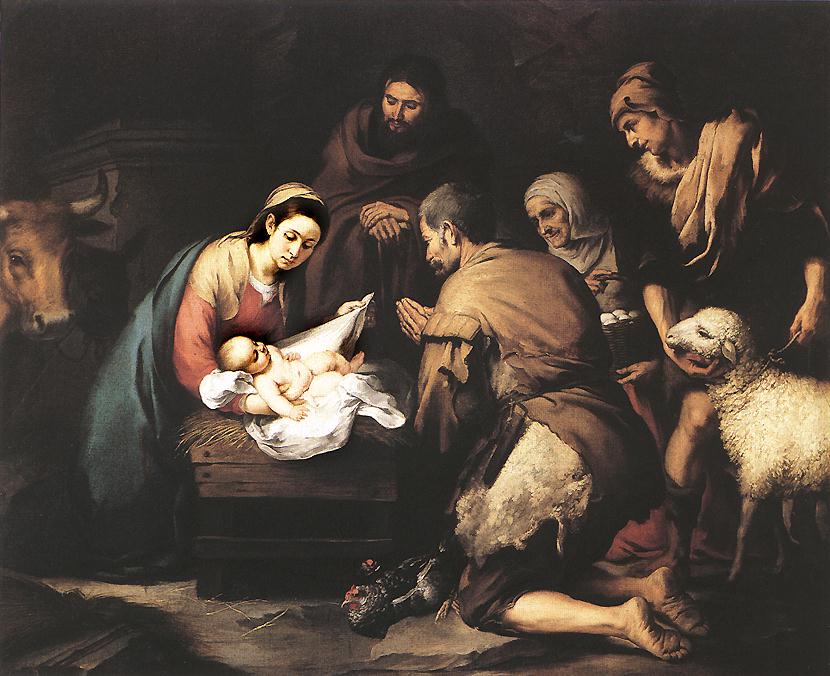
Holy Scripture gives us a beautiful picture of the birth of Jesus. It’s a glorious masterpiece. Breath-taking in detail. Fascinating in theological imagery. One of the many, many things we’re clearly shown in that little stable in Bethlehem is that the good news of salvation from God in Christ is for everybody. Christ Jesus came for everybody. Everybody’s in on this good news.

Look at the manger scene in Scripture. Look at the people in the story. Young and old, rich and poor, male and female, blue collar shepherds and professional scholars, righteous and sinners, Jew and Gentile. God with us means God with all of us!

No exceptions. No fine print. No disclaimers or escape clauses or special qualifications. The angels proclaim that the good news of great joy is for all the people. And the portrait of the stable illustrates it beautifully.

I’ve heard all my life that the ground is level at the cross. Well, the ground is just as level at the manger. In the glory of the nativity, God shows us that we all belong to the same family. We’re all equally lacking and equally blessed. By becoming a human, God draws the entire human family to himself without any distinctions. The good news is that all who are baptized into Jesus are the same. There’s neither Jew nor Greek, male nor female, slave nor free.

God is the God of the universe. But he’s no elitist.

And when we give in to our impulse to avoid uncomfortable people or awkward situations, that’s not Christ-like. The most awkward and uncomfortable birth for the most exalted figure of Jesus Christ shows us and reminds us that the value and importance of life is found in life itself, not in all the things that come with life.

The Gospel is for all. Including the uncomfortable and the awkward. Like you. And me.

Peace,

Allan

At That Time…

“At that time Jesus said, “I praise you, Father, Lord of heaven and earth…” ~Matthew 11:25

The words at the beginning of this passage in Matthew that lead directly to our Lord’s little prayer of thanksgiving refer to that time in Jesus’ life when he’s having to answer questions about his mission and denounce unrepentant cities. John the Baptist is openly questioning the Messiahship of Jesus. His closest family and friends in the fishing villages around Galilee are ignoring his message.

How do you think all this rejection made Jesus feel? How do you think Jesus was doing at that time?

With one word, how would you describe your current situation? Where are you right now? In one word, what’s going on with you at this time?

Content? Frustrated? Happy? Angry? Confused? Overwhelmed? Hectic? Depressed? Worried? Confident? Scared?

Jesus seems pretty confident that his heavenly Father is behind these perceived setbacks and that these disappointments are actually a part of God’s holy will. And he gives thanks. Jesus gives thanks for the problems he’s encountering and praises God for working in them to spread the Word and advance the Kingdom.

The powerful and unstoppable energies of the Kingdom of God are always moving, always growing, always surging just beneath the surface. All around us. Huge rivers of prayer and faith and hope and praise and forgiveness and salvation and rescue and holiness flow right by us every day. In every single nook and cranny, hidden in the shadows, overlooked in the crowds, drowned out sometimes by the noise, are the eternal works of our gracious Redeemer.

So, like our Lord, we give thanks. At that time. At this time. We give thanks.

~~~~~~~~~~~~~~~~~~~~~~~~

Two Sundays ago Kevin Schaffer, our marvelously talented worship minister, stopped us down right in the middle of song to correct our clapping. We were singing “King of Kings.” You know how it goes: King of kings and Lord of lords, glory (CLAP!) Hallelujah. And our congregation was butchering the clapping. We were clapping before the word, during the word, after the word; it was a mess. Near the end of the first stanza, Kevin had had enough and he stopped us.

“We are going to learn how to clap. And we’re going to start with just one. Just one clap. Do it with me…”

And he proceeded to teach us and show us how to clap. It worked really well. Kevin was very patient with us and we all had a good laugh. After we had practiced together for a few minutes, it actually sounded pretty good the second time around. There’s hope here at Central.

I was reminded of that episode by a blog post written by Jon Acuff. It’s called “Clapping Our Hands: A Step-By-Step Guide to the Death of Rhythm.” A dear friend of mine forwarded it to me this morning. Jon hilariously nails the reasons our churches have a hard time clapping during congregational singing and gets inside the minds of the congregants to show us what everybody’s really thinking as the song begins, why the clapping is all over the place, and why it dies out completely before the song’s even over. It’s a quick, light, funny read about why our church clapping sounds like “somebody lit a box of hand firecrackers.” Click here to read it. And try to click on the downbeat, not the upbeat.

Peace,

Allan

« Older posts Newer posts »