Category: Matthew (Page 17 of 24)

The Gospel is for All!

It’s sunny and 22-degrees in Amarillo as I’m penning this post. That’s a full twenty degrees warmer than it was this time yesterday. Oh, yeah. We haven’t been above the freezing mark in nearly four full days. And it has been an adventure. I got stuck in the snow and ice on the way to work Monday morning going around that uphill curve at Hillside and Criss to I-27. The fire department had to push me out. I wasn’t the only one; there were five or six other cars stuck on that hill and they were in the beginning stages of shutting the street down. But it was still a little embarrassing. Then yesterday morning, the van wouldn’t start. The battery was shot. Thankfully, by the time I had the new battery in hand and was ready to install it, the temperature had warmed up to six degrees. You know what it’s like to be turning a bolt and bang your knuckles against a sharp metal plate in six degrees?

I need some weight in the back of my Ranger. I need a better pair of gloves. And maybe one of those George Costanza gortex coats like Kevin Schaffer wears. I’ll never understand how Greg Dowell walks around in this mess in those topsiders without socks. Or how Mark Love is good with just a T-shirt. It’s supposed to warm into the upper 30s later today. But I feel like this snow and ice is going to be with us through March.

~~~~~~~~~~~~
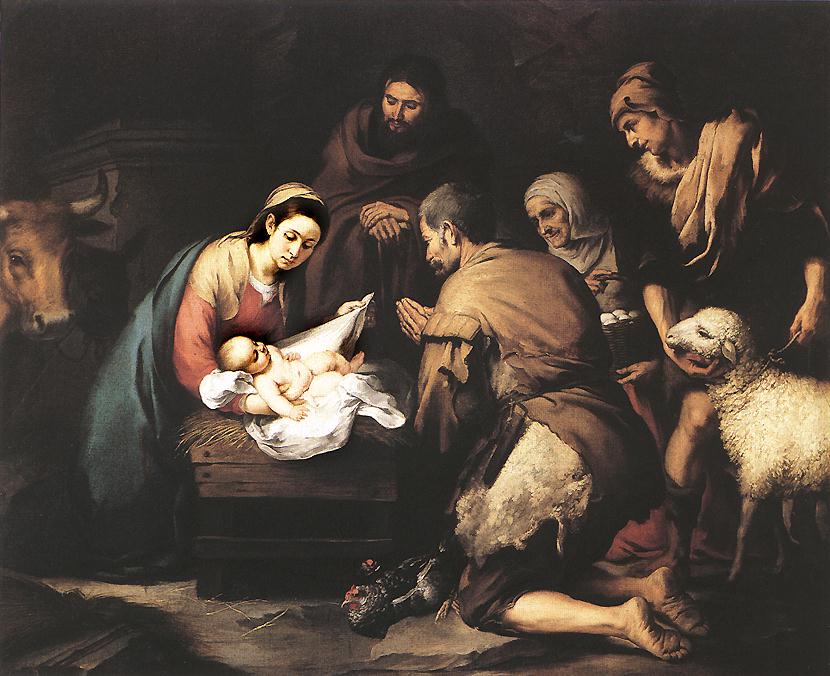
Holy Scripture gives us a beautiful picture of the birth of Jesus. It’s a glorious masterpiece. Breath-taking in detail. Fascinating in theological imagery. One of the many, many things we’re clearly shown in that little stable in Bethlehem is that the good news of salvation from God in Christ is for everybody. Christ Jesus came for everybody. Everybody’s in on this good news.

Look at the manger scene in Scripture. Look at the people in the story. Young and old, rich and poor, male and female, blue collar shepherds and professional scholars, righteous and sinners, Jew and Gentile. God with us means God with all of us!

No exceptions. No fine print. No disclaimers or escape clauses or special qualifications. The angels proclaim that the good news of great joy is for all the people. And the portrait of the stable illustrates it beautifully.

I’ve heard all my life that the ground is level at the cross. Well, the ground is just as level at the manger. In the glory of the nativity, God shows us that we all belong to the same family. We’re all equally lacking and equally blessed. By becoming a human, God draws the entire human family to himself without any distinctions. The good news is that all who are baptized into Jesus are the same. There’s neither Jew nor Greek, male nor female, slave nor free.

God is the God of the universe. But he’s no elitist.

And when we give in to our impulse to avoid uncomfortable people or awkward situations, that’s not Christ-like. The most awkward and uncomfortable birth for the most exalted figure of Jesus Christ shows us and reminds us that the value and importance of life is found in life itself, not in all the things that come with life.

The Gospel is for all. Including the uncomfortable and the awkward. Like you. And me.

Peace,

Allan
At That Time…

“At that time Jesus said, “I praise you, Father, Lord of heaven and earth…” ~Matthew 11:25

The words at the beginning of this passage in Matthew that lead directly to our Lord’s little prayer of thanksgiving refer to that time in Jesus’ life when he’s having to answer questions about his mission and denounce unrepentant cities. John the Baptist is openly questioning the Messiahship of Jesus. His closest family and friends in the fishing villages around Galilee are ignoring his message.

How do you think all this rejection made Jesus feel? How do you think Jesus was doing at that time?

With one word, how would you describe your current situation? Where are you right now? In one word, what’s going on with you at this time?

Content? Frustrated? Happy? Angry? Confused? Overwhelmed? Hectic? Depressed? Worried? Confident? Scared?

Jesus seems pretty confident that his heavenly Father is behind these perceived setbacks and that these disappointments are actually a part of God’s holy will. And he gives thanks. Jesus gives thanks for the problems he’s encountering and praises God for working in them to spread the Word and advance the Kingdom.

The powerful and unstoppable energies of the Kingdom of God are always moving, always growing, always surging just beneath the surface. All around us. Huge rivers of prayer and faith and hope and praise and forgiveness and salvation and rescue and holiness flow right by us every day. In every single nook and cranny, hidden in the shadows, overlooked in the crowds, drowned out sometimes by the noise, are the eternal works of our gracious Redeemer.

So, like our Lord, we give thanks. At that time. At this time. We give thanks.

~~~~~~~~~~~~~~~~~~~~~~~~

Two Sundays ago Kevin Schaffer, our marvelously talented worship minister, stopped us down right in the middle of song to correct our clapping. We were singing “King of Kings.” You know how it goes: King of kings and Lord of lords, glory (CLAP!) Hallelujah. And our congregation was butchering the clapping. We were clapping before the word, during the word, after the word; it was a mess. Near the end of the first stanza, Kevin had had enough and he stopped us.

“We are going to learn how to clap. And we’re going to start with just one. Just one clap. Do it with me…”

And he proceeded to teach us and show us how to clap. It worked really well. Kevin was very patient with us and we all had a good laugh. After we had practiced together for a few minutes, it actually sounded pretty good the second time around. There’s hope here at Central.

I was reminded of that episode by a blog post written by Jon Acuff. It’s called “Clapping Our Hands: A Step-By-Step Guide to the Death of Rhythm.” A dear friend of mine forwarded it to me this morning. Jon hilariously nails the reasons our churches have a hard time clapping during congregational singing and gets inside the minds of the congregants to show us what everybody’s really thinking as the song begins, why the clapping is all over the place, and why it dies out completely before the song’s even over. It’s a quick, light, funny read about why our church clapping sounds like “somebody lit a box of hand firecrackers.” Click here to read it. And try to click on the downbeat, not the upbeat.

Peace,

Allan

Like Little Children

“Unless you change and become like children, you will never enter the Kingdom of Heaven.” ~Jesus

Better writers than me, smarter theologians, more faithful Christians, have wrestled to put into words exactly what Jesus means when he says we have to become like little children if we’re to have any chance at his Kingdom. Some have pointed to child-like innocence; those are the ones who’ve never had kids. Others stress the humility of a child; those are the ones who’ve never experienced losing a game of Monopoly to a sibling. Still others say Jesus was talking about the selflessness of a child; to which I say, “What??!??”

I think Jesus is talking about complete, whole, utter dependence. Dependence on God the way a child depends on her parents for everything: for food and shelter, protection and provision, education and discipline, security, acceptance, and love. A child depends on his parents for everything. A little child can do nothing without them. And God longs for us to have that same dependence on him.

Carlo Caretto spent his Christian ministry writing and teaching about the freedom and real presence of God one feels when he finally decides to depend on the Lord for everything. His works remind us that it’s our privilege, not our punishment, to become like little children.

In a letter to his sister Dolcidia, a Catholic nun, in March 1955, he writes:

“Becoming like children is not easy for those who have been complicated by sin. To become little children means to increase our feeling for God’s fatherhood over us; it means to think and act as little children do towards a father they love. He looks after everything, he resolves everything, and so on. When does a little child ever worry about tomorrow? Never: the father takes care of it. Isn’t that right?

All our plans, even on the road to holiness, are perfectly useless. The real plan is in his hand and we need to go to him like children seeking love.”

Caretto prayed all the time that he might become “little, little, little. Small, small, small.”

Most of us think we’re too big. Most of us.

Me, too.

Peace,

Allan

Their Deeds Will Follow Them

“Blessed are the dead who die in the Lord from now on. ‘Yes,’ says the Spirit, ‘they will rest from their labor, for their deeds will follow them.'” ~Revelation 14:13

It’s a promise from the future that impacts our every moment in the present. Your labor in the Lord is not in vain. Not at all. The things you’re doing right now for the Kingdom will last forever.

You know, salvation is not a private thing. God saves us to work through us to save others. And everything we contribute to the cause — everything! — is used by God toward that great and ultimate end. Just like the parables of the talents, what we use to his glory, whatever it is, will be multiplied and used by God for his purposes. Like the cup of cold water given in his name, it will be rewarded. Like the weekend food packed for needy school children. Like the check written for Breakthrough Sunday. Like the prayer lifted for the single mom and the errand run for the divorced dad. Our deeds will follow us into eternity. Our efforts for the Lord are going to last forever.

We are building for the Kingdom. All our work matters. Every minute is packed with heavenly potential. Every action is loaded with eternal consequences.

To his enduring praise and glory!

Peace,

Allan

The Active Life

The life of a disciple is active, not reactive. It has nothing to do with just talking about faith or teaching religious principles or believing theological ideas or keeping biblical rules. It has everything to do with living one’s whole life in obedience to God’s call through personal action. It doesn’t just require a mind. It requires a body, too.

Ours is a life given to us by God to be lived not in some kind of rigid, cramped, crowded, small, compromised, legalistic way but in a full, wild, joyful, exuberant, cheerful, celebratory way. A way that apprehends and assimilates and then radiates the freedom we have from God in Christ.

Our Father wants his beloved children to operate out of joy and freedom to do what is good and right, not out of fear of making a mistake. Isn’t that one of the great lessons in Jesus’ story about the servants and the talents in Matthew 25?

The Christian life is an active life. Our God calls us to give our whole selves to him. Brakes off; no looking back; full steam ahead! We must act in faith that our God who calls us to live boldly and outrageously for him also promises us that if and when we do mess up in enthusiastic service to our King, he promises forgiveness and consolation and salvation.

Peace,

Allan

Faithful Among the Stumps

Of all the really cool stuff in Isaiah — the servant songs, the allusions to Christ, the prophesies about the Messiah, the comfort passages — the words at the end of chapter six about preaching to people who refuse to listen are the most quoted in the New Testament.

Jesus uses Isaiah’s words in Matthew 13 after telling the parable of the four soils. Same thing in Mark 4 and Luke 8. Jesus says, man, this is how Isaiah must have felt.

In John 12, right after Jesus predicts his death, God’s voice thunders down from heaven for the benefit of the people in the crowds. But they’re not listening. They don’t understand. They refuse to change. And, again, Jesus uses the Isaiah 6 passage to account for the blind eyes and stubborn hearts.

Paul’s near the end of his life in Acts 28, under house arrest in Rome. And he’s failed to make a dent in the sight or the hearing or the hearts of the religious leaders who’ve come to hear him preach. Nothing. And he quotes the Isaiah 6 passage. Same thing in Romans 11. “It’s still happening!” Paul says, “To this very day!” Paul’s a failed preacher in pretty good company.

The point of the last half of Isaiah 6, and the reason the passage is repeated so many times in the early history of God’s Church, is that we are called to be faithful to our Father and to his mission, regardless of where it takes us. No matter how bad it gets, no matter how many people reject the truth, we are called to keep preaching the truth.

The point of Isaiah 6:8-13 is that if we trust God, if we’ll remain faithful to him, he’ll do something with those closed eyes and plugged up ears. Those stumps (Isaiah 6:13). Isaiah and Jesus and the apostles are reminding us that God does his best work in the middle of a desolate field of worthless stumps.

God created the universe out of nothing. He raised a mighty nation out of a 90-year-old barren womb. He pulled a young boy from the bottom of a well and made him a powerful ruler of the most important nation in the world. He uses the death of a preacher and the persecution of his Church to spread the Good News of salvation from Jerusalem to Judea and Samaria and to the ends of the earth. He delivered forgiveness and righteousness to all mankind through a cruel wooden cross.

There’s more happening in horrible situations than we ever realize. These awful circumstances are holy. God does holy things with faithful people in a field full of stumps.

“The holy seed is its stump.” ~Isaiah 6:13

Peace,

Allan

« Older posts Newer posts »