Category: Lord’s Supper (Page 9 of 16)

Around the Table: Part 7

Sports Illustrated’s Andy Staples has written an excellent article on Baylor football coach Art Briles that centers on Briles’ time as a high school football coach in west Texas and in the Texas panhandle. Briles developed his spread offense in response to a quarter-finals playoff loss to Panhandle’s Panthers back in 1984. Staples’ account of that game includes a vivid description of what high school football was like before the days of overtime. Back when tie games were decided by penetrations and first downs, it wasn’t uncommon for teams to play for the penetration instead of the touchdown. It’s a very entertaining read that references lots of our regional towns and teams, including Canadian’s outstanding coach who was a star running back for Panhandle in that 1984 win. You can get to the article by clicking here.

~~~~~~~~~~~~~~~~~~

In addition, David Moore has written a nice column in the Dallas Morning News regarding the Cowboys’ chances at a playoff spot. You figure the Cowboys have to win three in a row to make the postseason. And this team hasn’t had a three game winning streak since 2010. I don’t know how the worst defense in the NFL and the statistically worst defense in franchise history is going to stop the Packers this week, regardless of whether Aaron Rodgers suits up for Green Bay. Josh McCown, Chicago’s back-up QB, looked like Jim McMahon Monday night. David’s article is here.

~~~~~~~~~~~~~~~~~~~

I would like to make the case in this space today that every single time the term “break bread” is used in the New Testament Scriptures, it’s referring to what we call today the Lord’s Supper. The phrase is never used to describe a common meal; it always represents or points to the Lord’s Meal. To illustrate this, we have to use a little Greek. Not a lot; just a little.

Klasas is the Greek word for “break” we find in our New Testaments. It’s the common word for “break.” There isn’t another word for it. It means “to break” like you would break your leg, break a toy, or break your mom’s favorite picture frame. Artos is the Greek word for “bread.” In both the common language and in our New Testaments, this word can have two meanings. The main meaning is simply a piece of common bread or a loaf of common bread. The secondary meaning is “food” or “a meal.” To “eat bread” in many places in Scripture is to eat food generally. The prodigal son in Luke 15:17 says his father’s hired men have “food” (artos) to spare. Jesus’ disciples are criticized in Matthew 15:2 for not washing their hands before they eat. Period. The NIV leaves out “bread” (artos). The Greek text says “…before they eat bread.” The same thing happens in Mark 3:20 when the disciples are so crowded in the house they are “not even able to eat.” Most English translations leave it at that: “eat.” The Greek says “…not even able to eat bread.” But the scholars understand that a full meal is meant by the context. There are a few other places in the New Testament in which “bread” means a meal. The last one I’ll mention is in 1 Thessalonians 3:8 where Paul claims not to have eaten “anyone’s food without paying for it.” The word translated “food” is artos. Bread.

You might think that the term “breaking bread” would be a fairly common term in ancient times, that it would refer, as it does in today’s English, to eating a common meal. When I say we’re going to the Bentleys’ house to break bread, you and I both know we’re having some kind of barbecue and fresh vegetables, peach tea, and a fancy dessert. Hasn’t it always been that way?

No.

According to the Thesaurus Linguae Graecae (TLG) database, a record of every single written word in the Greek language from the very earliest writings dating to about 1400 BC through the year 1453 AD, no one in history ever used the term “breaking bread” before the New Testament. For fourteen centuries — every novel, every song, every poem, every play, every government document, every worship order, every instruction manual, every word of every thing ever penned in that language — nobody ever combined “klasas artos” or “arton klao” (breaking bread) until Paul and the apostles. They were the very, very first. After the New Testament time, the phrase is only found in the writings of the early church fathers, always in reference to the Lord’s Supper.
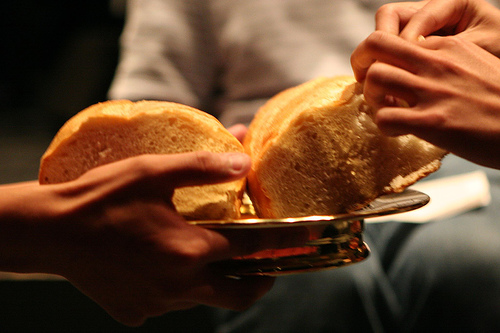
“Breaking bread” is not a common Greek phrase. It’s not an every day term. It doesn’t mean “have a meal.” It means “share a meal with Jesus.”

The term is used for the first time ever in the Greek language in the New Testament. We find it there eighteen times:

At the feeding of the 5,000 in Matthew 14:19, Mark 6:41, and Luke 9:16
At the feeding of the 4,000 in Matthew 15:36, Mark 8:6, and Mark 8:19
At the last supper in Matthew 26:26, Mark 14:22, and Luke 22:19
At the Emmaus Supper in Luke 24: 30 and 24:35
In Luke’s account of the first days of the Church in Acts 2:42 and 2:46
In Troas on the first day of the week in Acts 20:7 and 20:11
On a ship at sea in the middle of a storm in Acts 27:35
In Paul’s Lord’s Supper discussions in 1 Corinthians 10:16 and 11:24

In every case, this is Jesus eating and drinking at table with his disciples. The term is always used to describe the Messiah sharing a meal with his followers. This is the worship language of the early Church. Just like “born of water and the spirit” means “baptism” and just like “separate and apart” means it’s time to pass the collection trays, “breaking bread” means “Lord’s Meal.” It didn’t need any further explanation. Just like the sports page today doesn’t take the time or the space to explain what “touchdown” means in a story about the football game, the writers of the New Testament used “breaking bread” and all the hearers and readers knew what was meant.

Luke makes it easy to follow the thread:

When he feeds the multitudes, Jesus takes bread, blesses it, breaks the bread, and then gives it to his disciples (Luke 9:16).
At the Passover meal on that last night, Jesus takes bread, gives thanks, breaks the bread, and then gives it to his followers (Luke 22:19)
At the resurrection dinner in Emmaus, Jesus takes bread, blesses it, breaks the bread, and then gives it to the disciples (Luke 24:30)

“Jesus was made known to them,” Luke writes, “in the breaking of the bread” (Luke 24:35)

We shouldn’t be surprised to find the first church continuing the faithful practice of their Lord:

The disciples continued in the breaking of the bread (Acts 2:42)
The disciples broke bread daily in their homes (Acts 2:46)
The disciples gathered to break bread (Acts 20:7)

Knowing that the term “breaking bread” is an exclusively Christian term and refers only and always to Christ’s presence at the table where he eats and drinks with his disciples has some interesting ramifications. But I’m out of time and space today. Let’s continue the discussion tomorrow.

Peace,

Allan
Thanksgiving 4 Sunday

“I have given them the glory that you gave me, that they may be one as we are one.” ~John 17:22

We’ve been given a profound intimacy with the Father and Son that changes all of human life. It’s a unity that encompasses the Father with the Son, all disciples with them both, and all disciples, in turn, with one another. This is the gift of Jesus’ prayer. It’s not what we have to do or maintain; it’s what God through Christ has already given us and continues to maintain through the power of his Holy Spirit. It’s just a matter of whether we recognize it or not.

This Sunday, we are set to gather in gratitude to give thanksgiving to our God for the gracious gift of this unity. We will acknowledge the fellowship we share with the other Christian congregations in downtown Amarillo on this day of worship and praise and thanksgiving. Together.

Our guest preacher here at Central on Sunday is Howard Griffin, my good friend and the senior pastor at First Presbyterian Church. As has become our custom on the Sunday before Thanksgiving, we will share a special time of communion around several tables in the worship center piled high with a wide assortment of breads, representing the divinely-ordained diversity in Christ’s Body, his Church. Then at 6:00 Sunday evening, all four churches are meeting at First Baptist for the first ever “4 Amarillo” Thanksgiving service.

As God’s children, unity is our nature. This is who we are: One with Christ and one with his followers everywhere. What that means is that there is very little, if anything, outside of denying Jesus as Lord in word or deed that can separate us. If that’s the case — and it is! — then our diversity and our differences are not just tolerated, they’re embraced and appreciated. Even celebrated. Thanksgiving seems like a perfect time for just such a celebration.

Peace,

Allan

Around the Table: Part 6

“This is my blood of the covenant which is poured out for many.” ~Mark 14:24

There was a definite Passover context in the city, in the room, and around the table when Jesus celebrated the feast with his disciples on the night he was betrayed. Jesus and his closest followers had gathered to remember God’s great acts of redemption, specifically the deliverance of his people from bondage in Egypt. They gathered to sing the Psalms of divine rescue that recount those mighty deeds. They gathered to celebrate that past with great joy and to eagerly anticipate a future fulfillment when all of God’s people would be brought together around the banquet table in the Promised Land.

But Jesus takes this centuries-old covenant meal and gives it new meaning.

First, he ties it to the original covenant meal as recorded in Exodus 24 by quoting Moses. As Moses cleanses the people with the sprinkled blood, he says, “This is the blood of the covenant.” As Jesus shares this Passover meal with his disciples, he quotes Moses, but adds an all-important word to the well-rehearsed line, “This is my blood of the covenant.” Instead of the blood of the lamb(s) removing the sins of the people, the blood of Jesus, the perfect Lamb, will now be poured out for the forgiveness of all sin for all time. Jesus redefines the ultimate meaning of the meal. He is the sacrifice, he is the One being given as atonement for the sins of God’s people. Same covenant; different terms.

Secondly, he tells the disciples to “do this in remembrance of me (Luke 22:19).” Do what? Why, eat this meal, of course. The word “this” should not be understood as exclusively referring to the bread and/or the cup. Those are only two elements of what we know was always a full-blown, full-course celebratory meal. When the children are instructed in Exodus 12 and 13 to ask about the Passover feast — “What does this mean?” — the answer is a liturgical way to tell the story, to pass the faith on to the next generation: “I do this because of what the Lord did for me.” If Jesus and his apostles are good Jews — and they were — and if they were following the prescribed liturgy — and we have no reason to doubt otherwise — Jesus would be explaining the significance of the whole meal, the whole setting, all the elements from the bread to the vegetables to the lamb and the wine and dessert. And all the songs and prayers that went with it. Jesus was telling his disciples and us to eat the meal — the whole meal — in memory of him. At Passover, we remembered God’s redemption work in Egypt, at the Red Sea, and his faithfulness through the wilderness to the Promised Land. At this new covenant meal, we remember now the Gospel events regarding our Savior: his birth, life, teachings, healings, death, and resurrection.

Third, Jesus institutes the new way of understanding religious meals by pointing forward to the ultimate fulfillment around the wedding feast in heaven. The original instructions in Exodus 12 regarding the Passover include the command to observe the feast “when you enter the new land.” Built into the meal is an anticipation that this isn’t going to be the last time we do this. There will come a time when we do this in much better circumstances. Same with our communion meals today. Jesus, on that last night, apparently went out of his way to let his disciples know he would celebrate this meal with them again at the coming of the Kingdom of God. Next thing you know, there they are on Resurrection evening, eating and drinking with their Lord. And, there they are in Acts, eating and drinking together, by the power of the Spirit, with the risen Savior. While sharing the meal today, we understand this isn’t going to be the last time. In fact, we eagerly anticipate eating the supper with Jesus in the new heavens and the new earth with all the saints of all time.

So, there is certainly a past, present, and future element present every time we eat and drink together in remembrance of Jesus. We remember the earthly life and ministry of Jesus. We rejoice in the forgiveness and reconciliation achieved for us at the cross. We renew our end of the covenant, pledging anew our loyalty to Christ. We experience his presence at the table where he acts as host and servant. We celebrate the fellowship we enjoy with our Lord and with one another. And we look forward to that great eternal wedding feast on that one glorious day.

Same covenant. The promises of God didn’t change. He didn’t alter at all what he always promised us from the very beginning. The terms of the deal are what changed. Jesus is the difference. He has fulfilled all righteousness for us. And we celebrate with great joy every time we eat and drink with one another in his holy name.

Peace,

Allan

Around the Table: Part 5

“Obey these instructions as a lasting ordinance for you and your descendants. When you enter the land that the Lord will give you as he promised, observe this ceremony. And when your children ask you, ‘What does this ceremony mean to you?’ then tell them, ‘It is the Passover sacrifice to the Lord, who passed over the houses of the Israelites in Egypt and spared our homes when he struck down the Egyptians.'” ~Exodus 12:24-27

The final dinner Jesus shared with his disciples on the night of his betrayal was a Passover meal. The synoptic gospels all make the explicit claim that this was the Passover. Jesus made preparations and gathered his disciples to “eat the Passover.” Since this last supper has become for the majority of Christians the be-all, end-all paradigm for our own beliefs and practices regarding the Lord’s Supper (for right or wrong), it makes sense to study carefully the Passover context of that last night. I’ve had church leaders on more than one occasion point to the gospel accounts of this last meal to justify their order that we not sing any songs during the Lord’s Supper. After all, the logic goes, the Bible says they sang a song after the meal, not during. Of course, if we’re to follow that logic to its conclusion, we’d be sharing the Lord’s Supper only on Thursdays. Upstairs.

So, yes, let’s look at the Passover context of what was happening around the table on that last night.

As we’ve already noticed in this series, the Jewish Passover meal — all covenant and/or community and/or sacrificial meals for that matter — is a communal celebratory event. As an expression of salvation, it was yet another community meal celebrated following a sacrifice. The Passover, in particular, was a joyous celebration of God’s deliverance of his people from slavery in Egypt.

“Celebrate it as a festival to the Lord — a lasting ordinance!” ~Exodus 12:14

“Celebrate this day as a lasting ordinance for the generations to come.” ~Exodus 12:17

“I am going to celebrate the Passover with my disciples.” ~ Matthew 26:18

The Passover Supper also was a remembrance of that deliverance. By remembrance, we don’t mean a merely intellectual act or emotional recollection. This is a faithful action, a rehearsal, a participation in that deliverance. The Passover liturgies from the Hebrew Scriptures and the Jewish writings from the first century all contain actions and language that help the people around the table to identify with the historic salvation event as if they were present in Egypt and at the Red Sea.

“Celebrate the Passover of the Lord your God because in the month of Abib he brought you out of Egypt.” ~Deuteronomy 16:1

“…so that all the days of your life you may remember the time of your departure from Egypt.” ~Deuteronomy 16:3

“…because you left Egypt in haste.” ~Deuteronomy 16:3

“We cried out to the Lord… the Lord brought us out of Egypt with a mighty hand and an outstretched arm.” ~ Deuteronomy 26:7-8

“Each should celebrate as one who has gone out of Egypt.” ~ Mishna

We also know that as Jesus and his disciples gathered on that last night, their supper together was marked by great joy, praise, and thanksgiving. This was not a dirge or a funeral meal; expressions of joy at this supper were the command of God.

“…with great rejoicing… singing… praise.” ~ 2 Chronicles 30:21-27

“…celebrated with joy… Lord had filled them with joy.” ~ Ezra 6:22

“…your times of rejoicing, your appointed feasts.” ~ Numbers 10:10

The Passover was also established as an anticipation event. Children of God ate the meal together looking forward to that day when they would be eating it in a much better place, in wonderfully better circumstances. They eat and drink with an eye to the future, focused on an upcoming meal that will surpass the one they share today.

“When you enter the land that the Lord will give you as he promised, observe this ceremony.” ~ Exodus 12:25

If we’re really out to imitate every detail of that Last Supper at our communion times together on Sunday mornings — again, for right or wrong — then why don’t we? As good law-keeping Jews, Jesus and his disciples would have been in a festive spirit that night and engaged all the elements of the evening with great joy. The meal was marked by group identity and interaction. It was a present participation in the past events of God’s salvation. They were singing the psalms, specifically Psalms 113-118, before, during, and after the supper.

I would recommend singing songs of salvation, songs of praise for God’s mighty acts, before, during, and after our communion meals together. I would suggest swapping salvation stories around the table. I once was ______, but now I’m ________. Ask each other the questions: from what have we been delivered? From what to what have we passed? Who took our place that day? Do it together in the aisles or along the walls in your worship center. Huddle up around your pews. Allow the children to ask the questions: Why do we do this? And then share the story: because the Lord our God delivered us by the Passover Lamb. And then hug each other and sing another song.

Peace,

Allan

Around the Table: Part 4

Have you ever wondered how the Church’s practice of the Lord’s Supper actually began? There’s no right or wrong answer to the question; the Scriptures don’t give us a time and a place or a lined-out history of communion practice among members of the early Church. But think about that just for a second. I believe the New Testament is full of communion references. I think we see Lord’s Supper practices both assumed and described in lots of places other than the obvious ones in 1 Corinthians and Acts. But how did it begin? Who organized the orchestrated the first official Lord’s Supper?

Consider that on Resurrection Day — Easter Sunday, the actual day of Christ’s coming back to life and walking out of that garden tomb — Jesus appears to his disciples and eats a meal with them. It’s the first time they see the risen Lord. At dinner time. Sunday night. And he joins them and eats with them. At dinner time. On Resurrection Day. Sunday night.

On Resurrection Day, Jesus sees his disciples for the first time and eats with them: “Jesus appeared to the Eleven as they were eating” (Mark 16:14), “They gave him a piece of broiled fish, and he took it and ate it in their presence” (Luke 24:41-43), and “On the evening of that first day of the week, when the disciples were together…” (John 20:19)

These disciples experienced the real presence of the resurrected Christ at meal time on Sunday: “Jesus appeared to the Eleven as they were eating” (Mark 16:14), “Jesus himself stood among them” (Luke 24:36), “Jesus came and stood among them” (John 20:19).

These disciples experienced the realities of the risen Lord at this Sunday evening supper; their eyes were opened and they understood. In Mark’s account, Jesus rebukes his disciples for not believing he’s been raised. But he speaks to them at the meal, he commands and commissions them to preach the good news, and they are empowered to preach “everywhere.” Luke tells us that the disciples look at the wounds in Jesus’ hands and feet during this dinner, they touch the Lord and eat with him, and they confirm that he is indeed not a spirit or a ghost. “Then he opened their minds so they could understand…” (Luke 24:45). Jesus teaches them at the table, commands and commissions them, empowers and reassures them. In the fourth Gospel, after seeing his hands and his side, the disciples “were overjoyed when they saw the Lord” (John 20:20). A very similar Resurrection Day meal experience occurred with the two disciples on the road to Emmaus (Luke24:13-35).

Remember, too, that Thomas was not there for that first post-resurrection meal with the Lord. He missed small groups that night. But he heard about what had happened (John 20:24) and made sure he was present for that next Sunday night (John 20:26). Thomas was there early for that next Sunday gathering. The Cowboys were down by four with six minutes to play, but Thomas still got there early. He pulled up to the driveway at 5:45, ready to go. And, sure enough, as the disciples were eating their meal on that second Sunday, the Lord showed up (John 20:26) and revealed himself to Thomas in the same ways he had opened the eyes of the other disciples the Sunday night before.

So, my question is this: What do you think happened on that third Sunday?

Again, there’s no right or wrong answer. There’s nothing in the Scriptures to tell us what happened on that next Sunday night. But my assumption is that the disciples got together for a meal, expecting to see Jesus. Again. Expecting to eat with Jesus. Again. Anticipating another wonderful dinner with their risen Lord with all the food and drink, fellowship and communion, teachings and commissionings that go with it. And it only makes sense that these dinners would continue every Sunday night with the hope of seeing the Christ. It makes sense that, early on, most disciples had heard the amazing stories about that Resurrection Day meals; they each knew somebody or knew of somebody who had eaten with Jesus on a Sunday after his resurrection. So those Sunday dinners became a very natural way to remember the Lord, to anticipate the Lord’s coming, to celebrate the resurrection of Jesus.

If this is true — nobody has been able to convince me otherwise; in fact, nobody’s even tried — this makes the Lord’s Supper of the early Church a resurrection meal, not a funeral meal. It’s a meal that remembers his resurrection, not his death. It’s a meal that celebrates eternal life, not one that memorializes a temporary demise. Most scholars agree:

“It appears likely that the idea of the Resurrection of Christ was associated, in the minds of the disciples, with the recollection of one or more meals taken with their Master during the period from Easter to Pentecost. And when later these same disciples met to eat together, the recollection of the other meals during which the Risen One appeared to them for the first time must naturally have been very vivid to them. We can now understand why the Christian community in the Apostolic Age celebrated its meals ‘with joy.’ The certainty of the resurrection was the essential religious motive of the primitive Lord’s Supper.” ~Oscar Cullmann, Essays on the Lord’s Supper, 1958.

“The first day of the week, as resurrection day and as the day that Jesus ate with his disciples, became designated as the day when disciples would gather weekly to break bread together.” ~John Mark Hicks, Come to the Table, 2002.

“By eating and drinking with the disciples between Easter and the Ascension, Jesus demonstrates at least three things: he has been raised bodily; he resumes full communion with people who have forsaken him and despaired of the salvation they hoped he would bring; and he equips them to be trustworthy witnesses to his resurrection and to new life, to the life that he has brought to sinners such as they are.” ~Markus Barth, Rediscovering the Lord’s Supper, 1988.

“The promise of Luke 22:16, 18 is fulfilled: Jesus is risen; he is alive and now abides with his people. Therefore, we come to the table in joy, because Jesus is risen. Nowhere is this joy celebrated more appropriately than when believers have fellowship at a meal. Throughout Luke and Acts, meals function as an expression of the joy of the Kingdom of God, where the Lordship of Jesus shines forth in clarity.” ~Allan McNicol, Preparing for the Lord’s Supper, 2007.

We share the Lord’s Supper on Sundays, not Fridays. At the table, our risen Lord joins us and eats with us as we celebrate his resurrection, not his death. We eat and drink with one another and with the Christ with gladness and joy, not sadness and grief. Sunday is resurrection day and the Lord’s Supper is a resurrection meal.

Now, how do we better practice this?

Peace,

Allan

Around the Table: Part 3

Good morning, Lon.

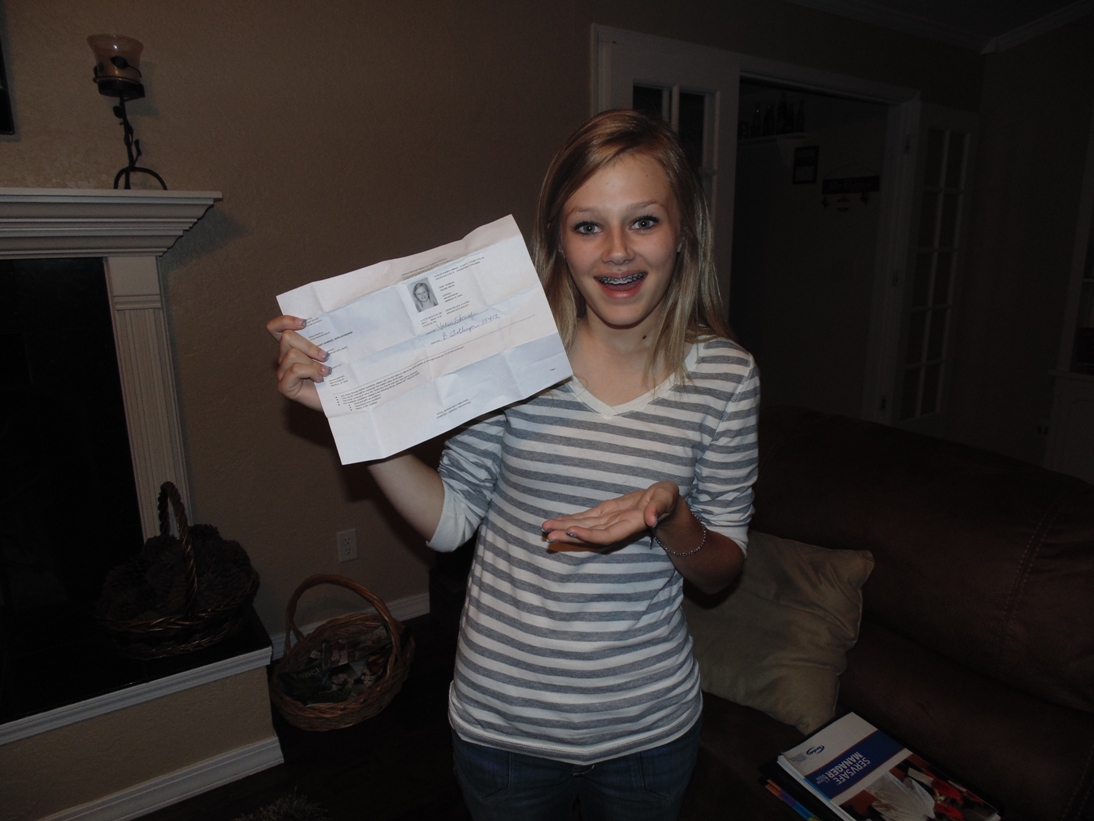
Alert all the local and regional safety agencies. Sound the alarm and post the warnings. The state of Texas has granted Valerie a driver license. On Friday morning, our Little Middle parallel parked like a champ and then aced the driving test, nailing it with a 96. So, consider carefully this advice: be extra cautious around the southwest part of town and, in the early evenings. between here and Canyon.

Congratulations, Valerie. Now, can you run to the store and get some bread and more Diet Dr Pepper?

~~~~~~~~~~~~~~~~~~~~~

After two weeks of intense Old Testament study concerning the covenant between God and man, the history and nature of covenant meals, the fellowship sacrifices and meals, the presence of God at those meals, and the great joy commanded and experienced around those tables, our Wednesday night Bible class in Sneed Hall has crossed the threshold into the New Testament and the ministry meals of our Lord Jesus. It’s a class on the Lord’s Supper, yet I think most everyone is surprised at how much we explored before we ever got to the Gospels. Well, we had to.

God comes to us in the person of Jesus as a fulfillment of the covenant: “I will make my dwelling place with you; you will be my people and I will be your God.” Emmanuel means “God with us.” And that’s just what/who Jesus is: God with us. God in Christ comes here to dwell among us (“The Word became flesh and made his dwelling among us…” John 1:14). He came to earth to reveal himself to us in Jesus (“Anyone who has seen me has seen the Father.” John 14:9). And God put on our flesh and came to this planet in order to eat and drink with us, to commune with us, around a table.

“I confer on you a Kingdom, just as my Father conferred one on me, so that you may eat and drink at my table in my Kingdom.” ~Luke 22:29-30

“Many will come from the east and the west and will take their places at the feast with Abraham, Isaac, and Jacob in the Kingdom of Heaven.” ~Matthew 8:11

“The Kingdom of Heaven is like a king who prepared a wedding banquet…” ~Matthew 22:2

You don’t have to read too far in the Gospels and you don’t have to pay too close attention to see that meals, eating and drinking with people, are the focal point of Jesus’ ministry. Jesus eats with his disciples and with his enemies, with the “righteous” and the “sinners,” with crowds of Jews and crowds of Gentiles, with tax collectors and prostitutes, with Mary and Martha and teachers of the Law. Jesus ate and drank with everybody. He was eating and drinking all the time, so much so that he was accused on several occasions of being a drunkard and a glutton.

And in all these Jesus stories, the meals are critically important. They reveal great truths about what God is doing through Jesus in the world. The meals teach lessons about what it means to live as citizens in God’s Kingdom. They express forgiveness and healing, they celebrate restoration and fellowship.

Jesus is eating with Levi and the other tax collectors, showing us in visible ways that the invitation to enjoy fellowship with God is open to all. He’s criticized for his choice in dinner companions and answers by proclaiming that “It is not the healthy who need a doctor, but the sick. I have not come to call the righteous, but sinners!” (Luke 5:31) You get the same thing with Zacchaeus. “The Son of Man came to seek and to save what was lost.” (Luke 19:10)

Jesus forgives the sins of the prostitute at the dinner at the Pharisee’s house in Luke 7. He teaches on hypocrisy and taking care of the poor during the meal with the Pharisees and teachers in Luke 11. At the supper with the Pharisee in Luke 14, our Lord declares again that he’s here to eat with everybody: “Bring in the poor, the crippled, the blind, and the lame!” (Luke 14:21)

Aside from the last dinner with his disciples and the post-resurrection meals, the most important meals during Jesus’ ministry came at the feeding of the multitudes. All four Gospels go to great lengths to report on the miraculous feedings of the five thousand Jews and the four thousand Gentiles. The imagery is unmistakably Messianic. Here’s this great prophet of God providing food for God’s people in the desert. They eat until they are full. Baskets of leftovers are collected. This fulfills Moses. This fulfills prophesy. This is the Anointed One, the Christ!

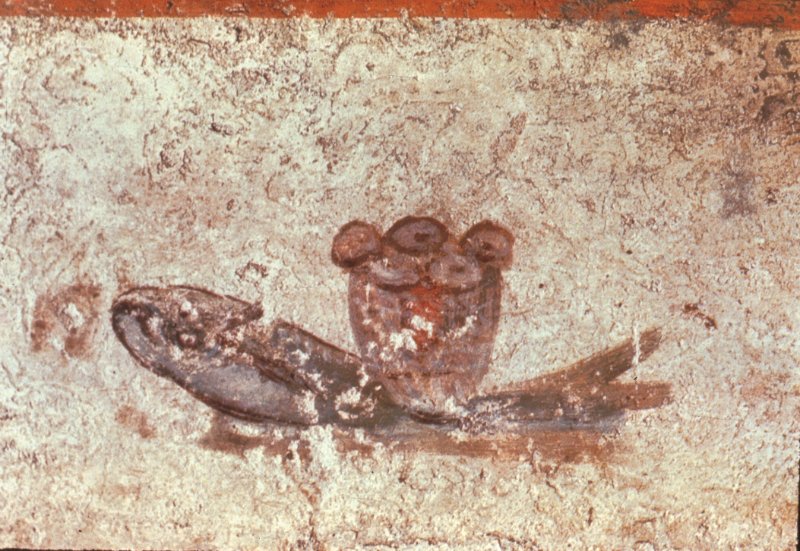
The early church made a pretty big deal about the feeding of the multitudes. The first churches ate their communion meals in the context of these feedings and the truths those stories revealed. It’s why the earliest communion art we have contains images of fish with the bread and the wine. The connections were made not just by the common themes and the prophesies, but by the deliberate wording the New Testament writers used to relate these important meals. They tied the church’s meals to the last supper, the post-resurrection dinners, and the feedings of the crowds with the four-fold liturgy of “take, bless, break, and give.”

In every account of these miraculous feedings, Jesus is said to “take” the bread, “bless” it, “break” it, and then “give” it to the disciples. Look it up; it’s in every passage (Luke 9:16, Matthew 14:19, Mark 6:41, Mark 8:6, Matthew 15:36). The same language is even used for the fish in John 6:11. Interestingly, the exact same formula is used in the Last Supper accounts. Jesus takes, breaks, blesses, and gives (Luke 22:19, Mark 14:22, Matthew 26:26). The same four words are used in the same order in the stories of Jesus’ post-resurrection meals, too, tying together all the meals Jesus ate during his ministry to the meals the church was sharing together at the time the stories were recorded. Everything that was going on in those meals — the teachings, the revealed truths, the fellowship and thanksgiving, the invitation and celebration, the anticipation of the final heavenly feast — is also going on today in our church’s meals.

They are all Kingdom meals. The feedings of the crowds, the last dinner, the post-resurrection suppers — they are all Kingdom meals, eaten in community, in the presence of the Lord, with great joy. They each anticipate the fullness of the Messianic banquet in the new heaven and new earth. They’re each characterized by joyful celebration and an abundance of food. To eat with Jesus (God) is to experience and celebrate redemption and acceptance. All the meals proclaim that the Day of great joy for all the people has dawned.

With this understanding, how in the world would the first Christians eat the “Lord’s Supper” in a quiet, somber, individualistic way? How would they imitate or recreate the Lord’s meal with little crumbs of cracker and tiny sips of juice?

Of course, they didn’t.  But, we’re getting ahead of ourselves a bit.

Peace,

Allan

« Older posts Newer posts »