Category: John (Page 12 of 30)

Jesus’ Judgment Will Be Fair

JudgmentDay

“A time is coming when all who are in their graves will hear his voice and come out — those who have done good will rise to live, and those who have done evil will rise to be condemned. By myself, I can do nothing; I judge only as I hear, and my judgment is just, for I seek not to please myself but him who sent me.” ~John 5:28-30

The first Christians believed that what you do matters. The writers of Scripture all confirm that a fair and impartial judgment day is consistent with the character of God who doesn’t play favorites.

“God will give to each person according to what he has done. To those who by persistence in doing good seek glory, honor, and immortality, he will give eternal life. But for those who are self-seeking and who reject the truth and follow evil, there will be wrath and anger. There will be trouble and distress for every human being who does evil: first for the Jew, then for the Gentile; but glory, honor, and peace for everyone who does good: first for the Jew, then for the Gentile. For God does not show favoritism.” ~Romans 2:6-11

2 Corinthians 5 tells us that all men and women are someday going to stand before the judgment seat of Christ and give an account of all their thoughts and words and deeds. Everything. And each of us is going to receive what’s right according to whether we’ve done good or evil.
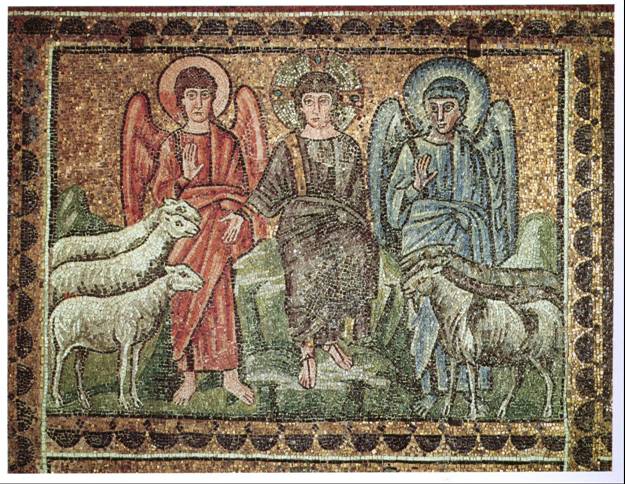
JudgeSheep&GoatsJesus gives us a compelling picture of this in Matthew 25 with the separation of the sheep and the goats.  To the sheep on the right, Jesus says, “Come!” Come on in. Come close. You belong. You’re in. Come. How cool would it be to hear the Lord say that to you?

Notice the righteous in this story don’t say, “Boom! Nailed it! Yeah! That’s right! We’re feeding the hungry and clothing the naked! Yes! The Kingdom has been prepared for me! That’s what I’m talking about!” No, it’s more like, “What?!? We did what?!? You mean we got it right?” The sheep on the right are surprised.

Jesus explains that the way you regard the poor and the sick and the abused and the hungry shows your high regard for him and his mission. Our King associates himself with the lowly, with people who don’t have any resources. So when you show compassion for the poor, when you extend mercy to the sick, when you show love to the marginalized, that’s proof that you belong to God. These aren’t good works to earn favor from God. You don’t give a cup of water so you can go to heaven. That’s not why these people did these good deeds. They were surprised their kindness to prisoners and aliens had anything to do with it. The way they treated the poor and the minorities proved that they had submitted to the Lordship of Jesus and that his Holy Spirit was shaping their minds and lives. Clothing the naked is not a qualification to get in — it’s an evidence of a saving faith.

To the ones on the left, Jesus says, “Depart!” Go away. Get out of my presence. You don’t belong to me.” How awful and terrible to hear the Lord say that to you.

Notice the unrighteous goats who are eternally condemned are just as surprised as the righteous sheep. “What? When did these things happen? I don’t remember not taking care of you, Jesus, when you needed help.?

I don’t think they were deliberately rejecting Jesus when they turned their backs on the poor and the weak. It’s just evidence that they had not submitted to Jesus as Lord and to his mission to seek and save and make things right. They didn’t see Jesus in the poor and hurting.

Maybe they saw Jesus in their church, so they had perfect attendance. Maybe they saw Jesus in their political candidates, so they voted regularly. Maybe they saw Jesus in their Christian jewelry and T-shirts, so they went shopping. But they never saw Jesus in the poor. They never experienced his character in his mission to the lost. This was proof they had not allowed the Holy Spirit to shape them and transform them into the image of Christ.
JudgeMosaic2

Being faithful, being righteous, doesn’t mean being burned at the stake or becoming a missionary to Yugoslavia. The righteous are just paying attention to the people around them and taking care of real, practical, every day needs. A cup of water. A sandwich. A visit. A coat. Just be faithful with what God puts right in front of you every day. What you do matters. It’s evidence.

The righteous will always produce evidence. You’ll always be able to notice the transformed speech and thoughts and actions and character of disciples of Christ. On that last day, Jesus will distribute rewards and penalties according to the clear evidence. And he’s always fair.

~~~~~~~~~~~~~~~~~~~~~~~~~~~~~~~~~~~~~~

RangersLogoYesterday, while basking in the glorious glow of another exciting round of last minute deals for the Rangers at the trade deadline, I wrote in this space that, with the additions of Beltran and Lucroy, this Texas team will score an average of more than five runs a game from here on out. Last night, Beltran and Lucroy went a combined 0-6 with three Ks in a 5-1 loss at Baltimore.

I’m sticking with it. Hold me to it. This Rangers lineup will average more than five runs per game the rest of the way. Starting……
Now!

Peace,

Allan

Full Time Work

HardWork

Today I’m speaking downstairs at our weekly Loaves and Fishes gathering, I’m finishing up the sermon for this Sunday, re-reading the passage in Mark I’m teaching in our Bible class, writing questions for the small groups discussions, and visiting a dear church member who was moved into hospice care last night. While you’re slaving away at the office or the construction site or the airport or the school, I’m at the church building doing God’s work. Right?

WRONG!

We are all doing God’s work, together, every day, seven days a week.

Sometimes we speak in ways that make what I do as a preacher “full-time Christian work” and what you do as a member of the Body of Christ “part-time Christian work” or “weekend Christian work.” You must know that you are a full-time Christian banker or plumber or homemaker. You are a full-time Christian truck driver or repair man, administrator or salesperson. When we are at our work, we are at the same time at God’s work. Just like our Lord Jesus.

You realize that most of what Jesus did he did in a secular workplace: in a farmer’s field, in a fishing boat, at a wedding feast, in a cemetery, at a public well, on a country hillside, in a court room, at dinner with friends and family, while walking along a road, in the marketplace. Sometimes in the Gospels Jesus shows up in a synagogue or the temple. But he mostly spends his time in the workplace.

The Fourth Gospel identifies Jesus as a “worker” 27-times. It quotes our Lord as saying, “My Father is still working, and I also am working.”

Your work does not take you away from God, it continues the work of God. Our God is always in his workplace, your workplace, working. And once we recognize that, we can more easily see ourselves — all of us — working in our workplaces in the name and manner of Jesus to his eternal glory and praise.

Peace,

Allan

Light of Life

EmptyTombAbstractNew

“In him was life, and that life was the light of all people. The light shines in the darkness, and the darkness has not conquered it.. The true light that gives life to every person was coming into the world.”  ~John 1:4-9

Throughout the Gospel of John, Jesus over and over refers to himself as the light, the true light of life.

“I am the light of the world. Whoever follows me will never walk in darkness, but will have the light of life.” ~John 8:12

“I have come into the world as a light, so that no one who believes in me should stay in darkness.” ~John 12:46

When Jesus was betrayed by his friends and then crucified on the cross, the gospel says it was dark. When Mary went to the tomb early on that first Easter Sunday morning, the Scripture is clear that it was dark. It’s also certain that Mary was not looking for a resurrected Jesus that morning; she was looking for a dead body. Maybe that’s why she didn’t recognize Jesus when she saw him — she wasn’t expecting it. But when he said her name, when she heard his familiar and powerful and loving voice, she knew it was Jesus her Lord, she knew he was alive, and she knew it wasn’t dark anymore.

2 Timothy says Christ Jesus has destroyed death and has brought life and immortality to light. 1 Peter tells us Jesus has brought all of us out of darkness and into his wonderful light.

I don’t know what kind of darkness maybe you’re living in. Maybe you feel trapped by sin or by some really bad decisions that you’re still paying for years later. Maybe there’s strife in your marriage or in your family. Maybe you’ve been diagnosed with something and your future’s unclear. Maybe you’ve just got this dark cloud hanging over you that follows you everywhere you go and you can’t really describe it or explain it, but it’s just there. It’s just dark.

“You were once in darkness, but now you are light in the Lord. Live as children of light… Wake up, O sleeper, rise from the dead, and Christ will shine on you!” ~ Ephesians 5:8, 14

Listen, that darkness is real. I don’t want any of us to pretend that it’s not. You and I are broken. We are fallen. We are sinners. And this world we live in is broken and sinful. There is starvation and disease and violence and injustice all around us. Every day. We can’t get away from it. And we are not called to deny it or ignore it. The darkness is real. The darkness in your life is real. Your sin is real. Your desperation is real. Your sickness, your depression, your lack of faith is real.

It’s OK to feel it. It’s OK to be sad. It’s OK to feel hurt and disappointed. It’s OK to get angry. As a Christian, though, it is not OK to live without hope. It’s not OK to live without courage and confidence. It’s not OK to live like the darkness has any power. Jesus is risen, he is alive, and the darkness, whatever it is, is no match for the light of life.

“The truth is seen in Christ Jesus and in you, because the darkness is passing and the true light is already shining.” ~1 John 2:8

Peace,

Allan

Maundy Means Commands

JesusWashingFeetToday is Maundy Thursday, the day Christians all over the world remember the events of the night our Lord Jesus was betrayed by his disciples. Yeah, remember, it wasn’t just Judas who betrayed Jesus; he was just the only one who got paid. They all fled that night when things got hairy. They all abandoned Jesus (Well, the guys did. According to the Gospels, the women were the only ones who did not flee the scene. They stood by their man, as it were, through the trials, the suffering, the crucifixion, and the burial).

The word “Maundy” is from a Latin word that means “commands.” That word has been used by Christians to describe that last night for centuries because Jesus gave his followers several commands during that last meal:

“Now that I, your Lord and Teacher, have washed your feet, you also should wash one another’s feet. I have set you an example that you should do as I have done for you.” ~John 13:14-15

“A new command I give you: Love one another. As I have loved you, so you must love one another.” ~John 13:34

“My command is this: Love each other as I have loved you.” ~John 15:12

Today is a day of solemn remembrance. Easter Sunday — I can’t wait for Easter, I love Easter, Resurrection! — is a day for exuberant celebration. But Maundy Thursday is for individual and corporate reflection. Inspection. Introspection. How have I betrayed my Lord? Am I keeping his commands? In what ways do I continually deny my Savior?

He told his disciples that night around the table to remain in his love, to obey his commands. At a meal together, he asked them to obey his commands just as he had obeyed the commands of the Father. And then he says it: My command is that you love each other as I have loved you. You’re my friends, he says, if you do what I command (John 15:9-14).

Are we obeying his primary command to love each other? Are we showing Christ Jesus’ sacrificial, servant-hearted, selfless love to other followers? Or do we betray our Lord and disobey his command by judging other disciples and withdrawing from other followers? Are we loving and serving all Christians as Jesus commanded, as he prayed to our Father on that dark night we would, or do we only love and serve Christians who think and behave exactly like we do? Do we reject Jesus’ command by criticizing other churches, even condemning them, because we have different understandings or different practices?

Print

Here at Central, we’re trying to love all Christians in Amarillo the way Jesus showed us during that last meal on that Thursday night. We’re trying to be sacrificial. We’re trying to be servants. We’re trying to come closer together with other Christians. We’re trying to erase the man-made lines of distinction and focus on the many, many things we all have in common in our Lord Jesus. No judgments. No criticisms. More grace. More forgiveness. More service. More love. We’re not perfect at this yet; nobody’s arrived. But we’re trying.

Tonight, our church family joins with our brothers and sisters at First Baptist, First Presbyterian, and Polk Street Methodist for a time of worship and communion with each other and with our risen and coming Lord. We’re going to reflect together. We’re going to inspect our lives together. We’re going to eat and drink together. And we’re going to commit to the Maundy Thursday spirit of paying attention to Jesus’ commands. And obeying them.

Peace,

Allan

Flesh and Blood

“The Word became flesh and blood and moved into the neighborhood.” ~John 1:14 (MSG)

JesusDisciplesFeet
God doesn’t wave a magic wand and cast a spell on the earth to restore it to its original condition. He doesn’t judge the world as beyond salvation and destroy everything. God comes to us. That’s his answer. That’s our God’s strategy. He enters our humanity with us, he puts on our skin and bones and blood, and participates in our problems. Immanuel. God with us. Jesus joins our mess.

This is how God works in the world. He takes on our humanness. He became one of us. The Son of God not only died for our sins as a human, he lived here as a human, too! He got hungry and tired with us. He laughed and cried with us. He bled. He sweated. He experienced joy and pain with us. He got surprised and he got frustrated. He was tempted. He struggled. He was betrayed by his best friends. He had to make hard decisions. He lost loved ones. He became one of us with us. This is God’s strategy.

Entering. Sharing. Engaging. Participating. All in.

That’s very, very different from Hinduism, Buddhism, and Islam. All the other world’s religions worship a god who stays in the heavens, who has removed himself from creation and demands that his people come to him. People are required to find secret knowledge and spiritual codes and work and strive and struggle to get to these gods. But our God comes to us. He comes here to us.

JesusHealsBlindIt’s important for us to know that Jesus is both 100% God and 100% man. I can’t explain it all, I certainly don’t understand it all. But the Scriptures declare it, the Apostles’ Creed affirms it, and Jesus’ life on earth proves it. He is both God and man. And this is critical to our Christian faith.

If Jesus wasn’t a man, then he didn’t really enter our mess. He came here, yes, but he remained above all the dirt. He didn’t really enter or share or participate in the ugliness of what is our situation. He wasn’t human, he was God! It was easy!

And if Jesus wasn’t God, then he didn’t really sacrifice anything to come to us. He didn’t risk anything. He didn’t really put anything on the line. And it didn’t really make an eternal difference. It didn’t matter in the long run. He wasn’t God, he was human! He was born here, he didn’t have a choice. And then he died. It was unfortunate, that’s all.

No.

Jesus the Messiah, the Alpha and the Omega, the Creator and Lord of Heaven and Earth, equal with God the Father from before the beginning of time, left his home in glory and put on our skin and bones in order to enter our mess. He entered your mess. He did. Jesus Christ entered your situation, he shared in your experiences, he carried all your burdens, he participated in your problems. He got very intimately involved in your situation at a tremendous personal cost. That’s the Gospel! Praise God!

Christ Jesus put on our flesh and lived with us. He entered the fray. And so we disciples of Christ today enter the fray with our money and time and resources and energy and talents and houses and everything we’ve got. By the power of the Holy Spirit, Christians shine light into darkness, we bring life out of death. We join in the problems. We jump into the ugliness. That’s why so many hospitals are named Methodist and Presbyterian and Baptist-St. Anthony’s — because Christians have been entering the mess and sharing and carrying and engaging and participating since that very first Easter Sunday.

It’s obvious that this is the way of our Lord. God’s Church is not called to just hang on until the uncleanness is destroyed. We’re not called to just pray about the mess so God can take care of it. And we surely don’t lock ourselves up in a gated monastery and ignore the problems. We enter it. We engage it. Heaven and earth, God and humans, present together in the redemption and restoration of the world.

Peace,

Allan

The Counter Cultural Way

JesusPraysInPainThe Word of God confronts us with two ways. The Law and the Prophets, the Psalms and Proverbs, the Gospels and Letters all present us with the choice of two ways. It’s not where you’re going to live or what career you’re going to pursue or who you’re going to marry or where you’re going to eat. The choice given us in Scripture certainly encompasses and impacts all the daily choices we make while we live in those places with the people we marry and in the work we do and while we’re eating lunch. But there’s only one choice in the Bible: the way of life of the way of death; the way of blessing or the way of curses; the way of God or the way of the devil.

Jesus says, “I am the Way.” I am the Way to God and I’m also the way God comes to you. I’m a two-way Way. And so we choose Jesus. And when we choose Jesus, what is it specifically that we’ve chosen? What are we signing up for when we say “Yes” to Jesus?

Well, the Gospels tell us plainly that Jesus’ Way is counter cultural. Popularity and power mean just about everything in our society, but popularity and power mean absolutely nothing to our Lord. In the Gospels, it looks like Herod has the power. The governing officials in the Roman Empire have all the power. So the Roman soldiers. The religious leaders have a lot of power. The chief priests and teachers of the Law and the Sanhedrin wield plenty of power. And all of these people and groups seem to have their way with Jesus. Jesus is the lowly servant who’s despised and rejected, beaten and crucified. Cursed by God and man.

But remember the centurion clearly sees the truth when he sees how Jesus dies: “Surely this man was the Son of God.”

Jesus’ way is upside down. It’s counter cultural. Our default, though, is the pursue the ways of the world. As disciples of Jesus individually and as churches of God collectively, we’re not very careful with this. Without even thinking about it, we embrace and adopt the ways of the culture. We imitate the ways used by powerful people who run large companies and corporations, high profile people who lead political parties and nations. By threat and force and power; with money and might; by out-yelling and out-insulting others; by demonizing those who disagree with us; by walling ourselves off from anyone who may do us harm. And we don’t even consider that those ways are totally at odds with the way of Jesus.

We see accomplished men who’ve achieved great success by using these worldly methods and we make them elders of the church. We make these guys preachers of the Word. Whatever the culture decides is exciting and successful and influential, whatever gets things done, whatever will gather a crowd.

We usually have to take four or five different looks at guys whose main character traits are gentleness and humility before we consider them for leadership roles — if we even look at those kinds of guys at all. Shouldn’t the man who lives only to serve others be moved to the top of the list? Shouldn’t the guys who consider the needs of others more important than their own, the guys who refuse to advance their own agenda, the guys who you’ve never heard say one bad thing about anybody else, shouldn’t they be the frontrunners for leadership positions in our congregations? Shouldn’t they be the ones to set the tone in our churches?

Peace,

Allan

« Older posts Newer posts »