
Category: Church (Page 7 of 60)

If Sunday morning worship is a beach vacation — it’s real, it’s physical, sand in the toes, sun on the face — and online worship is not; but if coming together on Sundays under social distancing restrictions, mask guidelines, “Rip N Sip” communion kits, and a lot of our church family still quarantining at home is like sticking your finger in a four-year-old jar of sand — it’s just not the same, it’s diminished, not the way we remember, almost a let down — should we even do it?
Let me finally now make a case for it. I’m convinced we can practice the priority and the purpose of our gatherings, while not forgetting what we’ve learned and experienced while we’ve been scattered. And I believe a helpful text is Hebrews 10:19-25.
Since we have confidence, boldness, authorization to enter the very Holy of Holies; since we have the blood of Jesus and the body of Christ that opens up the door for us to come into the very presence of God himself; since we have been given access by our risen and reigning high priest to the very throne room of God — because of all those mind-blowing blessings we share together — let us.
Let us draw near to God in faith. Let us go in, right into his presence. Let us hold unswervingly to the hope we profess, that God has promised an eternal gathering someday, a forever community to which we will all ultimately belong together. Let us take care of each other. Let us love, encourage, and support one another. Let us not give up meeting together — for all these reasons. Let us not stop meeting together.
It’s a taste, right? It’s a foretaste of what’s coming. Our Sunday morning assemblies point to the day when all God’s people are gathered together — every tribe, language, people, and nation — in God’s presence with one another around his great banquet feast. Our church gatherings anticipate that, our worship services point to that. It’s a taste. It’s a glimpse. And when we’re all physically together in the presence of God, in the name of Jesus, and by the power of the Spirit, we actually are really participating in that ultimate promised gathering.
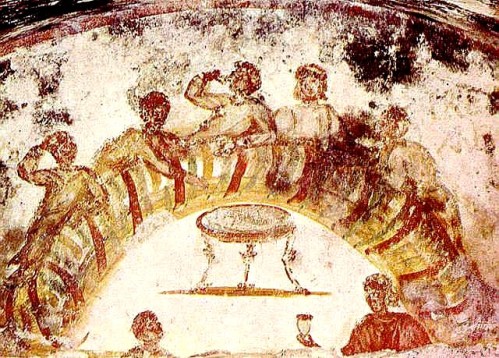 “You have come to Mount Zion, to the heavenly Jerusalem, the city of the living God. You have come to thousands upon thousands of angels in joyful assembly, to the church of the firstborn, whose names are written in heaven. You have come to God, the judge of all men and women, to the spirits of righteous people made perfect, to Jesus the mediator of a new covenant.” ~Hebrews 12:22-24
The assembly transcends time and space. We’re not meeting at 1401 South Madison in Amarillo, we’re gathering on Mount Zion! We’re in the heavenly Jerusalem! We’re not assembling with 600 people in a church building in Texas, we’re worshiping and eating and drinking with all of God’s saints for all time! That’s the invisible eternal reality!
When God’s people meet together, we meet the future. We get a taste of the future. We experience it. We join it. We get to see what our God is ultimately doing. It’s like receiving the down payment on God’s guarantee.
Church is a communal event. It’s spiritual communion with the Lord through which the divine community engages the redeemed community, where we delight in each other and we witness together to the not-always-seen realities of God’s Kingdom.
Sunday morning worship is Psalm 50 where God says, “Gather to me my consecrated ones.” It’s Leviticus 9 where the entire assembly comes near and stands before the Lord and his glory appears to them all. It’s Jesus saying, “How I long to gather you together.” It’s Ephesians 1 where the Bible says God’s ultimate will is to bring all things in heaven and earth together in Christ.
So what if May 31, or whenever your church gets back together, and the weeks after that are like just sticking your finger in a four-year-old jar of sand. It’s a taste. It’s a glimpse. It’s still a real, physical participation in a glorious, eternal reality with God and each other.
God has been obviously at work during the weirdness of doing church online. You think he might have something special planned for us in the weirdness of May 31?
Let us draw near to God and find out.
Peace,
Allan

This Sunday at Central will mark the tenth consecutive Sunday we have worshiped together online only. One more time we’re going to livestream the “assembly” from a nearly empty worship center to our scattered church participating in their homes via the marvel of the internet. We’ve added stage lights and changed the camera angles, we’ve manipulated the sound of the praise team and paid careful attention to start and stop times, we’ve incorporated more videos of our own people from their own settings and been as interactive as we know how.
But it’s just not the same.
Christian author Brian Zahnd writes: “Virtual church is like a virtual beach vacation — it’s just not the same thing. A real beach vacation means sand between your toes. And real church means human contact and sacraments.”
Our online offering is pretty good. But it’s no day at the beach. As a church, we’re not gathered right now. We’re scattered. And, I’ll tell you, it’s not my favorite thing. But it’s not the worst thing, either. Because the Church is God’s scattered people, too.
Yours is not the first church that’s ever been forced to scatter. And this is not the first time in history the Church as a whole has been unable to gather. In fact, it happened early on. The very first church, that Pentecost church in Jerusalem, got scattered pretty quick. Stephen was stoned in Jerusalem for preaching the resurrection…
“On that day a great persecution broke out against the church (assembly) in Jerusalem, and all except the apostles were scattered throughout Judea and Samaria. Godly men buried Stephen and mourned deeply for him. But Saul began to destroy the church (gathering).” ~Acts 8:1-3
Randy Harris says if the Church only knows how to be Church in mass gatherings, then it was never really the Church in the first place. And I agree.
We are, all of us, each of us, saved by God in Christ and called by God in Christ for the sake of others. The Church of God exists as people on a mission, men and women saved and called by God to join God’s acts of salvation for others. And sometimes our assemblies have to be broken up by outside forces, we’ve got to be dispersed in order to remember that the Church is God’s scattered people, too. And he can work in powerful ways whether we’re worshiping together in the same rooms on Sunday mornings or not.
“Those who had been scattered preached the Word wherever they went. Philip went down to a city in Samaria and proclaimed the Christ there. When the crowds heard Philip and saw the miraculous signs he did, they all paid close attention to what he said. With shrieks, evil spirits came out of many, and many paralytics and cripples were healed. So there was great joy in that city.” ~Acts 8:4-8
Think about those followers of Jesus in Jerusalem who had witnessed amazing demonstrations of the presence of God and the power of the Holy Spirit. The worship services at that church must have been over the top awesome. Peter’s preaching the Word as an eyewitness to the resurrected Christ. People are being healed. People are speaking in tongues. The Holy Spirit is there in visible pillars of fire. They’re singing 19-verses of Just As I Am because hundreds of people are being baptized every Sunday. And no announcements! That’s an awesome worship experience!
And they were forced to give it up. But the church didn’t shut down. The church actually expanded.
“Those who had been scattered by the persecution in connection with Stephen traveled as far as Phoenicia, Cyprus, and Antioch… telling them the good news about the Lord Jesus. The Lord’s hand was with them, and a great number of people believed and turned to the Lord.” ~Acts 11:19-21
During the early weeks of the Covid-19 shutdowns, the most loving thing we could do for our neighbors and our community was to stay apart. To not meet. Which is so strange because God always calls us to community, to be together, to be present with each other — bodily, physically, face-to-face present.
But look what’s happened to us. All of us have been forced to not just talk, sing, and pray about the mission. We’ve had to live it. You can’t lean on the crutch, “Well, of course I’m a Christian! I go to church!” No, you don’t. Not right now. And our hearts and our lives have been refocused for the past ten weeks on the mission. We’ve been given the time, space, and circumstances to actually do what we claim to do, what we really want to do. We’re serving our neighbors, we’re checking on the elderly, we’re providing money and meals to the needy, we’re reaching out to folks we know who live alone.
Your church has not been closed, it’s been expanded into all of your neighborhoods. We’re paying closer attention to the vulnerable and weak, we’re all thinking more about the marginalized and compromised. And the Bible says if we’re not doing those things, then our worship stinks and it’s not doing us or God any good anyway.
Worshiping online from our homes has brought other unexpected blessings. Some of us have become more acutely aware that Christians all over the world are doing the exact same things we’re doing. We’re all singing awkwardly by ourselves in our homes. We’re all eating and drinking the communion meal with whatever we can find — Cool Ranch Doritos and a bottle of Pedialyte? Sure! It works! All disciples of Jesus are doing the same things right now, every Sunday, and we feel more closely connected to the global Church.
God has done some very surprising and glorious things while we’ve been scattered. And we praise him for that. He’s helped us be creative. He’s opened our eyes to people who need the Gospel. He’s stirred our hearts to be more generous and kind.
But God’s Church is at a handicap when we’re not meeting together. It’s part of our essential nature.
So how do we make the transition from scattered to gathered? And do we even want to?
If Sunday morning worship is a beach vacation and online worship is not — no sand between the toes; it’s not real — then what’s it going to be like May 31? Or whenever your church reopens for in-person worship? With all the distancing and masks and weird communion kits and a lot of our older brothers and sisters staying home, it’s not going to be a day at the beach. It might be more like sticking your finger in a jar of sand you brought back from South Padre four years ago.
That’s not great. We need to anticipate that it’s not going to be the same for a while. It’s going to feel very different. So do we even want to do it?
Peace,
Allan
Most churches are beginning to reopen for in-person Sunday worship. Church leaders are taping off pews, sanitizing doorknobs, and trying to figure out what to do with the kids. There are many questions that come as a church transitions from scattered to gathered in the middle of a global pandemic, some of them seemingly unanswerable. All of us are doing this for the very first time, we’re flying by the seat of our pants. But one question that must be answered is this: Why bother?
Central is reopening for public worship next Sunday May 31. And it will not be like it was in February. In fact, it won’t be like it’s ever been in the 112-year history of this congregation. We’re asking our people in the at-risk categories to stay home. We’re blocking off two out of every three pews so we can maintain nine to twelve feet of distance between us. We’re wearing masks. We’re using those individually packaged “Rip n Sip” communion kits (yuk!). No Bible classes for a while, no children’s programming.
What is that going to look like? How is that going to feel?
Eric Gentry is a CofC preacher in Memphis, Tennessee and he wrote an article a couple of weeks ago asking this question: “Is there something about God, church, worship, or community that we are not experiencing now online that we will experience once we return, even under the restrictive conditions? If so, what is it?”
That’s probably the question we need to answer. Whatever “it” is, if we’re eager to experience “it” together at church, we should probably be able to define “it.” I keep hearing how desperate we all are to be back together in the same room, how we can’t wait to meet again as a church. But do we know why? Because when we do come back together, we’ll do so at the risk of compromising the health of our members and guests. It’ll cost us more money in utilities and cleaning than we’ve been spending for the past two months. And with all of us spread out so far apart and wearing masks and the weird communion, it’s going to be a diminished worship experience. It won’t be the same.
So, let’s work through this.
I believe the desire in us to assemble together on Sunday mornings is so deep and so strong because it is the very essence of who we are as God’s people. The Church is God’s gathered people.
In the account of the inception of the Church of Jesus Christ, the Bible makes clear that the people in Jerusalem that day had come from all over the known world. Acts 2:8-11 lists all the foreigners who were there the countries from where they came. The author doesn’t want you to miss it. God had brought these people together from all over and that’s when he established the Church.
Peter preaches that God’s Holy Spirit had raised Jesus from the grave and that Jesus is alive and reigning at the right hand of God and that the crucified Jesus is indeed both Lord and Christ. And three thousand people were baptized in the name of Jesus for the forgiveness of their sins and they each received the gift of God’s Spirit living inside them. And they responded. Saved by the blood of Jesus Christ, guided by the power of the Spirit, notice how they lived and worshiped and served together.
“They devoted themselves to the apostles’ teaching and to the fellowship, to the breaking of bread and to prayer. Everyone was filled with awe, and many wonders and miraculous signs were done by the apostles. All the believers were together and had everything in common. Selling their possessions and goods, they gave to anyone as he had need. Every day they continued to meet together in the temple courts. They broke bread in their homes and ate together with glad and sincere hearts, praising God and enjoying the favor of all the people.” ~Acts 2:42-47
Our God, in the death and resurrection of Jesus, has saved us and called us to be a gathered together people. Staying away from each other goes against our nature as Christians. It’s like a bird trying not to fly. It’s like Ted Nugent trying not to cuss. It’s not going to last very long. We must be together.
The literal definition of Church in the Bible is an assembly of people. The original Greek word is ekklesia. It means a gathering or assembly of people. You find it 111 times in the New Testament. Everywhere you see the English word “church,” it’s a translation of the Greek word for assembly.
David Watson writes, “The word ekklesia always speaks of the coming together of God’s people in answer to his call, in order to meet with God in the company of each other, and to meet each other in the presence of God.”
Meeting together — it’s the very definition of who we are. We are first and foremost a gathered people.
The Christian faith is an embodied faith. Coming together to share the same space, to breathe the same air, and to eat and drink the same meal embodies our incarnational God. In Christ Jesus, our God joins us in physical bodily form and calls us to also come together in community in one another’s physical, bodily, face to face presence. The things we do together like baptism, the Lord’s Supper, and congregational singing are communal acts meant to be shared and experienced in community. We don’t baptize ourselves. We break bread together. We believe the Church, the assembly of God’s people, is a spiritual reality that is manifest and given its power in physical acts done by physical people in physical proximity.
Jesus says, “Where two or three are gathered together in my name, I’m right there with them!”
I think that’s the “it.”
That’s what is so special about Sunday mornings together. It’s the unique presence of our God with us when his people all physically come together. It’s the powerful presence of God with his people on the Day of Assembly. It’s God himself eating and drinking with his people when they come together at Mount Sinai. It’s the Lord’s glory appearing in the midst of his assembled people during the appointed times. Being together in the same physical space in the presence of God — that’s the deal! That’s what we’re craving.
And you can’t get it online.
Peace,
Allan

“The Church exists to set up in the world a new sign which is radically dissimilar to the world’s own manner and which contradicts it in a way which is full of promise.” ~Karl Barth
The best thing the Church offers the world is to show the world a way of life that can never be accomplished with social coercion or government power. We serve the world by showing it something that it is not. The world doesn’t know any other way to live but by might and threat and competition and violence.
It could use a witness to something else.
We are witnesses to a reality that transcends the limits of this world. The world can’t fix any of the things that really need fixing. What can the world do other than pass tougher laws and build bigger bombs? That’s it.
The Church provides a witness, a light to the world, an imaginative alternative. Loving your neighbor is very different from being a nice guy. The peace that passes all understanding is not even in the same universe as the peace that comes from having your mortgage paid off. Receiving the forgiveness of all our sins is not the same as rationalizing and justifying our failures. The Church is a separate, distinctive community, not to isolate or protect ourselves, but because we can best serve the world by being the Church.
We reject violence and retaliation to help the world see the way of peace. We refuse to threaten or control people to show the world the way of equality and respect. We break down social, racial, and denominational barriers to show the world the sinfulness of its divisions. We let go of our possessions with joy and gladness to expose the world’s idolatrous attachments to money.
“He died for all, that those who live should no longer live for themselves, but for him who died for them and was raised again.” ~2 Corinthians 5:15
We live for the risen and reigning Christ Jesus. His vision for the world is our vision for the world. His ways are our ways. What he says goes. As the Church, we see things the way they really are: Jesus is Lord. And when we say “Jesus is Lord,” we’re also saying “Caesar is not.” You can’t serve two masters. You’re either going to love one and hate the other or despise one and be devoted to the other. We know you can’t have both. So there are moral consequences and political ramifications for a people who define reality as the last being first and the first being last. In our economy, the poor and hungry and sick are the most blessed. In our view, as soon as you try to save your life, you’ve lost it. We take the side of the powerless over the powerful because Jesus views people differently than Pilate does. We’re living for the new heavens and earth where the blind see, the deaf hear, and all the outcasts are coming to the feast!
And that kind of witness is not always practical and it’s not always safe. That kind of message might wreck somebody. It’s dangerous. It might turn something upside down. “Jesus is Lord” means we’re on a trip through the back of the wardrobe, we’re into a different world, a totally different reality that requires a completely different way to live.
The world needs to see and experience the Gospel vision in us. Who else is loving enemies and forgiving murderers and giving away possessions and saying “no” to violence and pre-marital sex and saying “yes” to suffering and sacrifice for the sake of others? The world needs to see that from us. How else will they even begin to imagine it?
We’re not asking the question: Is what we’re doing effective or practical? Is what we’re teaching offensive? Are the things we’re advocating acceptable? No, our question is: Are the things we’re doing and teaching and advocating true to the fact that Jesus is Lord?
“Let God be true and everybody else a liar.” ~Romans 3:4
The New Testament refers to the Church as saints, the people of God, the temple of the Lord, the household of faith, and about 85 other really high and lofty descriptive words and phrases. That seems very generous on the Bible’s part. The truth is, we have good days and bad days in the Church. We have good decades and bad decades. Actually, the Church has good centuries and bad centuries. We know that. We don’t claim to be right about everything all the time. We’re not immune to sin. We don’t know it all and we don’t have everything figured out. But one of the many things that’s right about the Church is that, by the grace of God, we are a community of faith that exists and acts in Christ. We are the alternative society that sees the world and responds to it differently. And that Christian witness matters.
Peace,
Allan
Recent Comments