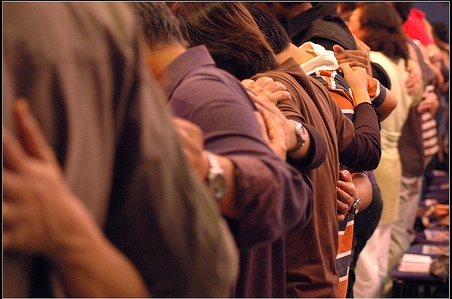
 In speaking against the evils of “worship wars” within God’s Church, John Mark Hicks, Johnny Melton, and Bobby Valentine say arguments and divisions over corporate worship practices are a sign of immaturity. Their book, A Gathered People: Revisioning the Assembly as Transforming Encounter, argues that our Sunday morning assemblies are fundamentally sacramental. They are encounters between God and his people that act to form and transform us more into the image of his Son.
Arguing over the many various styles and practices, they say, denies that basic premise:
We must learn to not only tolerate this diversity but to appreciate it and even learn from it. Diverse worship styles are one of the ways the body of Christ bears witness to the one gospel among diverse cultures and subcultures. As long as we are regulated by the gospel, we should value diversity as it reaches people beyond the limits of our own settings. But this demands maturity. The gospel calls us to put the interests of others above our own. As we walk worthy of the gospel, this calls us to listen to each other and prioritize others’ — including unbelievers. This demands mature discipleship.
The first level of maturation is tolerance. Can we tolerate different tastes and styles even when we do not like them?
A second level of maturation is mutual consideration. Can we not vary our styles out of respect for what touches the heart of another even if it does not touch ours?
The third level is appreciation. Can we appreciate what a particular style does for one even though it is not as meaningful to us?
The fourth level is appropriation. Can we practice what is uncomfortable for us for the sake of the other? The gospel demands that we do because Jesus himself endured great discomfort — to put it mildly — for our sakes. As disciples of Jesus, we must follow him into that kind of discomfort, even suffering. To say that we must “suffer through” a particular song for the sake of another trivializes the cross of Christ but to deny that song to others simply on the basis of our own comfort and tradition is to reject the cross of Christ for narcissism.
I long for the day when all of us — ALL OF US — mature to the point of worshiping together in Christ-like unity and mutual encouragement. What if the teenagers on the third row begin singing How Great Thou Art with great energy and gusto? Not because they love the song. Not because it particularly speaks to them at all. They may actually really dislike the song. But they sing it at the tops of their voices because they look across the worship center and see how that song really impacts an older man. They enjoy singing it because they recognize that the middle-aged woman behind them sang this at her dad’s funeral. They delight in encouraging the others. They understand that their singing is, first, their offering to God, and, second, their offering to their brothers and sisters.
What if the older people stood and sang and clapped to Days of Elijah? Not because they enjoy the song. Not because they think the lyrics are especially moving. They may personally dislike standing and clapping. They may have a list of 40 things wrong with the song. But they see very clearly how that song speaks to the young people. They observe the joy it brings to others around them. They understand this is the song that some of these teenagers rock out to on the way to school in the mornings. So they sing loudly and robustly. To bless God and to bless their younger brothers and sisters.
What if?
What if we all began to grow in the Spirit to the point of understanding that everything we do in our corporate assemblies is an offering to God? Our songs are our offerings to our Father. Your grumbling or non-participation is a clear message to our God and to your brothers and sisters around you that you’re putting yourself first. That’s the only way to say it, right? Is there another way to view it?
Our prayers, our readings from Scripture, our time at the table, are all offerings. These are the things we bring and offer to God. Your brakes-off, full-steam-ahead, all-in participation is a way of acting like Christ. And it’s a sign of your spiritual maturity.
So, sing!
Peace,
Allan










Recent Comments