Category: 1 Corinthians (Page 8 of 21)

Chosen By God

“Now that you know God — or rather are known by God…” ~Galatians 4:9

Paul is using Old Testament language in this passage. “Known by God” is the same phrase used in the Greek translation of the Old Testament for the way God knows Abraham, Moses, David, Jeremiah, and the nation of Israel. The Bible says they are all known by God. And that phrase is mostly used of very important people at very critical junctures in the story. To be known by God is to be chosen by God. It’s God acting on your behalf. It’s God choosing through no merit of your own — you’ve done nothing to deserve it — to bless you and work in you and through you in his salvation story.

The point is that God is the prime figure. He’s the main actor, the initiator. God determines the appropriate time for his Son to come (Galatians 4:4). God sent his Son (4:4). God sent the Spirit into our hearts (4:6). God made us his heirs (4:7). Paul is pointing to what happens when you are grabbed by God, when God’s attention is focused on you.

The Bible is consistently clear on this. Salvation always begins with God, not you.

“There is no one righteous, not even one; there is no one who understands, no one who seeks God. All have turned away, they have together become worthless; there is no one who does good, not even one… No one will be declared righteous in his sight by observing the law… Righteousness from God comes through faith in Jesus Christ to all who believe. There is no difference, for all have sinned and fall short of the glory of God, and are justified freely by his grace through the redemption that came by Christ Jesus.” ~Romans 3:11-24

People don’t seek God; God seeks people. Humans are so caught up in their sin, they’re so in love with their sin, they don’t seek holiness and righteousness on their own. God always has to make the first move. “We love because he first loved us” (1 John 4:19).

“The one who loves God is known by God.” ~ 1 Corinthians 8:3

In Genesis 18, God promises to bless Abraham and make him a great nation and save all people of the earth through his family. Why? “For I have known him.” God speaks to his people through the prophet Amos and reminds them, “You only have I known of all the families of the earth; you only have I chosen.”

God promises David that he will be king and that all David’s enemies will be defeated and that David’s family will reign on the throne forever. And David’s a little shook up. This is overwhelming news and David feels sort of inadequate. And he prays to God:

“Who am I, O Sovereign Lord, and what is my family, that you have brought me this far? And as if this were not enough in your sight, O Sovereign Lord, you have also spoken about the future of the house of your servant. Is this your usual way of dealing with people, O Sovereign Lord?” ~2 Samuel 7:18-19

What David knows about himself and about the throne, what David knows about God, is confusing and incomplete. Who am I that this is happening for me? Why am I so chosen and so blessed?

“What more can David say to you? For you know your servant, O Sovereign Lord.” ~2 Samuel 7:20

The answer is simple and profound and comforting. You know me. You chose me. That’s first. And that’s more than enough.

Peace,

Allan

Rocking Our Priorities

“I make myself a slave to everyone, to win as many as possible. To the Jews I became like a Jew, to win the Jews. To those under the Law I became like one under the Law, so as to win those under the Law. To those not having the Law I became like one not having the Law, so as to win those not having the Law. To the weak I became weak, to win the weak. I have become all things to all people so that by all possible means I might save some. I do all this for the sake of the Gospel.” ~1 Corinthians 9:19-23

Do you really own the Good News of the salvation we have from God in Christ? I mean, do you really have it inside you? Do you understand that salvation is a free gift of God’s grace? Do you comprehend that your salvation is based on Jesus’ righteousness, not yours? Do you get that it’s founded on God’s holiness, not mine? Have you grasped that eternal life is an undeserved, unmerited, by-God gift?

Because, when you do, it changes everything. It rocks your priorities.

Suddenly, church traditions take a back seat to grace. My feelings and preferences defer to the needs of the lost. My idea of justice is not as important as forgiveness. Rules and regulations take their place behind mercy and patience. And love for God and love for neighbor far surpasses all of it!

“I have become all things to all people.”

Depending on circumstances and who was involved and what the issues were, the apostle Paul could come across as really inconsistent. And he was fine with that. Whatever it takes to save people! In one case, Paul insists that Timothy be circumcised and in another case he demands that Titus not be circumcised. Do you have questions and doubts about that? What about Timothy!?!

Paul would do almost anything. He would change his mind, he would adjust his methods, he’d relax his rules, and confront the traditions. He’d do anything to make sure people could hear the Good News about Jesus.

Paul was not a chameleon because he had no conviction; he had a conviction about the Gospel that allowed him to be a chameleon. He would do anything to win people to Christ.

Peace,

Allan

First Importance

“What I received I passed on to you as of first importance: that Christ died for our sins according to the Scriptures, that he was buried, that he was raised on the third day according to the Scriptures, and that he appeared to Peter, and then to the Twelve.” ~1 Corinthians 15:3-5

The resurrection of Jesus from the grave is the very foundation of our faith; it’s the energy behind our hope; it’s the source and the sustenance of our life; it’s everything.

First importance, Paul says. This is the whole enchilada. Apart from this, nothing else matters. Jesus died, he was buried, he was raised. And we know it’s a fact because he appeared to all these witnesses. Ask them yourselves. They saw him. They talked with him. They ate with him. Most of them are still alive, ask them!

Everything hinges on the resurrection. I hear people argue that it doesn’t matter if the resurrection really happened or if it’s just a metaphor or a spiritual concept — what matters is that we take the stories to mean we’re all going to heaven someday.

No! The resurrection means everything!

The resurrection totally eliminates any possibility that Jesus was just a good moral teacher or that Christianity is just a nice way to live a good moral life.

“If Christ has not been raised, our preaching is useless and so is your faith.” ~1 Corinthians 15:14

Paul says clearly and unapologetically if the physical, bodily resurrection of Jesus has not happened, then Christianity is worthless. Jesus isn’t a good teacher, he’s a liar, he’s a fraud. Christianity is not a nice way to live, it’s a scam, it’s evil. If Christ is not raised, then death is not conquered. If Jesus is not alive, then I have no hope. None. And we are to be pitied more than anybody else on earth.

But Jesus was raised. Jesus is risen. He is reigning right now at the right hand of the heavenly Father and he is interceding for us. Right now. And because of that we have faith and hope and life. We have forgiveness and salvation and confidence and immortality and peace.

Peace,

Allan

Expressing the Gospel

If the table is the place to experience the real presence of Christ and the real fellowship and community we have together with God’s people — if the purpose of communion is, well, communion — then the way we do it matters. The form of the Lord’s Meal serves the function. In fact, I’ll suggest the form is the function. In many ways, the medium is the message.

You wouldn’t raise money to fight the sexual exploitation of women by having a car wash at Hooter’s. You can’t hold a Weight Watcher’s meeting at Furr’s Cafeteria. We don’t ask people to pay for Financial Peace University with a credit card. That defeats the purpose. The form matters.

That’s what’s wrong with the Lord’s Supper in Corinth. That’s what the apostle Paul is so concerned about: the form, the way they were eating the meal. The form of their meal was working against the purpose of the meal. In fact, Paul tells these Christians, the way you’re eating it, it’s not the Lord’s Supper at all.

“When you come together, it is not the Lord’s Supper you eat, for each one eats his own supper without waiting for anyone else.” ~1 Corinthians 11:20-21

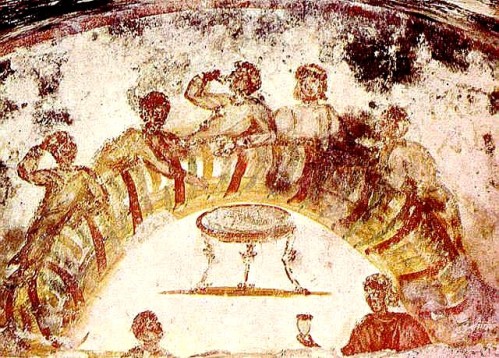
It’s important to remember that the Church’s Lord’s Supper started out as a full meal. For almost the first 300-years, the Lord’s Supper was a potluck. The Greek word “dipenon” is translated as dinner, feast, meal, banquet, main meal. It most commonly refers to the main evening meal. And, according to Paul, if the church eats the meal one way, it’s the Lord’s Supper; if you eat it another way, it’s your own supper.

So, what’s the problem Paul’s trying to correct? What are these Christians doing wrong?

“When you come together, it is not the Lord’s Supper you eat, for each one eats his own supper without waiting for anyone else. One remains hungry, another gets drunk. Don’t you have homes to eat and drink in? Or do you despise the Church of God and humiliate those who have nothing? What shall I say to you? Shall I praise you for this? Certainly not!” ~1 Corinthians 11:20-22

The problem at this church was the breakdown of community during the Lord’s Supper. You’re not waiting for others, you’re not sharing your food with others, people are going hungry, people are being humiliated. The rich Christians are getting stuffed and drunk while the poor Christians are starving and being singled out as not belonging. People are going back for seconds before others have been through the line once. They’re saving seats. Members are on one side of the room and visitors are on the other. New members are eating by themselves. Division. Selfishness.

Even if they had no idea what the Lord’s Supper is all about, common courtesy demands they refrain from getting stuffed and drunk while their brothers and sisters are hungry. But their meal was being shaped by culture instead of Christ. The Gospel is all about breaking down barriers and uniting together in holy community. Only thinking about yourself, only worrying about your own needs at the Lord’s Supper denies the Gospel the Lord’s Supper is intended to demonstrate. Paul says it makes a mockery of God’s Church.

So, that’s the problem. What’s the corrective? How does he fix it? By pointing to Jesus. He reminds them of Jesus.

“For I received from the Lord what I also passed on to you: The Lord Jesus, on the night he was betrayed, took bread, and when he had given thanks, he broke it and said, ‘This is my body, which is for you; do this in remembrance of me.’ In the same way, after supper he took the cup, saying, ‘This cup is the new covenant in my blood; do this, whenever you drink it, in remembrance of me.’  ~1 Corinthians 11:23-25

The table is shaped by the salvation work of Jesus. The Church’s Meal reflects and demonstrates the Gospel values of sacrifice and service. The Lord’s Supper expresses the way of Jesus: selflessness, giving to others, considering the needs of others more important than our own.

“For whenever you eat this bread and drink this cup, you proclaim the Lord’s death until he comes.” ~1 Corinthians 11:26

The Lord’s death broke down all the barriers between us and God and between us and each other. The Lord’s death unites all God’s people together. Around the table on Sundays and anytime we eat and drink together in his name, we’re proclaiming and practicing all the salvation things Jesus died for. The meal proclaims everything that was accomplished at the cross: acceptance, fellowship, unity, forgiveness, peace, love.

And when Paul uses the term “Lord” and when he says “until he comes,” he’s reminding us that Jesus is alive and he’s coming back! And until he comes, we express and experience the realities of our salvation with him and one another in holy community around his table. How we eat the Lord’s Supper matters.

Peace,

Allan

Experiencing the Gospel

Some of us say the communion meal is the most important part of our Sunday assemblies. That’s the whole reason we come together. In fact, some people leave church right after the Lord’s Supper: the crumb, the sip, we’re good, I’m gone! Our actions betray us: We take communion to the hospitals and preside over a lady in a wheelchair breaking a cracker while three men stand by and watch. Our language betrays us: We say we offer the Lord’s Supper on Sunday nights or in our small groups to people “who need it.”

The Lord’s Supper is not a binding duty or a mechanical ritual. It’s not a box to check or a magic pill to swallow. It’s about love and unity and fellowship.

We’ve done everything we can to mess it up. For several centuries now the Church has gone to great lengths to make the meal as private and personal and individual as possible. The joyful communal meal of the early Church has become a crumb of cracker and a sip of juice in quiet, somber, introspective, individual bubbles: “Don’t distract me!” We’ve removed ourselves from the transforming character of the meal.

If the Gospel is that by the death and resurrection of Jesus we can be totally forgiven of our sins and be completely cleansed and pure and can come right into the very presence of God; if the Good News is that we can have a holy and righteous relationship with God and one another; if the Gospel is that we are united with Christ and united with one another in Christ, where do we experience that? How does that become real for us? How do we feel it and know it’s true?

At the table. We experience the Gospel at the table.

Let’s remember our big picture understandings of the communion meal. The Lord’s Supper is eating and drinking a celebration meal with God. Remember, that’s God’s goal. That’s what God is after, it’s what all of salvation history is about: God eating and drinking with us. Because sharing a meal together means there’s relationship. You’ve got things in common. No barriers. There’s acceptance and understanding and trust and friendship around the table. When we’re all dipping our chips into the same bowl of salsa, all the walls are down. There’s community. That’s what God wants with us.

What makes the communion meal a sacrament is that by God’s Holy Spirit, we actually are participating in the reality it represents. We are literally eating with Jesus. Somehow, mysteriously, he meets us at the table and eats with us. All of us.

The table is where we experience what it means to be saved. The oneness, the forgiveness, the community, the relationship, the unity, the acceptance, the fellowship, the common ground. The blood of Christ is what makes us righteous and clean. And the Bible says in 1 Corinthians 10 that when we drink the cup together, we participate in those benefits. Eating the bread together is a communion or a sharing in the unity we have in Christ. We are the body of Christ together. And we experience that around our Lord’s Table.

The people of Israel eat the sacrifices and so receive the benefits of forgiveness and community that’s achieved at the altar. We eat the meal and receive the gifts of forgiveness and community that are achieved at the cross.

By faith, our baptisms make us one people in Christ. No divisions, no differences, no distinctions — we are one body in Christ. And we experience that around the table. The peace, the reconciliation, the community with God and one another.

You want to feel like you really belong? You sit down to a meal with your family.

Peace,

Allan

Unworthy Manner

“Therefore, whoever eats the bread or drinks the cup of the Lord in an unworthy manner will be guilty of sinning against the body and blood of the Lord. A man ought to examine himself before he eats of the bread and drinks of the cup. For anyone who eats and drinks without recognizing the body eats and drinks judgment on himself.” ~1 Corinthians 11:27-29

Boy, we have latched onto these three verses, haven’t we?! Our distortion of these three verses, maybe more than any other passage in the Bible, has irreversibly changed the dynamic of the Lord’s Supper from one of joyful and communal participation in salvation and life to one of somber and individual reflection on sin and death. And the key phrase in these key verses is “unworthy manner.”

The Greek word in the original text we translate “unworthy manner” is “anaxios,” and it’s an adverb, not an adjective. In this context, “unworthy” doesn’t describe you. This is not about the state of your soul or the status of your salvation or what you’re thinking about during the meal. “Unworthy” describes the way you eat and drink, the “manner” of your eating and drinking. “Unworthy” is describing the verbs, not the nouns.

Whether or not you are unworthy to eat and drink with the risen Christ and his holy people isn’t the concern. That question has already been answered: No, you are not worthy! None of us is worthy! We are unholy sinners who have no right to be in God’s presence, eating with him at his feast.

Or…

We are all worthy! By the death and resurrection of Jesus you and I are worthy! We’ve been made worthy by grace through faith in Christ. You see what we’re saying? The question of our worthiness is not the issue at stake in this passage.

The concern is, now that you’re at the Supper, how are you eating and drinking? Are you only concerned about yourself? Are you isolating yourself and others at the table? Are you paying attention to the people around you? As you eat and drink, are you recognizing the body?

The main point of the Lord’s Supper is to share it with one another, not satisfy your own needs. That’s the core of Paul’s instructions in this section of his letter to the Christians in Corinth:

“So then, my brothers and sisters, when you come together to eat, wait for each other.” ~1 Corinthians 11:33

Some translations say “welcome each other.” The point is that we eat together.

The joyful communal meal of the early Church has become a crumb of cracker and a sip of juice in quiet, somber, reflective, individual bubbles: “Don’t distract me!” Scripture says the focus during the meal, of our bodies and our brains, should be on one another.

Peace,

Allan

« Older posts Newer posts »