Author: Allan (Page 369 of 500)

Styrofoam Helmets & Roadkill Sheep

I love summer time at Legacy. Summers at Legacy just seem to be less formal, more relaxed, really fun. That’s not to say the pace is slower. No, no, no. It’s faster, much faster. Maybe even a bit hectic. But it’s really, really fun.

Wednesday night sno-cones. Brand new youth interns to initiate. Mission trips and summer camps. Messy games day. All the college kids back home, roaming the church halls, showing up for morning prayers and Bible studies, crashing our backyard pool, toilet papering our house. Sunday night cookouts and kites. Extra visitors. Faith Builders. Even in the middle of all the vacations and travel and trips, it just seems like summer is when our whole church family is really together. And it’s a lot of fun.

And, of all the special things and times we enjoy during our Legacy summers, VBS is my favorite.

I love Vacation Bible School because I get to see our church family at its best. During VBS, we give of ourselves to little kids. We do things we don’t normally do, for the sake of little kids. We sacrifice. We bend. We stretch. We get down in the floor and pick up washers, we burn our hands on Shrinky Dink ovens, we cut out sheep and sew rock pouches, we build sets and learn songs, we run up and down stairs and make one million trips to the workroom. For the sake of little kids.

I love Vacation Bible School because I get to watch people like Eric Gambill and Charles Barkley (real name) break out of their shells. I’ve never heard more than six words out of either of these guys. But I’m inspired when I watch them sing and dance and act as David and King Saul. For the sake of little kids. And those outgoing people with all the personality and talents? People like Kristen Sharp and Christy Roof, Vic Akers and Bill Crawford? It’s a blast watching them take it to that next level. Over the top! And where else can you see Doug Deere in eight-inch platform shoes, with an accent that sounds like a cross between Foghorn Leghorn and Mr. T, hamming it up as Goliath, and then tearfully pouring his heart out to the church when it’s all over, reminding us that our God is bigger and stronger than anything that might stand against us.

David Watson dressed one of our fifth graders, Elizabeth, as Goliath during our story time last night. He decked her out in a styrofoam ice-chest helmet, bubble wrap armor, a dashboard sun screen for a shield and an industrial sized leaf blower as a sword. Yes, he connects to our kids. Mike and Judy St.Clair and Jennifer Skelton wielded the hot glue guns to help our kids make little flat sheep out of recycled water bottles. They looked like road kill. In a funny way. Daryn Pope played David & Goliath Jeopardy with the kids, carefully making sure all four teams ended up with the same amount of points. And just as carefully making sure we all talked about the strength of our God and David’s great faith.

I love VBS because for four full days we all do things we don’t normally do. For the sake of the little kids. I love VBS because I keep thinking that one of these days it’s going to click that we need to always be doing things we don’t normally do for the sake of others. We need to be willing, even eager, to bend and stretch and run. We need to want to move and grow and serve for the sake of others. We’re quick to sing the songs and do all the hand motions, to throw out our backs moving stage pieces, to get our shirts messy with glitter and paint, and to walk the same little boy to the bathroom three times. For the sake of little kids. But sometimes for the sake of others we won’t budge an inch or move a muscle or give in on a single point or bow to a little request. I keep thinking that if we practice stepping outside our comfort zones for the sake of little kids, we’ll be more able to step outside our comfort zones for the sake of all our other brothers and sisters in Christ.

Peace,

Allan

Perspective Changes Everything

“The LORD does not look at the things man looks at.” ~1 Samuel 16:7

God chose David to be his king because he saw what was on the inside. God didn’t look at David’s age or his inexperience or his height or his looks. He looked at David’s heart and saw a man of faith and courage.

Once the Holy Spirit of God came upon David with power, the future king also began to view things differently.

When Goliath from Gath challenged God’s people in the Valley of Elah, Scripture paints a very stark contrast between David’s viewpoint and the viewpoint of the nation (1 Samuel 16:13). The Israelite troops are afraid of “this man,” while David sees the giant as nothing more than an “uncircumcised Philistine.” Saul’s soldiers say Goliath is coming out to “defy Israel.” But David sees it as much bigger. He says the enemy is “defying the armies of the living God!”

David sees the opposition to God for what it is. And he clearly sees the victory of God over that opposition. What scares and paralyzes the Israelite soldiers actually steels David’s resolve and motivates him to act in faith.

David never doubted God’s deliverance. Because God always delivers. We should all feel so deeply and act so boldly. And when the odds are stacked against us, it shouldn’t cause us to fear. We know that’s exactly when God does his best work.

Peace,

Allan

A Den of Robbers

“Is it not written, ‘My house will be called a house of prayer for all nations’? But you have made it ‘a den of robbers.'” ~Mark 11:17

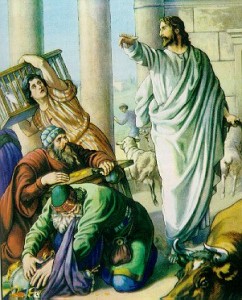
What made Jesus so mad that day at the temple? What riled him to the point of flipping tables and scattering coins and driving out doves and sheep? We generally speculate that pilgrims and travelers were being ripped off. Religious officials were probably cheating worshipers on the exchange rate between their Roman coins and the temple-approved currency. Sellers of cattle and sheep were overcharging and taking advantage of those who had come so far to sacrifice and whose animals had been harmed or blemished in some way along the journey.

Those things may very well be true. And if they were, that would surely upset our Lord. The only problem is that none of those things are attested to in Scripture. We have no scriptural evidence that anybody was being cheated out of money. The Gospels don’t speak or even hint at any economic wrongdoing.

We get the idea, I think, from Jesus’ statement about the temple being turned in to a “den of robbers.” But I believe we’ve missed the point. Jesus is not talking about money or possessions here. He’s quoting the Prophets. And if we go to the passages he quotes, it’s pretty clear what’s got him so angry.

Isaiah 56 is about God’s holy provision for those outside the nation of Israel. God loves the whole world, not just the Jews. And he’s going to take care of them, too. Isaiah 56 promises the “foreigner who has bound himself to the Lord” that he will never be excluded from God’s people. Eunuchs who keep God’s commands will always have a place “within my temple and its walls.” All foreigners who love the Lord:

“these will I bring to my holy mountain
and give them joy in my house of prayer.
Their burnt offerings and sacrifices
will be accepted on my altar;
for my house will be called
a house of prayer for all nations.” ~Isaiah 56:7

God has provided a place at his temple for Gentiles to gather and worship. God has promised covenant to these Gentiles and has sanctified a place for them to participate in the community life of God’s people. Gentiles, too, can experience the glory of God. Gentiles, too, can make sacrifices to God in faith that he will accept the offerings and forgive them of their sins. Gentiles, too, have a place in the Kingdom of God.

But it’s in these very temple courts — the Gentile courts, the Court of the Gentiles — where religious leaders are setting up shop and selling animals. They would never allow the inner parts of God’s temple to be turned in to a noisy, smelly, chaotic mess. They would never do anything to disrupt the expressions of praise and sacrifice from their own people in their special places. But these Gentiles? Yeah, let’s sell the animals there.

They are interfering with the divine provision of God. They are compromising God’s promises to the world. They’re messing with God’s plan. They’re depriving people of the space God has given them in which to worship. It’s a house of prayer for all nations, not just for people who look like me and talk like me and dress like me and behave like me. It’s not just for people who worship and sing and pray just exactly like us. It’s for everybody!

No wonder Jesus was so angry.

So, what’s it like at your church? Are the Hispanics relegated to an upstairs classroom in the back of the building? And is that classroom cluttered with leftover chairs and three ice chests from the youth trip? Where do the deaf worship in your church? Is it just understood that the homeless and the jobless and the “unchurched” won’t fit in? So nobody really tries?

Forget about the actual physical space for a minute. Do the ones who are not just like us — the new members, the move-ins, the poor, the young people, the old people, the divorced, the minorities — have a forum in your church to express their praise to God? Are they stared at, talked about, isolated, and discouraged from worshiping God? Or are they smiled at, hugged on, sung with, and encouraged to worship? Sometimes our haughtiness and complaints, our snide comments and dirty looks, our letters and threats rob our own brothers and sisters in Christ of their God-sanctioned forum and venue for giving him thanksgiving and praise. As Jesus says in John 2:16, “How dare you!”

“Accept one another, then, just as Christ accepted you, in order to bring praise to God.” ~Romans 15:7

Peace,

Allan

Get These Out Of Here!

“Get these out of here! How dare you turn my Father’s house into a market!” ~John 2:16

If Jesus were to walk into your church building tonight would he praise God for what is happening there or would he start flipping over pews? If Jesus walked into my church building on Sunday would he see empty ritual and dead tradition or would he recognize a living and vibrant people being transformed by a genuine relationship with God? What if he wandered into your elders’ meeting? What if he showed up to watch you prepare a sermon? Would Jesus be pleased to go through all the church policies in the secretary’s file cabinet? Or would that cause him to wince in pain?

When Jesus disturbs things in the Jerusalem temple, he is acting out his prophetic message. It’s not the power of the whip that makes his message succeed. It is his moral power, the power of the truth, that strikes the hearts of the people and so captures Christian readers today. Those who confront Jesus after the episode appear to know that Jesus is right and that the temple has become something other than what God had always intended. The purpose of the holy temple has been compromised. Maybe they sense something of God’s divine and righteous anger at work in Jesus.

Jesus is pointing out the problems with the institution of the temple. He is confronting its misdirection and its brokenness. In the process, he points out very clearly that the real activity of God, the real temple, is Christ Jesus himself. In other words, the focal point of the people’s religion has to be replaced by something — no, someone! — new.

The local church — my local church, your local church — is a fallen institution. It’s filled with sinners, filled with people just like you and me. Yes, the church aspires to goodness. But, admittedly, sometimes we succomb to programs and agendas that have very little to do with the Kingdom of God. Sometimes life in our churches can be driven by petty financial interests or social comforts and desires. We sometimes play religious politics, church leaders acting as representatives of their particular constituents, when deciding church policy. We may give in to pressures to be more modern and contemporary. We may bow to petitions to defend empty traditions and dead habits.

If Jesus walked in for a visit would he be outraged over the things we argue about? Would he be appalled at the ways we sing? Or don’t sing? Would he question some of the lines we draw or challenge some of the rules we keep? Honestly, we have plenty of religious customs and practices — even doctrines — that have everything to do with tradition and habit but may have little to do with our risen Lord. We must be willing to allow Jesus to step into our church worlds and openly critique the things we do and the ways we do them. Could the things we cherish and defend stand up to Jesus’ prophetic viewpoint?

I truly believe that everything we do in our churches and in our individual lives as disciples of Christ must have as its foundation the very Gospel we preach and teach. The root of our words and deeds must be connected to the life, death, and resurrection of Jesus. Our traditions and rituals must be born out of and give expression to the Lord who welcomes and forgives and loves and sacrifices. The One who invites all to his wedding feast, the One who gives in abundance the riches of heaven must be the informing and driving force behind every single thing that happens in church.

It’s OK to review and evaluate our habits. It’s allright to challenge our traditions. If they stand up to Christ’s critique, then affirm them. Teach them and practice them in all holiness and sincerity. But by all means be able to explain to your people and your community the hows and whys. If they can’t meet the Gospel standard, then discard them. Destroy them and abolish them in faith and trust in God. And be able to explain the hows and whys based on a true understanding of what Jesus came to this earth to do. And what he came to this earth to change.

~~~~~~~~~~~~~~~~~~~~

You’ve got to watch this 90-second video they’re showing at American Airlines Center to pump up the Mavs fans during these NBA Finals. The video features the most accomplished athletes in the history of DFW talking to Mavericks fans about what it means to win it all. An intense Emmitt Smith. A relaxed Daryl Johnston sitting in front of a couple of Super Bowl trophies. A no-nonsense Troy Aikman. An overly-animated Tony Dorsett with his Heisman Trophy. A blank-stare, monotone, can-we-just-get-this-over-with Nolan Ryan with the A.L. Championship hardware. Mike Modano. Gary Patterson with TCU’s Rose Bowl trophy. Roger Staubach in front of a portrait of downtown Dallas. And Ron Washington from the Rangers dugout in Arlington.

You must watch the video all the way through, all the way to the end.

Classic.

Peace,

Allan

The Back of the Line

“Thanks be to God who always leads us in triumphal procession!” ~2 Corinthians 2:14

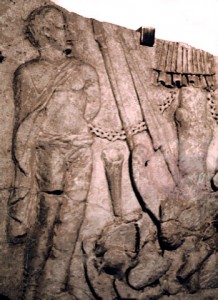
The apostle Paul writes while enduring great anxiety over his brothers and sisters in Corinth. He writes to give them a new perspective. He writes to bolster his own strength and faith. He writes about a great Roman military victory parade. The conquering general rides in a gold chariot up front. The senate and magistrates follow. Behind them are the royal and military musicians. The spoils of war, the loot from the conquered lands, is paraded next. And then the captives in chains, the prisoners of war, in the back of the line.

Paul says, “I’m in this parade! You’re in this parade! God is leading us in this triumphal procession! We’re all in this parade together!”

But the technical nature of the term and the linguistic nature of the verb can only mean one thing: Paul is not at the front of the parade with God. He’s at the back of the line with the captives.

Paul sees himself as a slave to Christ. He’s been captured by Christ, he’s a trophy belonging to Jesus, he’s one of the spoils of God’s great victory over sin and death. Paul is thrilled to be in the metaphorical chains of the conquering Christ and the unstoppable Kingdom of God. Paul shows us in a very graphic way his understanding of Christian ministry. He paints a vivid picture of himself — a picture of all of us — being led by Jesus in a long line to our own suffering and death.

See, the captives are the physical evidence of the victory. The conqueror receives the glory and honor due him when the world sees the people he’s defeated. The people at the back of the line, the conquered people in chains, are a display of and a testimony to the glory and majesty and power and authority of the conqueror in the gold chariot up front.

That’s Paul. That’s us. That’s the way he sees things.

“It seems to me that God has put us apostles on display at the end of the procession, like men condemned to die.” ~1 Corinthians 4:9

Paul goes on in that 1 Corinthians 4 passage to say we are humiliated. We’re ridiculed. We are the objects of great wrath and scorn. We’re spit upon by the crowds as we walk to our executions.

Things don’t always look so good from the back of a line like this. It doesn’t always feel good. Sometimes it’s downright painful.

But this is exactly where our Father wants us. God doesn’t want us better; he wants us deader! Dead to ourselves! Dead to the world! Completely dependent on God! Totally leaning on him for every step, every move, every breath! Wholly reliant on him for life itself!

Paul counts it as a blessing and a privilege to be led by Christ as his captive, as his slave, and to participate in this way as a part of God’s triumph. Paul has actually grown comfortable at the back of this line. He’s come to understand that “the all-surpassing power is from God and not from us.” He knows that “all of this is from God” and none of it is from his own strength or smarts. He knows that “our competence comes from God.”

Those are the lessons learned from the back of the line.

And that’s precisely where ministry is done. From the back of the line. God is glorified in his captured people. He is praised and honored by his slaves. May we stop wrestling with the chains and fully embrace them in complete submission to our Lord and King.

Peace,

Allan

« Older posts Newer posts »