Author: Allan (Page 251 of 500)

Instrument of God’s Peace

Mom70We spent all weekend behind the Pine Curtain in Liberty City celebrating my mother’s 70th birthday. As our children get older and our schedules become less predictable, getting the entire family together is becoming more and more difficult. But it’s always worth it. Dad grilled burgers in the rain, we played football and Frisbee and board games, we ate a ton, laughed a lot, and worshiped together as a big family yesterday morning at the Chandler Street Church of Christ in Kilgore.

The highlight for Carley was probably getting to drive the Impala. My dad owns a fully restored 1960 Chevrolet Impala that belonged to my grandfather. It’s a beautiful turquoise head-turner: huge fins on the back, wide whitewall tires, rocket-style tail lights, wrap-around windshield, add-on AC, and plenty of chrome. The younger kids all wanted to go for a ride and, somehow, they returned to the house with Carley behind the wheel. I’m not sure how she talked her grandpa into letting her drive, but it was pretty cool.


1960Impala1960Impala2


~~~~~~~~~~~~~~~~~~~~~~~

I received an email from Jerry Taylor last week. Totally out of the blue. Completely unexpected. No context. No explanation. Just a couple of short sentences from a great man of God whom I respect and admire.

“One person has said about the current political season that this is a time of moral reckoning for every American citizen. It can better be said that this is a time of moral reckoning for every Christian in America.”

That was it. Nothing else. Short. Simple. Yet penetrating. And provocative.

ShoutingI wonder about those in the United States who declare themselves to be Christians and, at the same time, are personally and emotionally invested in the race for president. As the shouting grows louder, as the insults become more pointed, as the fear tactics reach ridiculous levels, how do Christians participate in the process without personally joining and even contributing to the rancor of the political campaigns? I’m sure it’s possible; I just wonder how. It seems to me it would be maddeningly difficult.

Is there even one political YouTube video you can recommend that only builds others up without tearing anybody down? Is there even one political email you can forward that only encourages people without insulting or disparaging others? If you put a candidate’s name on the back of your car, are you telling everybody that you agree with that candidate’s position on everything and that you stand by his or her tactics? It must be really difficult for a Christian to engage this thing and still hold true to our calling as ambassadors for Christ.

I’ve been thinking about the opening lines of an ancient prayer that’s been attributed to St. Francis. The prayer petitions God to empower the one praying to be an instrument in the world of God’s peace. The one praying is asking God to work through him to show the world a different way

Lord, make me an instrument of thy peace;
where there is hatred, let me sow love;
where there is injury, pardon;
where there is error, the truth;
where there is doubt, the faith;
where there is despair, hope;
where there is darkness, light;
and where there is sadness, joy.

I’m sure I’m not the only one who’s getting the forwarded videos and emails, who’s thrust into the conversations at meal times, who’s bombarded with the rhetoric while waiting in line at Wal-Mart or while I’m getting my oil changed. How do you answer that hateful email? How do you reply to the mean-spirited video? How do you respond to the insults that disparage entire groups of people?

What it requires is discipline. Diligence. A refusal to join the rage. A commitment to combat the evil with love and grace. A constant awareness. A continuing asking of the question: Am I acting as an instrument of God’s peace?

Christians have to be intentional about sowing love where there is hatred. We must carefully choose words that build up, never injure; we must speak to forgive, never to hurt. We have to look through the lens of Christian hope in the face of so much despair. We must be full of joy when so many around us are filled with hate. And it’s not going to happen accidentally. We have to do this on purpose.

Peace,

Allan

The Counter Cultural Way

JesusPraysInPainThe Word of God confronts us with two ways. The Law and the Prophets, the Psalms and Proverbs, the Gospels and Letters all present us with the choice of two ways. It’s not where you’re going to live or what career you’re going to pursue or who you’re going to marry or where you’re going to eat. The choice given us in Scripture certainly encompasses and impacts all the daily choices we make while we live in those places with the people we marry and in the work we do and while we’re eating lunch. But there’s only one choice in the Bible: the way of life of the way of death; the way of blessing or the way of curses; the way of God or the way of the devil.

Jesus says, “I am the Way.” I am the Way to God and I’m also the way God comes to you. I’m a two-way Way. And so we choose Jesus. And when we choose Jesus, what is it specifically that we’ve chosen? What are we signing up for when we say “Yes” to Jesus?

Well, the Gospels tell us plainly that Jesus’ Way is counter cultural. Popularity and power mean just about everything in our society, but popularity and power mean absolutely nothing to our Lord. In the Gospels, it looks like Herod has the power. The governing officials in the Roman Empire have all the power. So the Roman soldiers. The religious leaders have a lot of power. The chief priests and teachers of the Law and the Sanhedrin wield plenty of power. And all of these people and groups seem to have their way with Jesus. Jesus is the lowly servant who’s despised and rejected, beaten and crucified. Cursed by God and man.

But remember the centurion clearly sees the truth when he sees how Jesus dies: “Surely this man was the Son of God.”

Jesus’ way is upside down. It’s counter cultural. Our default, though, is the pursue the ways of the world. As disciples of Jesus individually and as churches of God collectively, we’re not very careful with this. Without even thinking about it, we embrace and adopt the ways of the culture. We imitate the ways used by powerful people who run large companies and corporations, high profile people who lead political parties and nations. By threat and force and power; with money and might; by out-yelling and out-insulting others; by demonizing those who disagree with us; by walling ourselves off from anyone who may do us harm. And we don’t even consider that those ways are totally at odds with the way of Jesus.

We see accomplished men who’ve achieved great success by using these worldly methods and we make them elders of the church. We make these guys preachers of the Word. Whatever the culture decides is exciting and successful and influential, whatever gets things done, whatever will gather a crowd.

We usually have to take four or five different looks at guys whose main character traits are gentleness and humility before we consider them for leadership roles — if we even look at those kinds of guys at all. Shouldn’t the man who lives only to serve others be moved to the top of the list? Shouldn’t the guys who consider the needs of others more important than their own, the guys who refuse to advance their own agenda, the guys who you’ve never heard say one bad thing about anybody else, shouldn’t they be the frontrunners for leadership positions in our congregations? Shouldn’t they be the ones to set the tone in our churches?

Peace,

Allan

The Personal Way

JesusHealsBleedingWomanPeople matter to Jesus. Individual people — men, women, and children; young and old; rich and poor; educated and ignorant — mean a whole lot to Jesus. We find Jesus in the gospels calling crowds and feeding multitudes. But the main image is of Jesus with individuals. He heals individuals. He comforts and encourages individuals. Nothing’s abstract with our Lord. It’s not theory. It’s not impersonal. The Jesus Way is clearly a very personal way to be.

We’re carefully considering the Gospel of Mark here at Central. And I’m impressed by this picture Mark paints of a very personal Jesus.

On the opening page he presents Jesus as taking Peter’s mother-in-law by the hand and helping her up. He touches the man with leprosy. He calls Levi and then eats dinner with him at Levi’s house. The bleeding woman touches him and he calls her “daughter.” He takes the dead girl by the hand, it says, with her mom and dad there in the room with him. “Little girl,” Jesus says. On and on Jesus is touching people, hugging people, eating with people, meeting with people. Jesus’ Way is personal.

And we don’t always think about it. We write checks. We build buildings. We create programs. We serve on committees. And those are all really great things. Praise God for those wonderful things! But I feel like there are fewer and fewer visits in one another’s homes. I think there are fewer and fewer face-to-face conversations. Fewer touches and hugs. Fewer confessions. Fewer prayers lifted up together through streams of tears. Fewer and fewer deep, close, personal relationships.

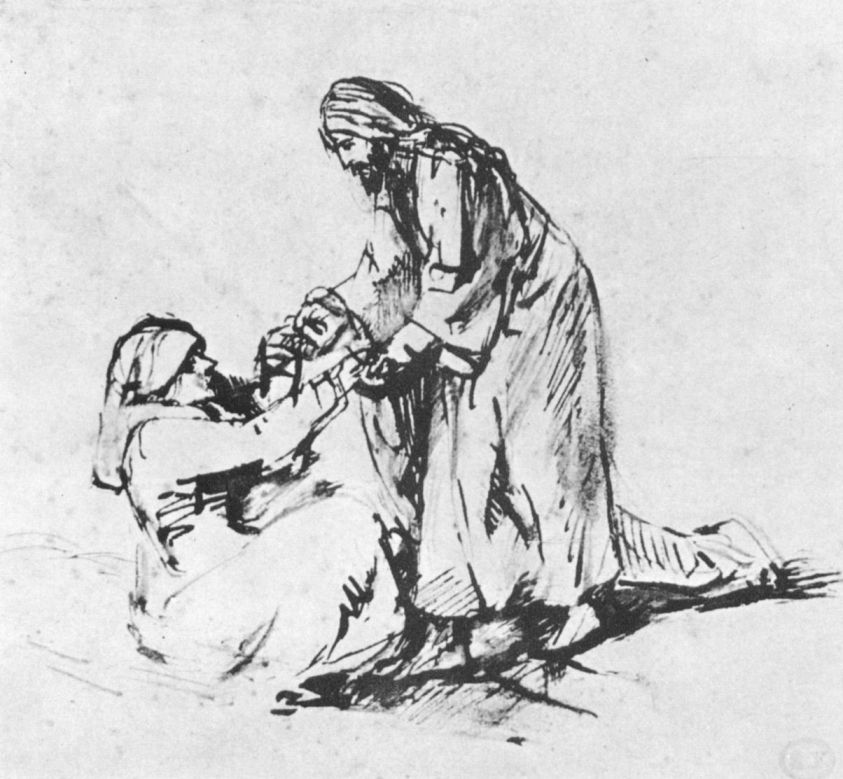
JesusHealsSketchIn the gospels, Jesus doesn’t stand on the edges of the scene. He never waits for something to happen. He grabs people, he walks toward situations. He makes things happen.

The way of Jesus is in bearing the burdens of others. Carrying the pains of others. Sharing their hurts. Not avoiding it. Not shielding yourself from it.

You can never go wrong showing up at somebody’s house to pray. That is always the right thing to do. You can never go wrong showing up at a funeral to cry. That is always the right thing to do. You can never go wrong showing up at a hospital to sit with somebody. That is always the right thing to do. And you’ll take it home with you. You won’t be able to shake it. It’ll keep you up at night. It’s heavy and it’s hard. It will burden you. It’ll impact you.

But it’s so like our Lord.

It’s so like Jesus who did not one time shy away from entering your mess and carrying your burdens. He walked toward you and your mess, he never walked away from you. He came to us and waded right into the middle of the tragedy of our lives to love and heal and restore. And it cost him. It cost him his life.

Peace,

Allan

Happy 180th!

TexasFlagDetailBetterOn March 2, 1836 — that’s 180 years ago today — fifty-nine courageous pioneers signed the Texas Declaration of Independence, forming forever the great Republic of Texas. I’d like to invite you to celebrate this Texas Independence Day with your favorite plate of barbecue or tacos, listen to your favorite Willie Nelson or ZZ Top album, and praise God you weren’t born in Arkansas or West Virginia or some other awful place like Oklahoma.

I’d also like to ask you a question: Do you know our state song? Do you know the title? Do you know the lyrics?

If you immediately answered “Texas, Our Texas,” give yourself a pat on the back. If you can sing the song with all the right words in the right order, then give yourself a standing ovation and use what’s left of your lunch hour to design and print an official-looking certificate to honor your achievement. Up until last weekend, I wouldn’t have thought that knowing and being able to sing on demand our official state song was any kind of special accomplishment for anyone born and raised in our great state. But a troubling article in the current Texas Monthly brought that assumption into serious doubt.

TexasOurTexasChristian Wallace has written an informative and highly entertaining piece on the colorful history of our state song. His premise is a provocative one: our state song is a terrible song. No one knows it, no one remembers it, and no one ever sings it. Our state is too great to have such an awful state song. While Wallace makes a decent argument, I was most struck by his initial evidentiary proof. He claims to have conducted many informal surveys among friends and neighbors, passersby and strangers, and the overwhelming majority of them are unable to name our state song. Nobody can sing it.

I was offended by the very notion. Why, we sang it regularly in elementary school choirs and special programs and learned it again in 7th grade Texas History class. It’s our song! While driving back and forth across the Red River for a variety of reasons during my teenage years, I never failed to turn the radio down so I could belt out “Texas, Our Texas” as I crossed the border. “All hail the mighty state! So wonderful, so great!” Didn’t everybody do this?

Apparently not. I’ve conducted my own informal surveys this week with friends and co-workers, cashiers and waiters and passersby. Nobody knows our state song. A lot of people guess “Yellow Rose of Texas.” One lady argued with me about “The Eyes of Texas.” Some folks wrinkled up their faces and said, “We have a state song?” It pains me to say that Wallace is on to something.

I highly recommend his article. You can get to it by clicking here.

~~~~~~~~~~~~~~~~~~~~~~~~~~~

KeithSermonSeminar2013Today is also my brother Keith’s birthday. He’s not 180. And I don’t think he has his own song. If he does, it might be “The Rover” from Led Zeppelin’s Physical Graffiti. If you wanted to celebrate his birthday, you might watch Naked Gun tonight, careful to skip past the scene on the ledge and to watch the balls and strikes scene at least twice.

Keith is an outstanding theological thinker, faithful follower of our Lord, and devoted servant of God’s Church. His article “Restorationism and Church History: Strange Bedfellows?” from the Christian Studies journal he edits is a classic work on the complicated relationship between Churches of Christ and the whole of pre-restoration church history. I highly recommend it, too. He takes head-on our Cambellite creed of “nothing not as old as the New Testament” and introduces us to the concept of “retrieval theology” that seems very helpful:

“This is not a call to re-create or ape the faith and practice of a specific time or place from the past; not every thought or practice in church history is equally good or relevant for us. It means learning from the wisdom of our ancestors and appropriating the best that it has to offer for the sake of the church today.”

You can get to it by clicking here: KeithStanglinRestorationism

Happy Birthday, Keith. I’m very proud of you and very honored to be your brother.

Peace,

Allan

Saying “No” to the Good Ol’ Days

Demolition update from the west parking lot at Central Church of Christ: two buildings down, one to go.

MadisonApts4MadisonApts5MadisonApts6
MadisonApts7


VotePinAs the Super Tuesday voting frenzy continues — on the streets of Amarillo, along the crawl at the bottom of my laptop screen, on the TVs at the Chinese food restaurant — I’d like to consider aloud a question posed by Philip Yancey in his 1999 work The Bible Jesus Read:

“Is it possible that God permitted the entire tragic experiment of Israel’s nationhood in order to prove a point about the visible kingdom — any visible kingdom? Solomon, with every advantage of wisdom, power, and wealth — all good gifts from God — led his nation to destruction. Did God grant Solomon those advantages in order to put to death illusions and thus prepare the way for a new kingdom?”

David had every blessing of God’s strength. He possessed great military might and strategic power. He conquered foreign lands and expanded Israel’s territory. Every enemy Israel ever had surrendered to David’s kingdom. Solomon after him had every blessing of God’s wisdom and peace. Great building programs. Wonderful economy. Peace. And it all failed. It collapsed. It was destroyed.

All kingdoms of this world are built on strength and power, on wealth and force, violence and intelligence. Yet even at their very best, they all fail. History has proven this over and over again.

Yancey continues:

“A later king — one greater than Solomon, he claimed — established his rule instead among the lame and poor and oppressed and ritually unclean. He belittled Solomon’s glory by comparing it to that of a common day lily. He offered no rewards other than the prospect of an executioner’s cross.”

Consider that the Jews in Jesus’ time were clamoring for a return to the good ol’ days. They wanted a Davidic King who would restore the nation back to the days when they were in charge, when they submitted to no one, when their enemies bowed to them, when the differences between them and everybody else was clear. They were hungry for a return of their nation to Solomon’s splendor, when peace was protected by the world’s biggest army, when religion reigned in fancy robes under the magnificent national temple, when everybody had plenty of what they wanted.

Jesus said “No” to that. Clearly.

Even after he was brought out of the tomb by God’s Holy Spirit, the disciples were still asking, “Are you going to restore the kingdom now?”

I hear Christians today clamoring for some return for the United States to some long ago glory days when followers of Jesus were in charge. Christians made the rules, I hear. Christians set the tone, they say. Christians had the respect, the power, the influence. Our churches were full and the laws of the land reflected our Christian will. That’s what they say. And, apparently, that’s why they vote. For the good ol’ days of Bush. Or Reagan. Or Solomon.

The good ol’ days were never ever ever better than David’s and Solomon’s. Those were the very best of anybody’s good ol’ days. And Jesus said “No.”

The kings of Israel who followed Solomon did not learn. The disciples who followed Jesus did not learn. What about us?

Peace,

Allan

Bye to Matt, Sort Of

MadisonApts2MadisonApts3

The Madison Apartments are coming down! The three dilapidated buildings on the northwest corner of our church property have long been a security risk, a safety hazard, and an eyesore. Our grand plans to remodel the structures for the expansion of Heal the City’s free clinic were scuttled by the YMCA’s outright donation of their building on Sixth Street to the non-profit group last year. And, after much prayer and study, the decision has been made to just tear them down. This is just the very beginning stage of a long range plan for our church and a future capital campaign to fund those plans and ministries. In the meantime, please drive carefully this week around that corner of Central’s property.

~~~~~~~~~~~~~~~~~~~~~~~~~~~~~~~~~~

MattHatAfter twelve years of faithful congregational ministry at Central, we said goodbye today to Matthew Blake. Sort of. Matt and his wife Katie have made the decision to leave fulltime congregational ministry and pursue small scale farming and the salsa industry. Matt’s got farming in his blood and he’s eaten enough hot sauce in his lifetime that he probably has some of that in his blood, too. So, they’ve bought a nice little spread just east of Canyon where they’ll raise their own tomatoes, peppers, and onions and produce enough of his “Matchstick Salsa” to feed everyone who wants it, not just staff members and family.

Matt led our young singles ministry here at Central and has been a vital part of our foreign missions efforts and our visitors and new members ministries. His quiet, mild-mannered, even-toned personality appears to be in conflict with his wicked sense of humor and his propensity for playing clever pranks, but it actually all works perfectly together: he lulls you off your guard with a reflective soliloquy on the contemplative prayer life of a Benedictine monk while he’s plotting to replace the nameplate on your office door or fill the bed of your pickup with foul objects.

Needless to say, we laugh a lot around here together as a church staff, and Matthew is a big part of that.

MatthewApronWe also pray together and dwell in God’s Word together as a church staff, and Matthew is a big part of that, too. I’ve known him and worked with him for only four-and-a-half years, but his insights and personal commitment to a disciplined life of following Christ have impacted me and every minister and every elder at this place. I’m forever grateful for the practices and disciplines he’s introduced to me that help me better engage our God. And I’m equally grateful for his imprint in those same areas on the leadership of our church. We’re all thankful for that.

Matt’s a good man. His heart belongs to our Lord. It’s clear to anyone who’s paying attention.

I’m excited for the Matchstick Salsa thing. I’m happy for Matt because he’s so clearly committed to chasing this passion. He’s really alive for this thing. It’s fun to see. But, there’s a part of me — I’ve shared this with him three or four times — that is sad, too. Matt’s a good minister. He’s a good congregational minister. God has blessed him with gifts for leadership and teaching and spiritual direction and I regret that we’re losing that. Of course, he’s not stopped being a minister. Our Father will have plenty of opportunities to work through Matthew in some of the same, but also in some very different, and maybe even potentially better, ways. But not having Matt as a congregational minister in our churches feels like a loss. That’s probably more my problem than anybody else’s. No, it’s definitely my problem.

Matt and Katie and little Lydia are staying here at Central and will remain vital members of our Central church family. For that, I’m grateful. The really good news is that now I won’t be nearly as hesitant when I choose a gift from under the tree at the staff Christmas party. I won’t have to wonder if he’s sabotaged my office or my truck. But if I’m going to eat some of his salsa, now I’m going to have to pay for it.

Peace,

Allan

« Older posts Newer posts »