Category: Worship (Page 8 of 27)

Putting On Christ

“Clothe yourselves with the Lord Jesus Christ, and do not think about how to gratify the desires of the sinful nature.” ~Romans 13:14

Ash Wednesday marks the first day of Lent, the 40-day period of fasting and prayer that precedes Good Friday and Easter Sunday on the Church calendar. Going back to the early years of church history, Lent has traditionally been a time for personal abstinence and self-discipline. In the middle ages, it became particularly associated with a fast from eating meat. It developed into a teaching tool for the church and a reminder for all Christians: in your hunger, be reminded of all that Jesus suffered and sacrificed to win your salvation.

As you enter this season of Lent on your own or together with your family or community of faith, allow me to suggest that it’s not just about giving something up. It’s not only about sacrificing a certain type or amount of food or some other regular pleasure in order to participate in the sufferings of Christ or to remember his selfless preparation for the cross. At least as important is the idea and practice of taking something on, adding something new to your life in Christ.

Not only the surrender of material things, but the taking on of spiritual things, eternal things that draw us closer to Christ and, by the power of the Spirit, transform us more into his image is the best way to prepare for Easter. A new ministry. A new discipline. A new work for the benefit of others. A new prayer. A new friend. A new passage of Scripture. While you’re cleaning out your house over the next six weeks, pay attention to what you’re moving in to the empty spaces. Add something important. Commit to something Spirit-filled.

Peace,

Allan

Bring It With You

I want to ask you to stop saying something to your brothers and sisters in your church. If you’re a preacher or a prayer leader or a communion guy table talker or a call to worship person or an announcement maker in your congregation, I want to ask you to consider never again saying the following in front of your congregation:

“Let’s clear our minds of our worldly troubles and just focus on our worship.”
“Let’s put everything out of our thoughts and concentrate only on the sacrifice of Jesus.”
“Let’s get out of our heads everything that’s happened this week and just think about why we’re here.”
“Let’s leave the cares of the world out there and turn our attention to God.”

These are certainly well-intentioned phrases uttered by well-meaning men and women in our Christian assemblies. And I know most of us have heard them in church for most of our lives. But they don’t make any sense. They’re not only impractical suggestions, they’re actually contrary to what our Father asks us to do.

Truthfully, it’s impossible for most people to put their struggles out of their minds. How do you ask somebody to not think about their deep loss or their painful trial or their debilitating disease? Imagine for a moment…

“You want me to just forget about the fact that I’m in a wheelchair while we pray?”
“My wife’s got cancer; you want me to just put that aside while we sing Firm Foundation?”
“I’m supposed to block out the fact that I’ve been out of work for four months or that my daughter is in rehab or that my husband just left me while we read Philippians 2?”

We may as well be asking people to hold their breath for 60-minutes. Or to just stay home. It’s impossible. Why burden people by expecting them or asking them to do the impossible?

Secondly, our Father begs us to bring ourselves to him in our worship. All of ourselves — all of our hurts and pains, all of our wounds and scars, all of our sin and sickness. These things are a genuine part of who we are as people, these things have worked to shape us and form us into the men and women we are. Our theology says God is actually using those tribulations, he’s working in and through those very tough things, to teach us, to transform us, to make us more like his Son. In the Christian assembly, Philippians 2 should speak to a person’s doubts and fears. Our time at the Lord’s table should speak into a man’s sickness and shortcomings. The Church’s prayers and songs are intended to give meaning and purpose to a woman’s struggles and trials. Why would we ask people to put that aside or ignore those parts of us while we’re in the holy presence of our God who desires that we give all of ourselves to him?

I know you mean well when you say those things. But, please, stop.

Peace,

Allan

I Worship the Lord

“I worship the Lord, the God of Heaven, who made the sea and the land.” ~Jonah 1:9

I imagine that when Jonah paid his fare and collected his ticket and boarded that ship to Tarshish, he never dreamed of talking to the boat’s crew about God. They would never listen. If he asked them to respond to his God, they would just say “no.” These kinds of people — these pagan sailors with their different gods and values, different cultures and beliefs and lifestyles — are not interested in the Lord.

But in the middle of that violent storm, as the wind and the waves grow increasingly stronger and the ship begins to break up, the sailors begin to fear for their lives. They’re drawing straws, casting lots, trying to figure out who or what is to blame for this great trouble. And Jonah, in the middle of the storm, in the middle of the turmoil and fear and noise and anxiety and panic — he answers their questions with a confession.

“I worship the Lord, the God of Heaven, who made the sea and the land.”

And that’s all it took.

Jonah confesses the Lord. The sailors reluctantly acted on Jonah’s instructions by throwing him overboard. And they begin calling on the name of the Lord. Praying to God. Begging God for forgiveness. And when the storm goes away and the seas grow calm, they greatly fear the Lord. They revere the Lord. They’re in awe. And they’re moved. They offer sacrifices to God and they make vows. They make commitments to him right there on the spot.

Jonah confessed the Lord to these pagan sailors. The sailors saw the great power of God. They experienced the merciful salvation of God. And their lives were changed.

This part of the story tells me that the world we live in is not closed to our faithful witness. Even if it’s a weak witness.

Hey, this world is in a crisis. This world is desperate. It’s hopeless. It’s grasping at straws, rolling the dice, shaking the magic 8-ball, grasping for truth, dying for something solid to believe in, anxious for something stable to hold on to. And so many people we run in to are wide open to the truth of our God. If we’ll just confess it in front of them.

The sailors were not looking for this witness. They weren’t looking for Jonah’s statement of faith. They weren’t looking for the Creator of Heaven and Earth. They didn’t know what they were looking for. But through Jonah’s witness — as weak as it was — they encountered our God and experienced his salvation. They acknowledged their helplessness in rowing against the storm on their own. They believed in God and his Word and they acted on it. And they worshiped him in reverence and in awe.

Your witness may be weak. But your God is strong. Your testimony may not be much more than “I worship the Lord.” But your God is ready to use that testimony to change the lives of the people around you.

Peace,

Allan

Christ is Preached and I Rejoice

While Paul is in jail in Rome, there are other Christian preachers there in the city piling on. They’re preaching Christ out of “envy and rivalry.” Their motivations are all wrong. They’re involved in power plays and intentionally trying to hurt Paul and discredit him in the eyes of the church and in the city. It’s selfish. It’s insincere. But Paul writes to the concerned brothers and sisters in Philippi that it doesn’t really matter.

“What does it matter? The important thing is that in every way, whether from false motives or true, Christ is preached. And because of this I rejoice.” ~Philippians 1:18

What a wonderful perspective! At the end of the day, after all their efforts to oppose Paul, they’ve only succeeded in doing the one thing that to Paul matters the most: they’re preaching Christ!

Paul’s not concerned about identifying this group. In fact, it’s impossible to know who he’s talking about because, to Paul, it’s not important. These other preachers are mean and selfish and they’re using Paul’s chains to promote themselves. But they’re doctrinally orthodox. They’re preaching Christ and him crucified for the forgiveness of sins. So Paul’s attitude is that it doesn’t matter. Christ is preached. Period. And I rejoice.

If we’re all going to grow more into the image of Jesus, if we’re really going to partner with our God in Christ’s mission for the world, we’re going to have to come to grips with the fact that God’s salvation work is bigger than us and what we’re doing. His work to redeem the world is bigger than the Churches of Christ. He’s using us, no question, praise God. He’s using Churches of Christ to some wonderful things for the Kingdom, no doubt, amen. But he’s using all kinds of people in all kinds of ways in all kinds of churches in all kinds of places to reconcile all of creation back to himself!

This is the part of Paul’s perspective that we both admire and, honestly, have a very difficult time practicing. And, I suppose, we’re in good company. When John and the apostles came running to Jesus in Luke 9, they were very exclusive and sectarian in their understandings about who God was using to do his will and who he wasn’t.

“‘Master,’ said John, ‘we saw a man driving out demons in your name and we tried to stop him because he is not one of us!'” ~Luke 9:49

Jesus’ reply to his disciples was something like, “Don’t! Don’t stop him! Just because he’s not with you doesn’t mean he’s not with me!”

When our identity is in Christ, and not in our own particular brands or preferred practices, we won’t complain or argue or bicker about Christians who don’t do things the way we do things. We don’t talk bad about them. We don’t question their motives or their sincerity. We don’t look down on them in any way.

We rejoice. We rejoice because, hey, look, here’s another group boldly proclaiming the life, death, and resurrection of our Lord!

Christ is preached. And I rejoice.

Somebody ought to put that on a T-shirt.

Peace,

Allan

Around the Table: Part 8

“When you come together, it is not the Lord’s Supper you eat, for as you eat, each of you goes ahead without waiting for anybody else. One remains hungry, another gets drunk… When you come together to eat, wait for each other.” ~1 Corinthians 11:20-21, 33

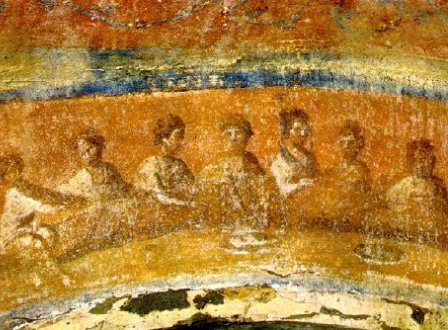
Paul’s instructions/corrections to the Corinthians regarding the communion meal are the earliest and oldest written accounts in existence about the Lord’s Supper. What we find is not an elaborate or systematic blueprint of the church’s meal; we have a narrow and focused response to a very particular and localized problem. However, in this response in 1 Corinthians 10 and 11, we find Paul’s very clear Lord’s Supper theology that informs and instructs the Lord’s Meal today: the church’s supper should be shared as a communal act that breaks down barriers between people and proclaims and promotes Christian unity. That’s what the meal is all about. But that’s not what’s happening at this church in Corinth.

The main overarching problem in Corinth is division within the church. Paul acknowledges the issue right out of the gate. He appeals to them in the name of Jesus to “agree with one another so that there may be no divisions among you and that you may be perfectly united in mind and thought” (1 Corinthians 1:10ff). The same exhortations appear again in chapter three where Paul points out their jealousy and arguing and pleads with them to stop. Elsewhere, it appears that these Christians were taking pride in their spiritual gifts, exalting some gifts over others, differentiating and dividing along lines of giftedness. And those decidedly anti-Christians attitudes were being expressed and manifested on the Lord’s Day at the table.

The Problem: Not Waiting for Others (11:21, 33)

Paul tells them they’re gathering for the Lord’s Supper, they’re calling it the Lord’s Supper, they’re saying all the right prayers and repeating all the right rituals, but it’s definitely not the Lord’s Supper. “You’re each eating your own supper,” he says. Why? Because you’re not sharing. You’re not waiting. You’re thinking only of yourself. You’re showing no regard for your own brothers and sisters who are going hungry while you’re stuffing your face and getting drunk. The problem is not that they were eating a full meal — the Lord’s Supper had always been a full meal (dipenon) and would be a full meal for another couple of centuries — it was that they weren’t sharing. This meal wasn’t about Christian unity, it was about taking care of one’s own needs over those of another. This, of course, is in direct violation of the way of Jesus. The rich homeowners were eating and drinking while the working class members of the church were getting nothing at all. This meal was being shaped by the culture instead of the Christ. The Gospel of Jesus is intended to break down barriers, to destroy division, and unite all people in his salvation blood. Instead, around this Corinthian table, poor people were being humiliated in the corner while rich people were gorging themselves in the main dining room. Even if they had no idea what the Lord’s Supper was about, common courtesy demands they refrain from getting fat and drunk while others are going hungry. Instead, they were making a mockery of the Gospel by their selfish behavior.

The Corrective: Pointing to Jesus (11:23-24)

Paul tells the Corinthians he cannot praise them for their awful behavior at the table. Their manners need correcting. So, he reminds them about their Lord. He reminds them that Jesus, “on the night he was betrayed,” gave up his very body and blood for the sake of others. The meal, Paul says, remembers the self-giving nature of our Savior. Our covenant with God, he recalls for these Christians, is based on sacrifice and service. It’s ratified by death. Around the table, we proclaim with one another that death and resurrection. Our actions at the table with one another must reflect and express that same sacrificial and servant-hearted nature of our Lord “until he comes.”

The Instructions: Wait for Each Other (11:33-34)

Paul does not discourage the eating of the meal. He does not command them to stop eating and drinking at the Lord’s Supper. Instead, he tells them how to eat and drink together around the Lord’s table. This follows his obvious pattern in correcting other abuses in the Corinthian congregation. He doesn’t tell them to stop speaking in tongues; he says, “When you speak in tongues, do it this way.” He doesn’t tell the disruptive women to stop praying; he says, “When the women pray, do it this way.” He doesn’t tell them not to eat meals at their Lord’s Day gatherings; he says, “When you come together to eat, do it this way.” Wait for each other. Eat and drink together. Share with one another. Consider the needs of others more important than your own. Now, if you’re unable to wait, if you’re incapable of restraining yourself, if you just can’t help it, go ahead and “eat at home so that when you meet together it may not result in judgment” (1 Corinthians 11:34). Don’t stop eating the Lord’s Supper. Eat it together, Paul says, in a way that honors the forever-giving nature and way of our risen and coming Lord.

Conclusions: Communal Intent of the Meal

Over the past 1,300 or so years, culture has turned the Lord’s Meal into a time of silent, individualistic piety. The Supper is restricted to the recesses of each individual’s mind and personal thoughts. In Corinth, the communion meal was restricted to class and socio-economic status. Today, it’s mainly a private affair. We have turned a celebratory meal designed by our God to proclaim and express unity and community and salvation into an individual ritually swallowing a crumb and drinking a sip while silently staring at the floor. I’m not completely certain how we recover the communal aspect of the church’s meal while worshiping in an auditorium with several hundred people, but we must try. Maybe we could use bigger portions of bread and more juice in bigger cups. Maybe we could all hold the cracker bits and tiny cups and wait for each other to eat and drink at the same time. Maybe we should enjoy a time of welcome and hospitality — a time to “shake hands and be friendly” — leading up to our time at the table. Singing together during the meal. Reading Scripture together during the meal. Instructing our churches to share with one another in the pews our favorite words of Jesus, our favorite deeds of our Lord, our favorite passage of Scripture, or our favorite song during the meal. Truthfully, there is more communion happening while passing a hot dog to a stranger at a football game than in most communion services in our churches on Sunday mornings. The form is the function; the medium is the message. It’s important that we recover the communal aspect of the Lord’s Supper.

The Lord’s Supper is serious. Not because it’s quiet time or meditation time or a time to solemnly reflect on Jesus’ death. It’s serious because the communion meal bears witness to the Gospel. It reflects and expresses the good news of salvation from God in the sacrificial death and powerful resurrection and eternal reign of the Christ. Judgment will come to those who deny the Gospel message and its values around the table (1 Corinthians 11:27-29). My advice would be to make sure communion is not about you. Make sure it’s about the people around you.

Peace,

Allan

Songs that Soothe

“Whenever the [tormenting] spirit from God came upon Saul, David would take his harp and play. Then relief would come to Saul; he would feel better, and the evil spirit would leave him.” ~1 Samuel 16:23

I’m particularly curious about what kinds of songs David played and sang for King Saul that brought him so much comfort and peace. As the writer of so many corporate psalms and congregational hymns, I’m convinced that David sang familiar temple songs for the king, songs both he and Saul would have recognized and known. Those old familiar hymns seem to be the ones that bring us the most comfort. Personally, a song like Be With Me, Lord has powers to calm me down, to re-orient my hectic life, to re-order my confused priorities:

Be with me, Lord — I cannot live without Thee, I dare not try to take one step alone,
I cannot bear the loads of life unaided, I need thy strength to lean myself upon.
Be with me, Lord, and then if dangers threaten, if storms of trial burst above my head,
If lashing seas leap everywhere about me, they cannot harm, or make my heart afraid.

Every phrase of this old song is intended to comfort, to soothe, to calm the troubled soul. Every stanza is meant by the writer and sung by the singer to restore belief, to strengthen faith, to increase confidence in the face of distress. It reminds me that I’m not alone, that even when God is not visible or not easily recognized as present, he has never abandoned me. He will never leave me. “A constant sense of thy abiding presence.” What a song.

In our Bible class this past Sunday we browsed through the song books together and remembered the songs that speak so powerfully to us in times of stress and despair. We shared our favorites with one another and told the personal stories that go along with each song and each specific set of circumstances. “Sweet Hour of Prayer.” “As the Deer.” “A Wonderful Savior.” “It is Well.” “Because He Lives.” “As the Mountains Surround Jerusalem.”

I wonder generally about the power of music and its deep connection with our God’s Holy Spirit. By playing and singing these soothing songs, David brought great peace and comfort to Saul. Most English translations of the above verse from 1 Samuel say the king was “refreshed” or “relieved” by the music. But the meaning of the original Hebrew wording is that God’s Spirit actually returned to Saul while David was singing. The tormenting spirit would leave and the Spirit of God would return. Through his music, David becomes a mediator of God’s Spirit; David brings life to Saul — Holy Spirit life — in his songs. In our Scriptures, spiritual music and the Holy Spirit are deeply connected:

“Be filled with the Spirit. Speak to one another with psalms, hymns, and spiritual songs. Sing and make music in your heart to the Lord.” ~Ephesians 5:18-19

It was good to flip through the song books together on Sunday and to be reminded of all those hymns that have brought us so much comfort through the years. These songs mediate the presence of God, they have the power to give life.

What’s the one song that has brought you the most comfort, the song that has soothed you during times of trial? I think my two are “Be With Me, Lord” and “It Is Well.” How about you?

Peace,

Allan

« Older posts Newer posts »