Category: Worship (Page 14 of 27)

Speak To One Another

“Speak to one another with psalms, hymns, and spiritual songs.” ~Ephesians 5:19
“There are different kinds of gifts… given for the common good.” ~1 Corinthians 12:4-7

There are times within the context of congregational worship for us to be edified by others. To be lifted up and encouraged by the singing of others. To be taught, to be inspired, to be challenged by the songs of others. There are times when the God-given abilities of one or two of his children should be used in a congregational setting to benefit the entire church body. We do it all the time in Bible readings, in prayer, in preaching, in worship leading, in teaching, and in making talks at the Lord’s Table. But we in our Church of Christ heritage have generally steered clear of that in our singing.

We have always upheld very strongly the concept of a congregational chorus. No choir. No robes. No select group of people standing up in front of the church and singing. Traditionally, that’s been our stand. Our idea is that everybody participates in the worship of God. We’re not gathered to be spectators; we’re here to worship. I, too, applaud that reasoning and support the theology behind it. However, traditionally, (as long as I can remember, and longer) we’ve taken the idea so far as to deny the exercise of God-given talents in God-ordained ways.

We’ve said ‘no’ to all choirs in our congregational settings. We’ve rejected the idea of quartets or duets. We won’t even have a discussion about solos. No one is to sing — ever! — in a congregational worship setting unless everybody is invited to sing. Whether it’s two dozen people in a choir or a trio of three, nobody can sing in church unless the whole church is singing. Traditionally, that’s been our view. If it’s not been our view, it’s certainly been our practice. And that position cannot be defended anywhere in our Scriptures.

If you’re banning choirs or forbidding the use of duets or solos in your church on Sunday mornings, you can’t use the Bible to justify it.

Regarding spiritual gifts such as singing, Paul writes in 1 Corinthians that they are to “edify the church” (14:4). The Christians in Corinth are to be careful with the exercise of their gifts, keeping in mind the number one objective is “so that the church may be edified” (14:5). The apostle claims we should “excel in gifts that build up the church” (14:12) and refrain from practicing things by which “the other man is not edified” (14:17).

What could be more lovely than a young woman who’s been given an amazing voice by our Father using that voice to glorify him and inspire the church? What could be more appropriate than a group of several dozen Christians teaching and encouraging the congregation through their gift of song?

That man was given that talent by our Creator; let him use it to praise God! Let him use it to minister! And let us be ministered to. Let us listen and enjoy. Let the song take us to the throne of God. Let it inspire us to live better lives. Let it remind us of what our Father has done in our lives and in his world. Allow the man with the gift to sacrifice it to God for the sake of God’s glory and for the benefit of the church. Allow us to affirm the goodness of that gift and the greatness of the One who gives it by listening, by appreciating, by applauding the free use of that gift.

We are so blessed here at Central to be led by a group of shepherds who allow and even encourage a great variety of expressions of praise to God. We’re diverse in the ways we encourage one another in our assemblies. When we’re together, we reach for the fullest manifestation of the gifts of God’s Spirit.

A couple of weeks ago, it was a trio during our communion time. Here in a couple of weeks it’ll be a duet as we close. Yesterday it was Kevin, Johnny, Kelley, and Dick in a quartet getting us ready for the sermon. They sang a medley of songs that included “O Holy Night,” “Mary, Did You Know?” and “I Am” to prepare us for the lesson about partnering with God in the mighty salvation deeds he initiated at that little stable in Bethlehem.

And it was fabulous. Spiritually stimulating. Wonderful.

Now, don’t you dare come at me with “But, that might be perceived as entertainment” or “Aren’t you elevating one group of people over another?” Don’t say, “You’re turning it into a show or a performance.”

To quote Paul again from 1 Corinthians: “Brothers, stop thinking like children!” (14:20)

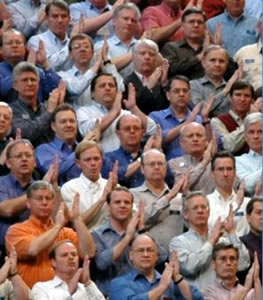
There need to be planned times in our assemblies to “just listen” to song. The same ways we “just listen” to preaching and praying and Bible reading.” Songs are strong. Music has the power to move people, to motivate and inspire, to encourage and comfort. There need to be times when a brother or sister with God-given abilities can use those abilities in a public way to bring glory to the Father and encourage the church. We need to be blown away every now and then by the talents God’s given us.

~~~~~~~~~~~~~~

Speaking of singing to one another, Carrie-Anne and I were suprised last night at our new house by a gaggle of Christmas carolers from our Central Youth Group. It seems those gathered at Tanner’s house decided to take the party on the road and wound up stopping by half a dozen houses to sing Christmas songs. We were thoroughly honored. And duly impressed. Not so much with Tanner’s Christmas tie and sweater or Spencer’s reindeer solo or Barrett’s improvised falsetto at the end of “Silent Night.” More so with the idea of sharing their gifts of song and fellowship with others.

~~~~~~~~~~~~~

I have no idea what “Blizzard Warning” means. But we’re in the middle of one right now. No snow yet. But the National Weather Service says it’s coming.

On Friday they issued a “Blizzard Watch” for Monday and Tuesday. So we’ve been on alert. Yesterday while Carley and I were stirring paint together in the dining room, the Police song on our classic rock station was interrupted by the harsh tones of a National Weather Service alert. You know, that noise always makes me think thunderstorm or tornado watch. That was my first reaction. But the computerized voice alerted us that the blizzard watch had been canceled. Carley and I looked at each other with a little bit of disappointment. But the voice went on to let us know that a blizzard warning had now been issued for our parts of Randall and Potter Counties in the panhandle.

We’re expecting 12-16 inches of snow over the next 24 hours. North winds gusting to 45-50 miles per hour. Temperatures in the 20s. Whiteout conditions. Visibilities down to nothing. Four and five foot drifts.

I have no idea what that’s going to look like. I don’t know what it might to do to the city here. I’ve never experienced anything even close to this. But we’re excited about it. It’s brand new for us. So our attitude at Stanglin Manor right now is “Bring it.”

Peace,

Allan
Joy at the Table

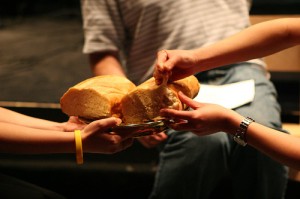
The Lord’s Supper is the central, communal, corporate act of God’s Church. Instituted by our Savior, passed on by the apostles, and practiced for centuries by God’s people, our communion meal has historically served as the primary reason for Christian gathering and the climax of the Christian assembly. It’s the high point. The pinnacle.

As most of you know by now, my great desire is to see the Lord’s Supper returned in our churches to the rightful place of prominence it has always enjoyed until recently. In our Church of Christ assemblies, our communion time needs to be the highlight. And it’s not. Not always.

And it won’t be — not consistently, anyway — until we return the joy.

When presenting the case for expressions of joy and gladness and celebrations of happiness during our Lord’s Meal, I’m often reminded by well-meaning brothers and sisters that our time at the table is meant for remembering the death of Jesus. It’s inappropriate, they say, to rejoice when thinking about death. Our time at the table is for somber introspection and solemn reflection, not conversation and singing and grinning. Certainly not laughter.

First, I would say our Sunday communion has much, much more to do with the Resurrection than with the Crucifixion. Much more. I would suggest the first Christians didn’t really think about Jesus’ death during their Sunday meals. They were too overcome by the fact that the Christ really was alive. That was the focus of communion.

But if a person insists that the communion meal is about remembering the death — and people will do this by quoting 1 Corinthians 11:26: “proclaim the Lord’s death until he comes.” — we’re on solid ground to celebrate in that case, too.

For the writers of Scripture, the death of Jesus was and is good news. It’s great news! And it is more than appropriate at the table of Christ  to express the pleasure and the joy that are caused by his death. To “proclaim” means to announce publicly and clearly what has happened and what it means eternally. It’s not to be whispered through cupped hands into the ears of a just a few disciples in the room. The good news is to be shouted with joy.

The Eucharist (thanksgiving, right?) is the perfect time and place, not to mention the most practical form, for showing and confessing that the death of Jesus is totally different from a natural event or a criminal act or some tragic loss. The death of Jesus gives us no reason to accuse or moan or lament or complain.

Those celebrating the Lord’s Supper know the pain and the shame, the horror and scandal, of Christ’s death. However, we rejoice in the crucifixion and praise the slaughtered Lamb because God has raised him from the dead and accepted his intercession on our behalf. In Paul’s theology and in the message of John, Hebrews, 1 Peter, and Revelation, the Crucified One is always the living and reigning Christ. The One who rules the Church and the world and who will come again is the crucified Christ.

We have abundant reason to rejoice in Christ’s death and praise the crucified yet living Lamb.

And until we recapture that sense of great joy around our living Lord’s table, we will continue to commemorate a solemn service instead of a celebratory feast. It will remain a weekly task to be performed instead of a community meal to be enjoyed. And it will stay in the background. It won’t ever rise past the preacher or the music in terms of proper position and prominence in our Sunday assemblies.

What if our Sunday communion services sounded and felt more like what you’re going to experience around your dining room table this coming Thusday? What if, when we dine with our risen Lord on Sundays, joy were the prevailing mood?

~~~~~~~~~~~~~~~~~~~~~~~~~~~

More than $7,500 raised for Madison Knebusch and her family at yesterday’s spaghetti lunch. Praise God!

Bad news received just this afternoon regarding the PET scan today on Madison’s right lung. Another round of chemotherapy to begin later this week.

“Yet I will rejoice in the Lord.” ~Habakkuk 3:18

We love you, Madison and Levi and Shannon, Britton, Londen, Gracyn, and Hudson. Our hearts are breaking with yours as you endure this horrible trial. We ache for you and with you. And all of us want so desperately to do something to help. We want so badly to help. And, honestly, sometimes we don’t even know what to say. We don’t have the words. Sometimes we say dumb things and do dumb things out of a deep love for you that is compelling us to try anything to provide you with encouragement and comfort. Please be patient with us and forgive us.

Please know how much we love you.

We trust in our loving Father. We ask for increased faith. And we continually lift you up to our mighty God for his divine purposes.

Grace & Peace,

Allan

At That Time…

“At that time Jesus said, “I praise you, Father, Lord of heaven and earth…” ~Matthew 11:25

The words at the beginning of this passage in Matthew that lead directly to our Lord’s little prayer of thanksgiving refer to that time in Jesus’ life when he’s having to answer questions about his mission and denounce unrepentant cities. John the Baptist is openly questioning the Messiahship of Jesus. His closest family and friends in the fishing villages around Galilee are ignoring his message.

How do you think all this rejection made Jesus feel? How do you think Jesus was doing at that time?

With one word, how would you describe your current situation? Where are you right now? In one word, what’s going on with you at this time?

Content? Frustrated? Happy? Angry? Confused? Overwhelmed? Hectic? Depressed? Worried? Confident? Scared?

Jesus seems pretty confident that his heavenly Father is behind these perceived setbacks and that these disappointments are actually a part of God’s holy will. And he gives thanks. Jesus gives thanks for the problems he’s encountering and praises God for working in them to spread the Word and advance the Kingdom.

The powerful and unstoppable energies of the Kingdom of God are always moving, always growing, always surging just beneath the surface. All around us. Huge rivers of prayer and faith and hope and praise and forgiveness and salvation and rescue and holiness flow right by us every day. In every single nook and cranny, hidden in the shadows, overlooked in the crowds, drowned out sometimes by the noise, are the eternal works of our gracious Redeemer.

So, like our Lord, we give thanks. At that time. At this time. We give thanks.

~~~~~~~~~~~~~~~~~~~~~~~~

Two Sundays ago Kevin Schaffer, our marvelously talented worship minister, stopped us down right in the middle of song to correct our clapping. We were singing “King of Kings.” You know how it goes: King of kings and Lord of lords, glory (CLAP!) Hallelujah. And our congregation was butchering the clapping. We were clapping before the word, during the word, after the word; it was a mess. Near the end of the first stanza, Kevin had had enough and he stopped us.

“We are going to learn how to clap. And we’re going to start with just one. Just one clap. Do it with me…”

And he proceeded to teach us and show us how to clap. It worked really well. Kevin was very patient with us and we all had a good laugh. After we had practiced together for a few minutes, it actually sounded pretty good the second time around. There’s hope here at Central.

I was reminded of that episode by a blog post written by Jon Acuff. It’s called “Clapping Our Hands: A Step-By-Step Guide to the Death of Rhythm.” A dear friend of mine forwarded it to me this morning. Jon hilariously nails the reasons our churches have a hard time clapping during congregational singing and gets inside the minds of the congregants to show us what everybody’s really thinking as the song begins, why the clapping is all over the place, and why it dies out completely before the song’s even over. It’s a quick, light, funny read about why our church clapping sounds like “somebody lit a box of hand firecrackers.” Click here to read it. And try to click on the downbeat, not the upbeat.

Peace,

Allan

Audience of One?

We must get out of our minds the warped idea that our corporate worship assemblies are human performances for our Creator. We must rid our brains of the distorted notion that our Father sits back on Sunday mornings to soak up our praise as we sing and pray, that he just watches and smiles as we commune around his table. We should work to remove from our vocabulary the damaging phrase “audience of one.”

Ever since the emergence of sin and death stained our God’s perfect creation, he has sought to redeem that creation by dwelling with them, by being fully present with them. The Hebrew Scriptures tell us the Father dwelt in the temple in Israel. John says the Son dwelt with us in the flesh. Paul says the Spirit dwells inside redeemed saints. And we know from Revelation that the mission of the Triune God is to live with his people, for his people to be in his holy presence, for ever and ever.

This is what happens when we assemble.

As children of God and followers of Jesus, our Christian gatherings take place in the presence of the Father, in the name of the Son, and by the power of the Holy Spirit. When we come together we draw near to God, we enjoy his presence with us. The writer of Hebrews says our assemblies are done in the presence of God. It’s God with us. Us with God. A mutual, communal event. Our assemblies are sacramental events, sacramental encounters with the true and living God.

Our God is active during our worship. He is working. Working. Working. He is placing his holy Word exactly where it needs to go; convicting, challenging, encouraging, motivating, comforting. He is giving us the hearts and the breath to sing songs of praise to him and edification to one another. He is inspiring us with the right sentences and paragraphs. He is changing us in the meal. He is shaping us through prayer. His Spirit groans with us. His Son intercedes for us. He is mediating his grace in the water and the bread and the wine. He makes our meager and shallow offerings worthy of his eternal glory. He is present in every handshake and hug. God is moving and doing. He is removing scales from our eyes in worship. He is revealing himself to us in brand new ways. He is reminding us of his wondrous love and matchless grace. He serves us and eats with us at the table. He molds us and forms us more and more into the perfect image of his Son.

Our Father is no audience during our worship. He is the instigator, the inviter, the host, the blesser, the giver, the sustainer, and the finisher.

There is no audience in worship. There is holy community and redemption. There is salvation work. There is God with us. But no audience.

Peace,

Allan

P.S. This is my first P.S. in almost five years of regular blogging: YOU are definitely not the audience in worship, either. I know you already know that. But it probably still needs to be said.

The Prayer of the Fellowship

If I were Skip Bayless, I would have headlined today’s post:

“Rain-gers Cruz to Detroit with 2-0 Lead!” 

I received the news of Nellie’s 11th inning drive via David Byrnes’ iPhone during Valerie’s choir performance at Amarillo High School. The Rangers won it right in the middle of Jubilate Deo. It means sing with joy to the Lord. And we did.

~~~~~~~~~~~~~

Yesterday’s post about our congregational prayer for Judy has pushed me even farther in reflecting on the importance of public prayer. So many times our hurried efforts at the pulpit or, worse, our rambling ruminations and repetition betray a careless attitude toward this sacred activity among the saints in the presence of God on his holy ground. Congregational prayer is never to be entered into lightly. It is serious. It’s heavy. It requires forethought and preparation. And it demands relationship. You really can’t pray appropriately for your brother unless you really know your brother.

Dietrich Bonhoeffer says as much in Life Together. And I agree.

“The prayer in the common devotion should be the prayer of the fellowship and not that of the individual who is praying. It is his responsibility to pray for the fellowship. So he will have to share the daily life of the fellowship; he must know the cares, the needs, the joys and thanksgivings, the petitions and hopes of the others. Their work and everything they bring with them must not be unknown to him. He prays as a brother among brothers. It will require practice and watchfulness, if he is not to confuse his own heart with the heart of the fellowship, if he is really to be guided solely by his responsibility to pray for the fellowship.”

If you’re asking people to lead prayers in your assemblies, please don’t wait until the day before to make that call. Give them several days, maybe a full week or more, to pray and prepare and practice for this awesome task. And if you’re leading these public prayers on behalf of an entire group of Christian brothers and sisters, by all means please take great care in the things you say and the ways you say them. Pray about it first, just between you and God; you’re going to need his help. Prepare the congregational prayer in advance; write down the words. Practice it; know what you’re going to say when you dare to address the Creator of Heaven and Earth.

Above all, remember that you are praying on behalf of the group. And that sanctifies you. It transforms you. Because when you intercede for others before the throne of God and focus more on their needs than your own, you are being like our Christ who always lives to intercede for us.

Peace,

Allan

Church Clothes

I vividly remember as a young teenager, after spending a Sunday afternoon at my friend Todd’s house, showing up to church that evening in blue jeans, a Huey Lewis and the News concert T-shirt, tennis shoes, and extra-wide sweat bands on my wrists. Upon entering the half-empty/half-full worship center I was notified that I was on the list of those who were supposed to serve communion. (This was back in the day when, if you weren’t at church that morning, we made you raise your hand or stand and the rest of us watched you commune. By yourself.) So, I stood up there, feet shoulder-width apart, hands firmly clasped in front, praying and passing the Body and Blood of Christ.

And, man, I got it when we got home. I was not wearing church clothes! I was waiting on the Lord’s Table and not wearing church clothes!

Of course, I know now what I did not know then. In all actuality, I was wearing my church clothes. You are right now wearing your church clothes. The place where you are sitting or standing right now is holy ground.

Scripture holds that everything — absolutely everything — takes place on holy ground. God has something to say about every aspect of our lives: the way we feel and act in the so-called privacy of our own hearts and homes, the way we make and spend our money, the politics we embrace, the entertainment we enjoy, the wars we fight, the tragedies we endure, the people we know. Nothing is hidden from the sight of our God. And nothing is exempt from his rule. The ground is holy, the folks are holy, the words we speak are holy.

“Holy, holy, holy is the Lord God Almighty; the whole earth is full of his glory!”

Not just in the worship center on Sunday morning, but everywhere you walk is holy ground. Everywhere you go is a sacred place. Everybody you meet is a holy opportunity. Everything you do is a sacred activity. Everything you wear is church clothes!

It’s all governed and ruled by God and set apart by him and acknowledged by his children as holy and set apart for his divine and eternal purposes. All of it.

“As God has said, ‘I will live with them and walk among them, and I will be their God, and they will be my people…’ Since we have these promises, dear friends, let us purify ourselves from everything that contaminates body and spirit, perfecting holiness out of reverence for God.” ~2 Corinthians 6:16, 7:1

~~~~~~~~~~~~~~~~~~~

The Texas Rangers are smoking hot heading into their second straight postseason. While clinching the title in the AL West, the Rangers won six in a row, ten of their last eleven, 14 of their last 16, swept the Halos, and notched a club record 96 victories. The only team hotter in the American League is the Tampa Bay Rays.

Come 4:00 tomorrow afternoon, I will be planted on the microfiber couch, in front of the tube, with Whitney, some ice-cold DDP, an ample supply of chips and hot sauce, and enough popcorn to make Orville Redenbacher blush. You can text me tomorrow afternoon after 4:00. But don’t call.

This is the most complete Rangers team ever assembled. Kinsler and Napoli are smashing the ball. Josh and Beltre are clutch. Michael Young is MVP-calibar. Ceej and Holland and Harrison are in a groove. Feliz has found his stuff. And Mike Adams is this year’s Cliff Lee.

Rangers in four.

Allan

« Older posts Newer posts »