Category: Worship (Page 11 of 27)

The Silence of Scripture

When our Restoration Movement divided between Disciples of Christ and Churches of Christ at the turn of the 20th century, it was largely a result of two different interpretations of silence in Scripture. As we’ve already seen, those opposed to the use of instrumental music during congregational worship reasoned that, since the Bible didn’t specifically authorize it, it was not allowed. There were no New Testament examples, so it couldn’t be practiced. On the other hand, proponents of pianos and organs declared that silence in the Bible permitted the use of instruments — Scripture didn’t specifically prohibit or condemn it. Since there was no biblical command against it, it was OK to practice it.

The same arguments regarding the interpretation of biblical silence were used for and against the Missionary Society, for and against located preachers, for and against open and closed communion. Is scriptural silence on a particular issue prohibitive or permissive? Does silence allow or condemn? I’m afraid we still run into forms of this debate almost every day. And we ought not.

When Alexander Campbell said, “Speak where the Bible speaks and be silent where the Bible is silent,” he didn’t mean that the lack of a clear biblical directive should embolden us to scream and yell and assert our own opinions about that silence and loudly and aggressively and divisively bind those opinions on others. He meant that we could all form our own thoughts and opinions — and they could be very strong opinions and passionately held — and then keep them to ourselves. Being “silent where the Bible is silent” means, in the words of the apostle Paul, “whatever you believe about these things keep between yourself and God” (Romans 14:22).

In my view, a reading of Romans 14:1-15:7 would convict any Christian of binding his opinions on anybody.

Paul says very plainly that we have “strong” Christians and “weak” Christians. His words, not mine. The weak Christians are vegetarians; the strong believers enjoy a good steak. The weak brothers keep all the Jewish holy days; the strong brothers don’t. The weak Christians are developing all kinds of elaborate worship and lifestyle theologies and drawing lines in the sand over what’s right and what’s wrong; the strong Christians don’t have very many lines and they’re not as concerned about which worship and lifestyle practices are right or wrong. The weak are criticizing the strong for being spiritually insensitive; the strong are looking down on the weak for being spiritually immature and inferior. The strong proclaim freedom in Christ; the weak say that doesn’t mean anything goes. The weak tell the strong, “You’re wrong!” The strong tell the weak, “Grow up!”

Paul commands both of these groups of disciples not to look down on anybody. Nobody is to condemn anybody. For God has accepted him. Accepted whom? This brother or sister or this group of brothers and sisters who disagree with you on your church tradition. This other Christian or group of Christians who don’t see eye to eye with you on your disputable matter. You’re not his master, Paul says. Christ Jesus as Lord is his master. Not you. Whether this other guy stands or falls is up to the Lord. Whether he’s right or wrong is up to God, not you.

And then Paul goes ahead and makes the judgment, he makes the call. “He will stand!” Whether he agrees with you or not or whether you’re both on the same page or not, Paul says this guy will stand because he’s in Christ. So, you accept him because Jesus accepts him. Christ died for him, Paul reminds.

Why do we have such a hard time with this? Is it because there might not actually be a “right way” or a “wrong way” to do a lot of the things we do in the name of Jesus, and we can’t stand it? Could it be that if we disagree with someone over a church matter or a biblical interpretation, one of us just has to be right and one of us just has to be wrong? How else would you explain our two thousand year history of dividing and dividing and then dividing even our divisions over trivial matters such as worship practices and leadership structures, days of the week and food and drink, baptism methods and signs on the front of the church? How else would you explain Paul’s clear command to be silent about such disagreements and never to label or divide over them? And our clear disregard and disobedience to that command?

You know, in this same Romans 14 passage, Paul doesn’t tell the weak Christians to change their minds about their immature beliefs. He does not tell them to change their practices which, again, he considers “weak.” In fact, he tells them not to change a thing. Why is that? Is it because, again, there might not actually be a “right way” or a “wrong way” to do a lot of the things we do in the name of Jesus?

“Whatever you believe about these things keep between yourself and God.” ~Romans 14:22

“Speak where the Bible speaks and be silent where the Bible is silent.” ~Alexander Campbell

Peace,

Allan
He Did It Again

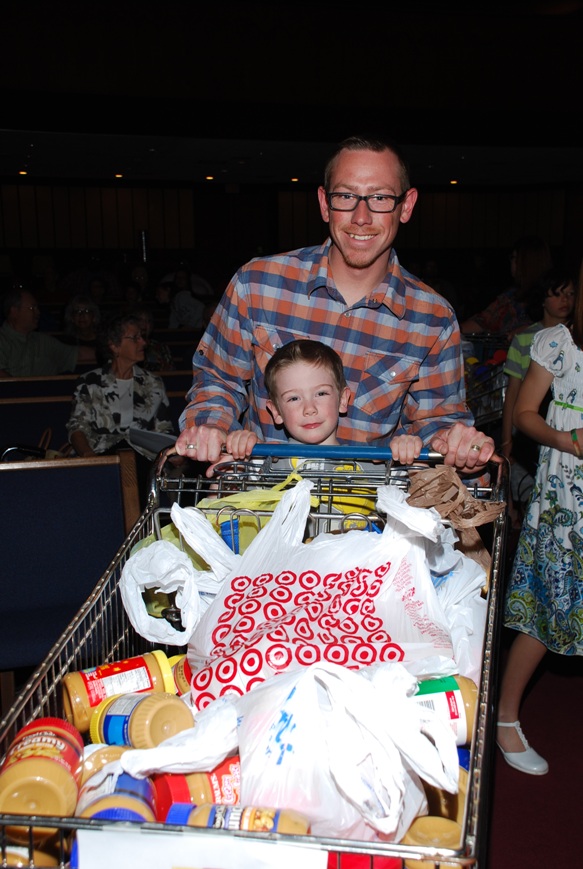
Our God revealed himself to us again yesterday. His children were gathered in his presence in a building on South Monroe in Amarillo, and he showed himself to us in a powerful way. Again.

Our God showed us that he is the Father of the weak, the Defender of the helpless, in providing 607 jars of peanut butter for our Snack Pak program for Bivins Elementary School. We saw his glory reflected in the faces of our own young children as they scurried about the packed worship center, collecting the jars, passing the jars, chasing and dropping the jars, which will be used to feed at-risk students and kids living in poverty in our city.

Our God showed us that he is the Savior of the World in showering Great Cities Missions with more than $75,000 for the training and sending of missionaries and planting of churches in Latin America. We saw his glory reflected in the grinning faces of the GCM board members and Central missions committee members scattered all over our worship center.

Our God showed us that he is the Creator and Sustainer of the Universe in supplying through his faithful servants here $55,000 to begin the new permanent Alara school building in Kenya. Our God calls things that are not as though they are. He is faithful to finish what he starts. And we saw his glory reflected yesterday in the great generosity of Jack and Barbara Vincent.

Our God also showed us that he is a patient God, gracious and compassionate, abounding in love and faithfulness, forgiving wickedness, rebellion, and sin. When Kimberly Vasquez was baptized into Christ yesterday, we saw his eternal glory reflected in her face. And we all joined the angels in heaven rejoicing.

Our God is not an audience when his people gather to worship him. He is active, very active, in ministering to us, comforting us, encouraging us, inspiring us. He is present in every song, he is there in every prayer, he eats and drinks with us at his table, and he is working in every handshake and hug. Our God is revealing himself to us, he is transforming us more into the image of his Son, and he is giving us little glimpses of his Kingdom come in all of its fullness and glory.

Thank you for bringing the peanut butter. Thank you for clapping for Jack and Barbara. Thank you for cheering so wildly for Kimberly. And thank you for coming to our worship assemblies every Sunday morning expecting our God to do something big. Again.

Peace,

Allan

Hold to God’s Unchanging Hand

I’ve been listening to beautiful classic Christian hymns in my office here at the church building all day long. The songs are not coming from a radio or a CD player or from the internet. These songs are coming from our chapel across the hall where Keith Lancaster and 130 men and women from all over the United States are recording two albums in the Acappella Praise and Harmony series.

Build your hopes on things eternal; hold to God’s unchanging hand…

For the past couple of hours my computer has been updating me with the horrible news out of Boston. Two explosions at the Boston Marathon. At least two people killed. Three dozen or more injured, some critically. Blood all over the sidewalks. Families separated from one another.

Because he lives, I can face tomorrow…

A most amazing blend of young voices and old, men and women, four-part harmony, Christians from here in Amarillo and from as far away as Michigan, Kentucky, New York, and, yes, Massachusetts. Praising God. Proclaiming his great love and faithfulness. Declaring trust in his promises. Giving us in the church offices a beautiful glimpse of heaven.

Resting in my Savior as my all in all, standing on the promises of God…

Chaos and turmoil near the finish line. Violence and death. Terrorism. Indescribable pain. Act of War. Panic. Screams of horror. Uncertainty. Fear. Lots of fear.

Fastened to the Rock which cannot move, grounded firm and deep in the Savior’s love…

In the middle of listening to these beautiful hymns sung by faithful Christians in an historic chapel in Amarillo, we’re reminded by the news out of Boston that Jesus has not yet returned in his glory. We’re shocked all over again at the realization that we live in a fallen world characterized by sin and death, pain and anguish, terrible tragedy and suffering. The headlines and pictures on my computer screen this afternoon have the capacity to completely take over. They can define the rest of my day. They could come to distort and shape my world view. But these songs drifting down the hall from the chapel put the day’s news in its proper perspective. Today’s news. Any day’s news. These songs remind us that our God is truly faithful, that he really is making things right, that he is doing what he always promised he would do, and that one day his Kingdom will come in all of its glory and power, destroying all sin and all death once and for all.

Lord, thank you for the gift of song and the power it possesses to encourage and inspire in dark times. Lord, please bless your children in Boston with your divine comfort and healing. And, Lord, come quickly.

Peace,

Allan

A Communion Glimpse

“People will come from east and west and north and south, and will take their places at the feast in the Kingdom of God.” ~Luke 13:29

Jesus is talking about heaven when he says Abraham, Isaac, and Jacob and all the prophets will be around the table. John’s Revelation tells us that heaven will be the ultimate gathering of “every nation, tribe, people, and language,” the ultimate feast around our Lord’s banquet table.

At communion time on Sundays, we get a small heavenly glimpse of that great eschatological feast. We come together around our Savior’s table. In the eating of the bread and the drinking of the cup, we connect not only to our Lord, but to every person in history — past, present, and future — who’s been saved by the blood of the Lamb. We’re united as one.

Different people. Different ages. Different cultures. Different languages. Different backgrounds. Different viewpoints. Different habits. Different genders. Different zip codes. Different jobs. Different haircuts. Different beliefs. Different likes and dislikes.

Same sin. Same need. Same Lord. Same baptism. Same forgiveness. Same salvation. Same commitment. Same table. Same loaf. Same cup. Same Body. Same Spirit. Same hope. Same faith. Same God and Father of us all who is over all and through all and in all.

Our communion meals point us to the heavenly meal. It gives us a peek. A holy glimpse. We spend most of our communion time in quiet introspection, reflecting on things that happened in the past. I believe our Christ intends that we spend our communion time in joyful expectation about what’s coming in the future. The way we eat and drink and share the Lord’s Supper must be shaped and practiced more and more by our great anticipation of that day when all of God’s children will be home, gathered around our Father’s table.

Peace,

Allan

Be Filled with the Spirit

“Be filled with the Spirit. Speak to one another with psalms, hymns, and spiritual songs. Sing and make music in your heart to the Lord, always giving thanks to God the Father for everything, in the name of our Lord Jesus Christ. Submit to one another out of reverence for Christ.” ~Ephesians 5:18-21

We worship in the Spirit. We submit to one another and sing and speak to one another in the Spirit. The Holy Spirit of God is who gives the Christian life its energy and enthusiasm. Its endurance. And power!

Be filled with the Spirit.

This is an imperative. It’s a command. So we do take some responsibility here. This singing together and submitting to one another is either the means by which we pursue this filling of the Spirit or the result of being filled with the Spirit. Or both. Either way, Paul says when we sing together, when we pray together, when we really belong to one another, we are filled with the Spirit.

And that tells me that God is not a spectator when we gather for worship. Audience of one? No way! God is not the audience of our worship. Our God is an active participant with us — inside us — when we worship together. God is not just sitting on his throne in heaven soaking up all the hallelujahs and amens. No. Through the Spirit, the Father and Son are engaged with us. Communing with us. Eating and drinking with us. Rejoicing with us. Transforming us. Changing us. Growing us. Shaping us more into the image of our Christ.

Be filled with the Spirit.

Encountering God together — in our Sunday morning assemblies, in our Wednesday night Bible classes, in our living rooms on Sunday evenings — being in the presence of God together allows us to recognize our own sinfulness and shortcomings. And that always leads to an acute recognition of his marvelous grace. And the power of God’s grace is not just forgiveness, it’s also transformation. New creature. New creation. Christ formed in you. Being saved. It’s a communal sanctification event that we participate in and experience together when we are filled with the Spirit.

Peace,

Allan

The Second Tablet

When God is reminding his people of the covenant promises in Deuteronomy, he vows that if they worship idols they will lose their land. If they commit idolatry/adultery with the foreign gods, if they worship these other dieties, God will send them into exile. He made those promises over and over again in Deuteronomy.

And the people worshiped idols.

Almost immediately upon entering the Promised Land, God’s people began worshiping the foreign gods. They built high places and shrines, they offered sacrifices and song, they worshiped idols. Off and on for more than 700 years, God’s people worshiped these false gods. For over seven centuries, our Lord showed tremendous patience with his people. He exhibited great restraint in not following through on his promises to strip them of their land for these atrocious acts of rebellion. They turned their backs on YHWH. They disrespected his name. They ignored him and sometimes cursed him. But our Father was long suffering with his chosen people.

In Amos, we see for the very first time in Scripture a distinction among God’s holy people between the rich and the poor. Our God speaks through the prophet and points out that the rich were getting richer at the expense of the poor. The orphan, the widow, and the stranger in the gate were not just being ignored, they were being exploited by the wealthy, for the benefit of the elite. 

“They sell the righteous for silver, and the needy for a pair of sandals.
They trample on the heads of the poor as upon the dust of the ground and deny justice to the oppressed.
Father and son use the same girl and so profane my holy name.
They lie down beside every altar on garments taken in pledge.
In the house of their god they drink wine taken as fines.”
~Amos 2:6-8

“You hate the one who reproves in court and despise him who tells the truth.
You trample on the poor and force him to give you grain…
You oppress the righteous and take bribes
and you deprive the poor of justice in the courts.
~Amos 5:10-12

God points out the injustice against the poor, the systemic oppression against those most defenseless in society, the exploitation of those who are unable to help themselves, the widening gap between the rich and the poor, and he condemns it. This is completely contrary to God’s eternal plan for his people, this is exactly the opposite of what he’s wanting to do through his children for the sake of the rest of the world. So he condemns them and he takes away their land.

In less than 25 years.

It’s almost immediate. In less than one generation, God sends the Assyrians into his chosen nation and, in a divine act of punishment, demolishes them for their sins against the poor.

That’s astonishing, isn’t it?

It appears in Amos that repeated breaking of the “first tablet” of the Law — the commandments dealing with love and God and respect for his holy name — isn’t nearly as offensive to God as the breaking of the “second tablet” which deals with love of neighbor and respect for our own brothers and sisters. Jesus and all the rabbis before him taught that love of God was the most important command and love of neighbor the second. I believe that is still true. But it seems that God shows much more patience when we sin directly against him than when we sin against the poor and the weak. It looks like God’s wrath is quickly aroused when we sin against the marginalized and the defenseless. He won’t tolerate us abusing or ignoring the “least of these.”

There are at least two lessons here: One, we must pay careful attention to our attitudes and our actions regarding the weak and the poor. The comments we make, the jokes we tell, the thoughts we think, the deeds we do or don’t do, the decisions we make — so many of these things impact the defenseless people around us. We should be careful to honor them. We should be diligent to help them. And, two, in the manner of our Lord, we should be much more offended when someone treats another harshly and much less offended when we ourselves are treated harshly. We should show more patience and more understanding when we are neglected or harmed. We should be quick to speak up and act out when the least among us are similarly neglected or harmed.

Amos teaches us that God takes our behavior seriously. Our worship is meaningless to us and to our world, and an offense to our Lord, if it doesn’t compel us to serve others in his name and in his manner every day.

Peace,

Allan


« Older posts Newer posts »