Category: Ministry (Page 21 of 35)

The Back of the Line

“Thanks be to God who always leads us in triumphal procession!” ~2 Corinthians 2:14

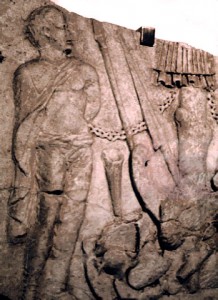
The apostle Paul writes while enduring great anxiety over his brothers and sisters in Corinth. He writes to give them a new perspective. He writes to bolster his own strength and faith. He writes about a great Roman military victory parade. The conquering general rides in a gold chariot up front. The senate and magistrates follow. Behind them are the royal and military musicians. The spoils of war, the loot from the conquered lands, is paraded next. And then the captives in chains, the prisoners of war, in the back of the line.

Paul says, “I’m in this parade! You’re in this parade! God is leading us in this triumphal procession! We’re all in this parade together!”

But the technical nature of the term and the linguistic nature of the verb can only mean one thing: Paul is not at the front of the parade with God. He’s at the back of the line with the captives.

Paul sees himself as a slave to Christ. He’s been captured by Christ, he’s a trophy belonging to Jesus, he’s one of the spoils of God’s great victory over sin and death. Paul is thrilled to be in the metaphorical chains of the conquering Christ and the unstoppable Kingdom of God. Paul shows us in a very graphic way his understanding of Christian ministry. He paints a vivid picture of himself — a picture of all of us — being led by Jesus in a long line to our own suffering and death.

See, the captives are the physical evidence of the victory. The conqueror receives the glory and honor due him when the world sees the people he’s defeated. The people at the back of the line, the conquered people in chains, are a display of and a testimony to the glory and majesty and power and authority of the conqueror in the gold chariot up front.

That’s Paul. That’s us. That’s the way he sees things.

“It seems to me that God has put us apostles on display at the end of the procession, like men condemned to die.” ~1 Corinthians 4:9

Paul goes on in that 1 Corinthians 4 passage to say we are humiliated. We’re ridiculed. We are the objects of great wrath and scorn. We’re spit upon by the crowds as we walk to our executions.
Things don’t always look so good from the back of a line like this. It doesn’t always feel good. Sometimes it’s downright painful.

But this is exactly where our Father wants us. God doesn’t want us better; he wants us deader! Dead to ourselves! Dead to the world! Completely dependent on God! Totally leaning on him for every step, every move, every breath! Wholly reliant on him for life itself!

Paul counts it as a blessing and a privilege to be led by Christ as his captive, as his slave, and to participate in this way as a part of God’s triumph. Paul has actually grown comfortable at the back of this line. He’s come to understand that “the all-surpassing power is from God and not from us.” He knows that “all of this is from God” and none of it is from his own strength or smarts. He knows that “our competence comes from God.”

Those are the lessons learned from the back of the line.

And that’s precisely where ministry is done. From the back of the line. God is glorified in his captured people. He is praised and honored by his slaves. May we stop wrestling with the chains and fully embrace them in complete submission to our Lord and King.

Peace,

Allan

The Joy of One

The apostle Paul changed his travel plans in order to spare the Corinthian Christians a great deal of pain. “For if I grieve you,” he writes, “who is left to make me glad?” Paul says he didn’t want to be distressed by the very people who are supposed to make him rejoice (2 Corinthians 1:23-2:4).

Paul really loved these people.

Despite their problems and spiritual immaturity, Paul really had a deep affection for this group. And he didn’t want to hurt them. Not only that, he wanted to do everything he could to please them. He was willing and eager to inconvenience himself for their sake.

He longed to “work with them for their joy” because his own joy was so tightly wound up in theirs. Paul understood that, in the Body of Christ, the joy of one is the joy of the other. Their happiness made Paul happy. Their gladness led directly to Paul’s rejoicing. He wouldn’t have it any other way.

When we were planning a bi-lingual worship assembly a couple of years ago, I was confronted by a well-meaning brother who couldn’t comprehend how singing songs in Spanish would be an encouragement to us Anglos. If our worship time is to be a time of edification, he reasoned, how is singing some of our songs in Spanish going to edify the English speakers? How does that lift me up? My response went this way: Do you think that hearing 900 white brothers and sisters in Christ sing a song of praise and encouragement in their native language will give a lift to the 40 or so Spanish-speakers in our assembly that day? Will it make them feel good? Will it make them feel valued and appreciated? Will they experience acceptance in our efforts to sing in their language? Will they feel joy?

If the answer is ‘yes’ — and it is — then doesn’t that give you great joy, too? Doesn’t it make your heart happy to know that a group of your brothers and sisters is encouraged and gladened by something you did? Does that not edify you at all? Of course it does. In the Body of Christ, the joy of one is the joy of the other.

Yes, we are called to sacrifice for others. Yes, we are commanded to put the needs of others ahead of our own. Absolutely, we are directed by Scripture and the way of our Lord to serve our brothers and sisters. But that never means one of the things we have to sacrifice is our own happiness. Our joy is never compromised just because we’re taking care of somebody else. In Christ, our mature understanding is that our happiness results from making others happy. Our greatest needs are truly met, more deeply met, when we work to meet the needs of others.

~~~~~~~~~~~~~~~~~~~~~

Peja and Terry got their looks in Game One. Dirk got the ball on the blocks. And J. J. penetrated the lane as always. It’s just that the shots didn’t fall. The threes were too strong off the back of the rim. Dirk seemed like he was rushing things. And Barea’s little running teardrops didn’t…well…drop. I hate to think that it was unfamiliarity with the Eastern Conference arena they only visit once a year. I hate to imagine it was a matter of not being comfortable with the Heat’s gym. That just sounds weak.

But that’s really the only hope we have, right?

Hopefully it’s just as simple as the Mavs’ shots didn’t fall. It was an off shooting night. Everybody regains their touch tonight. It has to be that way. Because if it’s something more than that — LeBron’s defense, Chandler’s shaky confidence, Jet choking in another big series, Dirk’s finger, a soft Mavs’ interior, Miami’s fresher and faster legs — Big D is in big trouble.

Peace,

Allan

WDJD

I like the idea of “What would Jesus do?” I like that concept. But I don’t believe that’s necessarily what the Bible is getting at when it links our beliefs and our behavior. As our theology shapes our practices, I think it’s much more about discovering the character of Christ and acting in concert with that character.

Following the death and resurrection of Jesus, it doesn’t seem like the apostles wondered what Jesus would do if were in their shoes. It wasn’t “What would Jesus do if he were me?” It’s not “What would Jesus do if were here right now?” It looks like the thought of the early Christians and the teachings and example of the apostles was, “Because of what Jesus has done, how should I act?”

“What did Jesus do?”

What decision will I make today that embodies the very character of the God who gave up everything for the sake of the world? What decision right now reflects the integrity of the Christ as he lived and died for the salvation of others? How does my decision today fit in with the eternal purposes of God in Christ?

Forgive one another as God in Christ forgave you. Accept one another as Christ has accepted you. Love one another as God loves you.

It appears to me that the apostle Paul took the truth of the Gospel into account with every single decision he made in life. Every single plan, every move, was made after first considering carefully the Gospel implications. Even something as normal and routine as changing his travel plans was done “in the holiness and sincerity that are from God.” Paul rearranged his schedule “not according to worldly wisdom but according to God’s grace.”

I have conversations from time to time — 20 and 30 minute conversations — about something we’re doing or not doing at our church. Something somebody really likes or something somebody really doesn’t like much at all. Some activity or practice or decision that has this person talking. And I listen to these long, heated, passionate pleas, and not one time does the person mention God. Or Jesus. Not one time does the truth of the Gospel get inserted into the discussion.

The faithfulness of God and the character of Christ must be the determining factor in everything we do as a church of his people and in our own individual ministries and lives.

It’s not so much “What would Jesus do?” It’s more like “Because of what Jesus did, and because of what God is doing through Christ today, what kind of a person am I and what kinds of choices and decisions do I make?

Go Mavs,

Allan

Ordering Jesus Around

The royal official in John 4 orders Jesus to do what he wants. He commands Jesus. This ruler has a sick son, a son who is dying in Capernaum, and he tells Jesus, “Come down before my child dies.” He’s ordering Jesus. He’s telling Jesus what to do.

And Jesus complies.

Ah, see, you didn’t think it was going this way, did you?

This royal official is a man of means and a man of power. This man is well connected. He’s got pull. This man spends most of every day ordering people around. And when he finds out there’s a healer out there who can take care of his boy, he rushes to command Jesus to do just that.

And Jesus agrees. He does it. Boom! Right there on the spot. The boy is healed immediately.

The royal official had no idea who Jesus really was. He didn’t know. He had completely misunderstood Jesus’ mission, his purpose for living on earth. Jesus was a man who could meet the ruler’s immediate and personal needs. This person was only thinking of himself and his family.

And it seems that Jesus was OK with that.

Please know that people are going to come to you, also, to command you and order you around to meet their own felt needs. People are going to misunderstand you and your mission. They’re not going to care a whole lot about your call to ministry or your obligations to our Lord and the big picture concerns of his Kingdom. Your Kingdom priorities and your Kingdom goals won’t matter to some of the people who will direct you to do what they want you to do no matter what. Sometimes people will approach you in order to use you; they will come to you intent on exploiting you so they can continue living their comfortable lives.

Our job, as I understand it, is to show them the love of Christ and share with them his compassion. We’re called by our Savior to give these people his blessings and his mercy and grace. We offer to them out of the abundance of what we’ve been given by God. Jesus loves people. And his greatest desire is to help them, to take care of them, even when they come to him to misuse him.

This is not a call to promote unhealthiness or immaturity in God’s Church. Sometimes the people who have been disciples of Jesus the longest are the very ones who will exploit you and your ministry in their own selfish interests and for their own self-serving purposes. Catering to them is not what I’m talking about.

The story at the end of John 4 is about compassion and the love of Jesus for those who don’t know any better. Jesus took orders from a guy who didn’t even know who he was. I suppose I can, too.

Peace,

Allan

Who Stands Fast?

“Who stands fast? Only the man whose final standard is not his reason, his principles, his conscience, his freedom, or his virtue, but who is ready to sacrifice all this when he is called to obedient and responsible action in faith and in exclusive allegiance to God — the responsible man, who tries to make his whole life an answer to the question and call of God.” ~Dietrich Bonhoeffer, Christmas Eve 1942

The life of a disciple is active, not reactive. It has nothing to do with just talking about faith or teaching religious principles or believing theological ideas or keeping biblical rules. It has everything to do with living one’s whole life in obedience to God’s call through personal action. It doesn’t just require a mind. It requires a body, too.

Ours is a life given to us by God to be lived not in some kind of rigid, cramped, crowded, small, compromised, legalistic way but in a full, wild, joyful, exuberant, cheerful, celebratory way. A way that apprehends and assimilates and then radiates the freedom we have from God in Christ.

The way I see it, a full grasp of the freedom we have in Christ and the grace and mercy we’ve received from our God will come to mean, eventually,  that we are no longer afraid of sin. We’re not worried about messing up. We don’t hold back because of an anxiety over doing something that might displease our God. At the very least — stay with me here — avoiding sin will not be the main thing that drives us as we follow our Lord.

Our Father wants his beloved children to operate out of joy and freedom to do what is good and right, not out of fear of making a mistake. Isn’t that one of the great lessons in Jesus’ story about the servants and the talents in Matthew 25?

We must be more zealous to please God than to avoid sin. We must act in faith that our God who calls us to live boldly and outrageously for him also promises us that if and when we do mess up in enthusiastic service to our King, he promises forgiveness and consolation and salvation.

The Christian life is an active life. Our God calls us to give our whole selves to him. Brakes off. No looking back. Full speed ahead. He’s not going to punish us when, in pursuit of his will, we might mess up.

~~~~~~~~~~~~~~~~~

Last Sunday’s sermon on Christ’s return from Revelation 21-22 prompted many, many kind comments and encouragements from dozens of my brothers and sisters here at Legacy. Many had never thought about heaven and earth and God’s ultimate mission in the ways Scripture so plainly paints it. Many seemed refreshed at the biblical promises that God’s will is ultimately going to be done on earth just as it is in heaven. That’s why we’re told to pray it, right? And that’s why we join it. The mission. The salvation objective. Those are the things we’re going to be considering together during Missions Month throughout March.

In a related item, Patrick Mead has posted a hilarious re-cap of all the individuals and groups throughout history who have predicted the return of Christ and the end of the world. Of course, mankind has a 100% fail rate in this useless undeavor. But the list is hilarious. I especially like the parenthetical comments in his list. One mentions the possibility that Van Halen may be the anti-Christ which may or may not, combined with Orwells’ vision, have led to the speculation about the year 1984. There’s a group called the Sword of God Brotherhood that is claiming the end of the world will come in 2017. They say that they alone will be spared and tasked to repopulate the earth. Here’s hoping there’s a Sword of God Sisterhood, too.

You can read the complete list by clicking here.

~~~~~~~~~~~~

I’m 24 hours away from my annual camping trip with my Four Horsemen friends. A weekend of encouragement, prayer, meditation, food, bonding, and at least one unforeseen near-catastophic incident to remember forever. These are the guys. These are the ones. They are my closest friends. They keep me going. They keep me accountable. They challenge me and they exhort me. They mature me in our faith. They inspire me to be a better man, a better husband and dad, a better preacher, a better disciple. Even while we’re throwing rocks at raccoons and making fun of Dan’s always-on survival mode, Jason’s tough guy facade (what a fake!), and Kevin’s wardrobe.

I can’t wait.

Peace,

Allan

Under Your Feet

We were finishing up Romans in our men’s Bible study this morning when we came upon one of the most powerful verses in all of Scripture, Romans 16:20.

“The God of peace will soon crush Satan under your feet.”

Wow. How powerful. How empowering. I’m not sure any of the motivational speeches in the history of the silver screen, from Knute Rockne to Braveheart, ever inspired so much hope. From Washington to Bowie to Patton, no commander has ever spoken a more immortal truth to rally the troops. Vince Lombardi and Tom Landry combined could never touch the power of these motivational words.

“The God of peace will soon crush Satan under your feet.”

If these words of Holy Scripture are true — and they are — then there’s nothing that can ever stop us. There is nothing to fear. There is nothing to doubt. Nobody can stand in our way. Satan can’t stop us. Satan can’t slow us down. He can’t scare us or intimidate us or trick us. His fate is sealed. His destiny is already being delivered. He will soon be completely crushed by God under our feet.

So, what are we afraid of? Why are we so slow to act? What are we waiting for?

With Satan out of the picture, we are liberated to do bold things, courageous things, great things for God’s Kingdom in the name of our Risen Lord. With no fear. No doubts. No hesitation.

“The God of peace will soon crush Satan under your feet.”

Cool.

~~~~~~~~~~~~~~~

I just finished making our hotel reservations for the Tulsa Workshop. Carrie-Anne and I are really, really looking foward to this latest installment of our annual treks to the home of the Drillers. There are 67 speakers scheduled to present at Tulsa this year. Thirty-one of them are rookies to the Workshop, first-timers. So, we get to hear new ideas, new motivations to evangelize, new energies and new interests as we are equipped and empowered to proclaim the eternal Lordship of Jesus to the world.

Again, for the first time ever, there will also be specific lectures and tracks for church elders, preachers, children’s ministers, worship leaders, and more. They’ve radically expanded the teen and children’s programs for the four days. If you’ve never been to the Tulsa Workshop, I highly recommend it. You’ll come away energized, revived, and equipped to be a more effective follower of Christ. The worship will inspire you, the speakers will provoke you, and the fellowship will remind you that we are part of a Kingdom without borders, a big picture realm of the rule of our God in which we are called to minister and serve in his name.

Can’t wait.

Allan

« Older posts Newer posts »