Category: Mark (Page 10 of 15)

Heart of a Disciple: A Question

(This is the first of a short, four-part series.)

Peter, Andrew, James, and John leave their boats and their nets and they follow Jesus. He calls, they jump. Matthew left his tax booth, left everything, Luke says, to follow Jesus. Philip and Nathaniel. All twelve of them drop everything, they radically reverse their lives, and begin to follow Jesus.

And these twelve apostles are true talmidim. Disciples. Real disciples. They don’t just want to know what their teacher knew. They aren’t in it to please their parents or fulfill the expectations of their society. No, this is for real. They have a passionate desire to be exactly like their rabbi. They are driven to do and think and speak and act exactly like their teacher. That’s the Twelve. In all their immaturity and stubborness, selfishness and pride, self-deceit and sin, they want nothing more than to be exactly like Jesus. What he says, they do; where he goes, they go.

It didn’t work that way with everybody.

The Son of God tells the young man in Matthew 19, “Come, follow me.” But the man refused. Instead, he went away sad. In Matthew 8, “Follow me!” and another refusal. Luke 9: “Follow me. Follow me. Follow me.” Three times. Three different people. Three more refusals. Several of Jesus’ disciples bail in John 6.

Jesus preached to the multitudes. He fed the large crowds. He taught in the synagogues. He was a well-known and well-respected rabbi. He was called “rabbi” by Pharisees and Saducees, Romans and Phoenecians. Why didn’t everybody become a disciple? Why did some keep asking for signs even after witnessing miraculous healings and spectacular feedings? If Philip and Nathaniel can take the Law and the Prophets, put two and two together, and recognize Jesus for who he is, why couldn’t the educated Scribes and dedicated teachers? All these potential students, all these potential disciples. What is it about the Twelve that made them different? These twelve young men, whose names we know, the fathers of our faith, the foundation stones of God’s Church, the ones our children sing about — what is it about them that sets them apart from all the rest?

What is it about you? What makes you such a faithful disciple of Jesus? What sets you apart from those who aren’t following our rabbi? What about the most faithful disciples of Jesus you know? What makes them different from everybody else? Whatever it is, it seems you’d want to cultivate that, right?

Peace,

Allan


God Bless the Duprees

Sunday, April 25, 2010. The date means a lot to me. I’ll never forget it. That was the day Don Dupree came up to me following our morning assembly at Legacy, shook my hand, looked me in the eye, and said, “Allan, you are my brother; and you are my preacher.”

Don was a crusty old dude. Very opinionated. Always friendly. But he could be loud and, sometimes, very blunt. He always smiled; he always asked me how I was doing; he was always very pleasant and warm. But I felt like he kept me at arm’s length. I don’t think Don trusted me. He had a lot of old school CofC in him. He was very “rules” oriented. He was very concerned about the “pattern.”

In 2008, Don’s son and daughter-in-law, Rick and Vicki, migrated to our small group. And we loved them. I think our mutual love for all things Van Halen is where Rick and I first connected. And, initially, that was about it. Rick has super long hair, he rides a Harley, he goes to heavy metal concerts, and he doesn’t care at all what anybody thinks. Vicki’s the same way. They don’t exactly fit in with the Legacy church scene. They always felt like outsiders. But I’ve never met a more generous pair. Vicki wouldn’t sing; but she showed up early to small groups and she stayed late washing dishes, cleaning up the kitchen, putting up chairs. Rick wouldn’t lead a discussion; but he read and prayed and sang with everything he had. They cooked for us all the time. They brought our girls gifts all the time. They hosted our small group at their home all the time. The best catfish I’ve ever eaten are at the hole-in-the-wall joints in Fort Worth that Rick and Vicki know best.

Rick and Vicki Dupree needed our small group. And our small group needed Rick and Vicki. They caused us to reconsider what a Christian looks like. They forced us to re-evaluate our judgments, to see the Kingdom of God in bigger ways than we ever had, to pay more attention to people than to patterns of predictability.

In the meantime, Don was still in the minority at Legacy who was holding out on small groups. He kept going faithfully to the little assemblies at the building on Sunday nights. Small groups in people’s homes was new to Don. It didn’t fit with his experience or with his idea of church. So, I think he eyed us with suspicion. He was grateful for what we were doing to help Rick and Vicki get back into church. He was glad Rick and Vicki were worshiping God and serving others with some Christian friends. But he still wasn’t completely sold on me or on our small groups.

In August of that same year, Don baptized Rick & Vicki’s son, Dustin. In November, their daughter Whitney had a baby without a husband. We were all there together at HEB hospital when Mariah was born. In December, our small group hosted a shower for Whitney and Mariah at our house. And then, two weeks later, another one at the Legacy church building.

It was during this time that Don became too sick and too stiff in his bones to get to the church building on Sunday nights. Rick and Vicki were not willing to miss our small group assemblies to get him to Legacy and back. In fact, Rick and Vicki were not willing to miss our small group for anything in the world. So they dragged Don to our house.

And he loved it.

It took some time. But he grew to love it. He’d sit there in our living room with that huge Bible propped up on his lap and in that really, really, really long drawn out drawl, he’d read and he’d talk and he’d pray. He held hands with us when we sang. He shared the bread and the cup when we communed. He laughed when the kids were being funny. And he cried when we all needed to cry.

He loved it.

He loved it when I baptized Whitney, his granddaughter on Sunday February 1, 2009.

We loved Don. We took care of Don. We fixed his plate and snuck him that second dessert. We helped Rick & Vicki get him in and out of the car. We made sure to always sing a song or two that he would enjoy. And he grew to love us. We had to explain to him why we shared communion every Sunday night; we argued occasionally about “patterns” and “decency and order;” we always disagreed about worship styles and women’s roles. But we loved Don. And he loved us.

On April 25, 2010 I preached a sermon from Mark 2:23 – 3:6 called “Which is Lawful?” It was based on Jesus’ question to the religious leaders in the synagogue who were criticizing him for healing on the Sabbath. I pointed out that Jesus didn’t do away with all the rules and regulations of religion, he didn’t throw everything out the window. Rules and regulations will always be a vital facet of life in God’s Kingdom. Our Lord boldly presented two ways of following God’s rules and regulations. “Which is lawful on the Sabbath, to good or to do evil, to save life or to kill?” Jesus says there are two ways to follow the rules. One is good and one is evil. One way gives life to people and one way kills people. One way frees people from burdens and one way places more burdens. One way liberates people from their chains and one way locks people up in prisons.

God’s law is never about the pattern; it’s about people. God’s Church is never about the institution; it’s about people. The priority of human need always outweighs the need for human conformity to rituals. And if we’re partnering with God and his plan to redeem the world, we take care of people first!

It was a tough sermon. It addressed head-on some of the problems we were having at Legacy. It confronted some of the issues that were being debated and it criticized those who were doing the judging and debating. And afterward, as I greeted people in the foyer, here came Don Dupree. I wasn’t sure which way this was going to go. But he grabbed my hand and said, “Allan, you are my brother; and you are my preacher. Thank you!”

I like to think that it wasn’t the sermon that one Sunday morning in the worship center; it was the small group over a whole bunch of Sunday nights in our living rooms and around our dining room tables. It wasn’t the gospel preacher; it was the community of faith. Words didn’t mean nearly as much to Don, I like to think, as our actions with and for one another in our homes. Wasn’t it Francis of Assisi who said, “Preach the Gospel; use words if you must.” Don’s outlook was changed by the way our small group embraced him and his family. His whole attitude was changed forever.

I knew his words to me that day were significant. Those words meant something coming from Don. I wrote them down in my calendar and in my journal. I kept them on my desk where I could see them, rewriting them every month in a different place, a constant reminder that our lives and our actions mean so much more than our sermons and assemblies. And that the toughest hearts can be softened in a loving community of faith.

I got the call from Rick this past Monday night at 6:00. Don had died. Rick’s sister Lisa, the calmer of the Dupree kids who did Carrie-Anne’s and the girls’ hair and nails for four years, had found him on the floor of his house. A blood clot in his leg had gotten to him, possibly a result of a knee replacement surgery he had endured a couple of weeks before. Rick and Vicki were driving in from a vacation in Galveston, and he was a wreck. Carrie-Anne called Lisa.

I love Rick and Vicki Dupree. And I love Don. The Duprees are an eternal part of so many wonderful things that happened for my family while we were at Legacy. I can’t think about those four-plus years without thinking about the Duprees. Three years ago I cringed every time I saw Don approaching me. When we left Legacy to move to Amarillo, I wanted to take Don and his whole family with me. As I’m writing this post, the Legacy church is celebrating his life together and praising God. They are comforting Rick and Vicki, Dustin and Whitney and Mariah and Lisa. And I wish I were there with them.

God bless the Duprees.

Allan

Identify the True Enemy

It was disclosed last night that Pudge Rodriguez, arguably the greatest catcher in the history of baseball, is going to sign a one day contract with the Texas Rangers and then officially retire as a Ranger in a ceremony Monday at the Ballpark in Arlington. A 14-time All Star and winner of a record 13 Gold Gloves as a catcher, Pudge was a highly respected and even feared defensive catcher. But he also won six Silver Slugger awards for his offensive prowess. During his twelve full seasons in Arlington, Pudge hit .305 with 215 HRs and 829 RBIs. And from behind the plate he could nail would-be base stealers at second and pick off straying opponents at first and third as effortlessly as you and I sneeze.

Whitney and I were at the Ballpark on a June night in 2009 when Pudge, then playing for the Astros, tied Carlton Fisk for the most starts by a catcher in MLB history. We gave Pudge a standing ovation when he hit a solo shot to cut Texas’ lead to 6-1. I doubt he would have received the same level of love from the crowd if his blast would have meant something for Houston that night. But we always loved Pudge Rodriguez. Anybody who ever watched him play loved Pudge.

He went to the World Series with the Tigers and Marlins, winning his only ring with the Fish in 2003. But he’ll always be a Texas Ranger. That’s where he won his MVP. That’s where he guided the franchise to its first ever division title (three of them to be exact). And that’s where he became the greatest catcher in history. He’s a first ballot Hall of Famer. And he’s a Ranger. The best ever at his position. And he’s a Ranger.

One question: shouldn’t he be catching the ceremonial first pitch before the Yankees game Monday instead of throwing it?

~~~~~~~~~~~

We’re reviewing together in this space Leroy Garrett’s book “What Must the Church of Christ Do to Be Saved?” Again, it’s a collection of essays Garrett penned almost twenty years ago to address our future relevance within the broader scope of Christianity. Our kids are leaving. Our members are checking out. Our congregations are shrinking. We live in an increasingly post-denominational, post-Christian world in which the disciples of Jesus who remain exhibit little if any “brand loyalty.” What are the Churches of Christ to do?

In chapter six Garrett suggests:

Find out who the real enemy is.

One only needs to read our church papers to see that for the most part we are fighting each other. Or if one listens to a lot of our sermons and reads our tracts he may conclude that “the denominations” are the enemy. Of if our argumentative spirit is not satisfied in any other way it is some “straw man” that is the enemy. Then there is the long history of our debates. We started out debating “the sects.” When they would no longer debate us we started debating one another.

I remember reading about the debates and studying the debates as a young boy. I remember the books containing transcripts of the debates and detailed analysis of the debates on the bookshelves in my grandparents’ house. Unfortunately, those are not just awful memories from the past. Debate and accusation and name-calling still take place today within large segments of our Church of Christ heritage. I’ve seen the videos of these Church of Christ conferences that blast away at the authors of recent Christian books and call them heretics and godless rebels. I’ve read the articles. I’ve seen the websites. I’ve heard the speakers at certain lectureships rail with much fanfare against their own brothers and sisters in Christ, denouncing their own as arrogant and adulterous apostates who’ve sold their souls for public attention and worldly status. Within our own stream of the faith we can get so riled up and so passionate and so energetic about ripping those who don’t see everything the same way we see everything to absolute shreds. It’s sick. It’s sinful.

The good news is that it’s not like that everywhere. I pray those kinds of events and websites and articles and publications and conferences are fading. Quickly. Please, Lord, quickly.

The apostle Paul claims that the real enemy is Satan. “Our struggle is not against flesh and blood, but against the rulers, against the authorities, against the powers of this dark world and against the spiritual forces of evil (Ephesians 6:12). Other people are not the enemy. Especially fellow Christians! Why is it that we cannot get as worked up, we can’t get as passionate or spend as much energy fighting the devil who is destroying us?

I believe these fights among ourselves is really a genius destraction sent by the devil to keep us from effectively spreading the Good News of the Kingdom of God. While we’re focused on destroying one another over corporate worship practices and communion details, Satan himself runs roughshod through our families and cities and churches. He’s going unchecked because we’re wasting all our time and energies on checking one another.

Granted, Jesus’ own apostles struggled with the same thing. They ran across some guy casting out demons in Christ’s name and told him to cut it out because he wasn’t doing it exactly like they were taught to do it. Jesus rebuked his disciples for that move. He said, in essence, “Just because they’re not with you doesn’t mean they’re not with me. Whoever is not against us is with us. Leave him alone!” (Mark 9:38-41)

That other guy was doing it differently, he hadn’t been properly vetted by the apostles; he hadn’t filled out the hundred-question survey, his orthodoxy hadn’t been firmly established. But he was fighting Satan. He was driving out demons. He was actively pursuing the mission of Jesus in fixing in the world all the things that were wrong. And Jesus commended him for it and chastised his apostles for bothering him.

There’s a lesson in there for us, right? Can you imagine if we all recognized Satan as our one and only enemy? What would happen, really, if every single member of every single Church of Christ vowed to never say or speak or think one more negative word or thought or deed against another Christian, no matter his stripe or flavor or practice or belief? What would happen if we all instead — every one of us — spent every ounce of energy and creativity and passion and thought on defeating Satan? What would happen? What would happen, seriously, if we identified the enemy as Satan and not other Christians?

Peace,

Allan

The Crown

Scripture tells us Jesus set his face toward Jerusalem. The Gospel of Mark describes this last journey for our Lord as Jesus “being on the way.” He was heading to Jerusalem with purpose, with great determination. Jesus was on a mission and nothing was going to stop him.

When he arrives near the holy city, he is greeted by cheering crowds. They praise him. They submit to him, throwing their cloaks in the path before him. They applaud him because of his miracles and his powerful teachings. They want to crown him their king. They’ve been praying for this King for generations, for centuries. They had heard the prophesies. They had told the stories. Luke says “the people thought that the Kingdom of God was going to appear at once.” They want to crown Jesus their king.

The crowds are cheering. But Jesus is crying. Isn’t that interesting? What a crazy contrast. What an unexpected bit of information.  The people are cheering and praising and exalting Jesus. But he’s crying.

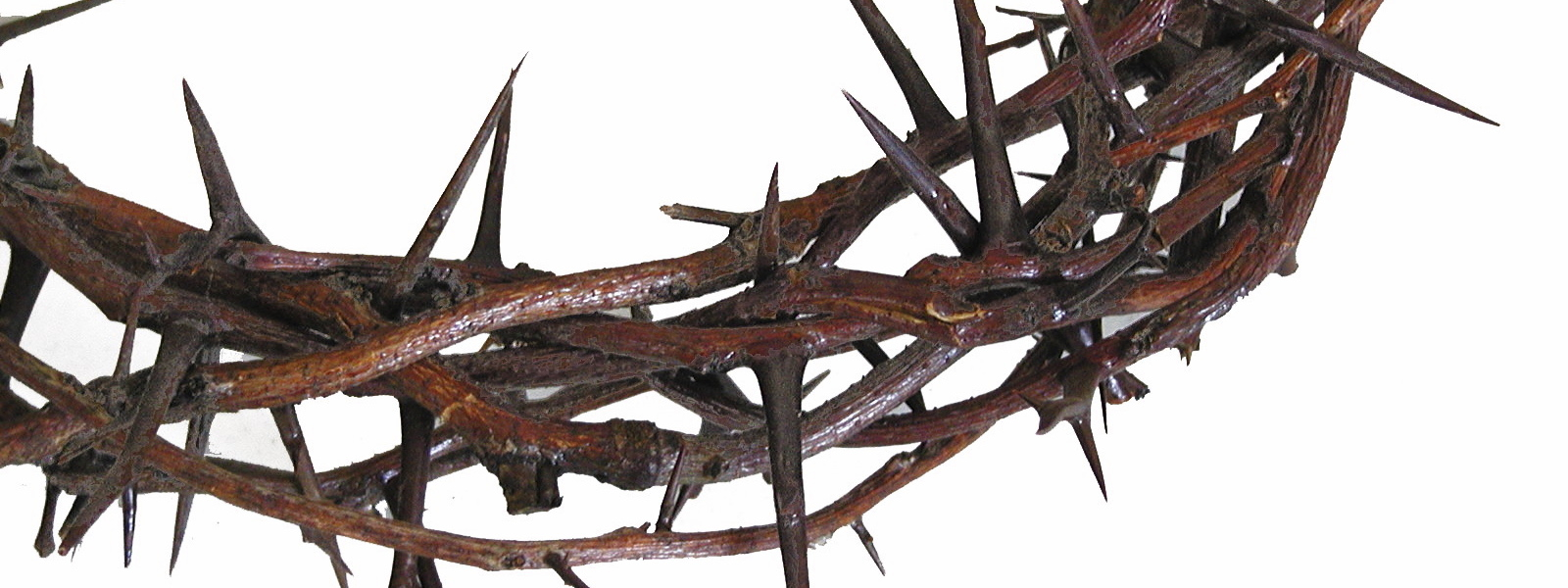
Jesus willingly rode into Jerusalem to be crowned. With a crown of thorns. A crown of suffering and pain, anguish and shame. This crown of thorns is a strong statement about the kingship of Jesus. This crown represents a whole new way of experiencing the world. This crown represents an entirely different way of seeing success. It shows us a new way to view time and history and reality. This crown is powerful.

The King who wore this crown loved his enemies. His righteousness was greater than that of the Pharisees. He was rich, but he became poor in order to save the world. And as he’s dying on the cross — suffering, suffocating, gasping for his last breath — he uses his final ounces of energy to intercede for his killers, “Father, forgive them; they don’t know what they’re doing.”

This crown of thorns is not a detour on the way to the Kingdom of God. It’s not an inconvenient hurdle, not even a necessary obstacle that has to be overcome to get to the Kingdom of God. This crown IS the Kingdom of God! This crown and everything it represents IS the Kingdom of God come on earth just as it is in heaven! It is an eternal statement about the kingship of Jesus and it communicates to us very clearly what God’s Kingdom is all about.

Some people accept this statement. Some people don’t fully understand the statement. And some people flat-out reject it. But, make no mistake: it IS the statement. It is the revelation. Jesus’ victory over sin and death was won in suffering and shame. He willingly, intentionally, determinedly wore the crown. And he is our Almighty King!

Peace,

Allan

Middle Class American Jesus?

We’re studying the radical ideas of discipleship found in the Gospel of Mark in our Wednesday night class here at Central. Tonight, we look at the idea of getting behind Jesus that is so prevalent in Mark’s writings. Jesus is in front, we are in back. Jesus leads, we follow. It’s not enough to be on the way with Jesus, we must recognize our place behind Jesus on that way. Behind him. Not beside him. Certainly not in front of him. He’s leading, I’m following. He’s leading, his Church is following. Jesus must be the one in front.

And the Church says, “Duh!”

What we’re going to talk about tonight is the fact that we are called to follow Jesus so that we do Jesus things in Jesus ways. Ways and means do matter a great deal to our Lord. How we do something is just as important as what it is we’re doing. The ways and means must always be consistent with the end.

Look at the call to follow: “If anyone would come behind me, he must deny himself and take up his cross and follow me.” ~Mark 8:34

Jesus calls us to completely abandon ourselves. He calls us to leave our certainty for uncertainty; to flee safety for danger; to ignore self-preservation and embrace self-denunciation; to run from security to accept downward mobility. In a world that prizes self-promotion, we claim to be following a Lord who calls us to crucify ourselves.

And we have a great tendency to spiritualize all that. We want to turn the radical call of Jesus into just a metaphor. His teachings are mainly just abstract thoughts, right? It’s figurative language, right? Jesus speaks in extremes to hopefully make us think differently, but not necessarily act differently.

Wait a second…

We’re starting to redefine Christianity here. We’re starting to define Jesus by our thoughts and ideas, not his. We want Jesus to keep us comfortable when, all along, Jesus came to this earth to shake us out of our comforts in order to save us.

David Platt, in his little book, Radical, says we’re always wanting to turn our Sovereign Lord into a nice, harmless, non-threatening, middle-class, American Jesus:

A Jesus who doesn’t mind materialism and who would never call us to give away everything we have. A Jesus who would not expect us to forsake our closest relationships so that he receives all our affection. A Jesus who is fine with nominal devotion that does not infringe on our comforts, because, after all, he loves us just the way we are. A Jesus who wants us to be balanced, who wants us to avoid dangerous extremes, and who, for that matter, wants us to avoid danger altogether. A Jesus who brings us comfort and prosperity as we live out our Christian spin on the American dream.

Jesus came here to save us; to shake us, to move us, to transform us into the perfect image of the Son of God. That doesn’t happen by doing things our way. That doesn’t happen by doing things the way the rest of the world does things. It happens when we fully submit to the impossibly difficult task of doing things the Jesus way, when we trust our Lord enough to allow him to work in and through us as we make the faithful attempts to live like him, when we dedicate ourselves to following through life and through death the One who goes before us.

“Whoever wants to save his life will lose it, but whoever loses his life for me and for the Gospel will save it.” ~Mark 8:35

Peace,

Allan

I Am Not A Dog!

“First let the children eat all they want,” he told her, “for it is not right to take the children’s bread and toss it to their dogs.” ~Mark 7:27

The way Jesus talks to this woman always messes us up. It’s fine for Jesus to be rude to Pharisees and Saducees. They deserve it. We even cheer at Jesus’ harsh words to the religious establishment… until we realize he’s talking to us. But it’s just not like him — it’s not Christ-like — for him to be rude to this woman who’s genuinely coming to him for help. It doesn’t make sense. It offends us.

Now, I do think Jesus is doing something deliberate here. And I think Mark is bending over backwards to show it to us. I believe Jesus is re-stating the salvation plan: first for the Jew and then for the Greek. And as he’s saying it, he’s demonstrating that the “then” is right now! He heals this Gentile woman in this Gentile land. And then our Lord immediately takes off for the Decapolis, ten pagan Gentile cities on the east coast of Galilee. And he heals. And then he feeds four thousand Gentiles in a Gentile desert. What Mark is saying in this section of his Gospel is that now it’s for everybody. The power of the Kingdom of God is for all people. You do not set any limits on the universal reach of the Savior of the World.

But sometimes that wonderful news overshadows the great humility of this desperate woman. And I believe Mark wants us to pay attention to that, too.

Jesus calls her and her people “dogs.” There’s no getting around it. And this woman doesn’t argue. She accepts the Jewish priority as explained by Jesus. She concedes the difference between the children and the dogs. And she humbles herself as a dog in order to accept healing from the Lord.

Her attitude is key. It’s necessary if one is going to be a true disciple of Jesus.

She comes to Jesus empty handed. She makes no claim. She has no merit. No priority. No standing. No privilege. She has nothing to commend herself to Jesus. She is in no way deserving of his mercy and healing. She does not argue that her case is some kind of special exception. She doesn’t lobby for special treatment. She completely accepts his judgment and bows down before Jesus as a beggar.

She’s not saying, “Lord, give me what I deserve on the basis of my goodness.” She says, “Lord, give me what I don’t deserve on the basis of your goodness.”

This willingness to humble oneself is a key requirement for discipleship. And it’s a lesson that Jesus’ own hand-picked apostles had a difficult time learning. Her attitude is the opposite of the apostles’ who are always arguing about who’s going to be the greatest. This woman is not bitter about the privileges of others. She doesn’t resent others’ shares of God’s blessings. She accepts her place and she comes to Jesus, just like we all must, as a sinner, poor and needy. She accepts that she’s unacceptable. Just like me. Just like us.

Martin Luther saw the entire Gospel in this one story. We are truly more wicked than we could ever believe; and we are more loved and accepted by God than we could ever dare to hope.

Pride, though, is our huge problem. Augustine said pride is what changed angels into devils. Pride is what causes us to thumb our noses at the God who insists we are unworthy. “I’m not a dog! I’m not weak! I’m not incapable! I’m not undeserving!” We’re offended. And we walk away from the Savior.

But not this woman. No, sir. This woman understood very well what Romans tells us, what all of Holy Scripture tells us: we are rebels and enemies of God, sinful and diseased, dead and powerless. In all humility she accepted that status, and received from Christ the healing and salvation she and her family so desperately needed. She is the perfect model of what it means to be last of all, to bow low and submit to the gracious King.

Don’t believe for a second you’re not a dog. You are. Don’t change the words in the song from “…such a worm as I” to “…such a one as I.” Don’t. You are an unrighteous, unholy, sinful, dirty human being in desperate need of a Savior. And he has come. And he loves you more than you can possibly begin to imagine.

Peace,

Allan

« Older posts Newer posts »