Category: Discipleship (Page 17 of 30)

Counter Cultural Jesus

Everything about our Savior flies right in the face of what the culture says is important. The values our culture upholds are counter to everything Jesus stands for. The ideas and philosophies our culture exalts are actually opposed to our Christ and his Kingdom.

Our culture says fight for our freedoms and assert your rights; Jesus willingly gave up his rights and his freedoms for the sake of others. The culture says gain more and more wealth and status and power; Jesus left behind all the wealth and status and power he enjoyed at the right hand of the Father to serve others. Culture says defend yourself at all costs, don’t let anybody mistreat you; Jesus walked purposefully into his own torture and to the cross to die. Culture works hard to establish and maintain boundaries between people of different colors, different languages, different backgrounds and zip codes and tax brackets; Jesus invites all the people of every nation, tribe, and tongue to enjoy a common feast at his one table.
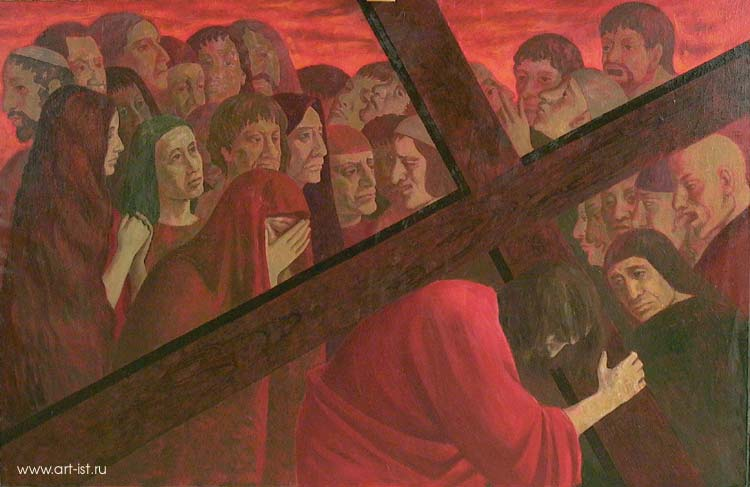
Jesus is completely counter-cultural.

I asked our Wednesday night Bible class this week in what ways the Central church is counter cultural, in what ways do we go against what society says is the proper thing to do? One of the first things somebody shouted out was that we feed the poor, we take care of the needy.

But that’s not counter cultural. Our society applauds those who feed the poor. The popular media produce slick feature stories for mass consumption about people who take care of the needy. Fancy buildings are named after those who minister to the less fortunate.

Somebody else said we proclaim God, we believe in God and profess his name. No, that’s not counter cultural, either. Not at all. This society absolutely upholds a belief in God as fundamental. Basic. I asked if any of the 75-80 people in the room had ever even met anybody who claimed there was no God. Only one woman raised her hand. Believing in God is a very cultural thing here. Very cultural.

The conversation went on and on, and I could write several pages about it. The bottom line is that some of the things we’re so proud of as disciples of our radical Lord don’t hardly make any ripples at all in our society. They don’t stick out as different from the crowd. We’re doing what everybody else is doing; we’re just attaching Jesus’ holy name to it.

We can do better. We can do more.

I mean, we’re still, for the most part, segregating our church body from the ones we’re blessing with food and monetary assistance. Some of us are in a huge multi-million dollar building with coffee bars and cushioned chairs and some of us are crammed in a crowded house across the street. We still betray our prejudices when our conversations are sprinkled with “us” and “them.” Some of us are watching Fox News four and five hours a day and listening to political talk radio, filling our hearts and our souls with angry words and malicious thoughts that oppose the very ideals of love and joy and peace for which our Lord died.
In 413 AD, Augustine wrote in “City of God” that Christians were villified by society because they were so different from what the culture expected. You can go back and read for yourself how the earliest Christians were criticized by the culture: Christians are bad citizens; Christians don’t march; they don’t fight; they don’t build; they don’t help govern; Christians are mixing the classes and races at common meals in common living quarters; they’re destroying the social structures of the society; they’re not patriotic; they’re not loyal to the Empire; they say we are to serve one God instead of the State; they advocate forgiveness toward our nation’s enemies.

Those are the teachings of the Church. Those are the apostolic interpretations of Scripture. And those teachings and that way of life is completely counter to the ways and powers and authorities of this world. It got Christians in trouble back then. That kind of living gets Christians in trouble today. Right here in Amarillo.

(When your Bible class is taking prayer requests this coming Sunday morning, try requesting that we pray together for the Iraqi and Afghanistani soldiers, that God would protect them and return them safely to their families. See where that’ll get you.)

We can do better. We can do more.

Someone Wednesday night pointed out that Central decided a dozen years ago to stay right where we are in this downtown location instead of moving away to a nicer, more upscale neighborhood on the outer margins of the city borders. Ah, yes. Very counter cultural.

Culture looks at deteriorating property values and changing demographics and says, “Get out while you can.” Culture sees declining church attendance and lower contribution numbers and says, “You’ve gotta leave.”

Central saw the very same things and said, instead, “We’ve gotta stay.” Central made the very difficult choice to eschew financial and geographical security, to put off any cares and concerns about attendance and buildings and cash, to fight through very real fears and anxieties of the unknown in order to fully embrace Christ’s mission in this zip code.

I praise God for that. Amen.

And I look forward to that great day when all the barriers have been destroyed here on earth just as they are in heaven. I long for that day when we truly worship our one God together as his children, when we truly fellowship together around that one table. Sooner, rather than later. Right here at Central. A clearly counter cultural vision that would get us in trouble with society. It would cause ripples. It would be noticed. It would be criticized. And it would bring glory and honor to our eternal Father.

We can do more. We can do better.

Peace,

Allan

Middle Class American Jesus?

We’re studying the radical ideas of discipleship found in the Gospel of Mark in our Wednesday night class here at Central. Tonight, we look at the idea of getting behind Jesus that is so prevalent in Mark’s writings. Jesus is in front, we are in back. Jesus leads, we follow. It’s not enough to be on the way with Jesus, we must recognize our place behind Jesus on that way. Behind him. Not beside him. Certainly not in front of him. He’s leading, I’m following. He’s leading, his Church is following. Jesus must be the one in front.

And the Church says, “Duh!”

What we’re going to talk about tonight is the fact that we are called to follow Jesus so that we do Jesus things in Jesus ways. Ways and means do matter a great deal to our Lord. How we do something is just as important as what it is we’re doing. The ways and means must always be consistent with the end.

Look at the call to follow: “If anyone would come behind me, he must deny himself and take up his cross and follow me.” ~Mark 8:34

Jesus calls us to completely abandon ourselves. He calls us to leave our certainty for uncertainty; to flee safety for danger; to ignore self-preservation and embrace self-denunciation; to run from security to accept downward mobility. In a world that prizes self-promotion, we claim to be following a Lord who calls us to crucify ourselves.

And we have a great tendency to spiritualize all that. We want to turn the radical call of Jesus into just a metaphor. His teachings are mainly just abstract thoughts, right? It’s figurative language, right? Jesus speaks in extremes to hopefully make us think differently, but not necessarily act differently.

Wait a second…

We’re starting to redefine Christianity here. We’re starting to define Jesus by our thoughts and ideas, not his. We want Jesus to keep us comfortable when, all along, Jesus came to this earth to shake us out of our comforts in order to save us.

David Platt, in his little book, Radical, says we’re always wanting to turn our Sovereign Lord into a nice, harmless, non-threatening, middle-class, American Jesus:

A Jesus who doesn’t mind materialism and who would never call us to give away everything we have. A Jesus who would not expect us to forsake our closest relationships so that he receives all our affection. A Jesus who is fine with nominal devotion that does not infringe on our comforts, because, after all, he loves us just the way we are. A Jesus who wants us to be balanced, who wants us to avoid dangerous extremes, and who, for that matter, wants us to avoid danger altogether. A Jesus who brings us comfort and prosperity as we live out our Christian spin on the American dream.

Jesus came here to save us; to shake us, to move us, to transform us into the perfect image of the Son of God. That doesn’t happen by doing things our way. That doesn’t happen by doing things the way the rest of the world does things. It happens when we fully submit to the impossibly difficult task of doing things the Jesus way, when we trust our Lord enough to allow him to work in and through us as we make the faithful attempts to live like him, when we dedicate ourselves to following through life and through death the One who goes before us.

“Whoever wants to save his life will lose it, but whoever loses his life for me and for the Gospel will save it.” ~Mark 8:35

Peace,

Allan

Like Little Children

“Unless you change and become like children, you will never enter the Kingdom of Heaven.” ~Jesus

Better writers than me, smarter theologians, more faithful Christians, have wrestled to put into words exactly what Jesus means when he says we have to become like little children if we’re to have any chance at his Kingdom. Some have pointed to child-like innocence; those are the ones who’ve never had kids. Others stress the humility of a child; those are the ones who’ve never experienced losing a game of Monopoly to a sibling. Still others say Jesus was talking about the selflessness of a child; to which I say, “What??!??”

I think Jesus is talking about complete, whole, utter dependence. Dependence on God the way a child depends on her parents for everything: for food and shelter, protection and provision, education and discipline, security, acceptance, and love. A child depends on his parents for everything. A little child can do nothing without them. And God longs for us to have that same dependence on him.

Carlo Caretto spent his Christian ministry writing and teaching about the freedom and real presence of God one feels when he finally decides to depend on the Lord for everything. His works remind us that it’s our privilege, not our punishment, to become like little children.

In a letter to his sister Dolcidia, a Catholic nun, in March 1955, he writes:

“Becoming like children is not easy for those who have been complicated by sin. To become little children means to increase our feeling for God’s fatherhood over us; it means to think and act as little children do towards a father they love. He looks after everything, he resolves everything, and so on. When does a little child ever worry about tomorrow? Never: the father takes care of it. Isn’t that right?

All our plans, even on the road to holiness, are perfectly useless. The real plan is in his hand and we need to go to him like children seeking love.”

Caretto prayed all the time that he might become “little, little, little. Small, small, small.”

Most of us think we’re too big. Most of us.

Me, too.

Peace,

Allan

I Am Not A Dog!

“First let the children eat all they want,” he told her, “for it is not right to take the children’s bread and toss it to their dogs.” ~Mark 7:27

The way Jesus talks to this woman always messes us up. It’s fine for Jesus to be rude to Pharisees and Saducees. They deserve it. We even cheer at Jesus’ harsh words to the religious establishment… until we realize he’s talking to us. But it’s just not like him — it’s not Christ-like — for him to be rude to this woman who’s genuinely coming to him for help. It doesn’t make sense. It offends us.

Now, I do think Jesus is doing something deliberate here. And I think Mark is bending over backwards to show it to us. I believe Jesus is re-stating the salvation plan: first for the Jew and then for the Greek. And as he’s saying it, he’s demonstrating that the “then” is right now! He heals this Gentile woman in this Gentile land. And then our Lord immediately takes off for the Decapolis, ten pagan Gentile cities on the east coast of Galilee. And he heals. And then he feeds four thousand Gentiles in a Gentile desert. What Mark is saying in this section of his Gospel is that now it’s for everybody. The power of the Kingdom of God is for all people. You do not set any limits on the universal reach of the Savior of the World.

But sometimes that wonderful news overshadows the great humility of this desperate woman. And I believe Mark wants us to pay attention to that, too.

Jesus calls her and her people “dogs.” There’s no getting around it. And this woman doesn’t argue. She accepts the Jewish priority as explained by Jesus. She concedes the difference between the children and the dogs. And she humbles herself as a dog in order to accept healing from the Lord.

Her attitude is key. It’s necessary if one is going to be a true disciple of Jesus.

She comes to Jesus empty handed. She makes no claim. She has no merit. No priority. No standing. No privilege. She has nothing to commend herself to Jesus. She is in no way deserving of his mercy and healing. She does not argue that her case is some kind of special exception. She doesn’t lobby for special treatment. She completely accepts his judgment and bows down before Jesus as a beggar.

She’s not saying, “Lord, give me what I deserve on the basis of my goodness.” She says, “Lord, give me what I don’t deserve on the basis of your goodness.”

This willingness to humble oneself is a key requirement for discipleship. And it’s a lesson that Jesus’ own hand-picked apostles had a difficult time learning. Her attitude is the opposite of the apostles’ who are always arguing about who’s going to be the greatest. This woman is not bitter about the privileges of others. She doesn’t resent others’ shares of God’s blessings. She accepts her place and she comes to Jesus, just like we all must, as a sinner, poor and needy. She accepts that she’s unacceptable. Just like me. Just like us.

Martin Luther saw the entire Gospel in this one story. We are truly more wicked than we could ever believe; and we are more loved and accepted by God than we could ever dare to hope.

Pride, though, is our huge problem. Augustine said pride is what changed angels into devils. Pride is what causes us to thumb our noses at the God who insists we are unworthy. “I’m not a dog! I’m not weak! I’m not incapable! I’m not undeserving!” We’re offended. And we walk away from the Savior.

But not this woman. No, sir. This woman understood very well what Romans tells us, what all of Holy Scripture tells us: we are rebels and enemies of God, sinful and diseased, dead and powerless. In all humility she accepted that status, and received from Christ the healing and salvation she and her family so desperately needed. She is the perfect model of what it means to be last of all, to bow low and submit to the gracious King.

Don’t believe for a second you’re not a dog. You are. Don’t change the words in the song from “…such a worm as I” to “…such a one as I.” Don’t. You are an unrighteous, unholy, sinful, dirty human being in desperate need of a Savior. And he has come. And he loves you more than you can possibly begin to imagine.

Peace,

Allan

Do You See Anything?

Yesterday’s Skip-shot in this space has started something. I received a text from Byrnes very early this morning that said:

 “Rangers Subdued by Iron Fister.”

I countered with:

“Colby Serves Up the Cheese in Rangers Loss.”

If you’d like to add a corny headline about last night’s game before this afternoon’s begins, jump in.

~~~~~~~~~

We’re conditioned by our world — actually it’s in our nature and then reinforced by the world — to see the things we want to see and hear the things we want to hear. Anybody with a spouse or any children know this first hand. I’ll tell the girls “maybe” and they run to Carrie-Anne and say, “Dad said we could!” As a preacher, sometimes this works in my favor. Somebody will tell me how wonderful it was when I said such-and-such and I have no idea what she’s talking about. What this lady heard is nowhere near what I was preaching. But it meant something to her. And I still take credit for it. Of course, it certainly can work the other way, too.

In the Gospel of Mark, Jesus keeps asking people if they’re seeing correctly. Jesus asks the blind guy in Mark 8, “Do you see anything?” Same chapter, in the boat before Jesus and his apostles reach Bethsaida, he asks them, “Do you still not see?”

The blind guy in Mark 8 whose vision is blurry, whose eyesight is not perfectly clear, who sees something but not everything, represents everybody in the Gospel. And most everybody we encounter today. We see Jesus. But we don’t see all of him. We only see what we want. We embrace the Jesus who heals and forgives and feeds and loves and accepts and saves. We want to follow Jesus and live like that Jesus. But a Jesus who suffers and dies? Peter refused to see it. Most everybody did. Sometimes we don’t see it. And our picture of the Messiah is woefully incomplete. The Savior we teach is less than whole. The Gospel we preach is only partial truth.

We don’t see Jesus completely until we see his suffering and death. To see Jesus die is to understand who he really is and what he really came to do.

There are only two people in the entire Gospel of Mark who are said to “see.” One is Bartimaeus, the only other blind guy in the whole book, in Mark 10. This is Jesus’ final miracle, his last healing, as he enters Jerusalem to die. Bartimaeus calls out to Jesus, “Son of David!” That’s the Messianic title. The blind guy is the only one who sees. Jesus asks him, “What do you want me to do for you?” And Bartimaeus answers, “I want to see.” And the text tells us that “immediately he received his sight and followed Jesus.” To the cross. To his death.

The other one is the Roman Centurion. At the cross. At Jesus’ death. The crowds were shouting, “Come down from the cross that we may see and believe!” When the soldier “saw how he died,” he confessed Jesus as the Son of God.

If you tell Jesus “I want to see,” what you’ll see is a commitment to trials and ridicule and persecution and suffering. You’ll see a road, a way, that leads to your death. What you’re promised is the same exaltation and glory that he now has as the resurrected Lord reigning at the right hand of the Father in heaven.

Peace,

Allan

The Active Life

The life of a disciple is active, not reactive. It has nothing to do with just talking about faith or teaching religious principles or believing theological ideas or keeping biblical rules. It has everything to do with living one’s whole life in obedience to God’s call through personal action. It doesn’t just require a mind. It requires a body, too.

Ours is a life given to us by God to be lived not in some kind of rigid, cramped, crowded, small, compromised, legalistic way but in a full, wild, joyful, exuberant, cheerful, celebratory way. A way that apprehends and assimilates and then radiates the freedom we have from God in Christ.

Our Father wants his beloved children to operate out of joy and freedom to do what is good and right, not out of fear of making a mistake. Isn’t that one of the great lessons in Jesus’ story about the servants and the talents in Matthew 25?

The Christian life is an active life. Our God calls us to give our whole selves to him. Brakes off; no looking back; full steam ahead! We must act in faith that our God who calls us to live boldly and outrageously for him also promises us that if and when we do mess up in enthusiastic service to our King, he promises forgiveness and consolation and salvation.

Peace,

Allan

« Older posts Newer posts »