Category: Church (Page 58 of 59)

One God, One People, One Purpose

“You will be for me a Kingdom of priests and a holy nation.” ~Exodus 19:6

Our behavior, not just the “belief system” we adhere to, is the most visible means by which we distinguish ourselves from those who have not been raised with Christ and united with him in his death, burial, and resurrection. We should never forget that what is required of us, because we are saved by grace, is a high moral standard of thought and action that for those outside the Kingdom of God is incomprehensible.

Our obedience to God reflects the fact that our citizenship is in heaven. It shows others that he is training us to transcend the present world even though we still occupy its space. It is what is expected of us, because God is forming us into creatures that this world can’t fully grasp.

We demonstrate by our words and actions, in no uncertain terms, that we are of a different pedigree, a holy race. It is, to the rest of the world, the clearest proof of the existence of God—not a logical exegetical argument, not forceful rhetoric, but pure, humble, godly lives lived in the shadow of the cross and in the brilliant glow of the resurrection.

Peter quotes Exodus 19:6 and follows it up with these words, “Live such good lives among the pagans that…they may see your good deeds and glorify God” (1 Peter 2:12).

We’re not called to be God’s people so we can belong to him privately or exclusively. He has a grand goal in mind when he creates us to be his kings and priests. He calls us to live public lives of sacrifice and service to others in his name. And when we do, we show the world that the Gospel works. It’s not just words or a great idea. It changes us from the inside out and makes us into creatures whose behavior is beyond explanation.

~~~~~~~~~~~~~~~~~~~~~~~~~~~~~~~~~~~~~~~~~~~~~~~~~~~~~~~~~~~~~~~~~~~~~~~~~~~~~~~~~~~~~~
FinalBowFinally, the Finale!

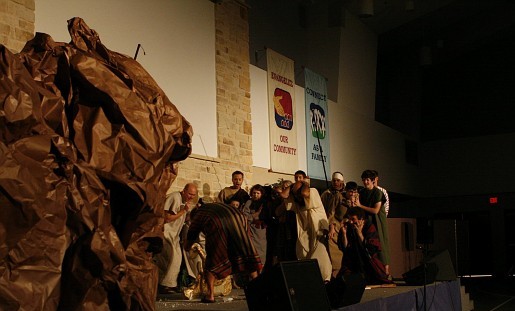
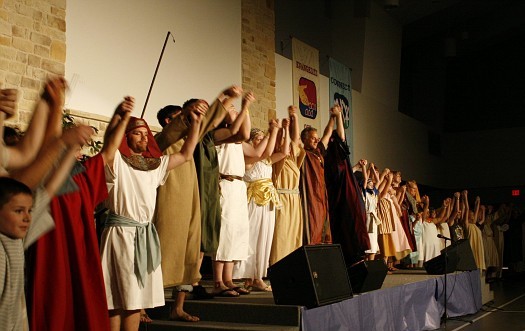
Legacy VBS 2008 is over. And those of us in the musical get our evenings back for the first time in a little over a month. My greatest fear going into last night’s final scenes would be that, after KidsAtFinaleaccidentally breaking or tearing or ripping something in the previous three nights, I wouldn’t be able to break the styrofoam Ten Commandments or the styrofoam golden calf when I was supposed to. But it all came off beautifully. And the kids were all very impressed by the fury of Moses’ righteous indignation.
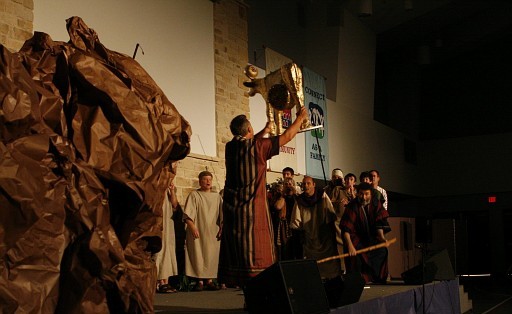
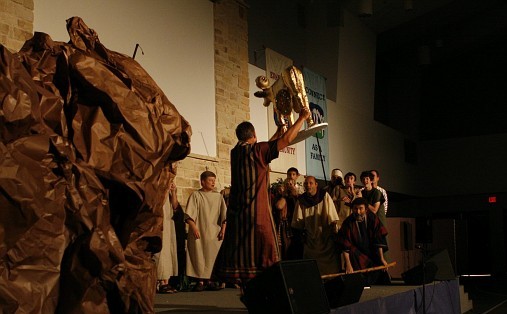
SmashingIdols SmashingIdols2 SmashingIdols3

Can I get theological with the musical?

I can’t help but see our God at work here.
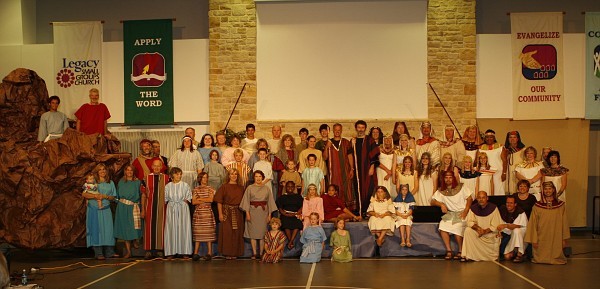
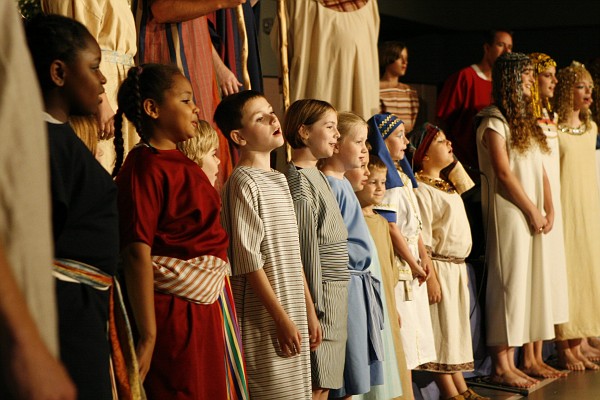
CastPhotoSomehow we were able to take 75 different cast members and set designers and technical operators with 75 different skills and abilities and dreams and visions and come together under one mission. Somehow we were able to unite behind one purpose. Together we fought through missed lines and muted mics and unlearned lyrics (my bad, sorry!) and sporadic rehearsal attendance. Together we smoothed out the rough edges. Together we sacrificed and served and built up and encouraged. We helped each other change costumes and sets and switch out microphones. We worked with each other on scripts and blocking and music.

The people with beautiful voices sang like angels. The funny people made everybody laugh. The focused people kept us on CurtainCallShepherdstrack. The creative people designed a parting of the seas and built a huge mountain. The technical people kept the whole thing lit up and loud. The nurturing people kept us all edified.
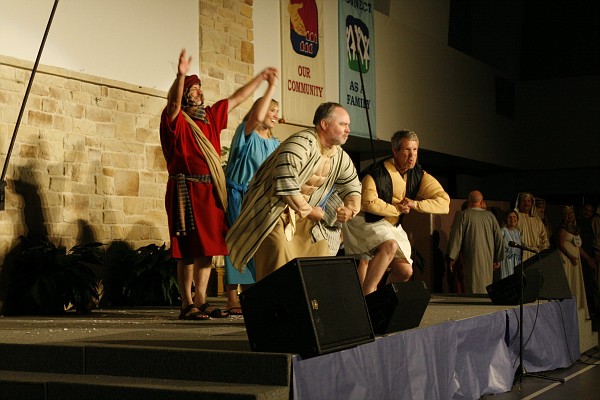
And we didn’t kill each other.

I was there every night for over a month and I can’t recall ever hearing one cross word. Not one. Yes, there were moments of exasperation and exhaustion and frustration. But not once did I hear one person say one bad thing about another person. Not once did anybody raise a voice toward anybody else. Not one accusatory finger was wagged. Not one motive was judged. Not one person was ridiculed or rebuked.

It doesn’t seem possible. You couldn’t have gathered a more diverse group than our 75—widely and wildly different ages, backgrounds, experience, personalities, expectations, talents, and tempers. How did it come together so smoothly?

Do I really need to explain?
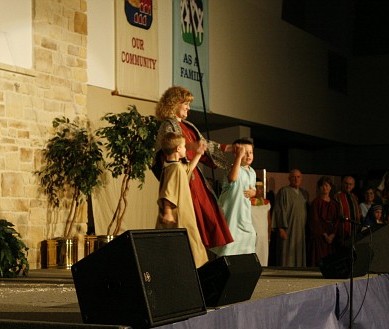
CurtainCallZippy&BoysOne purpose. We were way too focused on the mission to gripe or complain or grumble or worry about ourselves. Way too busy. Way too under the gun with the urgency of the task, way too determined to accomplish the purpose. There was a job to do, a big-picture job to do, and we had to do it. And that meant working together as a team, putting the show ahead of the individual personalities or scenes or numbers.

To me, theologically speaking, the musical represents the beauty of God’s Church. People from all walks and all personalities united as one people by the blood of Christ Jesus; working as a team, as one Body, helping each other, encouraging each other, sacrificing for each other, serving each other, to work toward the common purpose.
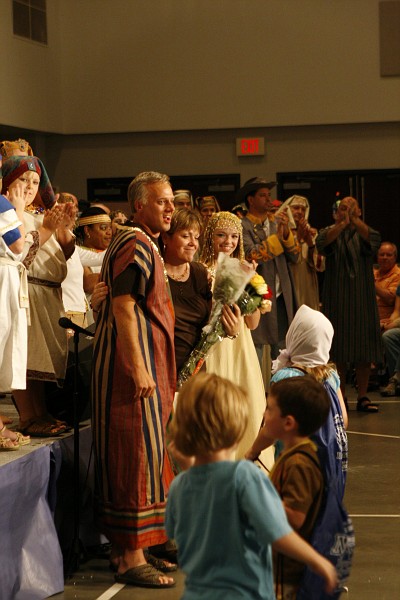
KipiKipi, thank you for your hard work and patience. Thank you for your commitment to the children and the families of Legacy and North Tarrant County. And everybody on the cast and crew of Moses: Bound for Holy Ground, thank you for showing everybody in unmistakable ways what it looks like to be the people of God.

~~~~~~~~~~~~~~~~~~~~~~~~~~~~~~~~~~~~~~~~~~~~~~~~~~~~~~~~~~~~~~~~~~~~~~~~~~~~~~~~~~~~~~

Jesse and/or Mason have posted tons of pictures—350, I think—of their recent mission trip to Honduras. Click here to check ’em out.

Peace,

Allan

Jumping Off The Line: Part Two

A young man (anybody younger than me is young) came into my study here last week to ask me some questions about Legacy. This man is going through the final stages of a horrible divorce. He’s lived out in West Texas for several years but is now moving back to DFW. He was born and reared in Dallas. And as he’s shopping for a church here in North Tarrant County, he asks me this question:

“Where is Legacy compared to ___ ___ Church of Christ and ___ ___ Church of Christ?”

And he named two congregations in Dallas, one known throughout our fellowship as being “progressive” or “liberal” and the other labled as “traditional” or “conservative.”

Where is Legacy on that line? Where are you?

Of course, it reminded me of that A-B Line we’re all trying to eradicate from our thinking and our conversations, this linear way of thinking and talking that does our church families and the Kingdom of God much harm. I wrote about this a couple of weeks ago. (You can read it again by clicking here.) And I told this man in my office, “I’m not going to have the conversation this way.”

When we use words like “conservative” or “progressive” or “liberal” or “traditional” we’re really just describing people’s opinions. And discussions that focus on these words and concepts and the issues they invite inevitably turn into political battles for power instead of spiritual searches for the truth.

The truth is nowhere to be found on that line.

Henri Nouwen, in his book In the Name of Jesus, addresses church leaders on the dangers of this type of thinking:

“Christian leaders cannot simply be persons who have well-informed opinions about the burning issues of our time. Their leadership must be rooted in the permanent, intimate relationship with the incarnate Word, Jesus, and they need to find there the source for their words, advice, and guidance.

Dealing with burning issues without being rooted in a deep personal relationship with God easily leads to divisiveness because, before we know it, our sense of self is caught up in our opinion about a given subject. But when we are securely rooted in personal intimacy with the source of life, it will be possible to remain flexible without being relativistic, convinced without being rigid, willing to confront without being offensive, gentle and forgiving without being soft, and true witnesses without being manipulative.”

I explained the A-B Line way of thinking to this young man in my study and he caught on very quickly. He seemed to appreciate my desires to jump off that line in our considerations and conversations to focus on the sanctification and salvation of the souls here at Legacy and the lost in our immediate community. He fell in love with the concept of being guided by the Word of God and his Holy Spirit instead of outside forces such as other churches and that constantly-moving “middle of the road.”

It’s really easy to show people the flaws in the way we think and talk about church and the benefits of the alternative “C” way of doing things. It’s a piece of cake to do that in one-on-one discussions. But how do we communicate this to the entire church body? How do we get everybody to jump off the line? It’s such a radical idea, and so opposite of the way we’ve always thought and talked, I’m afraid teaching this in classrooms or preaching it on Sunday would make things worse instead of better.

Is it even possible to get an entire church body to jump off the A-B Line? How do we do it?

Peace,

Allan

Dreamers Dream Dreams

Christ-Centered ChurchWe were asked a couple of months ago, in preparation for the elders/ministers retreat at Glen Rose, to write down our dreams for the Legacy Church of Christ. There were no time frames attached to the request. They could be dreams we have for the congregation in the coming months or visions of what we’d hope to see 20 years from now.

Toward the end of our time together, we shared those dreams with each other. We listened as everyone poured out their hearts and wishes and passions and hopes for the Legacy body. We prayed together that our God would use us for his purposes, to minister to his people in his Kingdom, as he wishes.

I was inspired by the commonality in our individual visions.

Of course, the details differed and the emphasis changed from person to person as we went around the room. One elder would speak of increased membership and a bigger staff. Another would bring up an idea to enhance outreach to the hispanic community or the Lifeline Chaplaincy program or our marriages and kids. Someone wants us to establish a local “Made In The Streets” program here in our area like the one Charles Coulston runs in Kenya. One spoke passionately about handing the “nuts and bolts of running the plant” over to the deacons to allow the elders to focus solely on the Scriptural teaching and praying roles for which they signed up. A couple of elders even tied their dreams to Legacy Small Groups Church and increased participation there.

And while different men and different personalities shared many different things, the overarching themes all connected. Each and all of the Legacy elders and ministers are determined that we become a “city on a hill,” a true force for God in our North Tarrant County communities. All of us want to be more mission-minded and mission-active, reaching out to heal both body and soul here locally and around the world. We’re all committed to faithful marriages and families in our congregation, spiritual growth in our individual and congregational relationships with Christ Jesus, and in more selfless service to one another.

I was never more proud to belong to Legacy than I was that day in Glen Rose.

Naturally, we acknowledged that it was one thing to sit around a big conference table and talk about these ideas and ideals and quite another to actually implement them in practical ways in our Body life. But we vowed to try. And we promised to hold each other accountable to the things we had discussed.

I came back and posted my own dreams and visions for Legacy on the wall above my desk in my study. I want to be continually reminded of my goals and the things I want to equip and inspire our brothers and sisters to be and do.

So, as I look at them and read them on my wall every single day, I think maybe you could be encouraged or inspired by seeing them, too. At the very least, it’ll help you keep me accountable to the things I feel our God is calling me to do and the ways he’s calling me to lead. I’ll my specific goals for the rest of 2008 and my goals for 2009 with you tomorrow.

Here they are, my big-picture dreams for the Legacy Church of Christ:

~to adopt the Ezekiel 34 vision as a motivation for everything we do in the name of God; to search for the lost, to bind up the injured, and to strengthen the weak.

~to be the leader within the Churches of Christ in the Kingdom of God; to provide leadership, ministry, and spiritual formation direction for other churches; that we would do things in a way that would inspire other Christians and other churches; that others outside our immediate fellowship would follow us as we follow Christ.

~100% Small Groups participation; that we would all serve and grow and minister and evangelize, with each other in each other’s homes, therefore becoming more like Christ.

~become a body that reflects the message of the Gospel by uniting and bringing together those from all color, economic, social, career, and ethnic backgrounds; that our Spanish-speakers and our deaf members would be integrated, not separated.

~flex our autonomy; be truly non-denominational; be guided by Christ Jesus and his Word, not outside forces.

~be a center for Christian unity events such as worship assemblies and lectureships and seminars for our brotherhood and beyond.

There they are. Keep me honest.

~~~~~~~~~~~~~~~~~~~~~~~~~~~~~~~~~~~~~~~~~~~~~~~~~~~~~~~~~~~~~~~~~~~~~~~~~~~~~~~~~~~~~~

SharonHappy Birthday today to my little sister, Sharon. Smash your sandwich, miss an important turn in downtown Dallas, and have an asthma attack to help her celebrate. I love you, Shassher!

Peace,

Allan

Jumping Off The Line

Issues.

Why are we defined by the issues?

Why do we label churches and each other according to the issues?

Why do our language and our attitudes and our thought processes center on the issues?

Why have issues become the heart of Christian leadership?

It seems that in the Church—and it’s been this way for a long, long time—we judge you and your spirituality and your doctrinal soundness on how you feel about this buzz word or how you think about that catch phrase regarding the issues. Or sometimes whether you use those pet words or phrases at all. If I’m having a casual conversation with you and you use the word “brethren” or “missional,” I’m going to label you as being somewhere on an imaginary line between liberal and conservative, between progressive and traditional. And I’m going to assume you’re heading in one direction or the other. If you declare an affection for the King James Version or express a fondness for a “praise team,” I’m going to know everything about your theology and your relationship with God and his Church based on this line between conservative and liberal, between one extreme and the other. I judge your congregation based on whether you do Small Groups or whether you assemble together at the building on Sunday nights. Or whether you meet on Sunday nights at all. When we think along this line between Point A and Point B, there becomes a big difference between a brother or sister who enjoys singing There’s A Stirring and one who prefers A Mighty Fortress. It’s become so ingrained and so absurd in the way we do church business that we draw a hard distinction between a female children’s minister and a female children’s coordinator.

These buzz words and catch phrases are now conversation-enders. If you use one in a discussion you and I are having, our conversation ends. We may still be talking to each other, but I’ve already heard enough to label you. I know exactly where you are and where you’re going based on your use of that word. I know your agenda. So you may still be moving your mouth, but I’m not listening. I already know.

This kind of thinking along the A-B Line and our reactions to the prevailing A-B Line culture in our churches have led to much mistrust and suspicion. This kind of thinking stifles true communication and growth. And it leads to churches being guided by outside forces and church leaders making decisions based on fears.

What would happen if we jumped off the A-B Line?

What if we totally changed the spectrum? What if we adopted a different vision? What if we did things in an alternative way?

What if every conversation in the church and every decision made by church leaders was based purely on the topic at hand on its own merits? What if, instead of being guided by what such-and-such congregation is doing down the road or what so-and-so across town might think, we did things that were best for Legacy and best for the lost of Tarrant County?

What if we found ourselves in a church culture in which a brother could wear a suit and a tie and still read The Message? What if a sister raised her hands while singing Standing On The Promises? What if a group of church leaders decided a praise team isn’t right but it is good for women to pass trays during communion? Can a person clap during worship and still use the small letter “c” in the word “church”?

See how those above scenarios go totally against the A-B Line thinking?

Thinking on that line causes us to believe that the issues or the practices all go along some kind of predetermined order. If a church uses a praise team, it’s only a matter of time before women are preaching from the pulpit. If a church still uses songbooks, it’s obvious they’re going to eventually tear down the kitchen and pull their support from the orphans home.

The alternative is to do what’s best for Legacy according to our understanding of the Scriptures, not according to what somebody might say or think. Or write. It’s to judge each issue and each practice solely on its own merit. It’s to never assume that anybody’s sliding toward or away from anything other than toward God and his will and away from Satan and his. It’s pro-active instead of reactive. It’s being guided by Christ Jesus and his Word, not by outside forces. It’s not a compromised position, it’s a responsible position. It’s not content with trying to stay in the middle (a futile exercise if there ever was one), it’s doing everything possible to be out front.

It requires strong and dedicated leadership, no doubt. And it’s only accomplished with mutual love and trust.

What would happen if we jumped off that line?

Peace,

Allan

Pastor or Cheerleader?

A couple of lines in a quick little interview with Eugene Peterson in World Magazine this month, brought to me last week by David Watson (thank you, brother), really have me thinking. Peterson’s not serving as the pastor of that big Presbyterian church in Baltimore anymore. He’s retired, sort of, living with his wife in a cabin on a mountain lake in Montana.

These two paragraphs right in the middle of the article intrigue me, especially as they relate to the current church culture in most metropolitan areas of the Bible belt, specifically in Dallas-Fort Worth, particularly here at Legacy.

“At his suburban church in Maryland, Peterson pastored people who ‘were rootless,’ lacking ‘generational continuity where they lived.’ So he spent a lot of time ‘thinking about, praying about how to make this a place where people feel relationally connected.’ Instead of offering non-stop activities, Peterson’s church had a ‘quiet order of worship’ that sought to draw people into the gospel story. When newcomers asked what activities his church offered, he’d speak of worship on Sunday, and ‘if you’d let me be your pastor I’d help you learn not to want so much activity.’

Peterson sympathizes with pastors who complain about the demands people make: ‘In this American culture they feel very competitive. Pastors feel that people want action.’ He challenges them: ‘Do you want to be their pastor or their cheerleader? It’s a desecration of the pastoral vocation to commodify it, to turn the church into a consumer place.'”

You already know, I cringe when I hear my own brothers and sisters judge our church family or judge other churches based on what new exciting program is offered, what new exciting technology is being used, and / or what new exciting worship element is being experienced. It’s even worse, much worse, when ministers and elders use that criteria to inform their pastoring and decision-making. In some cases, the spirituality of a body of believers is judged based on these programs, technologies, and worship practices.

More, more, more. Turn it up. Louder. Faster. Brighter. Bigger. Flashier. Fancier. What am I going to get out of this? Are my kids going to love it? Why should I come to your church? Why should I stay at your church? More. More. More.

We’ve just started again our quarterly “Legacy 101” class on Sunday mornings, a three-week course designed to introduce new members and visitors to our church family. This past Sunday I spent the entire 30-minutes talking about ministries at Legacy—not programs and classes to minister to them, but opportunities for them to serve and minister to others.

We held another training session last night for new Small Groups Co-Leaders and it gave us another chance to tell our leader-couples, “It’s not about you.” For our leaders, Small Groups is never about what they’re going to get out of it, what benefits they’re going to receive. It’s always about the ways they can serve and minister to the other half of our congregation who are not involved, not connected, not feeling like family here. We multiply to include more people. We multiply to serve and minister to more people.

And, for the most part, we all understand that. The new members of our church in that Legacy 101 session Sunday spoke much more about using their gifts and abilities to serve others than about what we can do for them. The new leaders of the multiplied groups talked much more last night about reaching out to their brothers and sisters in this church and to the lost of the community than they did about personal comfort levels and their own needs.

Peterson doesn’t cry out against activity. He cries out against activity for activity’s sake. Busyness. Entertainment. Diversion. He laments the kinds of things I hear increasingly more, not just from our church members but, from ministers and elders: we have to add this so more people will come, we have to add that so people won’t leave, we have to start doing this or begin offering that to keep everybody happy.

We have tons of activities at this place, something here almost every day and night. And I’d like to see us doing even more, but only when those activities are designed to equip and empower our people to serve and minister to others; when the focus is outward, not inward; when the emphasis is on you, not me.

~~~~~~~~~~~~~~~~~~~~~~~~~~~~~~~~~~~~~~~~~~~~~~~~~~~~~~~~~~~~~~~~~~~~~~~~~~~~~~~~~~~~~~

Jim Edgmon sent this to me. Enjoy.

4-28atthebank.bmp

Peace,

Allan

Attractional v. Missional

I know. I know. I try my very best to stay far away from Church Buzzwords. You know, words that we use that automatically end the conversation. Words that, once used out loud, label the user so that everybody else in the discussion stops listening to the actual conversation because they’ve already drawn their conclusions.

But try to hear me out.

In a column on mission-minded churches by Kent Marcum in the latest Christian Chronicle, he writes,

“Many congregations suffering from problems could probably attribute their internal struggles to an internal focus.”

It’s easy, perhaps, for some to see that in our churches. But I’ve also recently begun to witness this phenomenon in our Small Groups here at Legacy. (Now, please recongize that the following couple of statements are broad, general observations.)

It seems to me the groups that were built around friendships and strong existing relationships are struggling. These are the groups that started out so strong and so big and with so much promise. But these are the groups now that are fighting and arguing and getting feelings hurt and not growing and not inviting visitors and not really achieving what the groups are meant to achieve. People in these groups report that they almost dread Sunday nights. They’re walking on eggshells. Attendance is sporadic and the tension is real.

On the other hand, it seems that our groups that began with a few families who didn’t really know each other are doing so much better. These are the groups that started with doubt and uncertainty and lots of questions. I wasn’t sure about a couple of them. But now these are the very groups that are growing and inviting visitors and reaching out to the community and serving other people. Every week they report new people coming in, new projects they’re taking on, and new ways they’re getting to know each other. They love their Sunday night meetings together and they can’t wait to multiply and share what they have and what they’re doing with others. They seem to be achieving what the Small Groups are built to achieve.

Again, I don’t mean to paint our entire Legacy Small Groups Church with a broad stroke. But there is something important in the mindset of the groups in the same way there’s something significant about the mindset of an entire congregation. When the focus is on “us,” we struggle. When the focus is on “others,” we excel.

Whether in our Small Groups or in our congregations, it’s the difference between being attractional versus being missional.

A church with an attractional viewpoint says if we build it, they will come. If we do church better, they will come. If we sing newer songs (or older songs) they will come. If we take an appealing position on the hot church topic of the day they will come (or, they won’t leave). If we start more exciting programs, they will come. Bigger screens, cushier chairs, and a coffee bar! They will come!

A church with a missional mindset is different. It infiltrates its community. A missional viewpoint says it’s not what we do but, rather, what we do for you in the manner of God. Our Father through Christ shows grace, our God through Christ forgives, our God through Christ heals and loves and comforts. Jesus teaches and restores and shows compassion and brings justice. God, through his Son and by the power of the Holy Spirit, is today, right now, reconciling all of creation back to himself. And a missional church models that Good News. We go out from our places and, like our Savior, we show mercy and grace and compassion  and forgiveness to a lost and dying world.

This is what I’ve learned from Luke 15 over the past week and what I’m trying to communicate to my brothers and sisters at Legacy.

Forget the nine coins in the jar on the counter. As long as there’s even one single lost coin buried in the dirt in the corner of a dark house, I’m not going to stop until it’s found. Forget the 99 sheep safe in the nurturing and loving environment of the flock. As long as there’s even one solitary sheep wandering out there alone in the wilderness, I will not quit until it’s found. Every single sheep. Every single coin. Every single person. Everyone is significant. Everybody matters.

Luke 15 says clearly to forget the church building and the contribution and the worship traditions and the programs and the committees. Forget the ones already in. Don’t worry about them. Worry about the ones who aren’t in. Worry about the outsiders. Worry about the lost. And do something about it.

In Luke 15 the religious people are muttering. “Those kind of people don’t give. Those lost people don’t speak English. Their kids are not well-behaved. Have you seen what they wear? They’ll just mess things up. They’re on welfare. He just got out of prison. She has AIDS. He cusses. She smokes. We have to protect our kids. We have to be careful. Maybe those kind of people should just go somewhere else.”

Stop looking in. Start looking out. Forget the nine meeting in your house on Sunday night. Forget the 99 meeting in your church buildings on Sunday mornings. Go seek and save the lost.

~~~~~~~~~~~~~~~~~~~~~~~~~~~~~~~~~~~~~~~~~~~~~~~~~~~~~~~~~~~~~~~~~~~~~~~~~~~~~~~~~~~~~~

I must share this with you. Alvin Jennings sent me this video. Watch it once and you’ll watch it half a dozen times. If this little two-year-old girl can sing this beautiful classic hymn, why can’t we? What a precious angel.

And after you watch it, ask yourself this question: the way I’m smiling right now, does God smile like this when I sing to him?

Peace,

Allan

« Older posts Newer posts »