Category: Church (Page 50 of 61)

Saying "No" To Creating Spectators

SpectatorsI’m still not finished with that second desert temptation of Jesus. Two more things. One today and one more tomorrow. If Jesus would have jumped off the roof of the temple and allowed God’s angels to save him in front of all those crowds, it would have been quite the spectacle. Amazing. Incredible. Wow.

Do it again.

People would have kept showing up every week, every day, if Jesus were going to jump. And that would have created a community of spectators, a group of people who came for the show. They would be there faithfully. Every time the doors were opened. And they would watch. They would sit back and watch. And then they’d go to lunch and talk about what they saw. They’d critique this week’s jump. How did it make you feel? What did you like or not like about this week’s jump? A community of watchers. Spectators.

Might that be one of the reasons Jesus said “No”? Creating spectators is not The Jesus Way.

I believe there’s a real temptation to try to dazzle our people in our worship centers on Sunday mornings. More culturally-relevant songs, more culturally-desired audio and video presentations, a more culturally-acceptable pace and tempo and environment. If we’re not careful, we’ll create a community of spectators, a generation—or several—of not disciples but spiritual couch potatoes. We’ll find ourselves filling up our bleachers and trying to give our people a show. Or an experience. I think that’s a very real temptation today.

And that’s just the opposite of The Jesus Way.

Jesus invites his disciples to participate, never to just watch. He invites us to participate in the worship and to join him in the mission. He sends us out together in groups of two and groups of 12 with his power and with his authority to drive out demons and cure diseases and to preach the Kingdom of God and to heal the sick (Luke 9). When he feeds the five thousand in Luke 9 Jesus gives the bread and the fish to his disciples and has them serve it to the people. Participate. Get involved. Don’t just sit there.

The Jesus Way is to get up and get busy. Everybody. Nobody just watches. We minister as we’re ministered to. We care as we’re cared for. We forgive as we’re being forgiven. We love as we’re being loved. Together. That’s The Jesus Way.

~~~~~~~~~~~~~~~~~~~~~~~~~~~~~~~~~~~~~~~~~~~~~~~~~~~~~~~~~~~~~~~~~~~~~~~~~~~~~~~~

Whit&DadThanks to Dale Bankhead and Brian Kendall (we’ve got to stop calling him Brittany’s husband!) SweetSeatsWhitney and I got to take in Tuesday’s Rangers-Astros game in some sweet seats in the Ballpark. Ian Kinsler went deep in his first two at bats. Millwood and Jennings combined on a nice five-hitter. And Pudge Rodriguez tied Pudge Fisk for the all-time major league lead in games started as a catcher. (We gave Rodriguez a standing O when he hit his solo shot to cut the Texas lead to 6-1. I doubt he would have received the same level of love if his blast would have meant something for Houston.) A Lemon Chill and a new Josh Hamilton jersey for the Whitster, ballpark nachos for me, a big Rangers win and a great daddy-daughter night for both of us.

~~~~~~~~~~~~~~~~~~~~~~~~~~~~~~~~~~~~~~~~~~~~~~~~~~~~~~~~~~~~~~~~~~~~~~~~~~~~~~~~~~~

ValReadingOur Little Middle, Valerie, has been down in San Antonio all week on a Junior High trip to minister to urban children in the downtown parts of the Alamo City. We haven’t spoken to her since they left Sunday afternoon. But we’re able to keep up with her through the miracle of Lance’s blog. (It’s a miracle he’s actually updating it three or four times a day.) What a joy to log on and see Val, from 200 miles away, reading with little kids, teaching a Bible story with puppets, and giving piggy back rides. She’s so good with little children. She has a heart for that kind of thing. I think our God is going to use her to touch a lot of people in her lifetime.


ValPuppets ValPiggyBack

Being Church At Home

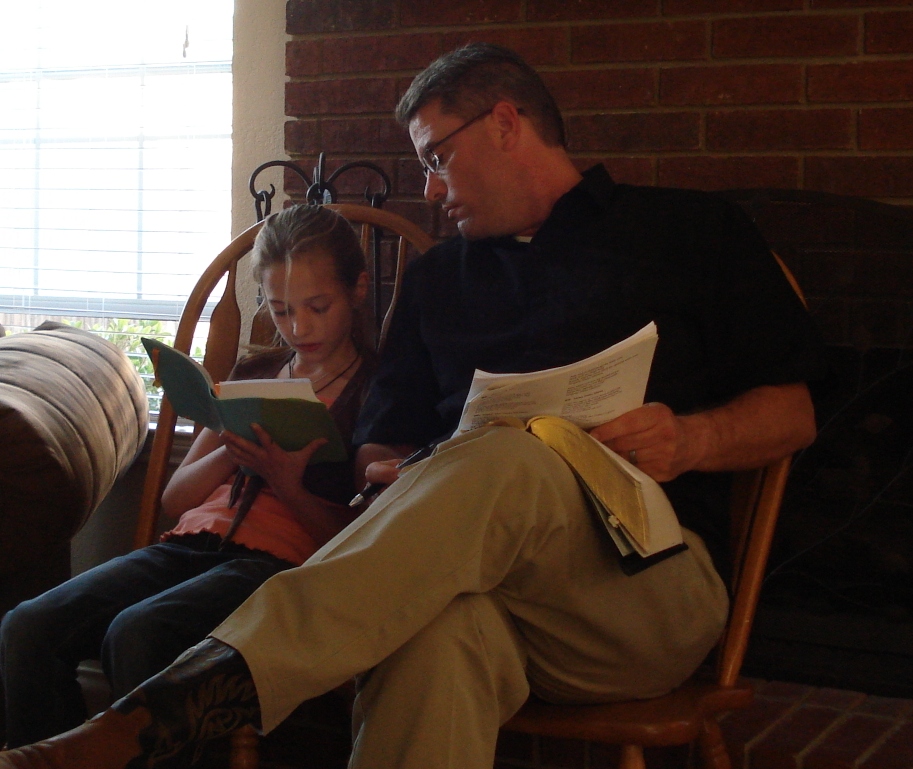
Being Church at HomePray with your kid today. Read the Bible with your child today. Don’t go to bed tonight without talking to your children about our gracious Father and his redemption plans for his people. And stop saying “go to church.” We don’t go to church. We ARE the Church. And we have to show our children that in our homes.

According to Search Institute and the results of a national survey of over 11,000 young people from 561 Christian congregations:

~ 12% of youth have a regular dialog with their mother on faith and life issues.

~ 5% of youth have a regular dialog with their father on faith and life issues.

~ 9% of youth have experienced regular reading of the Bible and devotions in the home.

~ 12% of youth have experienced a servanthood event with a parent as an action of faith.

George Barna research finds the same kind of conclusions. From Barna’s Transforming Children into Spiritual Champions:

“We discovered that in a typical week, fewer than ten percent of parents who regularly attend church with their kids read the Bible together, pray together (other than at meal times) or participate in an act of service as a family unit. Even fewer families — 1 out of every 20 — have any type of worship experience together with their kids, other than while they are at church during a typical month.”

Understand these statistics are all church kids! These are kids who go to church, whose parents go to church! These are our kids!

A Christian life in the home is much more influential than the Christian life in the church congregation. If that’s true — and I believe it is with all my heart — we need to all be asking ourselves some very important questions about being church at home. Do our children know beyond a shadow of doubt that our dedication to our Lord and to his Kingdom is the most important thing in our lives? Really? How do they know?

Pray with your kids today. Read a Bible passage together tonight. Impress it on your children. Talk about our Christ when you sit at home and when you walk along the road (I think that implies turning off the TV and pulling out the earbuds), when you lie down and when you get up.

Peace,

Allan

Church "Aliveness"

Wondering if the seamstresses at Nike headquarters in Eugene, Oregon are busy today sewing together Dwight Howard and Carmelo Anthony puppets…………

~~~~~~~~~~~~~~~~~~~~~~~~~~~~~~~~~~~~~~~~~~~~~~~~~~~~~~~~~~~~~~~~~~~~~~~~~~~~~

Healthy ChurchesPhilip Yancey and his wife recently visited all 24 different churches in their town on 24 consecutive weekends. They just went through the phone book (does anybody use the phone book anymore?) and went in alphabetical order. They visited churches with organs and choirs, churches with praise bands and electric guitars, and even a Church of Christ that featured acappella singing of songs projected on PowerPoint slides. They found churches full of suits and ties and others with blue jeans and cowboy boots.

Based on what Yancey is calling an unexplainable intuition, he says he could tell the “aliveness” of a church within just about five minutes. He bases some of this on the noise level in the foyer, laughter in the conversations, and activities promoted in the bulletin. He’s trying to put this “health-of-a-church-formula” into better organized thoughts and words. But most of it, he admits, is just a gut feel.

So far, Yancey’s come up with three main attributes of a healthy church, a congregation that’s alive. I’m quoting now from his November ’08 article in Christianity Today:

1) Diversity. As I read accounts of the New Testament Church, no characteristic stands out more sharply than this one. Beginning with Pentecost, the Christian Church dismantled the barriers of gender, race, and social class that had marked Jewish congregations. Paul, who as a rabbi had given thanks daily that he was not born a woman, slave, or Gentile, marveled over the radical change: “There is neither Jew nor Greek, slave nor free, male nor female, for you are all one in Christ Jesus.”

Diversity complicates rather than simplifies life. Perhaps for this reason we tend to surround ourselves with people of similar age, economic class, and opinion. Church offers a place where infants and grandparents, unemployed and executives, immigrants and blue bloods can come together. Just yesterday I sat sandwiched between an elderly man hooked up to a puffing oxygen tank and a breastfeeding baby who grunted loudly and contentedly throughout the sermon. Where else can we go to find that mixture?

When I walk into a church, the more its members resemble each other — and resemble me — the more uncomfortable I feel.

2) Unity. Of course, diversity only succeeds in a group who share a common vision. In his great prayer in John 17, Jesus stressed one request above all others: “that they may be one.” The existence of 38,000 denominations worldwide demonstrates how poorly we have fulfilled Jesus’ request. I wonder how different the Church would look to a watching world, not to mention how different history would look, if Christians were more deeply marked by love and unity. Perhaps a whiff of the fragrance of unity is what I detect when I visit a church and sense its “aliveness.”

3) Mission. The Church, said Archbishop William Temple, is “the only cooperative society in the world that exists for the benefit of its non-members.” Some churches, especially those located in urban areas, focus on the needs of immediate neighborhoods. Others adopt sister churches in other countries, support relief and development agencies, and send mission teams abroad. Saddest of all are those churches whose vision does not extend beyond their own facilities and parking lots.

Yancey’s list is, obviously, not complete. But, we can all agree that these three characteristics are huge for churches striving to reflect our Savior and his Gospel. And it’s not a stretch to see that all of our churches have work to do in all three areas.

This should not be a disappointment to us. We should view this as a challenge. And a great blessing and privilege — that our God would allow people like us to embody his presence on earth.

Peace,

Allan

Strangers In The World

“To God’s elect, strangers in the world…”

Strangers In The WorldThe apostle Peter addresses his letter to God’s Church, calling them “strangers” (KJV), “pilgrims” (NKJV), “those who reside as aliens” (NASB), “strangers in the world” (NIV). This first line reminds all Christian believers — those scattered throughout Pontus, Galatia, Cappadocia, Asia, and Bithynia as well as those scattered throughout Texas, Oklahoma, California, Montana, and Kentucky — that we are an alternative society. We are a counter culture. The Christian community is called to show a desperate world how to think and speak and act and behave differently.

Holy Scripture and the life of our Christ and his apostles always calls us to change the world; never to conform, instead to convert. And the only way it works is for us to be different.

Vaclav Havel, President of the Czech Republic, was once asked why the revolution there against the communists was successfully non-violent. He answered, “We had our parallel society. And in that parallel society we wrote our plays and sang our songs and read our poems until we knew the truth so well that we could go out to the streets of Prague and say, ‘We don’t believe your lies anymore’ — and communism had to fall.”

God’s Church must be a similar kind of parallel society. And we best form that society when we assemble together to worship. We speak our language together, we read our stories of God and his work with his people together, we sing the hymns of faith together, we pour out our prayers together until we know the truth so well that we can go out into the world around us, denounce the lies that threaten to force us to conform, and invite the world to share the truth with us. We are shaped by a Biblical narrative that tells a much different story from the one in our surrounding culture.

Marva Dawn in A Royal Waste of Time: “Rather than becoming enculturated and entrapped by the world’s values of materialistic and experiential consumerism, of narcissistic self-importance and personal taste, of solitary superficiality, and of ephemeral satisfaction, members of Christ’s Body choose his simple life of sharing, his willingness to suffer for the sake of others, his communal vulnerability, and his eternal purposes.”

Sociologists know that any alternative way of life that is substantially different from the larger society around it needs its own language, customs, habits, rituals, institutions, procedures, and practices if it’s going to remain alternative. These things are paramount to upholding and nurturing a clear vision of how we are different and why it matters.

Are we as Christians committed to the alternative way of life described in the Scriptures and incarnated in the Christ? It’s the only way to communicate to the world what they’re missing. If we’re too much like the surrounding culture, we have nothing, no alternative, to offer.

“Dear friends, I urge you as aliens and strangers in the world…live such good lives among the pagans that, though they accuse you of doing wrong, they may see your good deeds and glorify God.” ~1 Peter 2:11-12

Peace,

Allan

Kids' Church

Why Do I Have To Go To Church?

Involving Avery in our worship assembly at Legacy this past Sunday (see yesterday’s “Waiting On One Another”) is just one of the many ways we’re trying to be more intentional here of making our times together more interactive, more participatory, more inter-generational; something for every member of every age and life circumstance to grab, to own. We have a long, long way to go. But we’re trying.

As for the kids — our youngest young people — we need to be just as concerned with giving them a larger and more interesting view of God’s splendor in our assemblies as we are with our older folks.

I know a lot of the battle with a lot of our parents today is getting their kids into the worship assemblies to start with. Sometimes, they just don’t want to go. Most of you have heard it from your kids, “Why do I have to go to church?”

It’s a legitimate question that deserves real answers. It deserves much more than just “because I said so” or “because it’s good for you” or “because God wants us to” or “because we’re supposed to.” Our children deserve more than that.

Marva Dawn, in her excellent A Royal “Waste” of Time, supplies readers with ten answers she gives to the child’s question, “Why do I have to go to church?”

1)  We’re not going to church; YOU are the Church — and we go to worship so that we learn how to be Church.

2)  We need you with us in worship because those who are old and tired need your smiles and vitality.

3)  The congregation cannot get along without you. Just as your body needs every single part — like your eyes, your nose, your mouth, your hands and feet — so the church needs every single person to make it whole. Perhaps some Sunday some persons will need you to be eyes or hands for them.

4)  You need the gifts of worship because you will learn things there that will make sense later. Almost every week I learn something that comes up in the days to follow.

5)  If you pay close attention to the words of the songs and the Scripture readings and the liturgy, you will learn all kinds of new things about God. Since God is infinitely incomprehensible, all of life is an adventure in getting to know him better, but worship is especially rich with his presence.

6)  Attending worship will teach you skills for your Christian life — skills like how to pray, how to sing, how to sit quietly in God’s presence, how to study the Bible.

7)  I need you to come to worship because I have cancer and am taking chemotherapy, which makes me too sick to sing, so I need you to stand beside me and sing for the both of us.

8)  The congregation needs the talents you bring to worship — your singing voice in the hymns, your ability to learn new songs quickly, your ability to read the Scriptures well, your help with the ushering, your warmth and friendliness in the “Passing of the Peace,” the answers you give during the children’s sermon, your modeling of reverence for the other children.

9)  When I preach, I need to watch you to see if what I am saying is understandable to people your age. I need you to give me critiques when the worship service is over.

10)  Most important, God needs you there because he loves to be with you among his people.

Hmmmm. Come to think of it, those reasons work equally well with us older people, too.

Peace,

Allan

Waiting For One Another

I am so proud of our congregation.

Yesterday one of our wonderful ten-year-old boys, Avery Caddell, led us during three of our songs. Avery won a gold medal in song leading at last month’s LTC event at DFW. One of Avery’s dreams is to someday be a worship leader in God’s Church. He talks about it a lot. And Lance pretty much decided that someday was yesterday!

And I’m so proud of our congregation.

Lance introduced Avery right at the start, told the church Avery was going to be leading us in three of our songs, and then handed him the reins. (He already had a microphone.) And I was so nervous for him. I was grinning from ear to ear — and not just because Avery and Lance were wearing almost identical striped shirts (coincidentally, I’m told). But because I was nervous. I thought back to my very first times to lead singing, lead prayers, serve on the table, and read Scripture in front of the whole church. Just about at the same age. And I got the butterflies all over again. For Avery.

And I’m so proud of our congregation.

We sang our hearts out with Avery. Our God, He Is Alive! He is our God, the great I AM!

Have I mentioned yet how proud I am of our congregation?

It was during the second song Avery led that I was moved by our church family. See, Avery paused between verses during Our God, He Is Alive. It was just a couple of beats or so, but it was a definite pause. It caught all of us off guard. We didn’t really start the verses together because most of us were singing a very familiar song in a very familiar pattern. But by the second song, He Lives!, we started waiting.

As a congregation. All 858 of us. Together. Waiting for Avery to lead us.

You ask me how I know he lives? He lives…………(breath)…..within…(pause)…my heart.

Beat-one-two-three. Wait.

In all the world around me I see his loving care….

It was beautiful. It was amazing. It was moving.

We weren’t just singing with Avery. We were also singing for Avery.

All 858 of us. I didn’t see a single soul not singing. And not singing loudly. And we were all smiling. Smiling big. And focused on Avery. Really tuned in. Zeroed in singing with and for Avery. And waiting on him.

He’s ten-years-old, right? So of course, without exception, every single person in the room is intent on encouraging Avery, supporting Avery, doing everything in our collective power to make sure Avery’s experience is a good one. There’s not a person in the room who would ever criticize Avery or say anything that might discourage him. The whole church body was determined to lift him up. Oh, we exercised such grace. Such patience. Such love. Such encouragement. Such acceptance. Such….

What if we showed that exact same grace and patience and love and encouragement and acceptance to every brother and sister in our churches? What if we focused on lifting one another up? What if we absolutely refused to ever criticize? Ever? What if we concentrated on encouraging everybody? What if we each totally zeroed in on making sure I worship in a way, and respond to everybody in a way, that guarantees the people around me and up in front have a great experience?

We do it for Avery, we wait on him, because he’s ten-years-old. We support him and encourage him and love him and are patient with him and we shower him with well-deserved praise because he’s ten.

What makes us think the 53-year-old among us doesn’t need and deserve that exact same level of kindness and love? Don’t you believe the 19-year-old and the 61-year-old brothers and sisters in our churches need support? Don’t they need encouragement, too? Aren’t we required to treat every single person the same way we treat Avery? Isn’t it demanded of Christ’s disciples?

I know it’s mostly out of context, but I couldn’t help thinking yesterday and into today about Paul’s admonitions in 1 Corinthians 11. He got on to the church in Corinth because they refused to wait on one another. “Each one of you goes ahead without waiting for anybody else.” At the end of the chapter he encourages them, when they come together, to “wait for each other.”

I am so proud of our congregation.

Yesterday we waited on Avery. Today, a lot of us are learning to wait on one another.

Peace,

Allan

« Older posts Newer posts »