Category: Church (Page 48 of 59)

For The Sake Of His Body

For the sake of his body…Preaching the good news of the Kingdom of God is going to involve some suffering. Picking up a cross and following Jesus, as our Savior demands, is certainly a call to suffering. It’s a sharing in the sufferings of Christ, a participation in what he endured. It makes us more like him. It shapes us and molds us to be more like him.

Jesus’ afflictions are not complete. They’re not done. They’re not finished. They are “lacking.” The sufferings of the Christ are still being carried out in those of us who follow him.

“I fill up in my flesh what is still lacking in regard to Christ’s afflictions, for the sake of his body, which is the Church.”

The Colossians 1:24-29 context in which we find this sentence is all about preaching — proclaiming the death, burial, and resurrection of our Lord. Preachers, I think, are called to die. To die to self, to die to the world, to die to any other way of life, to model in a “the-medium-is-the-message” kind of way what it looks like to live in Christ. To take on the sufferings, to bear the burdens, to carry the weight. And to do it for the sake of the Church.

There’s a teenager in your church who will come alive if you’ll only die for him. There’s an older woman in your congregation who will blossom like never before if you’ll die for her. There’s a sick brother, a depressed sister, a spiritually immature Christian, a stubborn believer, a wounded soul, a damaged disciple who has no hope of living unless someone dies for him or her.

I need to be reminded of this constantly. My role as a proclaimer of the Good News is to preach it and live it the way Christ did. Even with the sufferings. Accepting the sufferings. Embracing the sufferings. Welcoming them as a way of joining my Lord in his mission to redeem the world.

“I fill up in my flesh what is still lacking in regard to Christ’s afflictions, for the sake of his body, which is the Church. I have become its servant by the commission God gave me to present to you the Word of God in its fullness — the mystery that has been kept hidden for ages and generations, but is now disclosed to the saints. To them God has chosen to make known among the Gentiles the glorious riches of this mystery, which is Christ in you, the hope of glory. We proclaim him, admonishing and teaching everyone with all wisdom, so that we may present everyone perfect in Christ. To this end I labor, struggling with all his energy, which so powerfully works in me.” ~Colossians 1:24-29.

~~~~~~~~~~~~~~~~~~~~~~~~~~~~~~~~~~~~~~~~~~~~~~~~~~~~~~~~~~~~~~~~~~~~~~~~~~~~~~~~~~

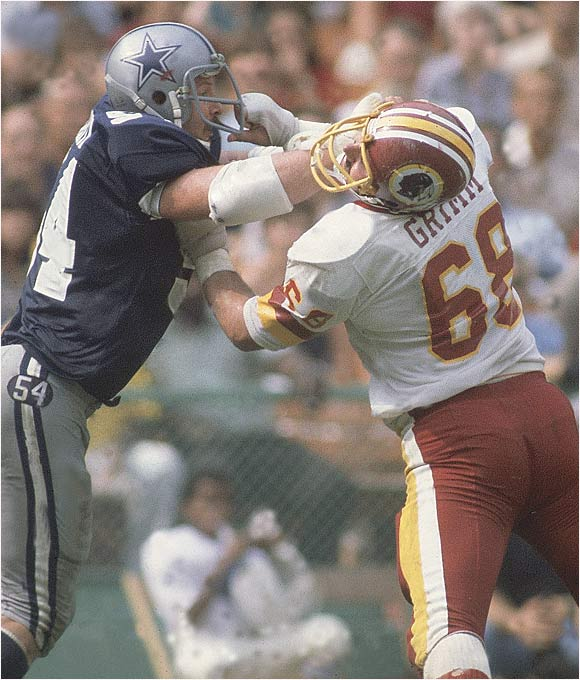
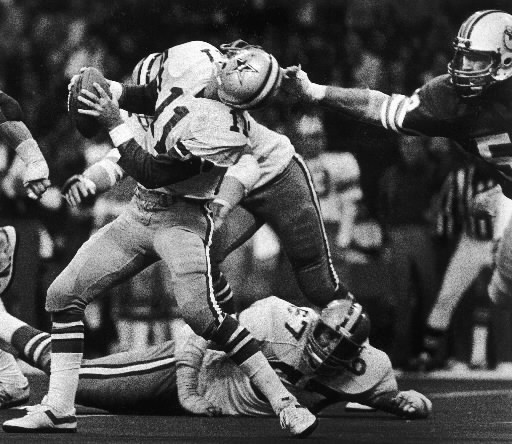
Red Ribbon ReviewToday’s #60 in our Red Ribbon Review countdown to Cowboys season is a downer. Twelve players have worn #60 in Cowboys history. And it’s a less than stellar group. The noteables among them include the likes of Jackie Burkett, Ben Noll, Lee Roy Caffey, and Dean Hamel. You don’t remember them. You can’t tell me what position they played or when. This is a tough group. Only two of these 12 played for Dallas longer than two seasons. One of them is the second-best #60 ever to play for the Cowboys. And he is defensive lineman Don Smerek.

(I can’t even find a picture of the guy. All I’ve got for you are these career stats. If you find a picture of Smerek please send it to me. Still looking for a picture of our Red Ribbon #69, Ben Fricke, too.)

I do remember him, though. Smerek played 69 games for the Cowboys as a backup defensive lineman from 1981-87. An undrafted free agent out of Nevada-Reno, Smerek finished his career with 14.5 quarterback sacks, six of those in 1983, probably his finest season. Smerek is remembered for his time in Dallas, mainly, for two things.

One, he was shot in the chest one night by a Dallas motorist who claimed the 6′-7″, 260-pound Smerek kicked his car and challenged him to a fight. A Dallas grand jury refused to indict the shooter for attempted murder. They ruled it self-defense.

Two, Smerek was riding shotgun with Randy White when they famously crossed the Cowboys players’ picket line to participate in practice on the first day of the 1987 NFL players strike. Tony Dorsett stood in front of White’s pickup in a tense standoff in front of TV cameras and nearly got run over by an angry “Manster.” Of course, Dorsett actually joined the “scabs” two weeks later, along with Too Tall Jones and Danny White. I’m not sure the Cowboys ever got over what happened during those six weeks. But Smerek and Randy White were the first two to cross. And Smerek is the second-best player to ever wear #60 for the Cowboys.

Peace,

Allan

The Anointed

Caves At En GediIn 1 Samuel 24, in the cave at En Gedi, David’s men see King Saul, their ruthless enemy, in a humiliating and vulnerable position. Most translations say Saul went in to relieve himself. The New King James Version says Saul went into the cave to “attend to his needs.” Whatever the terminology, Saul is completely helpless. He’s right in front of them. And he thinks he’s all alone. David’s men see their enemy. And they’re ready to kill him.

By contrast, David sees the magnificent — flawed, yes — and wonderful king anointed by God. He sees the Lord’s chosen ruler. And he didn’t kill him. He submitted to him. David turns this crude scene in this dark cave in the wilderness into an act of homage to his Lord. He made it a sacred moment.

David’s motivation has nothing to do with his own pride or safety or reputation. David is motivated purely by a genuine devotion to his God, his Rock. The idea of taking Saul’s life is unthinkable. Not because of Saul. But because of God.

I see the flawed, anointed one of God in his Church. I see it in church leaders. Flawed, but anointed by God, standing for God, representing God. And our treatment of the Church and church leaders ought to reflect that understanding.

All of us brothers and sisters in Christ are anointed by God in the waters of baptism. We’re together standing for God, representing God, working with God. And our honorable treatment of one another ought to reflect that understanding.

~~~~~~~~~~~~~~~~~~~~~~~~~~~~~~~~~~~~~~~~~~~~~~~~~~~~~~~~~~~~~~~~~~~~~~~~~~~~~~~~~~~~

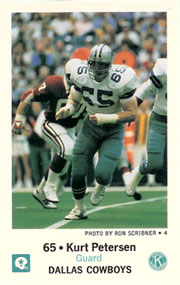
KurtPetersen65 days until the Cowboys begin their 2009 football season. And the second-best player to ever wear #65 in Cowboys history is offensive lineman Kurt Petersen. As a 4th round draft pick out of Missouri, Petersen was a six-year starter at right guard, blocking for Danny White and Tony Dorsett from 1980-85. He helped lead Dallas to three straight NFC Championship Games, all losses.

You’ve probably never heard of him. That’s OK. He’s never heard of you.

Peace,

Allan

Saying "No" To Creating Spectators

SpectatorsI’m still not finished with that second desert temptation of Jesus. Two more things. One today and one more tomorrow. If Jesus would have jumped off the roof of the temple and allowed God’s angels to save him in front of all those crowds, it would have been quite the spectacle. Amazing. Incredible. Wow.

Do it again.

People would have kept showing up every week, every day, if Jesus were going to jump. And that would have created a community of spectators, a group of people who came for the show. They would be there faithfully. Every time the doors were opened. And they would watch. They would sit back and watch. And then they’d go to lunch and talk about what they saw. They’d critique this week’s jump. How did it make you feel? What did you like or not like about this week’s jump? A community of watchers. Spectators.

Might that be one of the reasons Jesus said “No”? Creating spectators is not The Jesus Way.

I believe there’s a real temptation to try to dazzle our people in our worship centers on Sunday mornings. More culturally-relevant songs, more culturally-desired audio and video presentations, a more culturally-acceptable pace and tempo and environment. If we’re not careful, we’ll create a community of spectators, a generation—or several—of not disciples but spiritual couch potatoes. We’ll find ourselves filling up our bleachers and trying to give our people a show. Or an experience. I think that’s a very real temptation today.

And that’s just the opposite of The Jesus Way.

Jesus invites his disciples to participate, never to just watch. He invites us to participate in the worship and to join him in the mission. He sends us out together in groups of two and groups of 12 with his power and with his authority to drive out demons and cure diseases and to preach the Kingdom of God and to heal the sick (Luke 9). When he feeds the five thousand in Luke 9 Jesus gives the bread and the fish to his disciples and has them serve it to the people. Participate. Get involved. Don’t just sit there.

The Jesus Way is to get up and get busy. Everybody. Nobody just watches. We minister as we’re ministered to. We care as we’re cared for. We forgive as we’re being forgiven. We love as we’re being loved. Together. That’s The Jesus Way.

~~~~~~~~~~~~~~~~~~~~~~~~~~~~~~~~~~~~~~~~~~~~~~~~~~~~~~~~~~~~~~~~~~~~~~~~~~~~~~~~

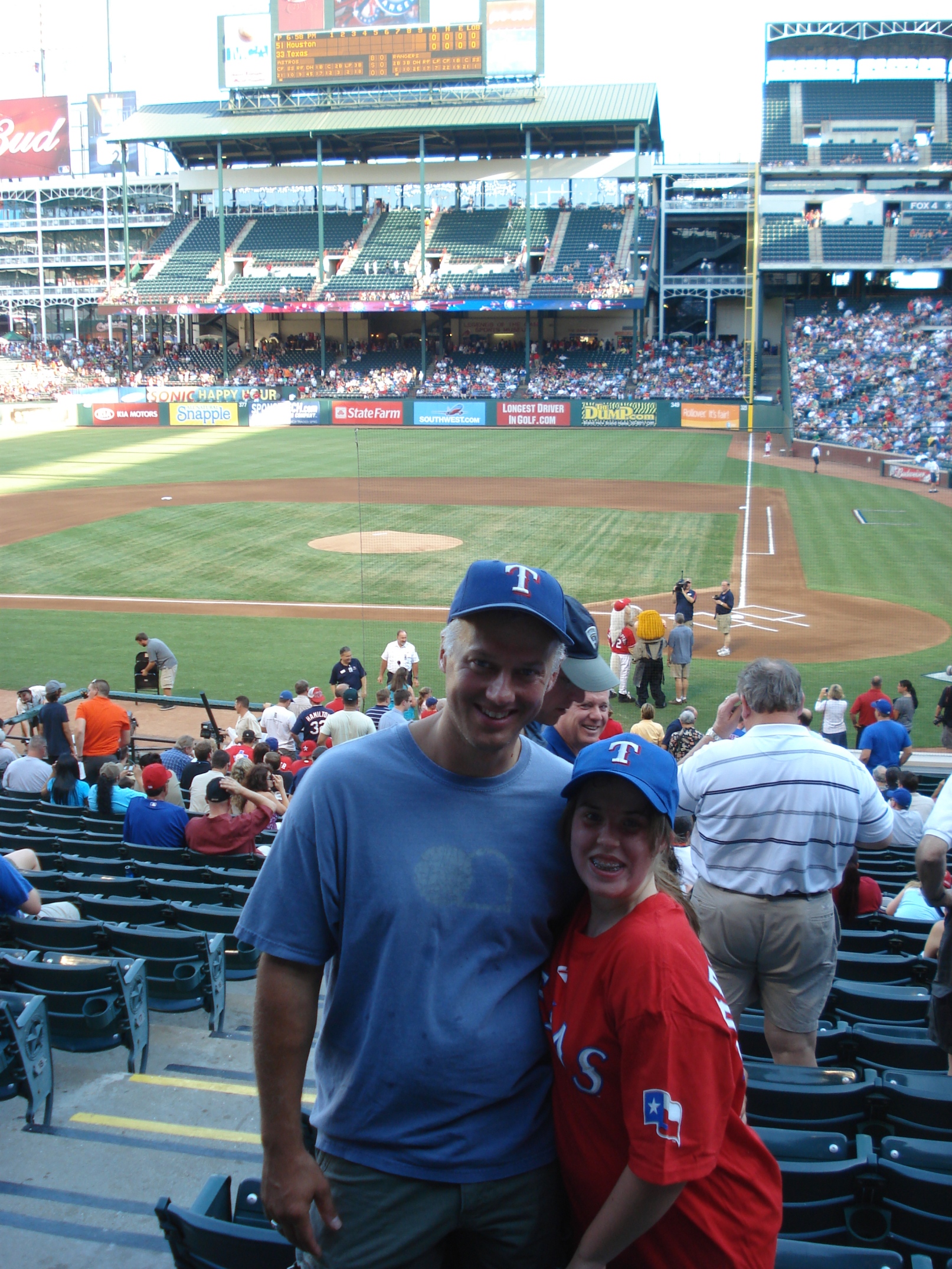
Whit&DadThanks to Dale Bankhead and Brian Kendall (we’ve got to stop calling him Brittany’s husband!) SweetSeatsWhitney and I got to take in Tuesday’s Rangers-Astros game in some sweet seats in the Ballpark. Ian Kinsler went deep in his first two at bats. Millwood and Jennings combined on a nice five-hitter. And Pudge Rodriguez tied Pudge Fisk for the all-time major league lead in games started as a catcher. (We gave Rodriguez a standing O when he hit his solo shot to cut the Texas lead to 6-1. I doubt he would have received the same level of love if his blast would have meant something for Houston.) A Lemon Chill and a new Josh Hamilton jersey for the Whitster, ballpark nachos for me, a big Rangers win and a great daddy-daughter night for both of us.

~~~~~~~~~~~~~~~~~~~~~~~~~~~~~~~~~~~~~~~~~~~~~~~~~~~~~~~~~~~~~~~~~~~~~~~~~~~~~~~~~~~

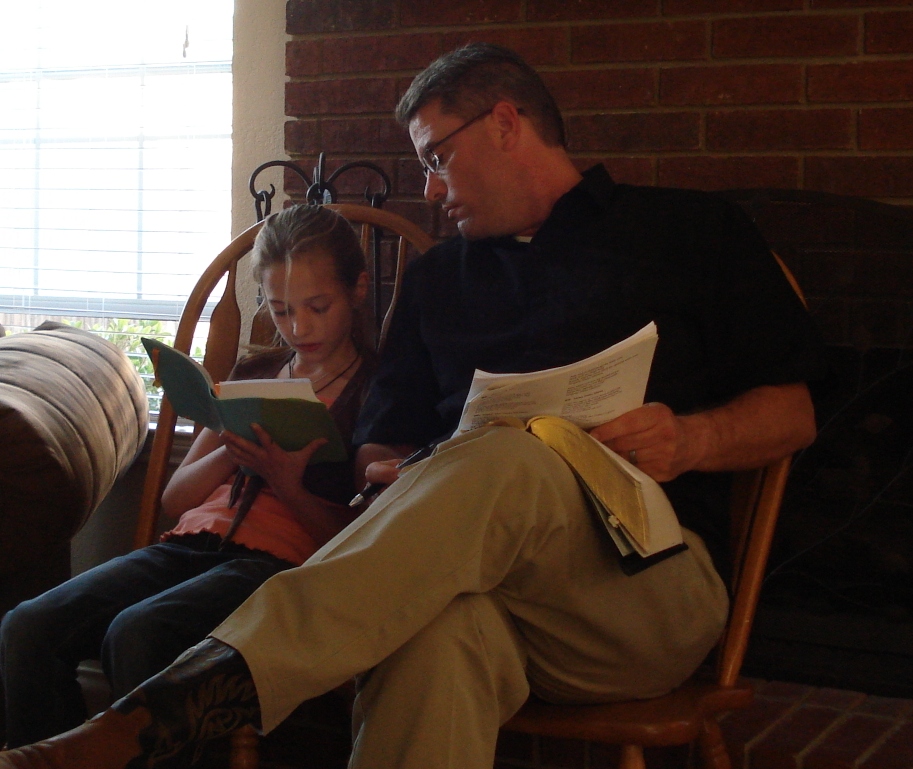
ValReadingOur Little Middle, Valerie, has been down in San Antonio all week on a Junior High trip to minister to urban children in the downtown parts of the Alamo City. We haven’t spoken to her since they left Sunday afternoon. But we’re able to keep up with her through the miracle of Lance’s blog. (It’s a miracle he’s actually updating it three or four times a day.) What a joy to log on and see Val, from 200 miles away, reading with little kids, teaching a Bible story with puppets, and giving piggy back rides. She’s so good with little children. She has a heart for that kind of thing. I think our God is going to use her to touch a lot of people in her lifetime.

ValPuppets ValPiggyBack

Being Church At Home

Being Church at HomePray with your kid today. Read the Bible with your child today. Don’t go to bed tonight without talking to your children about our gracious Father and his redemption plans for his people. And stop saying “go to church.” We don’t go to church. We ARE the Church. And we have to show our children that in our homes.

According to Search Institute and the results of a national survey of over 11,000 young people from 561 Christian congregations:

~ 12% of youth have a regular dialog with their mother on faith and life issues.

~ 5% of youth have a regular dialog with their father on faith and life issues.

~ 9% of youth have experienced regular reading of the Bible and devotions in the home.

~ 12% of youth have experienced a servanthood event with a parent as an action of faith.

George Barna research finds the same kind of conclusions. From Barna’s Transforming Children into Spiritual Champions:

“We discovered that in a typical week, fewer than ten percent of parents who regularly attend church with their kids read the Bible together, pray together (other than at meal times) or participate in an act of service as a family unit. Even fewer families — 1 out of every 20 — have any type of worship experience together with their kids, other than while they are at church during a typical month.”

Understand these statistics are all church kids! These are kids who go to church, whose parents go to church! These are our kids!

A Christian life in the home is much more influential than the Christian life in the church congregation. If that’s true — and I believe it is with all my heart — we need to all be asking ourselves some very important questions about being church at home. Do our children know beyond a shadow of doubt that our dedication to our Lord and to his Kingdom is the most important thing in our lives? Really? How do they know?

Pray with your kids today. Read a Bible passage together tonight. Impress it on your children. Talk about our Christ when you sit at home and when you walk along the road (I think that implies turning off the TV and pulling out the earbuds), when you lie down and when you get up.

Peace,

Allan

Church "Aliveness"

Wondering if the seamstresses at Nike headquarters in Eugene, Oregon are busy today sewing together Dwight Howard and Carmelo Anthony puppets…………

~~~~~~~~~~~~~~~~~~~~~~~~~~~~~~~~~~~~~~~~~~~~~~~~~~~~~~~~~~~~~~~~~~~~~~~~~~~~~

Healthy ChurchesPhilip Yancey and his wife recently visited all 24 different churches in their town on 24 consecutive weekends. They just went through the phone book (does anybody use the phone book anymore?) and went in alphabetical order. They visited churches with organs and choirs, churches with praise bands and electric guitars, and even a Church of Christ that featured acappella singing of songs projected on PowerPoint slides. They found churches full of suits and ties and others with blue jeans and cowboy boots.

Based on what Yancey is calling an unexplainable intuition, he says he could tell the “aliveness” of a church within just about five minutes. He bases some of this on the noise level in the foyer, laughter in the conversations, and activities promoted in the bulletin. He’s trying to put this “health-of-a-church-formula” into better organized thoughts and words. But most of it, he admits, is just a gut feel.

So far, Yancey’s come up with three main attributes of a healthy church, a congregation that’s alive. I’m quoting now from his November ’08 article in Christianity Today:

1) Diversity. As I read accounts of the New Testament Church, no characteristic stands out more sharply than this one. Beginning with Pentecost, the Christian Church dismantled the barriers of gender, race, and social class that had marked Jewish congregations. Paul, who as a rabbi had given thanks daily that he was not born a woman, slave, or Gentile, marveled over the radical change: “There is neither Jew nor Greek, slave nor free, male nor female, for you are all one in Christ Jesus.”

Diversity complicates rather than simplifies life. Perhaps for this reason we tend to surround ourselves with people of similar age, economic class, and opinion. Church offers a place where infants and grandparents, unemployed and executives, immigrants and blue bloods can come together. Just yesterday I sat sandwiched between an elderly man hooked up to a puffing oxygen tank and a breastfeeding baby who grunted loudly and contentedly throughout the sermon. Where else can we go to find that mixture?

When I walk into a church, the more its members resemble each other — and resemble me — the more uncomfortable I feel.

2) Unity. Of course, diversity only succeeds in a group who share a common vision. In his great prayer in John 17, Jesus stressed one request above all others: “that they may be one.” The existence of 38,000 denominations worldwide demonstrates how poorly we have fulfilled Jesus’ request. I wonder how different the Church would look to a watching world, not to mention how different history would look, if Christians were more deeply marked by love and unity. Perhaps a whiff of the fragrance of unity is what I detect when I visit a church and sense its “aliveness.”

3) Mission. The Church, said Archbishop William Temple, is “the only cooperative society in the world that exists for the benefit of its non-members.” Some churches, especially those located in urban areas, focus on the needs of immediate neighborhoods. Others adopt sister churches in other countries, support relief and development agencies, and send mission teams abroad. Saddest of all are those churches whose vision does not extend beyond their own facilities and parking lots.

Yancey’s list is, obviously, not complete. But, we can all agree that these three characteristics are huge for churches striving to reflect our Savior and his Gospel. And it’s not a stretch to see that all of our churches have work to do in all three areas.

This should not be a disappointment to us. We should view this as a challenge. And a great blessing and privilege — that our God would allow people like us to embody his presence on earth.

Peace,

Allan

Strangers In The World

“To God’s elect, strangers in the world…”

Strangers In The WorldThe apostle Peter addresses his letter to God’s Church, calling them “strangers” (KJV), “pilgrims” (NKJV), “those who reside as aliens” (NASB), “strangers in the world” (NIV). This first line reminds all Christian believers — those scattered throughout Pontus, Galatia, Cappadocia, Asia, and Bithynia as well as those scattered throughout Texas, Oklahoma, California, Montana, and Kentucky — that we are an alternative society. We are a counter culture. The Christian community is called to show a desperate world how to think and speak and act and behave differently.

Holy Scripture and the life of our Christ and his apostles always calls us to change the world; never to conform, instead to convert. And the only way it works is for us to be different.

Vaclav Havel, President of the Czech Republic, was once asked why the revolution there against the communists was successfully non-violent. He answered, “We had our parallel society. And in that parallel society we wrote our plays and sang our songs and read our poems until we knew the truth so well that we could go out to the streets of Prague and say, ‘We don’t believe your lies anymore’ — and communism had to fall.”

God’s Church must be a similar kind of parallel society. And we best form that society when we assemble together to worship. We speak our language together, we read our stories of God and his work with his people together, we sing the hymns of faith together, we pour out our prayers together until we know the truth so well that we can go out into the world around us, denounce the lies that threaten to force us to conform, and invite the world to share the truth with us. We are shaped by a Biblical narrative that tells a much different story from the one in our surrounding culture.

Marva Dawn in A Royal Waste of Time: “Rather than becoming enculturated and entrapped by the world’s values of materialistic and experiential consumerism, of narcissistic self-importance and personal taste, of solitary superficiality, and of ephemeral satisfaction, members of Christ’s Body choose his simple life of sharing, his willingness to suffer for the sake of others, his communal vulnerability, and his eternal purposes.”

Sociologists know that any alternative way of life that is substantially different from the larger society around it needs its own language, customs, habits, rituals, institutions, procedures, and practices if it’s going to remain alternative. These things are paramount to upholding and nurturing a clear vision of how we are different and why it matters.

Are we as Christians committed to the alternative way of life described in the Scriptures and incarnated in the Christ? It’s the only way to communicate to the world what they’re missing. If we’re too much like the surrounding culture, we have nothing, no alternative, to offer.

“Dear friends, I urge you as aliens and strangers in the world…live such good lives among the pagans that, though they accuse you of doing wrong, they may see your good deeds and glorify God.” ~1 Peter 2:11-12

Peace,

Allan

« Older posts Newer posts »