Category: Central Church Family (Page 27 of 54)

Benediction

A few of our members here at Central have asked for a copy of the benediction that was used at the end of our assembly this past Sunday. It was written by John Newton, the author of “Amazing Grace,” in 1779.

“May the Father’s boundless love, the grace of Christ our Savior, and the favor of the Holy Spirit rest upon you. May we abide in union with our Lord and with each other. And in this sweet communion. may we possess joys which earth cannot provide. Amen.”

Confession at the Cross

Beware of exploring the spiritual disciplines. Practicing the traditional disciplines will force you to confront your sins. I know this first hand. Silence before God or a prolonged meditation on a Psalm tends to bring out the honest truth of your relationship with the Father. Fair warning. There’s no hiding it when you’re in that place with our God.

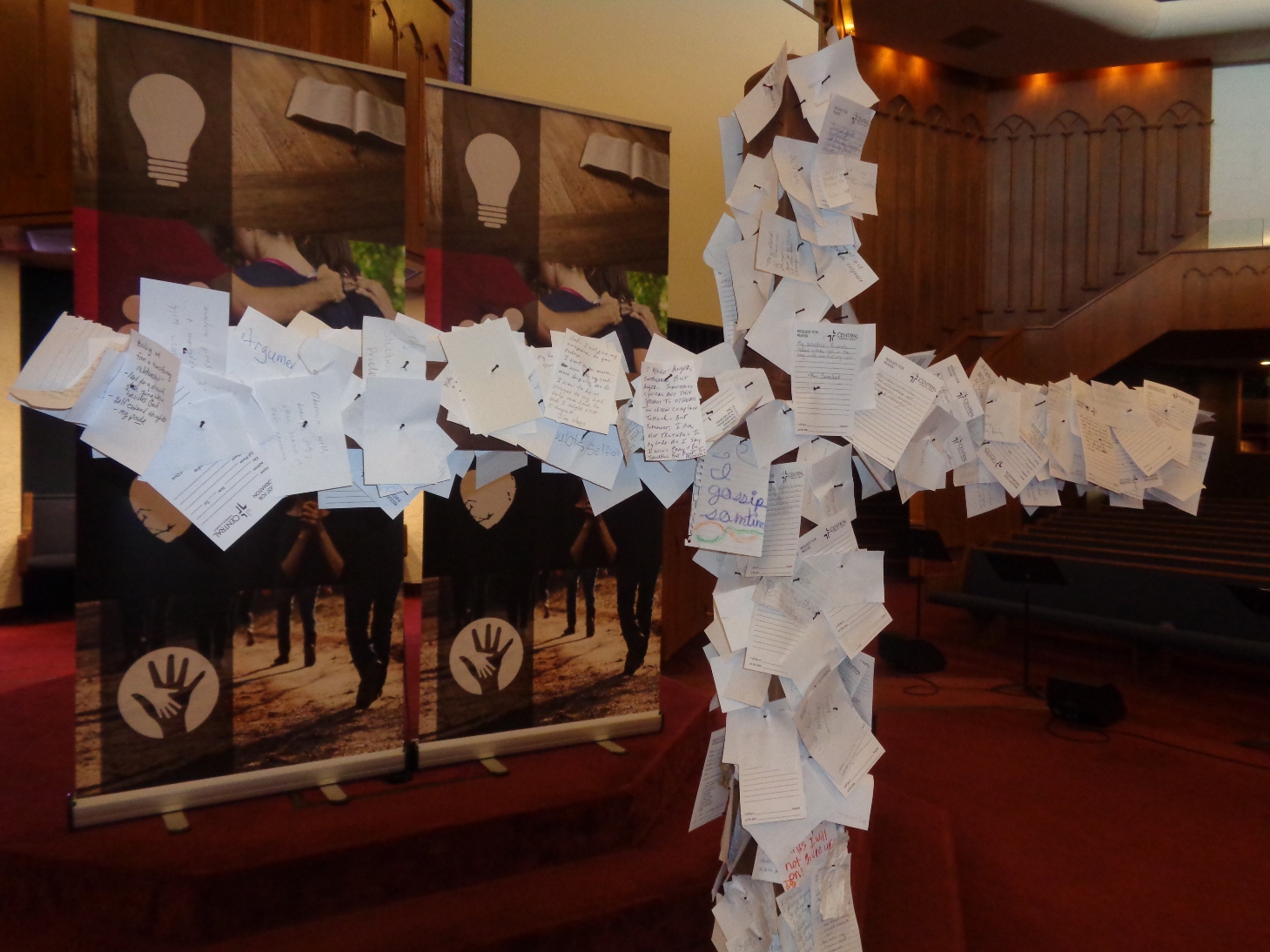
Yesterday at Central, we explored a few of the historic spiritual disciplines together. We began with our middle school and high school students reciting a prayer of invocation written by Walter Brueggemann in 1996 and ended with a benediction penned by John Newton in 1779. We prayed the Lord’s Prayer together at the table and we observed two moments of silence around Psalm 32. And we confessed.

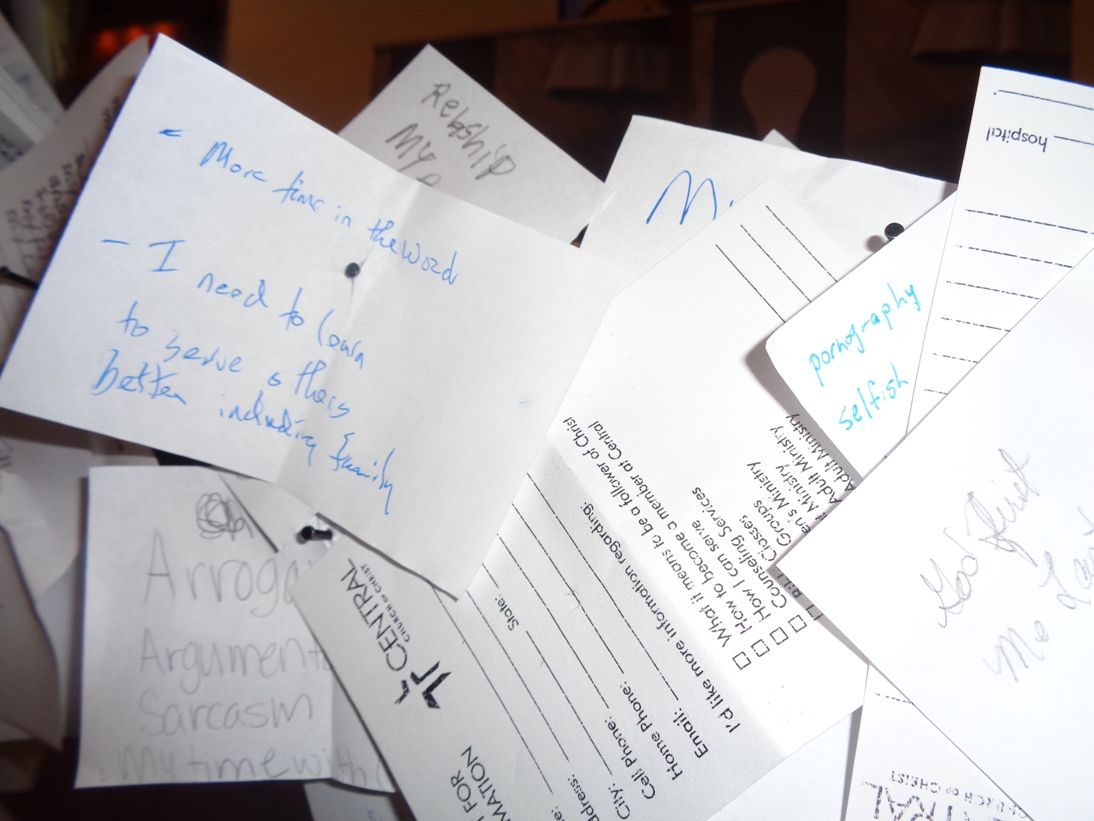
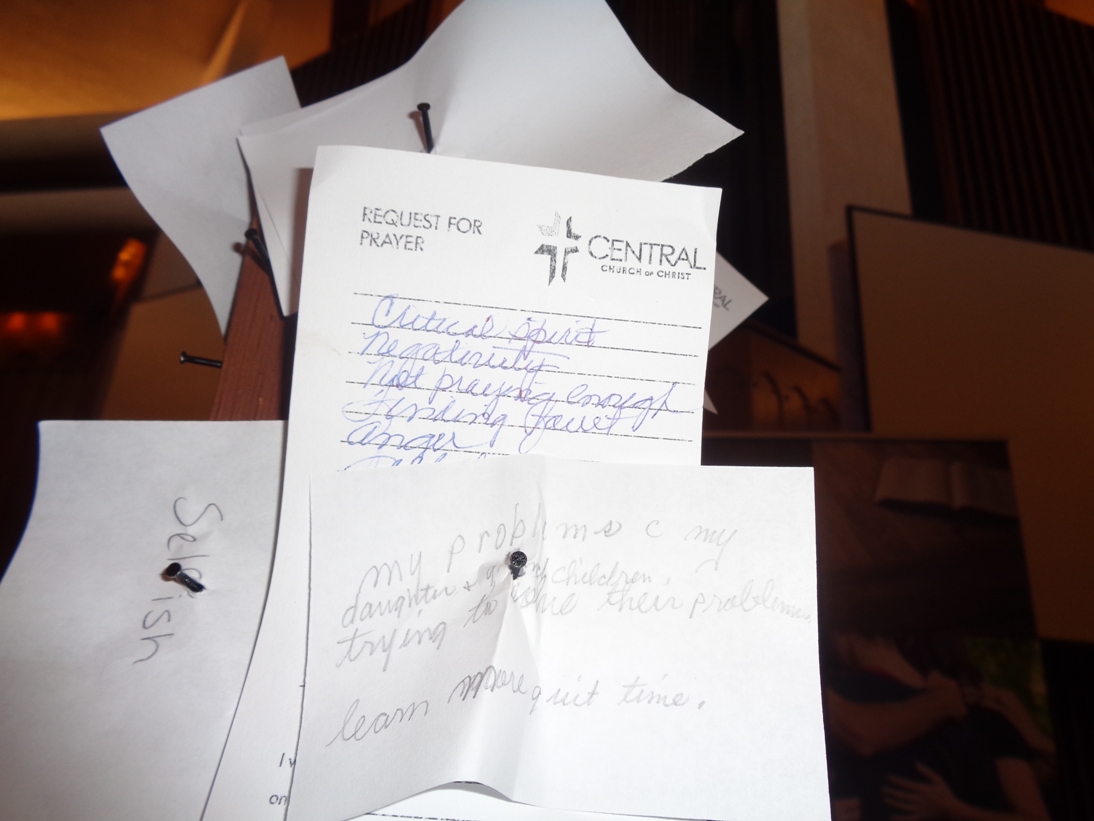
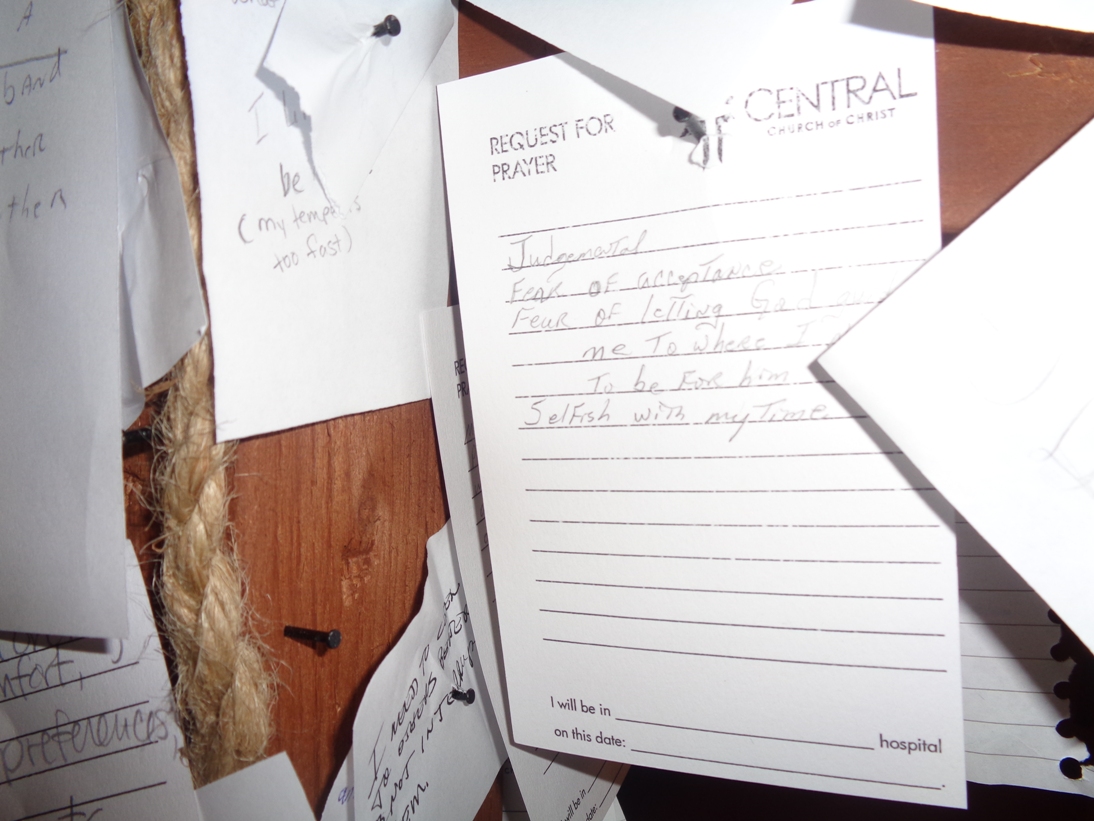
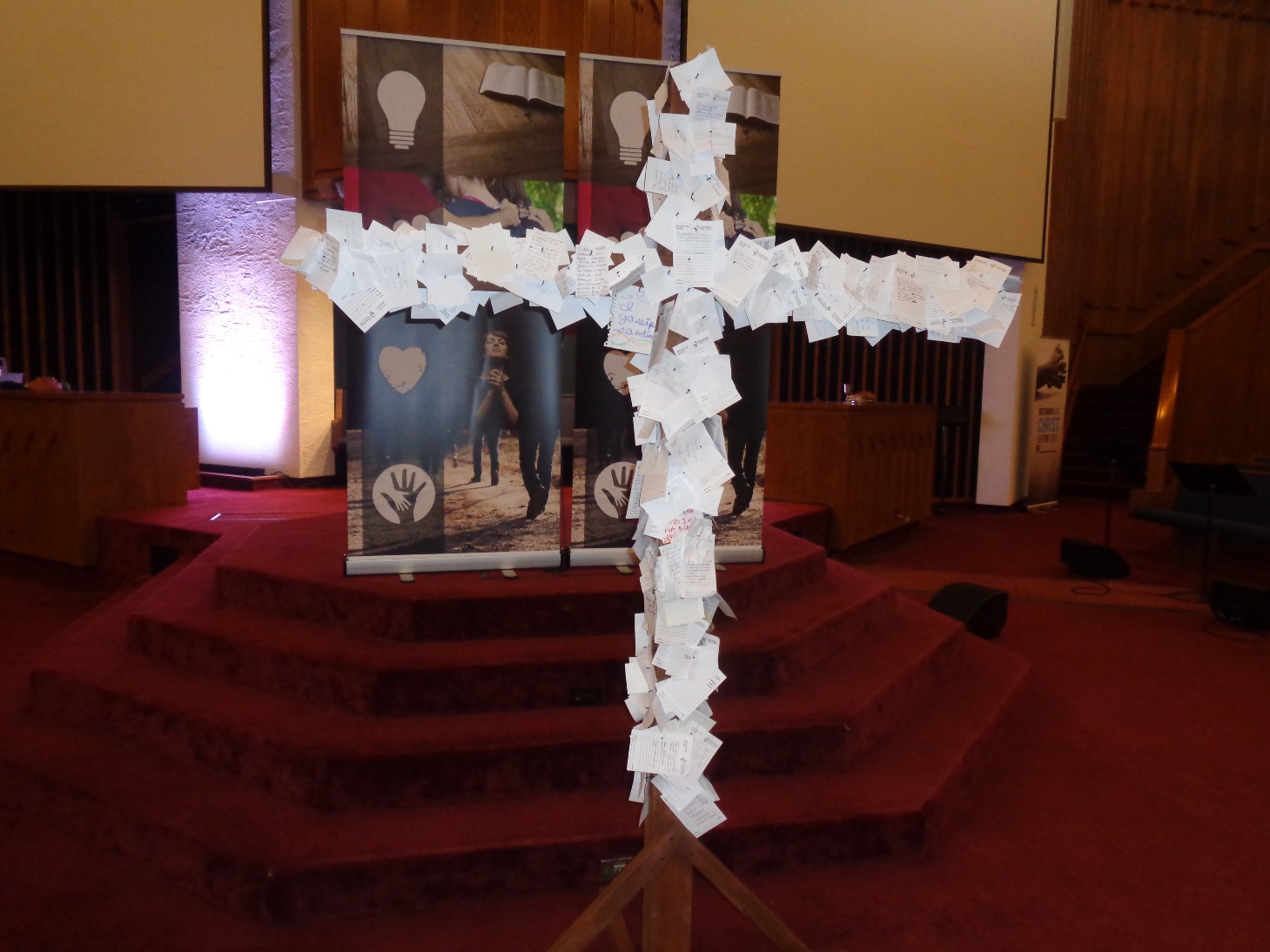
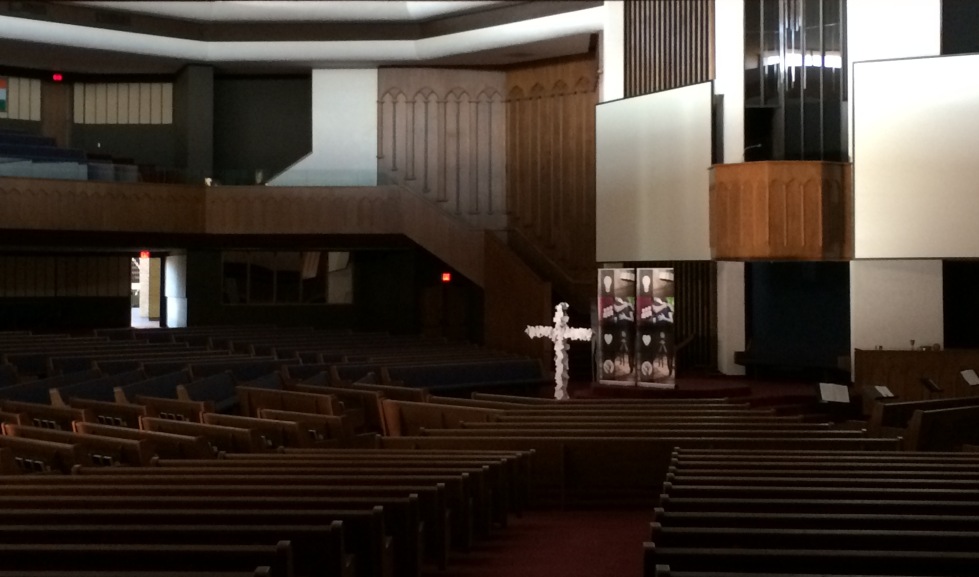
The inner life is about being in a place with God where he can work on you. And as we commit as a church family to pursuing a more holistic discipleship, which includes the traditional disciplines, confession just seemed like a good thing to do. If we’re going to be in that place with God, we’ve got to be up front with him about our sins. So we wrote down on pieces of paper the things that are wrong in our lives that need to be fixed by God, the attitudes of our hearts that need to be redeemed by God, and the situations in our lives that need to be given completely to him. And then we placed them on a large wooden cross at the front of our worship center.


The cross of Christ represents forgiveness and restoration and new life. It stands for a trust in God that he is bringing to completion that thing he has started in us. It reminds us that our Father has promised to make all things right — if things aren’t right in my life, it means that God’s not finished yet, he’s still working. So, after dwelling in Psalm 32 (“I acknowledged my sin to you and did not cover up my iniquity. I said, ‘I will confess my transgressions to the Lord’ – and you forgave the guilt of my sin.”) we brought our sins and our attitudes and our lives to the cross and left them there.

And they’re still in there.


I’ve walked in to our worship center twice already today to spend some time at that cross. I read the confessions, I see the lists of sins and attitudes that plague our people, and I can relate to a bunch of them. Reading the words on that cross today, praying for the people who wrote those words and placed them on the nails on the cross, brings to light sins and attitudes in my own life that I haven’t written down or even acknowledged yet that need to be forgiven and transformed by God.

I don’t ever want us to come into the worship center on a Sunday morning Just As I Am and leave an hour-and-a-half  later Just As I Was. Part of that corporate assembly experience is to be changed by God. Confession is good. Silence is good. Embracing a contemplative posture in the holy presence of God is good. You can’t hide anything when you get into that place with God. And it’s impossible to stay the same.

Peace,

Allan

Knowledge of the Lord

“…asking God to fill you with the knowledge of his will through all spiritual wisdom and understanding.” ~Colossians 1:9

The Holy Scriptures are certainly a primary way we receive the gift of the knowledge of the Lord. We are shown through the Bible exactly what our God has done and is doing through our Lord Jesus Christ. It’s a beautiful story, a compelling drama that draws us into the action. It involves us, it inspires us, it moves us to join in. But some of us still view the Bible as something else. We see the Scriptures as a book of rules and laws that must be kept before an all-seeing and all-judging God. No, the Bible is something different. The Bible is the grand sweeping story of God and his faithful presence and activity with his people and his people’s faithful and sometimes not so faithful response. God created something beautiful and he is right now re-creating something beautiful. He’s restoring everything back to its original pre-sin condition. His will — what God is doing — this knowledge of the Lord, includes redemption for all of creation, including us.

What God is doing is a story. It’s a narrative. And this is how we’re going to explore it and experience it together at Central:

ACT 1
Genesis 1-2      Creation – Pattern of the
Kingdom

ACT 2
 Genesis 3-11      The Fall – Perished Kingdom

ACT 3
Gen. 12 – Malachi 4      Covenant – Promised Kingdom

ACT 4
Matt. 1 – John 21      Jesus – Present Kingdom

ACT 5
Acts – Rev. 20      Church – Proclaimed Kingdom

ACT 6
Revelation 21-22      New Creation – Perfected Kingdom

This more narrative view of Scripture helps us make more sense of things and brings more order to our own lives and experiences. We live today in the 5th ACT of the drama. So, more than restoring New Testament Christianity or going backwards to the times of Jesus or the days of the apostles, we’re called to move forward in the drama. We’re called to live it out, to play our roles and say our lines in ways that move the story forward toward its glorious conclusion.

Sometimes our biggest problems come when we place our lives and experiences in the wrong acts of the play. Leukemia belongs in ACT 2 of the play, not ACT 1. God did not create cancer; cancer is a result of living in a fallen world, broken by sin. Don’t let anybody tell you God gave you leukemia. The affair you’re having with that other man is not something God wants for you because your husband is a punk and God wants you to be happy. The adultery belongs in ACT 2 with sin, not in ACT 1 with the perfect things God created for us. Muslims are living today as if ACT 4 never happened; they’re still fighting the battles of ACT 3. A guy who is sleeping with his girlfriend before they are married because he’s a red-blooded American male and doesn’t really have a choice because nobody waits for marriage anymore needs to be reminded that we are living in ACT 5 of God’s story where our lives are a proclamation of the truth of Christ Jesus and his eternal Kingdom. Our lives are a testimony to the great change that was inaugurated when Jesus rose from the grave.

We need to know where we are. And we need to know what’s coming. We need to know that God is the author of the story and he has the last say. He writes the final word. And we need to see ourselves in the story and join it, live it, with everything we’ve got.

Isaiah says when the Kingdom is finally perfected, when God’s holy will has all been finally fulfilled, there will be righteousness and justice and peace because “the whole earth will be full of the knowledge of the Lord.”

Knowledge changes the whole world. And it changes us.

~~~~~~~~~~~~~~~~~~~~

After 22 years of serving the Central family as a member of the church staff, Connie Green is retiring at the end of this month. Connie started out here as a teacher with Kid University in 1993, moved on to work with our singles and membership ministries, and for the past fifteen years has served as a valuable administrative assistant and faithful ministry partner to the preacher. Since we moved here three-and-a-half years ago, Connie has kept me out of trouble and one step ahead. She makes me look good. And that’s a tough assignment: I can be impulsive and last-second.

Connie, we all feel great appreciation and admiration for your selfless service to Central. I’m so glad that you and Jay are remaining here in Amarillo and at Central. We all wish you the very best of God’s richest blessings in this next phase of your lives together.

Peace,

Allan

Vision Statement: Part Two

The second half of our new vision statement at Central is about Christian ministry. This is what God is doing through us. As we become like Christ, as we are shaped more into his image, the natural outcome will be ministry. This is God’s great purpose and will for his people: to call and save and change people so they can sacrifice and serve the world. As we act more like Jesus, as we increasingly think and behave like our Lord, we’ll sacrifice and serve like him. We’ll notice that God is working in us and through us for the benefit of others. Just like Jesus.

“Do nothing out of selfish ambition or vain conceit, but in humility consider others better than yourselves. Each of you should look not only to your own interests, but also to the interests of others.” ~Philippians 2:3-4

Paul is saying we know how Jesus lived. We know what Jesus was all about. In his own words, Jesus said he did not come to be served, but to serve and to give his life. And Scripture says if you’re going to claim to follow him, you’ve got to live like him.

“Your attitude should be the same as that of Christ Jesus: Who, being in very nature God, did not consider equality with God something to be grasped, but made himself nothing, taking the very nature of a servant.” ~Philippians 2:5-7

Admittedly, this is a hard truth to hear. So we all have to work on it together. But, as God’s children and devout followers of his Son, it’s not about us. It’s always ultimately about God using us, transforming us and using us to benefit others.

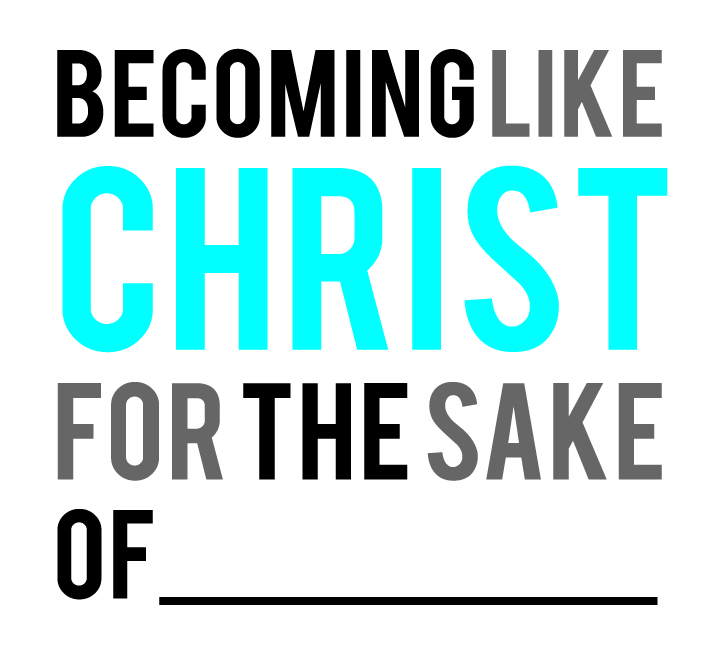
So… the blank. Yeah, we’ve got probably the first ever fill-in-the-blank vision statement in the history of vision statements. But we left it open-ended like that for several reasons.

Ownership – We want each member at Central to see herself or himself in this statement, to own it, to consider how they and God together are going to complete the sentence. What goes in the blank? This statement is both what God is doing in you and what God is doing through you. But we’re not going to fill in the blank for you. That’s for you to discern. You take it and wrestle with it. This is about your ministry. We want everybody in the church to have that kind of focus: What is God doing through me? Who is God impacting through me? And you fill in the blank. Everybody’s blank will be different; and they ought to be. You fill it in yourself. We don’t want to place any limits on our God on box in your imagination about God’s possibilities to do incredible things through you, things that are beyond anything you could ever ask or imagine.

Opportunity – I think this blank is intriguing to outsiders, maybe even provocative. I think the blank might lead to questions and conversations with others. People at work, people at school, maybe your mailman comes up to you: “Hey, you go to Central. What’s up with that blank?” And, you’re ready. Because you own this thing. And you launch! “Here’s how Jesus is changing me. Here’s how God is growing my faith. And here’s what he’s doing through me.” Bang! All of a sudden, you’re sharing the Gospel. You never would have approached this person to have that kind of conversation, but they approached you. And you started sharing the good news: Here’s what God is doing in me and here’s what God is doing through me. Because you own it.

Flexibility – The blank can change depending on the way life happens for each of us, depending on the different circumstances God puts in front of us and the life stages that bring their own set of transitions.

Fit – It just makes sense. It works really well with our increased focus on the narrative nature of Scripture and finding our own places and roles in the ongoing story of God.

And, finally, this last caution: This is not your blank, it’s God’s blank. You don’t just fill this in for yourself based on what you want to do. It’s not “Becoming like Christ for the sake of making my sales numbers” or “for the sake of losing 30 pounds” or “for the sake of not killing the kids this week.” The idea is to discern with God and our community of faith at Central your purpose in God’s plans. The whole statement should be engaged as “God’s Spirit is changing me for his purposes; now what is that purpose and how do I enter into it with everything I’ve got?”

Discipleship and Mission go together. Transformation and Ministry go hand-in-hand. Following Jesus and serving others are inseparable realities. The life of our Lord and the witness of Scripture are clear: you don’t really have one without the other.

This is who we are at Central. This is our identity and our vision. The statement is not a strategy — the formation zones are not a program or a plan. It’s a commitment to fostering an environment that places transformation and ministry above all else.

Peace,

Allan
Vision Statement: Formation Zones

For the past two years we’ve been listening closely to the stories of our people at Central. We’ve heard every elder and minister talk about how God has worked in his life to change him. We’ve visited with small group leaders and Bible class teachers. We’ve done this with our young people and with half of our adult Bible classes. We’ve asked folks to share with us a time in their lives when God was changing them. Tell us about a time when your faith grew deeper, when something about following Christ finally clicked, when you felt God’s presence and guidance in ways you never had before. Where were you when that happened? What was going on at the time? Who was a key part of your life for that moment? Tell us about a couple of times when you really grew in Christ.

And we’ve listened. And some common themes have clearly emerged. Over and over again we’ve heard the same four things. And we are convinced that God’s Spirit works in these four key areas to shape us more into the image of Jesus: Knowledge, Community, Inner Life, Mission. These are the areas where God does his transformation work. This is what we’ve heard in our own stories.

Knowledge – We’ve all experienced spiritual growth through knowledge: a Bible study that opened your eyes to the truth of God, a preacher who inspired you to deeper faith and commitment, an author who explained things in a way that really made it click, or being immersed in Scripture for two weeks at a Christian camp. Yes, we believe that God changes us through his Word. Of course, the holy Scriptures are transformative. But the Scriptures never uphold knowledge only for the sake of knowledge. It’s not just gaining more information about God. The knowledge of God is intended to transform the way we think and behave.

Community – This is by far the number one thing mentioned by our church family when we talk about how God has made us stronger in the faith or more like Christ. And we’ve all experienced it: the older couple who paid attention to you during the early years of your marriage, your small group that’s been together through thick and thin for more than twenty years, the relationships you have in your youth group. We can all look back and see where God placed the perfectly right people in our lives at the exact right times. These are the people he uses to love us, encourage us, challenge us, and support us. God works in community to deepen our faith and enrich our relationships to him and to one another.

Inner Life – This is mainly what are traditionally called spiritual disciplines. A lot of our members told us that a period of fasting, a season of intense prayer, a commitment to daily Bible reading brought them closer to God and made them stronger in the faith. This has not been a particular area of strength for us in the Churches of Christ, but we’ve all experienced spiritual growth by participating in these kinds of exercises.

Mission – These are good works done in the name of Jesus to benefit others. And I know most of us have experienced spiritual formation here: on a mission trip to Brazil or Kenya, working with the kids at Dry Bones or up at Camp Shiloh, volunteering at Martha’s Home or Another Chance House. Ephesians 2 says we are created in Christ Jesus to do good works which God has prepared in advance for us to do. And Ephesians 4 tells us those works are intended by God to grow us in the spiritual maturity.

We already know this is how God works to grow our faith and make us more like Jesus. These formation zones are exactly where the Father meets us and does his best work on us, whether we’re paying attention to it or not. This is how God changes us in spite of how we might organize or program our churches. Can you imagine what would happen if we actually walked together in step with God as he transforms us? What if we paid more attention to the methods we already know God is using? Instead of just waiting for it to happen, we actually seek out these zones where we know it does happen, and we expect it to happen!

These formation zones are not steps or principles. These are not building blocks or projects. Spiritual formation — becoming like Christ — is not a strategy or a program. These are faith catalysts. What we want to do is pay more attention to these things. This is the atmosphere, the place, where God makes us into the people he uses to touch the world with his joy and peace. So we want to nurture that atmosphere. We want to create a culture at Central where all of us explore and experience all four of these zones together and expect that God will faithfully make us more into the image of his Son.

Peace,

Allan

Vision Statement: Part One

Remember the Russian comedian Yakov Smirnoff? Born and raised in Russia, Smirnoff lives in the U. S. now — Branson, I think. A lot of his comedy was based on comparing life in Russia to life in the United States. One of his funniest bits is about the first time he ever walked into an American grocery store. He says, “I walked in and one of the first things I saw was powdered milk. You just add water and, boom, you’ve got milk! A couple of aisles over I saw cans of powdered orange juice. You just add water and, boom, you’ve got orange juice. Then I saw a whole shelf of baby powder!”

“What a country!”

Wouldn’t it be great if we just added water to ourselves and became instantly just like Jesus? What if the waters of baptism didn’t only wash away our sins, fill us with God’s Holy Spirit, and connect us to the body of Christ? What if the moment we came up out of the water we were automatically perfect? We know it doesn’t work that way. Whatever you call it — sanctification, salvation, spiritual formation, transformation — it doesn’t happen overnight.

Becoming like Christ is a gradual thing. It’s a process. Scripture calls it “being saved.” The course of being made perfect, being changed into the image of Jesus is difficult and lengthy. But this is exactly what God is doing with those he’s calling and saving. He is forming us into the image of his Son.

“We all reflect the Lord’s glory and are being transformed into his likeness with ever-increasing glory, which comes from the Lord, who is the Spirit.” ~2 Corinthians 3:18

Being saved means being changed: changed into the image of Jesus, shaped into his character, formed into his nature. It’s conducting ourselves every day in a manner worthy of the life, death, and resurrection of our Lord. Paul tells the Galatians he’s agonizing until Christ is formed in them. He writes in Romans that we’re predestined by God to be conformed to the image of his Son. He writes to the Colossians and says the goal of everything God is doing with Jews and Gentiles alike is “Christ in you, the hope of glory.”

But it’s slow. It takes time.

That’s why the very first word in our vision statement is “Becoming.” We want to constantly remind ourselves and proclaim as loud as we can to anyone who’s listening that nobody at Central Church of Christ has arrived. Nobody here is perfect. Nobody here has it all figured out. We are becoming like Christ. It’s a process. You know, some people won’t give life in Christ a chance because there are so many church people out there who think they’ve got all the answers. We want it to be known up front that we’re still pretty much a mess. Yes, we’re on our way. But nobody’s there yet. It’s a journey of ups and downs, of thrilling victories and devastating setbacks. We still have a lot to learn, we still make terrible mistakes. There’s a place in our church for anybody who has questions or doubts, for anybody who still says or does the wrong thing from time to time, for anybody who doesn’t feel perfect. Because we’re all in that little boat, fighting the storm, straining at the oars. But in the middle of all that, God is making us more like Jesus. It’s slow, but he’s doing it.


Happy Texas Independence Day!

Allan

« Older posts Newer posts »