How many church songs do you know by memory? How many praise hymns, gospel songs, and youth-type songs do you know by heart? If I gave you the title or sang the first line, how many church songs could you be able to finish? 100? 200? More?
Next question: how many times did you actually sit down with a song book and intentionally work on memorizing the words? How many hours did you spend in a room by yourself pouring over the lyrics to memorize those hundreds of songs?
I’m betting you never did that once.
But you know the songs. The songs are in you. The music and the words and the tunes and all the images and emotions and memories and feelings those songs stir up are in your head AND in your heart. Our songs are so important to our worship and to our growth as God’s children. They become a part of us. They become who we are. I think half our theology is learned in the songs we sing. We know the names of the 12 apostles because of the song. We run the song in our heads as we’re searching for Philippians or Thessalonians in our New Testaments. Everyone of us would be able to recite all 39 books of the Old Testament in order if only there were a song. The passages of Scripture we know best are the ones that have been turned into church songs. Our pictures of heaven, of the cross, of Jesus in the Garden come from our songs. Our songs have defined for us our ideas about salvation and forgiveness and love. Our doctrines are shaped by our songs. Our songs are critical, paramount to our faith.
That’s the first thing on singing: the importance of it for the church, the community of faith.
The second thing is this: Sing!
Don’t just sit there. Sing.
Everything we do in America now is geared more and more toward consuming entertainment and pleasant diversion and less and less toward active participation. We watch and listen. We don’t do. And I’m struck by the words of Darryl Tippens in his book That’s Why We Sing:
“We are less and less a singing culture, more and more a listening culture. We are surrounded, day and night, by professionally produced music. As we move from active participation to passive listening, an even more ominous consequence emerges. In a world of “American Idol,” we have become entitled judges of everyone’s performance. In other words, we move from being singers to being listeners, then, finally, to being consumers and self-appointed critics. In such a consumerist world, congregational singing suffers. Instead of praise being understood as a sacrificial gift to God; it becomes a human performance subject to critical analysis. (What did you think of the singing this morning?)
We moved all the chairs in our Worship Center Sunday afternoon so that the rows all faced toward the middle. And we spent an hour Sunday evening singing to our God AND to each other. Praising God, yes; but also teaching, encouraging, challenging, and loving each other with our songs. Instead of the backs of their heads, I got to see the faces of my brothers and sisters in full throat and wide smile as we sang together. And it was powerful.
~~~~~~~~~~~~~~~~~~~~~~~~~~~~~~~~~~~~~~~~~~~~~~~~~~~~~~~~~~~~~~~~
65 days until football season. And #65 is old Houston Oilers great Elvin Bethea. 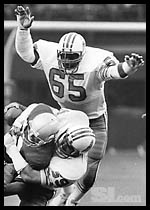 You know, I’m a sucker for the old Houston Oilers. He played defensive end for the Oilers for 16 seasons, from 1968-83 and is the franchise’s all-time leader in sacks with 210. He played in 135 straight games until his streak was ended by a broken arm against the hated Raiders in ’79. Bethea is old school—he played in the very last AFL All-Star game in ’69. He was a vital part of those Luv Ya Blue teams of the late ’70s. But he was also the best player on those lousy teams of the late ’60s and early ’70s. He racked up a record 17 sacks on a 1-13 team in 1973. That’s why he was so beloved. The Oilers retired his #65 in 1983. But his memory lives on in the countdown.
Peace,
Allan


Recent Comments