Category: 1 Corinthians (Page 15 of 21)

The Leader as Pauper

I’m re-reading several parts of Norman Shawchuck and Roger Heuser’s book, Leading the Congregation, in advance of our elders / ministers retreat this weekend. I’m especially interested in chapter two: The Interior Attitudes of the Leader. A couple of days ago, I wrote a little bit about childlikeness in our spiritual leaders. Today, let’s consider the church leader as a pauper. A poor person.
“Blessed are the poor in spirit, for theirs is the Kingdom of Heaven.” ~Matthew 5:3

This is the first of the Beatitudes, those ideas and promises at the beginning of Jesus’ “Sermon on the Mount” that are intended to shape our thoughts and lives. Bonhoeffer says it’s not the actual poverty that is the virtue — there’s nothing good about being poor. Instead, it’s the willingness to be poor, it’s the desire to follow Christ at the risk of becoming poor, it’s embracing the call of Jesus knowing that you may very well lose everything. I’m obviously paraphrasing here. But, that’s the virtue. That’s the blessing.

Shawchuck and Heuser put another twist on it. They say that church leaders go into their roles, they accept their mantels of leadership, from a position of poverty. We know that when it comes to leading God’s people, we have nothing. We’re wholly inadequate. We can’t do this; and we know it. Inherent in our call to ministry is the realization that we are not by nature equipped to bear this burden of leadership that God has dropped in our laps. We always embrace our calling as paupers.

Now, personally, this one’s easy for me. I feel completely inadequate every single time I jump in the pulpit to preach. I’m terrified every single Sunday morning. Scared to death. The words of God are too powerful for me. Knowledge of him and his great love for us is too lofty for me to attain. I rarely ever feel like I’ve done our holy God justice. In the words of Augustine, I am saddened that my tongue cannot live up to my heart.

I’m not smart enough to teach these classes I’m supposed to teach. I’m not trained to counsel these brothers and sisters in Christ through their marital problems and addictions and depression. I’m not equipped at all to visit with parents who just lost their teenage daughter to cancer. I’m not able to adequately lead this church staff. I’m not prepared for any of this.

I know what that means to entirely lean on God for my ministry. It’s his; it’s not mine. I couldn’t even begin to do any of this without his power, his strength, his pushing and guiding and equipping. I have no competence on my own; it all belongs to and comes from God. I get that part of it. I understand fully that the apostle is staring right at me when he says, “Consider your own call… not many were wise by human standards, not many were powerful, not many were of noble birth (sorry, dad). But God chose what is foolish… what is weak. God chose what is low and despised in the world” (1 Corinthians 1:26-31).

Humility? Yeah, I guess. It’s the same; but different.

The authors move on to say that being a pauper, being poor in spirit as a church leader, means to actually desire this poor position. To be a faithful leader of God’s people means, in their view, to seek this poverty. Because that’s what our Lord did.

“It is hard to desire littleness and nothingness, obscurity and benign respect, in a world obsessed with possessions and positions. It is hard to choose a pauper’s station when everyone around us is scrambling for upward mobility. The temptation that afflicts us as leaders is not that of monetary wealth. Only a fool would choose a profession in the church if the goal were to become rich. Indeed, the ‘to be rich’ temptations among most clergy are not for money but for admiration, respect, adulation, prestige, and power. These are the riches that must be guarded against, if ever we are to experience the freedom of being poor in spirit. God means this poverty as a gift and blessing, not as a practical joke upon those whom God has chosen as leaders in the church.”

Downward mobility. (Did Nouwen coin that term?) The way of the cross is downward mobility. We empty ourselves of all desire for gain — monetary or otherwise — just like Jesus in order to take on the role of a lowly servant. Like our Lord, we move down to the bottom of the ladder, down the depth chart, giving up all power and position and prestige to seek the good of others.

This world draws hard lines between the winners and losers. We label everything as failure or success. No middle ground. What a difference is God’s way for us! His Word came down to us and lived among us in order to serve us. He became poor so that we, through his poverty, might become rich.

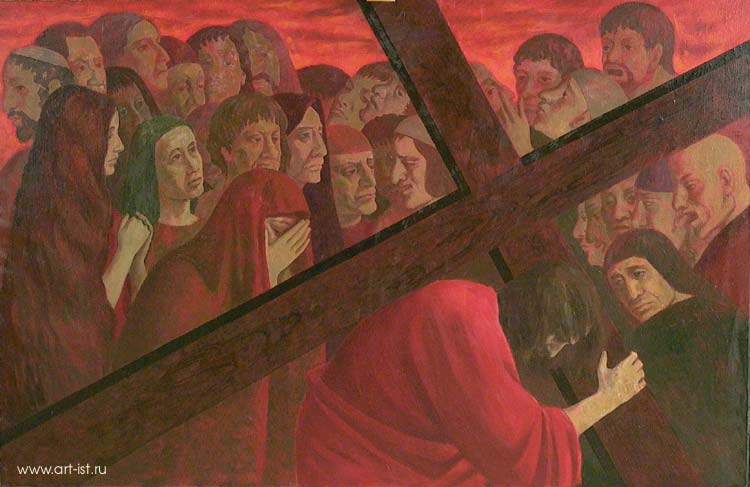
Bishop Walpole is credited with saying to a friend who was considering a call to ministry, “If you are uncertain of which two paths to take, choose the one on which the shadow of the cross falls.” That’s the way and the spirit of poverty, to which our Christ calls every Christian leader.

Peace,

Allan

Madison Lives With The Lord

“Where, O death, is your victory?
Where, O death, is your sting?
Thanks be to God! He gives us the victory through our Lord Jesus Christ!”

Madison Knebusch passed away this morning in her bedroom, surrounded by her family, while being sung to by her friends, listening to words of comfort from the Scriptures, wrapped in the loving arms of her God, forgiven and made whole by the blood of her Savior.

Madison’s two-year battle with cancer is sad in many ways. It’s heart-breaking. But in countless other ways it is so marvelously beautiful. Breath-taking, inspiring, in the truly Gospel way it’s played out. The way the Body of Christ has come together to minister to the Knebusch family. The loving community that was experienced in hospital rooms and living rooms in the name and manner of our Christ. The burdens that were being shared. The great faith that has been shown by Levi and Shannon, not to mention Madison’s Holy Spirit strength that refused time and again to give in to the disease that was robbing from her everything we think it means to be really alive.

Realizing that Madison was more alive while she was battling cancer than I am right now. Or ever have been.

Madison never stopped thinking about others. Right up until Tuesday when her condition took that awful and irreversible turn, she was concerned about others, worried about others, ministering to others. Sending notes of encouragement to friends of her family who are dealing with their own illnesses. Asking questions about those at church she knew were hurting. Wondering aloud if her circumstances were taking away from the joy of others. Using her blog and her facebook page to record her innermost thoughts about God and his presence and his great promises and her unwavering belief and faith in his Word. Madison was truly alive, really living, that whole time. Thinking more about others, regarding the needs of others ahead of her own. At her sickest points, Madison was more alive than most of us ever have been because she was doing what she was made by her Creator to do. Serve. Sacrifice. Look like and think like and act like the Christ.

Realizing Madison is eternally alive right now. Forever. In the intense face-to-face presence of our God.

Madison’s eyes are open now. She’s made the trip. She’s on that other side. She sees everything so clearly now. She understands it all fully. Everything makes perfect sense to Madison right now. She’s there! She’s right where all of us so long to be. And she is so happy! Lord, come quickly! He has! Praise God, Madison today is an overcomer. She’s a conqueror. She’s an eternal daughter of our God and wearing the beautiful crown of a righteous princess. She’s there! Fully alive! Eternally alive!

Bonhoeffer wrote that “those who have died are in reality those who live and those living on earth are the dying. The cemetery is the place of life’s victory. Here lie those who live with the Lord.”

Hug your kids today. Kiss your spouse tonight. Call your parents. Express your love. Show your appreciation. And then get down on your knees and face and thank God for the wonderful people he’s put in your life.

Like Madison. And Levi and Shannon. And that whole Knebusch family.

While you’re down there, pray for the Knebusches. Pray for our merciful Father to bless them each with his grace and comfort and peace.

“On this mountain the Lord Almighty will prepare a feast of rich food for all peoples,
a banquet of aged wine —
the best of meats and the finest of wines.
On this mountain he will destroy the shroud that enfolds all peoples,
the sheet that covers all nations;
he will swallow up death forever.
The Sovereign Lord will wipe away the tears from all faces;
he will remove the disgrace of his people from all the earth.
The Lord has spoken.
In that day they will say,
‘Surely this is our God;
we trusted in him, and he saved us.
This is the Lord, we trusted in him;
let us rejoice and be glad in his salvation!'”

Lord, come quickly.

Allan

Speak To One Another

“Speak to one another with psalms, hymns, and spiritual songs.” ~Ephesians 5:19
“There are different kinds of gifts… given for the common good.” ~1 Corinthians 12:4-7

There are times within the context of congregational worship for us to be edified by others. To be lifted up and encouraged by the singing of others. To be taught, to be inspired, to be challenged by the songs of others. There are times when the God-given abilities of one or two of his children should be used in a congregational setting to benefit the entire church body. We do it all the time in Bible readings, in prayer, in preaching, in worship leading, in teaching, and in making talks at the Lord’s Table. But we in our Church of Christ heritage have generally steered clear of that in our singing.

We have always upheld very strongly the concept of a congregational chorus. No choir. No robes. No select group of people standing up in front of the church and singing. Traditionally, that’s been our stand. Our idea is that everybody participates in the worship of God. We’re not gathered to be spectators; we’re here to worship. I, too, applaud that reasoning and support the theology behind it. However, traditionally, (as long as I can remember, and longer) we’ve taken the idea so far as to deny the exercise of God-given talents in God-ordained ways.

We’ve said ‘no’ to all choirs in our congregational settings. We’ve rejected the idea of quartets or duets. We won’t even have a discussion about solos. No one is to sing — ever! — in a congregational worship setting unless everybody is invited to sing. Whether it’s two dozen people in a choir or a trio of three, nobody can sing in church unless the whole church is singing. Traditionally, that’s been our view. If it’s not been our view, it’s certainly been our practice. And that position cannot be defended anywhere in our Scriptures.

If you’re banning choirs or forbidding the use of duets or solos in your church on Sunday mornings, you can’t use the Bible to justify it.

Regarding spiritual gifts such as singing, Paul writes in 1 Corinthians that they are to “edify the church” (14:4). The Christians in Corinth are to be careful with the exercise of their gifts, keeping in mind the number one objective is “so that the church may be edified” (14:5). The apostle claims we should “excel in gifts that build up the church” (14:12) and refrain from practicing things by which “the other man is not edified” (14:17).

What could be more lovely than a young woman who’s been given an amazing voice by our Father using that voice to glorify him and inspire the church? What could be more appropriate than a group of several dozen Christians teaching and encouraging the congregation through their gift of song?

That man was given that talent by our Creator; let him use it to praise God! Let him use it to minister! And let us be ministered to. Let us listen and enjoy. Let the song take us to the throne of God. Let it inspire us to live better lives. Let it remind us of what our Father has done in our lives and in his world. Allow the man with the gift to sacrifice it to God for the sake of God’s glory and for the benefit of the church. Allow us to affirm the goodness of that gift and the greatness of the One who gives it by listening, by appreciating, by applauding the free use of that gift.

We are so blessed here at Central to be led by a group of shepherds who allow and even encourage a great variety of expressions of praise to God. We’re diverse in the ways we encourage one another in our assemblies. When we’re together, we reach for the fullest manifestation of the gifts of God’s Spirit.

A couple of weeks ago, it was a trio during our communion time. Here in a couple of weeks it’ll be a duet as we close. Yesterday it was Kevin, Johnny, Kelley, and Dick in a quartet getting us ready for the sermon. They sang a medley of songs that included “O Holy Night,” “Mary, Did You Know?” and “I Am” to prepare us for the lesson about partnering with God in the mighty salvation deeds he initiated at that little stable in Bethlehem.

And it was fabulous. Spiritually stimulating. Wonderful.

Now, don’t you dare come at me with “But, that might be perceived as entertainment” or “Aren’t you elevating one group of people over another?” Don’t say, “You’re turning it into a show or a performance.”

To quote Paul again from 1 Corinthians: “Brothers, stop thinking like children!” (14:20)

There need to be planned times in our assemblies to “just listen” to song. The same ways we “just listen” to preaching and praying and Bible reading.” Songs are strong. Music has the power to move people, to motivate and inspire, to encourage and comfort. There need to be times when a brother or sister with God-given abilities can use those abilities in a public way to bring glory to the Father and encourage the church. We need to be blown away every now and then by the talents God’s given us.

~~~~~~~~~~~~~~

Speaking of singing to one another, Carrie-Anne and I were suprised last night at our new house by a gaggle of Christmas carolers from our Central Youth Group. It seems those gathered at Tanner’s house decided to take the party on the road and wound up stopping by half a dozen houses to sing Christmas songs. We were thoroughly honored. And duly impressed. Not so much with Tanner’s Christmas tie and sweater or Spencer’s reindeer solo or Barrett’s improvised falsetto at the end of “Silent Night.” More so with the idea of sharing their gifts of song and fellowship with others.

~~~~~~~~~~~~~

I have no idea what “Blizzard Warning” means. But we’re in the middle of one right now. No snow yet. But the National Weather Service says it’s coming.

On Friday they issued a “Blizzard Watch” for Monday and Tuesday. So we’ve been on alert. Yesterday while Carley and I were stirring paint together in the dining room, the Police song on our classic rock station was interrupted by the harsh tones of a National Weather Service alert. You know, that noise always makes me think thunderstorm or tornado watch. That was my first reaction. But the computerized voice alerted us that the blizzard watch had been canceled. Carley and I looked at each other with a little bit of disappointment. But the voice went on to let us know that a blizzard warning had now been issued for our parts of Randall and Potter Counties in the panhandle.

We’re expecting 12-16 inches of snow over the next 24 hours. North winds gusting to 45-50 miles per hour. Temperatures in the 20s. Whiteout conditions. Visibilities down to nothing. Four and five foot drifts.

I have no idea what that’s going to look like. I don’t know what it might to do to the city here. I’ve never experienced anything even close to this. But we’re excited about it. It’s brand new for us. So our attitude at Stanglin Manor right now is “Bring it.”

Peace,

Allan

Joy at the Table

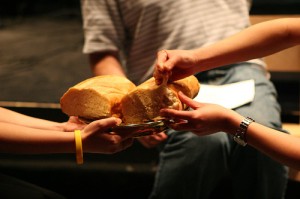
The Lord’s Supper is the central, communal, corporate act of God’s Church. Instituted by our Savior, passed on by the apostles, and practiced for centuries by God’s people, our communion meal has historically served as the primary reason for Christian gathering and the climax of the Christian assembly. It’s the high point. The pinnacle.

As most of you know by now, my great desire is to see the Lord’s Supper returned in our churches to the rightful place of prominence it has always enjoyed until recently. In our Church of Christ assemblies, our communion time needs to be the highlight. And it’s not. Not always.

And it won’t be — not consistently, anyway — until we return the joy.

When presenting the case for expressions of joy and gladness and celebrations of happiness during our Lord’s Meal, I’m often reminded by well-meaning brothers and sisters that our time at the table is meant for remembering the death of Jesus. It’s inappropriate, they say, to rejoice when thinking about death. Our time at the table is for somber introspection and solemn reflection, not conversation and singing and grinning. Certainly not laughter.

First, I would say our Sunday communion has much, much more to do with the Resurrection than with the Crucifixion. Much more. I would suggest the first Christians didn’t really think about Jesus’ death during their Sunday meals. They were too overcome by the fact that the Christ really was alive. That was the focus of communion.

But if a person insists that the communion meal is about remembering the death — and people will do this by quoting 1 Corinthians 11:26: “proclaim the Lord’s death until he comes.” — we’re on solid ground to celebrate in that case, too.

For the writers of Scripture, the death of Jesus was and is good news. It’s great news! And it is more than appropriate at the table of Christ  to express the pleasure and the joy that are caused by his death. To “proclaim” means to announce publicly and clearly what has happened and what it means eternally. It’s not to be whispered through cupped hands into the ears of a just a few disciples in the room. The good news is to be shouted with joy.

The Eucharist (thanksgiving, right?) is the perfect time and place, not to mention the most practical form, for showing and confessing that the death of Jesus is totally different from a natural event or a criminal act or some tragic loss. The death of Jesus gives us no reason to accuse or moan or lament or complain.

Those celebrating the Lord’s Supper know the pain and the shame, the horror and scandal, of Christ’s death. However, we rejoice in the crucifixion and praise the slaughtered Lamb because God has raised him from the dead and accepted his intercession on our behalf. In Paul’s theology and in the message of John, Hebrews, 1 Peter, and Revelation, the Crucified One is always the living and reigning Christ. The One who rules the Church and the world and who will come again is the crucified Christ.

We have abundant reason to rejoice in Christ’s death and praise the crucified yet living Lamb.

And until we recapture that sense of great joy around our living Lord’s table, we will continue to commemorate a solemn service instead of a celebratory feast. It will remain a weekly task to be performed instead of a community meal to be enjoyed. And it will stay in the background. It won’t ever rise past the preacher or the music in terms of proper position and prominence in our Sunday assemblies.

What if our Sunday communion services sounded and felt more like what you’re going to experience around your dining room table this coming Thusday? What if, when we dine with our risen Lord on Sundays, joy were the prevailing mood?

~~~~~~~~~~~~~~~~~~~~~~~~~~~

More than $7,500 raised for Madison Knebusch and her family at yesterday’s spaghetti lunch. Praise God!

Bad news received just this afternoon regarding the PET scan today on Madison’s right lung. Another round of chemotherapy to begin later this week.

“Yet I will rejoice in the Lord.” ~Habakkuk 3:18

We love you, Madison and Levi and Shannon, Britton, Londen, Gracyn, and Hudson. Our hearts are breaking with yours as you endure this horrible trial. We ache for you and with you. And all of us want so desperately to do something to help. We want so badly to help. And, honestly, sometimes we don’t even know what to say. We don’t have the words. Sometimes we say dumb things and do dumb things out of a deep love for you that is compelling us to try anything to provide you with encouragement and comfort. Please be patient with us and forgive us.

Please know how much we love you.

We trust in our loving Father. We ask for increased faith. And we continually lift you up to our mighty God for his divine purposes.

Grace & Peace,

Allan

The Back of the Line

“Thanks be to God who always leads us in triumphal procession!” ~2 Corinthians 2:14

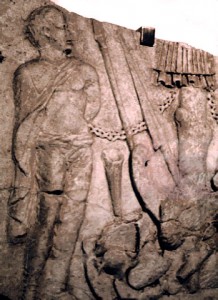
The apostle Paul writes while enduring great anxiety over his brothers and sisters in Corinth. He writes to give them a new perspective. He writes to bolster his own strength and faith. He writes about a great Roman military victory parade. The conquering general rides in a gold chariot up front. The senate and magistrates follow. Behind them are the royal and military musicians. The spoils of war, the loot from the conquered lands, is paraded next. And then the captives in chains, the prisoners of war, in the back of the line.

Paul says, “I’m in this parade! You’re in this parade! God is leading us in this triumphal procession! We’re all in this parade together!”

But the technical nature of the term and the linguistic nature of the verb can only mean one thing: Paul is not at the front of the parade with God. He’s at the back of the line with the captives.

Paul sees himself as a slave to Christ. He’s been captured by Christ, he’s a trophy belonging to Jesus, he’s one of the spoils of God’s great victory over sin and death. Paul is thrilled to be in the metaphorical chains of the conquering Christ and the unstoppable Kingdom of God. Paul shows us in a very graphic way his understanding of Christian ministry. He paints a vivid picture of himself — a picture of all of us — being led by Jesus in a long line to our own suffering and death.

See, the captives are the physical evidence of the victory. The conqueror receives the glory and honor due him when the world sees the people he’s defeated. The people at the back of the line, the conquered people in chains, are a display of and a testimony to the glory and majesty and power and authority of the conqueror in the gold chariot up front.

That’s Paul. That’s us. That’s the way he sees things.

“It seems to me that God has put us apostles on display at the end of the procession, like men condemned to die.” ~1 Corinthians 4:9

Paul goes on in that 1 Corinthians 4 passage to say we are humiliated. We’re ridiculed. We are the objects of great wrath and scorn. We’re spit upon by the crowds as we walk to our executions.

Things don’t always look so good from the back of a line like this. It doesn’t always feel good. Sometimes it’s downright painful.

But this is exactly where our Father wants us. God doesn’t want us better; he wants us deader! Dead to ourselves! Dead to the world! Completely dependent on God! Totally leaning on him for every step, every move, every breath! Wholly reliant on him for life itself!

Paul counts it as a blessing and a privilege to be led by Christ as his captive, as his slave, and to participate in this way as a part of God’s triumph. Paul has actually grown comfortable at the back of this line. He’s come to understand that “the all-surpassing power is from God and not from us.” He knows that “all of this is from God” and none of it is from his own strength or smarts. He knows that “our competence comes from God.”

Those are the lessons learned from the back of the line.

And that’s precisely where ministry is done. From the back of the line. God is glorified in his captured people. He is praised and honored by his slaves. May we stop wrestling with the chains and fully embrace them in complete submission to our Lord and King.

Peace,

Allan

Following Jesus to the Cross

We don’t ever come to the cross of Christ to worship his death or to remember the grisly details of that day. We come to the cross — we’re actually drawn to the cross — to see what it looks like for me to die. What is the meaning of my daily dying to myself and dying for Christ? And dying with Christ? What does it look like? How do I do it? And what does it really mean?

People say Jesus died so I don’t have to. No, that’s not right. Jesus died to show us how to.

As holy children of God and disciples of his Christ, we die every day. We participate every day in the eternal dimensions of Jesus’ death.

“I have been crucified with Christ…” ~Galatians 2:20

“I die every day — I mean that, brothers! ~1 Corinthians 15:31

“You died, and your life is now hidden with Christ.” ~Colossians 3:3

Dietrich Bonhoeffer famously wrote, “When Christ calls a man, he bids him come and die.” We are called to participate in the death of Jesus. We don’t just stand around and ask questions about the death of Christ. We don’t just talk about it and marvel about it. We live it. The death of Jesus shapes everything about the way we live, how we believe and love, why we do what we do.

If we’re going to follow Jesus as his subjects — and we are! — then we’re going to follow him into the pain and darkness of Calvary where he faithfully and fully submitted to our Father’s will and gave his very life for the sake of the world.

~~~~~~~~~~~~~~~~~~~~~~~~~~~~~~~~~

Tomorrow is Warrior Dash. And I’m not quite ready.

Warrior Dash is a 5K obstacle course highlighted by runs through waist-deep muddy water, climbs over cargo nets and 20-foot hay bales, crawls under barbed wire and through dirty ditches, and jumps over junk cars and pits of fire.

There are runs like this all over the place. Some of them are called Mud Runs. Some are called Jail Breaks. This Warrior Dash is held every year in Roanoke, just down the street from the Texas Motor Speedway. I’d never heard of this, or any other organized obstacle event, until last year when Greg Hardman and his daughter, Emily, ran it together with some of her college friends. His stories and his pictures were truly inspiring. I even used their experience to illustrate a sermon here last spring.

And several of us caught the fever.

Valerie and I made plans to start training in October. I was going to start eating right. I was going to start running more. (By more, I mean just start running. Period.) I was going to lose 15-pounds. I was going to lift weights and really be ready for this thing in April.

I’m not ready.

None of those things happened. Valerie and I have run together at the Northridge Middle School track a total of five times since the middle of February. We did two-and-a-half miles last night. We’re going to do three miles this evening.

We’re not ready. But we’re very much looking forward to it. Valerie has always been my little adventurer. She’s excited to be doing something so outrageous with her dad. And this will be something I’ll treasure with her forever.

There are at least a dozen of us from Legacy running the Warrior Dash in the morning: John & Suzanne, Bruce & Cathy, Mike & Lisa, Keith & Beth, Josh (who promises to stay right with me), Jason, Margaret, David and, from what I understand, a whole slew of our younger marrieds.

My goal is to finish in one hour or less. And to not have to be carried out in a stretcher.

Peace,

Allan

« Older posts Newer posts »