
Author: Allan (Page 302 of 500)

Where Were You?

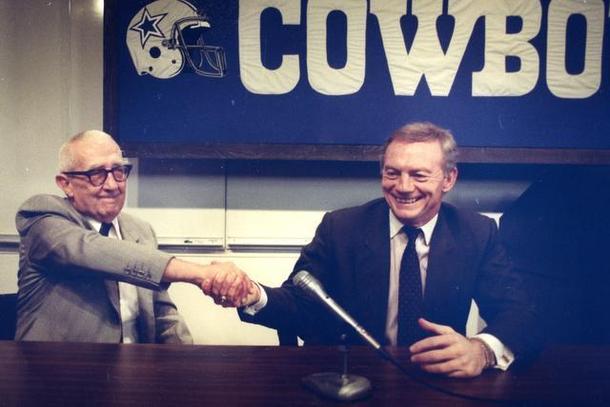
Where were you 25 years ago today? When you first heard the news of the great tragedy, where were you? What were you doing? Who were you with? On that Black Friday, February 25, 1989, when Jerry Wayne bought the Cowboys and fired Tom Landry, where were you and what were you doing? I was a senior broadcasting major at Oklahoma Christian College, in my last semester, sitting in my apartment after lunch, getting ready for a 2:00 class. A roommate and great friend of mine, Mike Osburn, was the first to deliver the news. He told me: Tom Landry has been fired. And I didn’t believe him. Mike had heard about it while passing through the student center after lunch. Somebody had heard it on the radio. And I didn’t believe him. We didn’t have cable on the TV in our on-campus apartment. Besides, even if we did, ESPN was brand new and showing Australian Rules Football seemingly around the clock. There were no sports radio stations in Oklahoma City. No internet. So I called my mom, long distance, on a land-line phone, to confirm the information. She told me that KRLD was reporting the same news and that a press conference was happening at around 5:00.

Ah, yes. “Socks and jocks.” Oklahoma City television didn’t run that press conference live like they did on both radio and TV in Dallas. I only saw the highlights at 6:00 and 10:00. Tex Schramm sitting in a folding chair in a back corner of the stage. The introduction of Jimmy Johnson. The bumbling and stumbling explanations of the botched firing of the only coach the Cowboys had ever had.

To help you reflect on your own feelings and emotions relating to that horrible day, I’ve included a couple of links here to some pretty good reading material. First, Tim Cowlishaw, the excellent Dallas Morning News columnist, has written a piece about Jerry Wayne’s recent apology for firing Landry. Cowlishaw makes the point that Jones has apologized for the wrong thing. He should apologize to Cowboys fans for his performance as the team’s general manager. But, alas, that apology, the only one that would count, is never going to come. Cowlishaw’s column is here.

John Henry has written an interesting time-line piece for the Star-Telegram that highlights all the highs and lows of Jerry’s ownership of the Cowboys. It’s lengthy, but it provides lots of reminders of just what a mess this franchise has become with Jones at the top. You can find it here.

To commemorate the occasion, why don’t you make a couple of really horrible decisions today at work, and then film a commercial for Papa John’s Pizza.

Peace,

Allan

In Solidarity with Sinners

Most disciples of Jesus would profess that churches are called to make a public witness to Christian faith. But it seems that more and more of us disagree with what that witness should look like and how it should function. What does it mean for the Church to testify to the truth of Christ Jesus?

I’ve recently come across a review of a yet-to-be-released work by Jennifer McBride called The Church for the World: A Theology of Public Witness. McBride is a theologian and author who teaches at Wartburg College in Iowa. The review and an accompanying interview with McBride are in the December issue of Christian Century. But — D’oh! — I can’t link you to them because the articles are only available online if you’re a subscriber. I’m intrigued by the interview, written and conducted by David Heim. And I’d like to spend this space this week breaking it down. Yes, I’ve ordered the book. So, there may be more of this coming in a couple of weeks.

In response to Heim’s first question, asking the author to elaborate on an assertion that Christian public witness has gone bad in the United States, McBride says:

“The main problem is that Christian presence in public life tends to be triumphalistic. The purpose of Christian witness is to point to Jesus and the reign of God he embodies, but a triumphal presence actually contradicts Jesus’ way of being in the world as depicted in the Gospels.

The triumphal character of Christian witness has contributed a good deal to how polarized our society and churches have become. Christians so thoroughly disagree about war, sexuality, ecological care, immigration and other issues that we wind up on opposing sides of the political spectrum. This is cause for great concern, because partisan politics ends up defining what is Christian; it shapes the way we think and speak about public issues.”

I’ve wondered a lot about this in the past dozen years or so. The Church that I see and experience in the heart of the Bible Belt in the Southwest United States has become so politically juiced that it’s become difficult to think or speak theologically if one Christian’s understandings of Gospel oppose another Christian’s understandings of country or patriotism. Have you noticed? Some Christians will unapologetically claim that one cannot be a true disciple of Christ if she belongs to a certain political party or adheres to a certain political belief. Farther along, and worse, in my judgment, is the way the Church’s identity has been compromised by our embracing the world’s politics. We have become so entangled in the sheets and blankets of the dirty bedrooms of American politics that we are labeled as “right wing” or “conservative” or “Republican” by outsiders we’re trying to convert to Christ. Non-Christians are attaching to the Church the same corruption, deceit, ethics, and behaviors that characterize the worst kinds of politicians. “Tea Party” and “Christian” are becoming synonymous in our culture. And we have only ourselves to blame.

Who do we think we are, seeking or claiming some kind of privileged status in the government or in American society at large? What makes us believe it’s good to force others — by boycott, insult, petition, million-dollar campaigns, attack ads, holier-than-thou attitudes, pamphlets, protests — to live by the same standards we profess as Christians? Why are we so surprised that the more the Church gets caught up in this world’s politics, the more noise we make about legislation and ethics, the louder we claim to have all the answers for how everybody in the world should live, the less and less interested the world is in Christians? Is it really any wonder that society is hostile to us?

You’ve noticed, right? Generally speaking, Christians are now portrayed by the media and understood by the culture as angry, anti-abortion, anti-homosexual, shove-it-down-your-throat, power-hungry, politicos. It wasn’t too long ago we were merely thought to be irrelevant. Too nice. Too naive. Now it’s become just the opposite. Pay attention to our general attitudes. Notice the worldly lengths to which we’ll go in order to get our way. Christian prayer has to be mandated in the public schools, but not Muslim prayer. Christian marriage has to be recognized as legal, but not homosexual marriage. The Ten Commandments must be displayed on the courthouse wall, but not the tenets of Buddha. Christian churches should be exempt from local and state taxes, but not a mosque. Really? Should the Church of Jesus Christ be seeking or claiming some kind of privileged status in government? Should Christians receive more and better benefits from the world’s governments than anybody else? On what basis? At what cost?

We are setting ourselves over and above others, claiming by our words and actions to know more and to be better than everybody else, in direct contradiction to the way our Lord lives on earth. More from McBride:

“We tend to think that as the sinless one, Jesus distinguished himself from sinners by setting himself up as a model of ethical perfection. But Jesus was in solidarity with sinners in at least three main ways that define his person and work.

First, as God incarnate, he assumed sinful flesh, as Paul says in Romans 8:3. He took on human nature’s damaged state and through his body became intimately acquainted with the complexity and messiness of fallen existence.

Second, he begins his public ministry by being baptized with sinners in response to John the Baptist’s call to repent and in this way ‘numbers himself with the transgressors’ (to use Isaiah’s language about the suffering servant).

Third, and finally, refusing to be called good (Mark 10:18), he instead accepts responsibility for sin as a convicted criminal on the cross. Throughout his ministry Jesus denies any claim about his own moral righteousness and instead actively accepts responsibility for the world’s sin and suffers on the cross out of love for fellow human beings.”

What would it look like for the Church to be in solidarity with sinners? To identify with sinners? To be one with sinners? To recognize every day our own sinfulness in the presence of sinners? To sympathize with, to minister with, to be seen with, to learn with, to walk alongside sinners? What would that look like? How would that improve our Christian witness? In what ways would it transform us more into the image of our Lord? How might it change the world?

Seems to me, it’s got a much greater chance of making an impression than another angry ad or fiery Facebook post.

Peace,

Allan
The Whitster is 21

I love you every day, girl;
always on my mind.
One thing I can say, girl,
I love you all the time.

It was the first song I ever sang to you, Whitney. Holding you in my left arm, holding that little oxygen tube up to your tiny little nose with my right hand, marveling at your thick dark hair, worried a little bit about your purple hands and feet, and looking square into your newborn blue-blue-blue-blue eyes, I sang to you Eight Days a Week. Twenty-one years ago today. Or, tonight, I should say; you took a good long while getting here.

Oxygen tubes. Surgeries. Set backs. Physical therapy. Tutoring. More surgeries. Crutches. Wheelchairs. Casts. Disappointments. Surgeries. My word, we’ve spent a lot of time together in hospital rooms and doctors’ offices. I remember a lot of it. It’s been painful, I know. But I treasure in my heart your optimistic outlook and your positive attitude through every single adventure. You were ten or eleven years old when you and I had a fairly serious talk while sitting on the curb outside our house in Arlington. There’s no way you remember this. We talked together about how God is using you, how he’s proud of you, how he teaches all of us how to be better people through you and what you’re enduring. We talked about how his Spirit is inside you, helping you overcome the things that cause you so much trouble. I guess I was doing all the talking and you were listening. I wanted to encourage you. I wanted to inspire you. I wanted so desperately to help. And you looked at me with that little dimpled grin and those blue eyes sparkling in the late afternoon summer sun and said, “I know. I’m OK.”

You always say that. “I’m OK.”

No, you’re way more than OK. You’re wonderfully amazing, Whitney. You really are. You’ve never let anything ever get you down. Ever. Oh, yeah, you have your meltdowns every now and then. They’re rare, but you’ve wigged out a few times. And then the next day it’s like nothing at all happened. Your optimism is most seen by others in the precious ways you think every spring that the Rangers are going to go 162-0, every winter that the Mavericks are going to win every night, and every summer that the Cowboys are going to win the Super Bowl. You never give up on your teams. And you never give up on yourself or on the people around you. You are faithful and loyal, Whitney; just like our Lord. You never give up, Whitney; just like our Lord. You keep trying, you keep pushing, you endure, and you overcome; just like Jesus.

I am so proud of you. And so blessed by God to know you and to be taught by you. I see God in you. And, wow, that’s really cool.

Of course, these are not the only things I appreciate about you, Whit. I appreciate that you beat me about half the time we play Backgammon and, when I lose, you make sure I know I lost. I appreciate your fanaticism for sports and the way you and I share special games. The way you still follow me around the house. The important ways you interact with my friends. Your supreme organizational skills and the fact that you make up your bed every single morning. Your diligence in your job. The volunteer work you do at Central. Your unbridled and barely contained enthusiasm for whatever is happening right now in this place at this very moment.

Are you really 21 today?

I love you, Whitney. Happy Birthday. May our gracious God continue to bless you richly with his merciful outpouring of peace and joy. And may all who know you be blessed by that same peace and joy.

~Dad

Because the Lord

In one of the last stories about David before he is crowned King of Judah in Hebron, he and his nephew, Abishai, walk through the middle of three thousand of Israel’s mightiest soldiers to find Saul sound asleep on the ground. David and Abishai make it past all the guards, all the men, all the horse and chariots, all the spears and swords, right into the very center of the army’s camp, right next to Saul’s sleeping bag. These two are standing by Saul’s head and having an argument about what to do. Abishai’s adrenaline is rushing and he’s ready to kill the enemy king. David is holding his young nephew back and waxing theological about what God is and isn’t doing this night. So they eventually decide to grab Saul’s spear and water jug and leave camp the way they came in.

“No one saw or knew about it, nor did anyone wake up.” ~1 Samuel 26:12

How is that possible? I’m a fairly heavy sleeper; I can sleep through almost anything. But I know what it’s like to sleep on high alert. When two little girls are throwing up and the other one has a fever, you go to bed on high alert. In the dead middle of the night the least little sound from the other end of the house causes both Carrie-Anne and me to jump straight out of bed and grab the mop! Recently, we’re going to bed more and more often with one or two of our girls still out on the town. We go to sleep knowing they’ll be home in a couple of hours. And I promise I can hear Whitney exit Bell Street three miles from our house! I’m wide awake before the garage door opens!

The king and his bodyguard and three thousand trained soldiers. How did not one single person wake up and catch David?

“Because the Lord had put them into a deep sleep.” ~1 Samuel 26:12

Because the Lord.

God causes three thousand men to fall into a deep sleep so David and Abishai can slip into camp, discuss what they’re going to do, take the royal spear and canteen, and get away undetected. Do David and Abishai think it’s because of their own skills they’re able to get away with this? Are they aware at all of the miraculous nature of what just happened? The writer is very clear: God is personally involved in protecting and defending David and keeping him safe. But I don’t think David knows all the details of God’s involvement like the writer and reader do. Yes, David is growing in confidence that God is working to bring Saul’s reign to an end and put David on Israel’s throne. But the comment about the deep sleep is between the author and the reader. Yes, David is more convinced than ever about the truth of God’s activity in his life, but he’s unaware of the specifics.

Get the picture: David is working his way here in the dark, on the run, under attack, picking his way through the nitty and gritty details of the task at hand, and not fully aware of the very specific way God is intervening to help him and make sure the mission is accomplished.

Same with us: We walk through this life in this place where God has put us, doing his will, sometimes under attack, occasionally on the run, trusting God to provide, putting faith in God to deliver, totally convinced that God loves us and he’s involved in our lives, but not fully aware of the specifics.

Because the Lord.

I am breathing today because the Lord. You are where you are right now because the Lord. I am typing this post because the Lord. You are reading this at home or at work or in traffic because the Lord. I can show patience and restraint because the Lord. I can show compassion, I can demonstrate love because the Lord. I don’t worry about enemies or the economy or the elections because the Lord. I am fully protected against any one or any thing that could ever do me harm because the Lord. My sins are forgiven, my future is certain, my past is redeemed, and my destiny is decided because the Lord.

Peace,

Allan

Flesh and Blood

“For our struggle is not against flesh and blood, but against the rulers, against the authorities, against the powers of this dark world and against the spiritual forces of evil in the heavenly realms.” ~Ephesians 6:12

To me, flesh and blood means people. Flesh and blood is a person. It’s a man or a woman. Skin and corpuscles. Tissue and cells. Epidermis and marrow. Mortal. Humankind. People.

Our struggle is not against people.

Our struggle is not against people across the street, people in other countries, or people in other churches. Our battle is not against preachers or politicians or pundits. Our fight is not against family members, our employers, or our persecutors. It’s not against actors, authors, or athletes. It’s not against political parties or social organizations or even your country’s enemies. Our struggle is not against our elders or ministers or the people who sit three pews over.

Our struggle is not against people.

Our struggle is against Satan and the demons of hell. Our battle is against the kingdom of darkness. Our common enemy is the prince of liars who convinces us to fight against one another while he advances unchecked against our families and our churches and the rest of God’s magnificent creation.

Taking our stand against the devil’s schemes means refusing to struggle against people. It means declining to engage in division. It means we never fight each other or our neighbors. It means having no enemies other than the enemies of Christ Jesus, our risen and coming Lord.

Grace & Peace,

Allan

« Older posts Newer posts »