Author: Allan (Page 267 of 500)

Sixteen and Licensed

16thTruckTurning sixteen is one of those magic moments in a person’s life. It’s not quite a watershed, it doesn’t change everything. But it’s highly significant. At sixteen, it seems like you’ve finally moved beyond the troubling middle school and Freshman years of uncertainty, the awkwardness of searching for yourself and forming an identity. It seems that, at sixteen, you’ve finally figured out a few things and are well on your way to knowing who you are and where you’re going. There’s more confidence at sixteen, more assurance, more stability. At least, that’s what it looks like on the outside. Inside the brain and heart and emotions of a sixteen-year-old girl, I really have no idea. I’m only guessing.

Our youngest daughter, our Little Bear, Carley Renae, turned sweet sixteen today. And, yeah, it’s magic.

She passed her drivers license test this morning. The State of Texas has determined that she’s ready mentally and physically and has the skill set to drive a motor vehicle on the public roads. Today, Carley inherits the 2002 Ford Ranger, the little pickup all three of our girls have now used as their first car. She’s already purchased a new steering wheel cover and a license plate frame to personalize it just for her. A little more bling than it’s ever had. It’s hard to believe that when we first bought it brand new, all five of us could fit in that tiny thing at the same time. Since those days it’s had the back bumper replaced twice, the front bumper and grill replaced once, one quarter panel repaired, one windshield replaced, and it’s been totaled by the insurance company due to hail damage. Come on, Carley; you’ve got to make this thing go at least three more years.

CarleyBearBirthday5Carley’s always been our most athletic daughter and she’s becoming more so all the time. This week, Carley finished just three strokes off from representing the Canyon High School girls golf team at this weekend’s tournament. Until four months ago, she had never picked up a golf club in her life! She’s close, really close. And I’m very proud of her for being so determined to start up something brand new and work so hard at it like she’s done. She’s very talented. And competitive. She plays ping-pong like a crazy woman. She wants to race everybody all the time. She wants to punch me and kick me and pretend that I can’t still take her down and out anytime I feel like it.

She’s also pretty stinkin’ smart. Straight A’s. Every report card, every time. Right now she’s in the Top 20 in her sophomore class and has designs on Top Ten and higher by the time she graduates. She can pen a beautiful poem, raise and show a rabbit for the FFA, ace a physics exam, and build a paper mache’ elephant in the same week. She’s brilliant.

And she’s funny. She’s become a Seinfeld and Simpsons freak; a girl after my own heart. She notices things that are subtly humorous or ironic that not everybody appreciates. And she points it out. She sees the folly in presidential politics and daytime TV. She has an affinity for Airplane! and Naked Gun. She makes weird faces and strange noises with her friends. And sometimes in her room by herself.

CarleyFishThose things all make me smile. I truly enjoy her company. I love doing things with her because I know we’re always going to laugh. I have to sit by Carley when we go to a choir concert or a school play or some other social function because we always wind up laughing together about things nobody else around us can get. It thrills me to read her writings, I’m inspired by her art, and I can’t wait to watch her play golf.

For all those blessings, I’m thankful. Carley fills my life with joy and happiness.

But the thing that gives me pause, the thing that makes me stop and reflect, is the fact that, like it or not, she’s not a little kid anymore. She’s not. Carley has become a beautiful young lady. We’re in a weird transition together now. She’s learning how to be an adult and I’m learning how to treat her like one. We’re not there yet — neither one of us. But we’re in that transition.

And I thank God that she has her eyes on him as we do this. Carley is more focused CarleyWithClarksCat2on her Lord, more interested in his mission, more in tune with his will for her life and his creation than she’s ever been. She’s taking leadership roles within the student ministry and in our congregation. She’s active in our covenant group with an intergenerational mix of different backgrounds and experiences. She’s asking the questions. She’s singing the songs and praying the psalms. She’s in the Word. Our Christian faith is becoming hers. And it’s really cool to watch.

I love you, Carley, and I’m so very proud of you. Sometimes you’ll make a face or do something that causes me to see you as a first grader. I see you as that super cute five- or six-year-old with the perfect eyebrows and snaggle-teeth. Other times you’ll say something or react in some way that causes me to see you for where I imagine you’ll be in college in the next four or five years or married or working somewhere in your 30s. I see you as grown up. You’re on your way, sweetie. You’re running your race. And you’re doing it very well.

I love you,

Dad

Presence

Tabernacle

“I will establish my covenant as an everlasting covenant between me and you and your descendants after you for the generations to come, to be your God and the God of your descendants after you.” ~Genesis 17:7

We’re going to be together. We’re going to live together, just like in the garden in the very beginning. God says we’re going to occupy the same places together just like in Act One. The covenant is about God being visibly, physically present with his people.

When he delivers them from Egypt, God leads them from a pillar of cloud by day and a pillar of fire by night. Scripture tells us neither pillar “left its place in front of the people.”

And then God brings his people to a mountain in the middle of the desert and he tells them the details of the covenant. God is right there, physically and visibly on the mountain. There’s smoke and fire, thunder and lightning. The people are trembling with fear.

“They offered burnt offerings and sacrificed young bulls as fellowship offerings to the LORD. Moses took half of the blood and put it in bowls, and the other half he sprinkled on the altar. Then he took the Book of the Covenant and read it to the people. They responded, ‘We will do everything the LORD has said; we will obey.’

Moses then took the blood, sprinkled it on the people and said, ‘This is the blood of the covenant that the LORD has made with you in accordance with all these words.’

Moses and Aaron, Nadab and Abihu, and the seventy elders of Israel went up and saw the God of Israel. Under his feet was something like a pavement made of sapphire, clear as the sky itself. But God did not raise his hand against these leaders of the Israelites; they saw God, and they ate and drank.” ~Exodus 24:5-11

God uses the blood of the covenant, the blood of the sacrifice, to cleanse his people so they can sit down together and share a meal. They saw God and they ate and drank. The blood made them righteous. Because of the blood, God considered them holy, so they could be right there in his face-to-face presence. Eating together! With God! It’s remarkable! But that kind of proximity, that kind of physical relationship and presence, is what God and the humans had in the garden in Act One. And that’s what God is working to restore with his covenant.

God longs to physically live with his people. So, next, he tells them to build him a tent.

“Then I will dwell among the Israelites and be their God. They will know that I am the LORD their God who brought them out of Egypt so that I might dwell among them.” ~Exodus 29:45-46

“I will put my dwelling place among you… I will walk among you and be your God and you will be my people.” ~Leviticus 26:11-12

This is the promise, this is the language through the rest of the Old Testament. I will live with you; you will be my people and I will be your God. At the tabernacle. At the temple. Five times in Ezekiel. Five times in Jeremiah. Three times in Zechariah. God gives us his covenant so we can live together with him in his presence.

Peace,

Allan

Revelation

EscapeValerie bought her first car yesterday: a 2008 Ford Escape with just 46,000 miles and one previous owner. Leather seats. Moon roof. Power everything. And clean. A far cry from the ’74 Monte Carlo I bought with roofing money when I was sixteen. This is a pretty sweet ride. Her mom and I matched the money she had saved and now Val’s cruising around campus and Canyon in her own set of wheels. Her “whip,” she calls it. I have no idea what that means.

~~~~~~~~~~~~~~~~~~~~~~~~

GloryGod gives us his covenant and he works through his covenant to reveal himself. He tells us who he is, he shows the world who he is, by his covenant actions with his people. In Exodus 34, God does not destroy his people after the golden calf incident, although he wants to. Moses talks him out of it. Instead, God reveals his glory to Moses. He tells Moses his full name, he discloses to his people exactly who he is:

“The LORD, the LORD, the compassionate and gracious God, slow to anger, abounding in love and faithfulness, maintaining love to thousands, and forgiving wickedness, rebellion, and sin.” ~Exodus 34:6-7

It’s such an important revelation of God that it’s quoted nine times in the Old Testament. This is who God is. These are his eternal characteristics, his eternal nature. And you find these character traits on display as God keeps his covenant Word to his people. It’s a very helpful exercise in reading and interpreting the Bible, I think, to look for these characteristics in every passage. Is revealing his compassion here? Is God demonstrating his patience here? Is this where God shows me that he’s forgiving? It’s important to God that we know him; we should look for it in his Scriptures.

There’s a well known Assyrian prayer that’s titled “A Prayer to Every God.” And in this pagan prayer, the worshiper is trying to appease a god from his anger over some offense the worshiper has committed. There are only two problems: One, he doesn’t know which god is angry and, two, he doesn’t know what he did wrong. So he makes a bunch of confessions to sins he doesn’t know if he’s committed or not. And each confession is addressed to “the god I do know or the god I do not know.” Maybe he’s eaten a forbidden fruit he knows nothing about. Maybe he accidentally wandered into a sacred space nobody told him about. The prayer is so frustrating and hopeless. You can hear the desperation at the end:

“Although I am constantly looking for help, no one takes me by the hand;
when I weep, they do not come to my side.
I utter laments, but no one hears me;
I am troubled; I am overwhelmed; I cannot see…
Man is dumb; he knows nothing;
mankind, everyone that exists — what does he know?
Whether he is committing sin or doing good, he does not ever know.”

This is how we would be without revelation. That’s why the covenant is so important, that’s why God’s law was such a treasure to Israel: because God had spoken to them. In an act of divine grace, God communicates to his people what pleases him and what angers him. We don’t have to guess.

Today, we look back at some of the Old Testament laws and we criticize the strictness and we question the seeming arbitrariness of some of it. But you don’t get that reaction from the Hebrews themselves. They seemed rather relieved that their God had agreed to define a relationship with them.

The covenant is about revelation.

When God’s planning and raining down the ten plagues on Egypt, he states over and over again it’s so “you will know that I am the Lord” and so “all of Egypt will know that I am the Lord.” When the Israelites were getting close to Jericho, Rahab told the two spies they were all afraid because they had heard about what God did to Egypt. She claimed their hearts had all melted at the news “for the LORD your God is God in heaven above and on the earth below.” When the Israelites cross the Jordan River, the people are told that God divided the waters “so that all the peoples of the earth might know that the hand of the LORD is powerful and so that you might always fear the LORD your God.”

When you have a covenant with God, you no longer have a remote, unapproachable God. You have a God you can know. A God you can count on. It’s important to God that we know who he is. And he reveals himself in clear terms though his covenant actions in Act Three.

Peace,

Allan

Act Three – Covenant

In Act Three of the Story of God, the Lord comes to one of the humans and articulates a solemn promise to make things right between the Creator and his created. He guarantees to repair the relationship and to once again live with his people. His love for all men and women and his loyalty to the earth he created compels God to make this covenant. Act Three is good news.Lamb-Art

“I will make you into a great nation and I will bless you;
I will make your name great, and you will be a blessing.
I will bless those who bless you, and whoever curses you I will curse;
and all peoples on earth will be blessed through you.” ~Genesis 12:2-3

God makes this covenant with Abram of Ur. And he uses the word “bless” five times, some say because he uses the word “curse” five times in Act Two. So the blessings counter the curses. This is God’s solution to sin. This is how God’s going to fix the problem and redeem the creation and restore the relationship. Through Abram. And every single thing that happens for the rest of the Story, from here in Genesis 12 through Revelation 22, hangs on this covenant. It’s so important that God repeats it four other times:

“Abraham will surely become a great and powerful nation, and all nations on earth will be blessed through him.” ~Genesis 18:18

“Through your offspring all nations on earth will be blessed.” ~Genesis 22:18

“Through your offspring all nations on earth will be blessed.” ~Genesis 26:4

“All peoples on earth will be blessed through you and your offspring.” ~Genesis 28:14

God proclaims the covenant five times, some say because the word for “corrupt” or “spoiled” is used to describe the earth five times in Act Two. So the covenant undoes the corruption.

This is enormous! It’s everything! This is the good news that, despite the wickedness, rebellion and sin, despite the chaos and darkness of Act Two, God is going to bless the whole world through this family. The apostle Paul calls this the gospel in advance:

“[God] announced the gospel in advance to Abraham: ‘All nations will be blessed through you.'” ~Galatians 3:8

And then God seals the covenant with blood. Blood makes the covenant official. Since before recorded history in the Middle East to this time in Genesis almost five thousand years ago to some Bedouin communities in the Middle East today, all covenants require the shedding of blood to make them official. God and Abraham did it in Genesis 15. Abraham cut up the five animals and then God walked through the blood to ratify the covenant. God owns it. It’s his promise.

In Genesis 22 when God asks Abraham to sacrifice his only son to hold up his end of the covenant, he was ready to. Covenants require blood. On the way up the mountain, Isaac asks his dad, “Um… hey… where’s the lamb for the sacrifice?” And Abraham answers, “God himself will provide the lamb.” And he does. A ram caught in the bushes by its horns. Sheep blood was spilled instead of the blood of Abraham’s child. The blood of a lamb provided by God.

From here on out, blood sacrifice is a central aspect of life for God’s people. Lots of blood. Blood everywhere. Blood all the time. They pour blood on the altar. They sprinkle blood on the people. They paint their doorposts with blood.

The blood says to the people: Remember, God promised to pay for our sins. He said he would fix what’s wrong with everything. We have an arrangement with God. He’s going to make things right. And the blood says to God: Please, remember your promise. Please, fix everything like you say you will.

Act Three: Covenant. It’s a long act. Hundreds of scenes. From Genesis 12 through the end of the Old Testament is about God enacting and working out the covenant. And it’s long. If you were sitting through this play in a theater, this would be the act right before intermission. And it takes forever.

Obviously, I can’t write about all the scenes this week. That’s impossible. It’s thirty-eight-and-a-half books. It’s too much. What I’d like to do is give you four things to look for when you’re reading the Old Testament. This will help you, equip you, to read and interpret and apply the Bible as a story and not as a law book. I think God’s communicating four things, he’s doing four things with his covenant: Revelation, Presence, Partnership, and Faithfulness. We’ll start in on those tomorrow.

Peace,

Allan

God’s Voice in Act Two

FallAppleSketchYou ever wanted to just throw up your hands and leave? I’m sick and tired of it. I’ve had enough. I’m done. I’m done with this job. I’m done with this marriage. I’m done with this church. You ever feel like just walking away?

As bad as things get — as bad as the people get — in Act Two, God remains engaged. He’s committed to us. He doesn’t walk away. Even in the worst parts of Genesis 3-11, God keeps loving his people. He’s forced to remove Adam and Eve from his presence, but he makes them clothes first. He protects them and blesses them with many children and long life. God protects Cain so he won’t be murdered. God saves Noah and his family. In the middle of all the wickedness, rebellion, and sin, you can hear God’s voice.

“I’ll bring someone from your family to crush the head of the snake.”

In Genesis 8, God promises, “As long as the earth endures, I’ll be here.”

After the flood, God re-ordains human beings to their original calling, “Be fruitful and increase in number and fill the earth.” Just like in Act One.

You can hear God. Even in the worst parts of this. You can hear his voice. Believe me. Trust me. Walk with me. You’re not alone. I’m still here. I still know. I still care. I haven’t walked away. I’ve not abandoned you. Choose me. Obey me. Live for me. I still love you.

We have all turned our backs on God. We’re all rejected him. We’re all guilty. And I know that even in the darkest stretches of your sin against the Lord, you still heard his voice. If you’re trapped right now in a cycle of sin you just can’t break, do you hear his voice?

Believe me. Trust me. In your anger and violence, walk with me. Obey me. In your bitterness and isolation, you’re not alone. I’m still here. In your sexual sins, your selfish sins, your sins of greed and lust, I still care about you. Choose me. Live for me. I still love you.

Listen for him. No matter where you and God are right now, he’s still right there. He’s committed to you. He’s still very much engaged with you and your situation.

Peace,

Allan

Separation from God

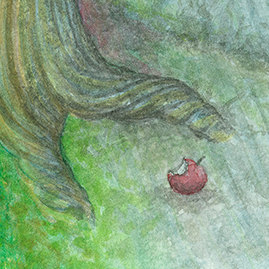
We’re all guilty. We’ve all lived Act Two of the Story of God, personally and corporately. We have all sinned and fallen short of God’s glory. We’ve all taken huge bites out of that apple.FallApple

“There is no one righteous, not even one;
there is no one who understands,
no one who seeks God.
All have turned away,
they have together become worthless;
there is no one who does good,
not even one.” ~Romans 3:10-12

So, how bad can it be? Well, immediately after committing that first sin, we see Adam and Eve avoiding God. They’re actually hiding from God. They’re afraid of their good and loving Creator. They make excuses. They blame each other. They blame God. Nobody confesses. They don’t admit anything. Because the relationships have been busted. The trust, the communion, is broken. And the consequences are dire. And immediate.

Because of the sin, there is now going to be constant struggle between the snake and the humans. Always strife. Always conflict. Always treachery and hate. Because of the sin, the man and woman are no longer equal partners. Their community has been wrecked. The woman now wants to control the man, the man now wants to dominate the woman. Always strife. Always conflict. No peace. Very little trust. And the ground isn’t friendly anymore. Nothing’s going to be easy anymore. The earth is now fighting back against the humans. No more cooperation. All of life is now a struggle to survive. And they won’t. They’re going to die. You sin, you die.

The worst part is that the people are thrown out of the garden. They are driven away from the presence of God.

“The Lord God banished them from the Garden of Eden… After he drove them out, he placed on the east side of the Garden of Eden cherubim and a flaming sword flashing back and forth to guard the way to the tree of life.” ~Genesis 3:23-24

The overwhelming result of sin is not the loss of the garden, it’s the loss of God. The humans are no longer in his face-to-face presence. That’s the tragedy. Throughout the whole rest of the Old Testament, you never hear the people dream of regaining the Garden of Eden. They don’t long for those comforts and luxuries. They talk about regaining access to God’s presence. They dream about and prophesy about and wonder about once again being allowed into the presence of God.

We have traded trust and obedience to a gracious and friendly God and the intimacy of living in his presence for chaotic misery and isolating independence. It’s a horrible transaction.

Peace,

Allan

« Older posts Newer posts »