“How long, O Lord, must I call for help, but you do not listen?
Or cry out to you, ‘Violence!’ but you do not save?
Why do you make me look at injustice?
Why do you tolerate wrong?
Destruction and violence are before me;
there is strife, and conflict abounds.
Therefore the law is paralyzed, and justice never prevails.
The wicked hem in the righteous, so that justice is perverted. “
~Habakkuk 1
Author: Allan (Page 204 of 500)
Ash Wednesday begins the period of Lent, the forty days followers of Jesus use to prepare their hearts and souls in anticipation of Easter Sunday. Ash Wednesday is typically a day of fasting and prayer, a day for renewing vows and making promises. Lent is generally a period of fasting and prayer, six weeks of focusing on purity and cleanliness. A putting away. A taking off. A solemn burial of the habits and issues that get between us and a complete commitment to our crucified and risen Lord.
I’ve suggested in the past that if Lent is for putting things away, then Easter is for taking up new activities in service of Christ. You shouldn’t rid your life of damaging attitudes and practices and not replace them with helpful habits and perspectives. If Lent is dying with Christ, Easter is certainly rising with Christ.
But, I’d like to revise my recommendation.
Don’t wait until Easter to start those new habits. Don’t wait until Resurrection Day to take up that new something that will draw you closer to our Lord.
Every day is a dying and rising with Christ. Every day is a taking off and putting on with Jesus. Living under his exclusive lordship requires that we die to ourselves and rise to walk with him every hour. It’s the rhythm of the Christian life. It begins with our baptisms — dying and rising with Christ — and continues as our habit, our daily routine. Clothe yourselves with Christ. Put off and take on. Be buried and rise again. Every morning and throughout your day.
In unity with all my brothers and sisters in Christ around the world, I’m fasting and praying today. I’ll attend the Ash Wednesday service down the street at Polk Street United Methodist Church this evening. And I’ll not wait until Easter to celebrate the resurrection of our Lord Jesus who gives us new life today, tomorrow, and for all eternity.
Peace,
Allan
We gut-laughed until we were both crying. We laughed so hard we were hoarse the rest of the night and into the next morning. Jerry Seinfeld went an hour-and-fifteen-minutes Thursday evening in Midland/Odessa breaking our common everyday lives down to the finest hilarious details as only he can. The only way it could have been any better is if he had gone longer. Bathroom stalls, marriage as a game show, texting abbreviations, Swanson Hungry Man TV dinners, bucket lists, the U.S. Postal Service, buffet restaurants — he’s a genius! We were dead center, 50-yard-line, on the twelfth row; they were the best seats in the house! What a wonderful Christmas present from my fabulous wife!
~~~~~~~~~~~~~~~~~~~~~~~~~~~~~~~
I was honored to speak at Oklahoma Christian University’s chapel yesterday, the most excruciatingly nervous 15-minutes of my year. I love public speaking — you know I do. I like speaking to small groups of a dozen or so in intimate settings, I like speaking in front of a couple thousand in a conference atmosphere, I enjoy speaking every Sunday at Central. I love speaking to little kids and older adults and people my own age. Speaking to a roomful of preachers, to the homeless people at Loaves and Fishes, to business professionals at a Rotary lunch, or to a ladies Bible class never gives me a problem. But talking to college aged young people in the middle of their school day is brutal. They let you know in no uncertain terms exactly how they’re receiving the message. They don’t hide anything. There’s no pretending.
It felt a little better this time than in previous years. I kept it much shorter than normal and I specifically mentioned some key buzz words that spoke to particular hot-button issues in society and tied my message as directly to those issues as possible. Valerie gave me some good advice. It looked like they were paying attention. 
I was blessed to get caught up with my sister Rhonda and her husband Geoff. I was privileged to eat dinner Sunday night at Ted’s (!) with our middle daughter Valerie, her friend Paige, and my nephew Asa. And then yesterday it was lunch at The Garage with Rhonda, Valerie, and Delta Gamma Sigma sponsor Chris Adair, who sent me home with OC and Delta gear for the whole family.
I appreciate Jeff McMillon’s kind words of encouragement and affirmation; if I were an OC recruiter, I’d make sure every high school senior spent an hour with Jeff. And I’m blown away by our Lord who thinks it’s a good idea for me to speak at OC chapel. His grace reaches even me!
Peace,
Allan
I have no idea why Jerry Seinfeld is playing in Midland, Texas tonight, but I do know Carrie-Anne and I will be on the floor of the Wagner-Noel Performing Arts Center in our seats in the middle of Row 12! It’s a Christmas present from my super-cool wife and I’m excited beyond description. I’d drive to Midland to watch Seinfeld read a phone book.
~~~~~~~~~~~~~~~~~~~~~~~~~~~~~~~~~~~~~~~~~
Once a month our covenant group gets up early and serves breakfast to the folks staying at the League House. We hang out for a couple of hours and pray with people from out of town who have relatives in the hospitals here. A couple of weeks ago we met a guy named Jeff (not his real name) who’s from the Austin area. He and his wife and three kids had come up to be with Jeff’s brother who was in serious condition after suffering a terrible brain aneurysm. As we’re talking with Jeff and hearing his story, he mentions that his wife is from Vietnam. Then, later in the conversation, Aleisha asked him, “How did you meet your wife?” And he told us a fascinating story.
The company he works for in Austin is headquartered in the D.C./Virginia area and they regularly send a woman from there to train the employees in Austin. This woman’s originally from Vietnam. So Jeff and this woman get to know each other in a friendly, working relationship kind of way. And one day she calls Jeff from Virginia, from completely out of the blue, and says her family is looking for someone to marry her sister so she can come to the states.
“What?”
“Yeah, my sister can come to the U.S. if she has an American husband. So, if you know anybody who might be interested in helping us out…”
“I don’t know anybody who’d actually want to get married.”
“No, they don’t have to stay married. Only for a year or two. Then they can get divorced and she can stay in the U.S.”
“No, sorry, I don’t know anybody.”
“We’d pay him money.”
(short pause)
“Um… How much money?”
“We’d pay him $30,000.”
“Well, I think I might could get interested in that!”
So, Jeff agrees to do it. He’ll marry this lady from Vietnam, pocket the $30K, and they’ll split up later.
Now, here’s the catch. Jeff had to take three or four trips to Vietnam to sell everybody over there that it was legit. The family paid for the trips, but Jeff had to go to Vietnam to spend time with her. They had to go on dates together, eat dinner together, spend time with her family. They had to take a lot of pictures together and post them on social media. And the most important thing: when he’s in Austin, he had to write her letters. He had to call her and facetime her and send her gifts. He had to act like he was in love with her. He had to do things a guy in love would do.
And in the middle of all that, Jeff fell in love with her. For real.
He never would have thought himself into loving this young lady. He never could have studied himself into loving her. But he acted himself into it and he didn’t even know it was happening. He was forced by the circumstances into some habits that actually changed his feelings and his thinking. Doing what people in love do shaped him into a guy in love. They were married 14-years ago, they have three children, and he never took the $30,000.
Why do we go to church? We go to church because it makes us more like Jesus. Church is one of the main habits, one of the critical spiritual practices that shapes us into the people of God. 
It’s hard to think yourself into loving others. It’s difficult to study yourself into considering the needs of others more important than your own. Being together around Word and Table puts us in the circumstances and into the habits that will, by God’s grace and the power of his Holy Spirit, actually change our feelings and thinking. Doing what Jesus does shapes us into the image of Jesus.
So many of us grew up going to church. It’s a habit of our lives that started before we can remember and possibly one that we sometimes see as very ordinary. Maybe even humdrum and boring. We can do church with our eyes closed, and sometimes do.
But what if we understood our church gatherings as sacramental encounters with our Lord? What if we believed God’s Spirit was powerfully at work during our songs and prayers, during the Scriptures and the meals, to transform us into the image of Christ? What if we allowed ourselves to be swept up into the habits of the church as formation practices through which our Lord meets us and moves us into better fitness for eternal life? What if we were filled with awe at the possibilities in front of us? What if we were filled with awe in the face of a vision of how we can be and how the world will be in the future? And what if that awe increases as the power of God’s Spirit heals us and transforms our lives?
Peace,
Allan
The Bible does care about what we can and cannot do in church. The guy who wrote half the New Testament did lay down a few rules about our worship assemblies. I’ll suggest those rules are about attitude and heart, not about methods and forms.
The apostle Paul knows that what we do when we’re together shapes us. Our habits in our worship gatherings are molding us into a particular kind of people. So, Paul’s main concern is that our worship assemblies reflect the Gospel. Our Christian assemblies have to reflect the character of Christ. When he writes to churches, he expresses his deep desire that Christ be formed in them. He asks them to imitate Christ Jesus who, in his own words, said he came not to be served, but to serve and to give his life for others. Paul says being united with Christ, having the same attitude as that of Jesus, means considering others better than yourselves, looking to the needs of others.
So, yeah, he spills a lot of ink in 1 Corinthians to fix what they’re doing wrong.
“I have no praise for you, for your meetings do more harm than good.” ~1 Corinthians 11:17
That’s harsh. Brutal. Can you imagine? Your church is so bad, your people would be better off if they slept in!
Paul goes on to explain that the church is divided. They’ve got little cliques and groups among them and he sees it when they’re around the table.
“When you come together, it’s not the Lord’s Supper you eat; you’re eating your own supper! You’re not waiting for others, you’re not sharing your food with others. People are going hungry, people are being humiliated. The rich folks are getting stuffed and drunk while the poor people are starving and being singled out as not fitting in. What am I supposed to say to you? Nothing good!”
Then he reminds them that when we eat and drink together, we’re proclaiming and practicing all the salvation things that Jesus died for. Our meal proclaims everything that was accomplished at the cross: acceptance, fellowship, unity, love, forgiveness, peace. Jesus is alive and he’s coming back. And until he comes, Paul says, we proclaim his salvation in our church meals. So, then, my brothers and sisters, when you come together to eat, wait for each other. Consider the needs of others. Treat each other as equals.
That’s Paul’s constant instruction when it comes to doing church: consider others. Pay attention to others. Put yourself last.
These Corinthians Christians were showing off their spiritual gifts. They were clamoring for the spotlight in their assemblies and judging others according to giftedness. In 1 Corinthians 12, Paul says the gifts of the Spirit are given for the common good. They’re supposed to benefit everybody, not just you. In fact, in chapter 14, he says since you’re so eager to have spiritual gifts, try to excel in gifts that build up the church!
What does Paul say about speaking in tongues? Well, sometimes there’s no interpreter, nobody knows what you’re saying, and it’s not doing anybody any good but yourself. And sometimes y’all are talking over each other, trying to upstage each other and it’s a mess. You’re not thinking about others. So, brothers and sisters, stop thinking like children! Take turns. Speak one at a time. And if you don’t have an interpreter, sigato (Greek). Don’t speak until it’s appropriate.
Same thing with prophesy. Take turns, just speak one at a time. Why? What’s the point? So that everyone may be instructed and encouraged. And if you’re speaking and someone else has something to add, the one speaking should sigato. Stop speaking until it’s your turn again.
Same thing with women. Some women were apparently disrupting the gatherings. They, too, were speaking out of turn. So Paul uses the same word, sigato. Be quiet until it’s appropriate to speak. Put yourself last. Consider others more important than yourself.
There’s a big picture principle at work here. 
Paul didn’t say stop eating or do away with the meals, he said WHEN you eat be nice to others, treat everyone as equals. He didn’t say stop speaking in tongues, he said WHEN you speak in tongues be considerate of others. He didn’t say stop prophesying, he said WHEN you prophesy take turns, be polite. He didn’t tell women to stop praying and prophesying, Paul didn’t say they couldn’t. He said WHEN you pray and prophesy, women, do it like this. Don’t offend people. Don’t elevate yourself.
We worry about our Sunday mornings. We’re anxious to do everything just right. Instead of worrying about whether a worship practice is prescribed or legal, we should be asking if what we do fosters community and equips us for mission. Applying the Gospel to our assemblies is much more important than trying to do it right.
Do we value all people? Do we treat everyone the same? Do we make sure everyone belongs? Are we serving and loving others during our time together? Are all voices heard? Is everybody sharing? Is everybody made to feel welcome? Does everybody get a say? These are the questions we ought to be asking about our worship assemblies.
None of the New Testament gives us a set of legally specified timeless rules for conducting a Christian worship assembly. The New Testament gives us Jesus and the Gospel embodied by a community gathered by the Holy Spirit around word and table.
Peace,
Allan
“They devoted themselves to the apostles’ teaching and to the fellowship, to the breaking of bread and to prayer.” ~Acts 2:42
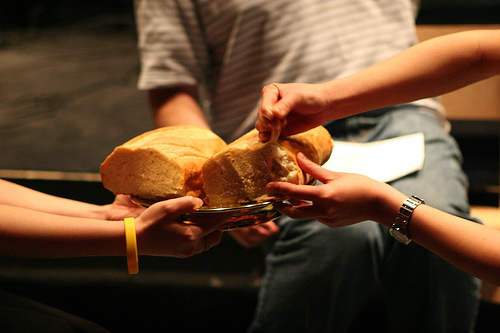
The Greek word koinonea means fellowship. Communion. Sharing. Having things in common. Luke describes it in the above verse as eating together and praying together. That’s what makes a Christian assembly, those are the worship habits: Teaching and Fellowship. Scripture and Communion. Word and Table. That’s the time and place where everybody ministers together, everybody participates, everybody’s heard, everybody shares. God meets us, Jesus is present with us, and the Holy Spirit shapes us in our regular gatherings around Word and Table.
That two-thousand-year-old pattern, I believe, is based on the habits of Jesus during his ministry.
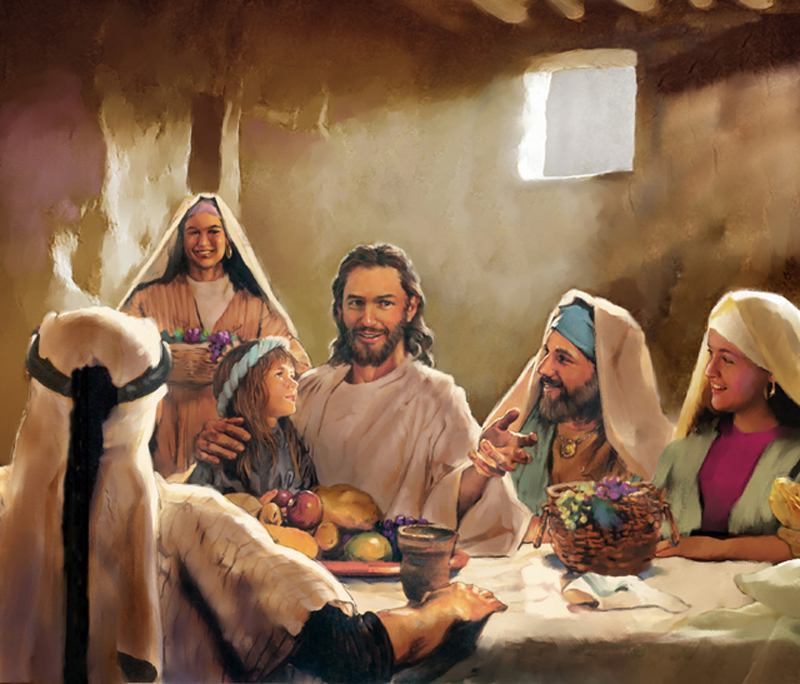
When Jesus taught, he generally did it in the context of a meal. He opened up the Scriptures and ministered to others around a common table. The Word is proclaimed and then the reality of the Word is practiced and experienced around the meal.

In Luke 14, Jesus is eating a Sabbath meal at the home of a prominent Pharisee and, as we would expect, he starts teaching: “When you give a luncheon or dinner, do not invite your friends, your brothers or relatives, or your rich neighbors; if you do, they may invite you back and so you will be repaid. But when you give a banquet, invite the poor, the crippled, the lame, the blind, and you will be blessed. Although they cannot repay you, you will be repaid at the resurrection of the righteous.”
At the banquet at Levi’s house, Jesus gives us the Word: “I have come to call not the righteous, but sinners to repentance.” And he’s sitting around a table with tax collectors and prostitutes. The Table is the tangible experience of the Word.
With five-thousand hungry people in the wilderness, Jesus tells his apostles, “You give them something to eat. You engage the mission. You participate in serving others.” And then he empowers them to do just that. Then they all ate together, as much as they wanted.
At Zacchaeus’ house, the Word, the teaching: “The Son of Man came to seek and save the lost!” And around the meal, the hospitality and community of the Table: “Salvation has come to this house! This man is a son of Abraham!”
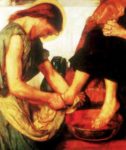
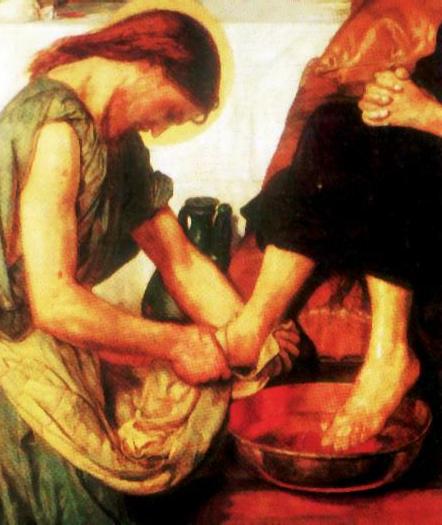
In John 13, on that last night before he was crucified, Jesus shared a meal with his disciples. And some teaching. The evening meal was being served, the Bible says, and Jesus got up and washed everyone’s feet. A tremendous act of humble service. Jesus made himself the least important person in the room in order to serve others.
“Do you understand what I have done for you? You call me ‘Teacher’ and ‘Lord,’ and rightly so for that is what I am. Now that I, your Lord and Teacher, have washed your feet, you also should wash one another’s feet. I have set you an example that you should do as I have done for you.”
Our habits together around Word and Table shape how we think and act. It shapes us into a people who think and act like our Lord. Jesus gets up from the table during the meal to say to each of his followers to say, “I am your servant.” And he tells us to do the same for each other.
Some of us view our worship gatherings as a legal duty and everything has to be done exactly right. Some of us see our worship assemblies as an experience; it’s all about how it makes me feel, so there aren’t really any rules to follow. Some of us have grown up with no real understanding about community worship, so we don’t really think about it at all.
Our worship assemblies are the time and place where our living God meets us, where we all meet in the presence of God together. We are gathered by God’s Spirit around the Word. The Word of God reminds us who God is and what he’s doing and who we are and to whom we belong. The Word has to the power to teach us, train us, and transform us to continue the Kingdom work Jesus has already begun. The Word reorients us away from the shadows of this world’s fading kingdoms and toward the eternal realities of the Kingdom that has come and is coming.
And we experience those realities around the Table. The Holy Spirit brings us together around a meal where we actually experience God’s mercy, acceptance, wholeness, equality, compassion, and peace.
But we can get so wrapped up and bogged down in the details of our worship practices and the finer points of our traditions and our methods, that we don’t give much thought at all to the main point of our assemblies. We worry about how we do church and what we can and cannot do in church, forgetting this a Holy Spirit endeavor. All of this takes place in and by the Spirit.

We worship God in Spirit. It’s the Holy Spirit who mediates God’s grace and the presence of Christ to us around Word and Table. God gathers us together. God initiates and enables our praise. God eats with us, the Holy Spirit prays with us and for us with groans we can never comprehend, Jesus intercedes for us. God gives us the words to say in our worship. God speaks to us through his Word and then places that Word into each heart in exactly the way he wants it to go. We are brought together in the presence of God and he’s the One doing everything!
We should relax about our rules and stop worrying about our methods and submit to what God’s Spirit wants to do. Instead of fretting about how we do church or how somebody else does church, we should pay more attention to how God does church.
Peace,
Allan



Recent Comments