Category: Incarnation (Page 10 of 10)

Prayer, Momentum, & Once More on the Incarnation

“Seek the Lord while he may be found; call on him while he is near. Let the wicked forsake his way and the evil man his thoughts. Let him turn to the Lord and he will have mercy on him, and to our God for he will freely pardon.” ~Isaiah 55:6-7.

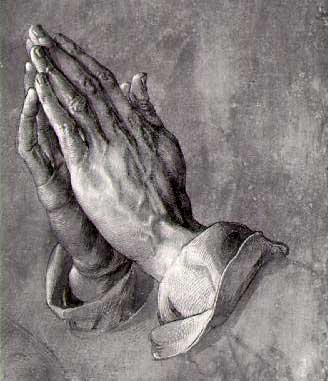
PrayerThe disciples asked Jesus in Luke 11 to teach them how to pray. They want to be like him in every way. So they want to pray just like him, too. They want to identify with their rabbi and to be identified with their rabbi by praying like him. So Jesus gives them the basics as far as the words go and then he tells them a story so they don’t lose the big picture.

The parable of the persistent friend. It’s midnight, the guy’s in bed, his whole family’s asleep. He doesn’t want to get up and get his friend the bread he needs to feed his surprise guest. In fact, he tells the neighbor at the door it’s not going to happen.

“Hey, it’s late! We’re all in bed! The kids are going to school in the morning! I’ve got an early meeting at work! Buzz off!”

In Jesus’ story, the man does get up and give his neighbor the bread he desperately needs. But not because he wants to. He does it, Jesus says, because of the friend’s boldness or persistence. And I’ve heard this story traditionally interpreted like this: keep praying. Even if God says ‘no,’ keep praying. He’ll give in eventually if you keep praying. Keep bugging him. He’ll change his mind. He doesn’t want to give you this thing you’re asking, but he will if you just keep knocking.

For that to make sense, God has to be the guy in the bed. For that interpretation to hang with the story, the guy in bed is God. The guy in bed. The guy who’s already turned out all the lights. The guy who’s locked his door. The guy who’s only thinking of himself. The selfish guy who doesn’t want to get up from under the covers and give his neighbor what he needs. That guy represents God?

No way.

If Jesus had put God in this story, all the lights would be on in the house. All the doors and windows would be wide open. There would be huge search lights criss-crossing the sky and giant neon billboards with flashing arrows pointing to the house saying, “Get your bread right here! Get as much bread as you want right here! And it’s free!” You couldn’t even get to the door to knock because the man would be out in the street looking for you and running to meet you and give you the bread before you could even ask.

The guy in the bed is not God. The guy in the bed is the opposite of God. And there’s the point. There’s the teaching of Jesus. He’s drawing a stark contrast. He’s not making a comparison. Jesus says here’s a man who will eventually get out of bed and give bread to his neighbor, if not because they’re friends, then certainly out of a sense of duty or honor or hospitality. You fathers, if your child asks you for something he really needs, you’re not going to give him something that would hurt him. So if this reluctant sleepy guy and you imperfect human dads know how to provide good gifts, why would you ever assume that God doesn’t? Our God is definitely more kind and generous and loving and giving than any man, regardless of how decent or good that man may be.

Jesus’ point in telling the story in Luke 11 is that our God is never reluctant to help. We ask God knowing he’ll honor our requests. We seek God knowing we’ll find him. We knock on God’s door knowing he’ll give us what we need.

“This is the confidence we have in approaching God: that if we ask anything according to his will, he hears us. And if we know that he hears us — whatever we ask — we know that we have what we asked of him.” ~1 John 5:14-15

~~~~~~~~~~~~~~~~~~~~~~~~~~~~~~~~~~~~~~~~~~~~~~~~~~~~~~~~~~~~~~~~~~~~~~~~~~~~~~~~~~~~~~

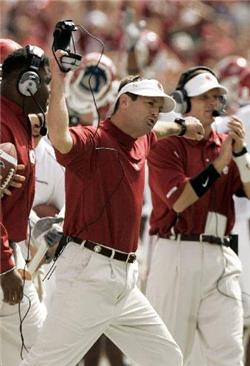
FootballWith 6:23 to play in the third quarter of last night’s Fiesta Bowl, Oklahoma scored a touchdown to pull to within five points of West Virginia. By this point the Mountaineers had proven clearly that they were the faster, more athletic, more explosive team. And by kicking an extra point, the Sooners would only be down by four with some real positive momentum. Maybe even some potentially game-changing momentum.

But Bob Stoops decided to go for two. The pass was incomplete. And OU trailed by five. Not only that, but instead of feeling good about a success, the team felt bad about a failure. Instead of West Virginia feeling negatively about their failure in giving up a touchdown on a long drive, they felt positively about their success in stopping the two-point play.

Momentum is huge. The psychology of what happens in the course of a football game and how it all shifts back and forth at a moment’s notice is generally tied to turnovers and failed two-point conversions.

And then, to defy logic even further, Stoops calls for an onside kick. Halfway through the third quarter. West Virginia recovers at the OU 39 yard line and goes on to score three of the game’s next four touchdowns to salt it away.

It was like Stoops thought he was playing OSU or something.

If I were the owner or GM or AD of a football team, I would put it in my coach’s contract that he could never, ever, go for two before the start of the fourth quarter. Period. No exceptions. I don’t care how far we’re down or how lousy our kicker. Going for two, going against the percentages, unnecessarily risking that precious momentum, it doesn’t add up. It’s never worth it.

Someday we’ll discuss “the chart.”

~~~~~~~~~~~~~~~~~~~~~~~~~~~~~~~~~~~~~~~~~~~~~~~~~~~~~~~~~~~~~~~~~~~~~~~~~~~~~~~~~~~~~~

IncarnationFinally, my good friend Todd Lewis, down in Marble Falls, sent me a Christmas article he wrote last month exploring the ways the Christmas season produces cheer even in the midst of war, disease, and crime. His words go right to the heart of what we preached here at Legacy for the past three weeks, how we see ourselves in the infant Jesus — God’s intentions in creating us, our own potential, our high calling. Click here, Observations on Christmas Cheer, to read Todd’s excellent article.

Peace,

Allan

Us With God

For the past couple of weeks here at Legacy we’ve taken a close look at the birth of Jesus in an effort to see God’s Incarnation, not as a complex and confusing theological abstraction but, as a way of looking at life and living life that changes our whole worldview. We’ve seen in all of the contrasts between human and divine at the stable scenes that the birth of Jesus shows us the low condition and the high potential of God’s creation. We’ve noticed in the genealogies that our God jumps right into the middle of our sin and grief to save us. By looking at all the different kinds of people in the birth stories we’ve concluded that the saving gospel of Jesus is for all. And in the vulnerable infant Jesus we’ve seen our own neediness and utter dependence on our Father God.

We’ve seen what God is doing by becoming human and living with us here on earth.

And this coming Sunday we’re wrapping up this short three-part series by identifying ways to live into the story, finding ways to jump in and join what God is doing in the Incarnation, how to embody this and live this out in our individual lives and as a church family.

Emmanuel is God with us, not God instead of us. And God with us means us with God.

In 1 Thessalonians 3, the apostle Paul uses a phrase that presents a striking way of viewing our partnership with our God. He refers to Timothy as “God’s fellow worker.” The idea of God and Timothy being co-laborers or co-workers with each other in the Kingdom—equals, if you will, in service—is such a scandalous thought that several later manuscripts of Paul’s letter change the wording to identify Timothy as Paul’s fellow worker or as God’s servant. But the earliest Greek manuscripts of the passage are crystal clear: Timothy is God’s fellow worker. It’s the same designation Paul uses in 1 Corinthians 3:9 when he describes Cephas, Apollos, and himself as “God’s fellow workers.”

That language should fill us with a tremendous sense of confidence and calling.

As God’s children we are in a partnership with him. God is a God of reconciliation. God’s work in the Christ is a work of reconciliation. And as God’s fellow workers, that’s our work, too!

Doing the work of Jesus, with Jesus, is the greatest part of being transformed into his image. We reflect his glory and are being transformed into his likeness with ever-increasing glory, because of the ministry we’ve been given. Living like Jesus is not something we do to get salvation. It is our salvation! We are “being saved.” It’s a process—one that clearly sees the destination, but never at the expense of the journey. Jesus preached all the time about the Kingdom of Heaven. But all his teachings had to do with living right here, right now, with people on this earth, not in the afterlife.

Our calling as God’s children is to behave as a people who realize God made us to be his partners. Fellow workers. Co-reconcilers in the world.

Peace,

Allan

Little Replicas of Himself

Screwtape“One must face the fact that all the talk about His love for men, and His service being perfect freedom, is not (as one would gladly believe) mere propaganda, but an appalling truth. He really does want to fill the universe with a lot of loathsome little replicas of Himself—creatures whose life, on its miniature scale, will be qualitatively like His own, not because He has absorbed them but because their wills freely conform to His.”  ~Screwtape

It’s easy to sense the senior tempter’s frustration in C. S. Lewis’ masterpiece. Screwtape and the other devils in Hell can’t comprehend why in the world God would expend so much energy on loving and caring for all these dispicable humans. Instead of using people and exploiting people and sucking them dry of all energy and life, God nurtures them and provides for them and longs for actual relationship with them. We are God’s children and he wants us to be just like him. But he wants us to make those decisions on our own. He doesn’t “override a human will.” As Screwtape observes about God, “He cannot ravish. He can only woo. For his ignoble idea is to eat the cake and have it; the creatures are to be one with him, but yet themselves; merely to cancel them, or assimilate them, will not serve.” And the devils don’t get it.

In working to conform our wills to our Father’s and in striving to be like him, his perfect son, Jesus, is our example. When we look at Jesus in the flesh, incarnate God, we see what God created when he created us. Or at least we see God’s intent. And we see our own high potential, our high calling.

As a baby in the manger in Bethlehem, Jesus is completely helpless, vulnerable, needy, dependent. A newborn baby is the absolute picture of total dependence. And as all the political and religious and military powers in Judea scheme to murder this innocent child, Jesus, as a baby, is completely dependent on his Father to protect him. What chance does Jesus have against the ruthless King Herod and the chief priests? His young peasant mother and his impoverished and unproven dad from the insignificant town of Nazareth are way overmatched. But we see clearly that the Father provides and protects. He thwarts the enemy’s plans. He rescues his child. He carries the child and his parents to a safe place and then destroys the enemies.

Our calling is to be just as dependent on our Father as Jesus was. The life of the Christ is a beautiful portrait of complete surrender to God, from the manger in Bethlehem and the temple courts in Jerusalem to the garden in Gethsemane and the cross at Golgotha. Total surrender. Complete dependence. Confidence that God will deliver. He will save.

“…we, who with unveiled faces all reflect the Lord’s glory, are being transformed into his likeness with ever-increasing glory, which comes from the Lord.”  ~2 Corinthians 3:18

~~~~~~~~~~~~~~~~~~~~~~~~~~~~~~~~~~~~~~~~~~~~~~~~~~~~~~~~~~~~~~~~~~~~~~~~~~~~~

Excellent column by Gene Wojciechowski today asking the same questions I asked last night regarding Roger Clemens telling us he’ll address the steroid and HGH allegations in baseball’s Mitchell Report in “an appropriate way at the appropriate time.” What time could be more appropriate than right now? What way could be more appropriate than a common news conference? Click here to read the column.

Peace,

Allan

Salvation + Creation = Incarnation

I think as children of God we’re usually more concerned with the destination than with the journey. “Heaven holds all to me.” So much so I’m afraid that a lot of the time we separate salvation from creation. Being saved, to a lot of us, means being rescued out of this world. To many Christians, the world and whatever is of the world or in the world is worthless and useless. We don’t care about the world. We’re being delivered from the world.

But the Incarnation drastically alters that viewpoint.

The birth of Jesus, instead of separating salvation and creation, connects salvation and creation. It joins the realities of heaven with the ordinariness of life on earth. It brings together the human and the divine. By becoming one of us, God reaffirms the original goodness and purpose of creation. Our human condition, even with all its flaws and shortcomings, even with all our weaknesses, this world and everything in it is not so sad and worthless that God himself is above becoming flesh. In fact, it’s Jesus taking on our everyday human condition that is the means for our salvation! God reclaims us as his own by becoming one of us.

God created the world and all the people in it. And that world and that people—all of creation—have been groaning, Paul says in Romans 8, as in the pains of childbirth to become what we were truly created to be. We were created to be truly divine children of God, just like Jesus. We look at Jesus, God in flesh, and we see what the Father created when he created us. Or at least we see his intent. We see our potential, our calling.

John writes in the opening lines of his Gospel that when we receive Jesus, when we believe in the name of the Christ, God gives us the right, he gives us the power, he gives the authority to become children of God, “children born not of natural descent, nor of human decision or a husband’s will, but born of God.” Just like Jesus.

Yes, Jesus preached about the Kingdom of Heaven. But all his teachings had to do with how to live here on this earth. How to get along as a child of God here in this world. Here in the middle of God’s creation.

Seeing Jesus as a human helps us understand why God made us. And it empowers us to reclaim that purpose for our own lives. It enables us to live our lives fully here on earth, with each other, in all of our mundane ordinariness, as children of God. Just as he intended from Day One. To live like him.

~~~~~~~~~~~~~~~~~~~~~~~~~~~~~~~~~~~~~~~~~~~~~~~~~~~~~~~~~~~~~~~~~~~~~~~~~~~~~~~~~~~~~~

Whitney experienced her first ever live Mavericks game at the AAC last night, compliments of our good friend and Small Groups Co-Leader, David Glover. (The Mavericks were able to pull out a nail-biter over Orlando, despite the fact that David’s been to two Cowboys games this year: Patriots and Eagles.)

Whit,Garrett,MavsManI love experiencing things through my girls. I’ve attended a couple of hundred Mavericks games through the years—pre-season, regular season, and playoffs. But I saw things from an entirely different perspective last night. Whitney was genuinely thrilled by the things I’ve always taken for granted. The player introductions, the drum line, the T-shirt cannons, Mavs Man, Champ (that thing still looks like a Dragon Tales character, not a horse), chanting “De-Fense” and “Let’s Go, Mavs!” (didn’t they rip that off from the Spurs?), souvenir cups, thundering dunks, a three-on-one break, player interaction on the bench, the guys who continually distribute and clean up all the towels and water bottles, even P. A. announcer Billy Hayes and sideline shill Chris Arnold. Everything that is the spectacle of a Mavericks game. She was completely involved from before the opening tip to well after the final buzzer. She was trying to distract Orlando free throw shooters from our seats, which were not anywhere close to behind the backboard. She yelled throughout the fourth quarter for the Mavericks to “get it to Dirk!” She never sat still. She never stopped screaming. She never stopped laughing. I’m sure right now, even as she’s probably in the middle of some math or social studies class at school, she hasn’t stopped smiling.

And usually I would just sit there.

I saw it differently last night. It was a different game for me last night because I was sitting by Whitney.

And our Savior says unless we become like little children we can’t enter the Kingdom.

May our God grant us the vision, the humility, and the grace to be wowed by his creation and by his goodness and by his blessings. May we pay attention to all that is around us and recognize every bit of it as a wonderful blessing from our Father. And may others experience their daily lives differently as a result of watching us experience ours.

~~~~~~~~~~~~~~~~~~~~~~~~~~~~~~~~~~~~~~~~~~~~~~~~~~~~~~~~~~~~~~~~~~~~~~~~~~~~~~~~~~~~~~

In 2004, Cowboys safety Roy Williams tackled Titans receiver Tyrone Calico from behind by grabbing the back of his shoulder pads and yanking him to the ground. As a result, Calico suffered torn cartilage in his left knee and a sprained ACL in his right knee. That same season Williams took out two Baltimore running backs with the same style of tackle. Jamal Lewis suffered a sprained ankle and Musa Smith a compound fracture of his right tibia. That same season Williams broke the right fibula of then-Eagles receiver Terrell Owens with the same horsecollar tackle. In May 2005, the NFL made that kind of tackle illegal. It was called the Roy Williams Rule.

RoyWilliamsRuleGoing into this past Sunday’s game against the Eagles, Williams had been fined $27,500 by the NFL this year for making two illegal horsecollar tackles. The NFL sent Williams a letter two weeks ago telling him he would be suspended if he did it again. And he did. His tackle on Donovan McNabb is the very reason that style of takedown was outlawed. He was flagged at the time. And last night the league suspended him for one game. Williams can’t practice with the team and he can’t play in what is now a critical game Saturday night in Charlotte. It’ll cost him at least $35,000 in salary. It’ll cost the Cowboys one of their best run-stoppers against a Panthers attack that is running all over opponents.

I saw a quote from Wade Phillips this morning claiming that in Sunday’s situation with McNabb, and in all the others this season, grabbing the back of the shoulder pads is the only way Williams can make the tackle.

Isn’t it because Williams is always running behind the ball carrier? None of this would be an issue if he could just get in the proper position.

~~~~~~~~~~~~~~~~~~~~~~~~~~~~~~~~~~~~~~~~~~~~~~~~~~~~~~~~~~~~~~~~~~~~~~~~~~~~~~~~~~~~~~

Are Eagles Defensive Coordinator Jim Johnson and Austin Grad Professor Michael Weed the same person?

 JimJohnson MichaelWeed

Peace,

Allan

A Doctrine of Participation

Incarnation

I’m beginning a three-week sermon series this Sunday on the Incarnation, that wonderful, mysterious miracle of our God becoming flesh and dwelling among us. Fully human and fully divine. God embracing our humanity, submitting to his creation, joining the world in order to save it. Unfathomable. I’ve prayed over and poured through all of the Scriptures. I’ve highlighted all my commentaries. I’ve re-read Unveiling Glory. I’m making a feeble attempt at trying to preach this in terms of 1) God coming into our sinful situation, our messy world, just the way it is, to save all of mankind; 2) God as a human baby showing us our own weakness and dependence and teaching us how to surrender; and 3) God’s call to join him in his salvation work, to imitate him as he partners with his creation to redeem it back to himself.

 I think I could preach for three or four hours on each topic (but I won’t, I can’t) and still just barely scratch the surface of the depth of the theological realities behind the Incarnation. It’s so rich and meaningful. So full of life-affirming truth.

I like this from Kallistos Ware:

“The Incarnation is a doctrine of sharing and participation. Christ shares to the full in what we are, and so he makes it possible for us to share in what he is, in his divine life and glory. He became what we are, so as to make us what he is. Christ enables us to share in the Father’s divine glory. He is the bond and meeting point: because he is a man, he is one with us; because he is God, he is one with the Father. So through and in him we are one with God, and the Father’s glory becomes our glory…the divine likeness that we are called to attain is the likeness of Christ.”

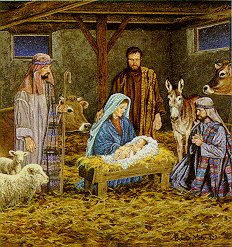
What we see in the watering trough in the stable in Bethlehem is the coming together of heaven and earth. Creator and creation. Holiness and sinfulness. Angels with their beautiful voices and shepherds with their bleating sheep. The aromas of incense and myrh mixing with the stench of livestock and hay. It all converges in that stable. God and man as one.

How am I supposed to tackle all that?

Peace,

Allan

Newer posts »