Category: Genesis (Page 6 of 7)

God Prepares the Course

“You intended to harm me, but God intended it for good to accomplish what is now being done, the saving of many lives.” ~Genesis 50:20

We can’t always see where our course is leading. As we’re running the race, we’re not always certain of what’s around the corner. We don’t always know. Only one sees the course perfectly: the loving ONE who marks it out for us.

Joseph is told at the very beginning of his race in Genesis 37 that he would provide for his brothers and family. He had no way at all to anticipate how that would come about in such a massive way. Yet God knew all along that he was going to use Joseph to feed his family and provide for the welfare of the world. It just took a while. It took a long while. It took thirteen years of slavery and prison before God eventually placed Joseph where he knew he’d be all along. God intended it for good. We just don’t always see it.

What I want you to know is that it doesn’t matter where you are in your race right now. If you’re at the top of the highest peak or at the bottom of the lowest valley; if all your dreams have come true or if your life feels like a never-ending nightmare, there will always be ups and downs. Some lives are more up than down, true, and vice-versa. But there will definitely be highs and lows in your race. The truth is that regardless of your present circumstance, God’s sovereignty — his love, his mercy, his justice, his faithfulness, his loyalty, his goodness — always wins!

Evil will not triumph. Blessing will always prevail. Obstacles will all eventually melt away. Joseph’s story shows us God’s complete control of our races.

In Joseph and the Amazing Technicolor Dream Coat the narrarator encourages Joseph while he’s in prison. He tells Joseph not to despair. Don’t give up. “I’ve read the book,” he says, “and you come out on top!”

Now, we don’t have that benefit. Our books aren’t finished yet. The chapters of our lives are written as we live them out every day. And we don’t know exactly what our endings are going to look like. But the call from our God is to run the race with endurance and faithfulness. Wherever we are. Whatever our circumstances. Keep in mind, our race is much more than just the end result. The journey, the process, is just as important.

Joseph’s complete faithfulness while he was a slave, while he was in prison, was every bit as valuable to God as the ultimate deliverance he brought to his family. Faithfulness is faithfulness. It’s huge!

Our response to the God who marks the course and runs the race with us is not a raised hand in a moment of prayer in the worship center. It’s not an emotional walk down the aisle during the singing of Trust and Obey. It’s not the amount on your Sunday morning check or the Bible passage you read Tuesday. The only appropriate response to God’s total sovereignty and loving faithfulness is complete submission. Total commitment.

“We have all had human fathers who disciplined us and we respected them for it. How much more should we submit to our Father and live! Our fathers disciplined us for a little while as they thought best; but God disciplines us for our own good that we may share in his holiness.” ~Hebrews 12:9-10

Peace,

Allan

Concerning the Women: Part Two

Acknowledging together that we in the Churches of Christ must do something different if we’re going to remain a viable witness to the Christian faith in our rapidly changing world, we’re spending our time here reviewing and reflecting on Leroy Garrett’s “What Must the Church of Christ Do to Be Saved?”

To paraphrase Garrett, what must we do to escape extinction in the decades ahead, to avoid being regarded as an insignificant Texas-Tennessee sect? What must we do to be loyal to the Scriptures and true to our Stone-Campbell heritage of unity? What’s it going to take for us to, as a movement, advance toward being “truly ecumenical, truly catholic, truly holy, and truly apostolic?”

In the 18th chapter, Garrett returns to the subject of women he addressed in chapter nine:

Bring women into the church.

Although Garrett gets much more into the “women’s role” passages in Corinthians and Timothy here than he did in the previous chapter, his focus in this essay is on Paul’s universal statement (creed?) in Galatians 3:28: “There is neither Jew nor Greek, slave nor free, male nor female, for you are all one in Christ Jesus.”

If that passage means anything it means that gender is not to be made a test of fellowship or ministry, such as, “She can’t do that because she is a woman.” Paul himself may have sometimes fallen short of that ideal of perfect equality, due to the pressures of custom, as in the case of slavery, which he tolerated, and which is forbidden in that same passage, “There is neither slave nor free.” If socio-economic conditions had been different, Paul might not have said what he did about women and slaves, tolerating their unequal treatment.

To put it another way, Paul almost certainly would not say to the 21st century church what he said to the first century church about women and slaves. But still he laid down the principle that applies to all generations because it so reflects the mind of Christ: In the Church of Christ there is to be no distinction between slaves and freedmen, Jews and Gentiles, men and women! We have to recognize that this was the ideal that even he was not always able to effect due to the conditions beyond his control.

Despite Paul’s clear directive here and his similar admonition in Colossians 3:11, the Christian church in America used the Bible for decades to justify slavery. Wherever slavery is mentioned in Scripture as the current conditions in society at the time of the writing, those passages were used by Christians to say, “Well, God didn’t condemn it in that Scripture; it must be OK. Or at least, it’s just the way things are.”

Today the practice of slavery is officially, socially, morally, and publicly condemned in every corner of the United States. Our churches now preach against slavery, loudly abhor the idea of slavery, and lament the behavior of our forefathers who justified it. What changed? Scripture certainly has not changed. Our God has not changed. The evil of slavery has not changed. What’s changed is our society. That’s what’s different now. For an American church today to actually uphold the idea of slavery and teach and practice in favor of slavery is unthinkable. That church would not do very well at evangelizing. That church wouldn’t grow. That church today wouldn’t have much credibility when it came to proclaiming the good news of salvation in Christ Jesus. Who would listen to a church like that?

Regardless of the ways you might interpret 1 Corinthians 11 and 14 or 1 Timothy 2, we all agree that the social conditions that existed then in first century Corinth and Ephesus do not exist today in 21st century America. It’s vastly different. It is certainly not a shame for a woman to speak in public. It’s not a disgrace for a woman to teach in a room full of men. It happens all the time. Women are just as educated as men, just as capable as men, just as qualified as men. Nobody blinks when a woman is named president of a major university or CEO of a global corporation. Your professor or your police officer or your accountant or your doctor is just as likely to be a woman as a man. The cultural conditions to which Paul wrote in Corinth and Ephesus do not exist in America today. It’s different. It’s changed. For an American church today to actually uphold the idea of man’s superiority and teach and practice in favor of denying women leadership and teaching roles is unthinkable. That church would not do very well at evangelizing. That church wouldn’t grow. That church today wouldn’t have much credibility when it came to proclaiming the good news of salvation in Christ Jesus. Who would listen to a church like that?

OK, is that a little strong? Maybe. I hesitated to write it that way, but I think I need to in an effort to at least present the possibility that the two issues are the same in Paul’s eyes. Afterall, in speaking to the Galatians he uses both examples in the same breath.

Garret points out that we are very good at drawing lines according to our own preferences and comforts. Foot washing is both a command and an example in Scripture, but we decline to practice it because it only applied to that biblical culture during that biblical time. Same with the holy kiss. In Acts 15, the church council claims the Holy Spirit himself gave them four commands that had to be followed by all Gentile Christians. We completely ignore the first three! And I’m not so sure we even take the fourth one very seriously.

1 Timothy 2:8 tells men everywhere to lift up holy hands in prayer, without anger or disputing. It’s a command. Is it then, that all men who do not lift their hands while they pray are sinning against God and his Church? No! Of course not. The command is to pray; lifting hands was the customary and cultural prayer posture of the day. Does that mean that it’s OK for the women to be angry and to dispute? No! It’s that the men were apparently the problem in this particular Ephesian church, not the women.

1 Timothy 2:9 tells women to dress modestly, with decency and propriety, not with braided hair or gold or pearls or expensive clothes. Does that mean that all women who braid their hair are sinning against God? No! Of course not. It’s cultural. The command is to dress appropriately for the culture in order to preserve your Christian witness to a lost and dying world.

1 Timothy 2:11 says women should learn in quietness and submission; women are told not to teach or to seize authority from a man; women must be quiet. Does this mean then that a woman who speaks in church is sinning against God?

For way too long we’ve not hesitated to answer “Yes! Of course!” For way too long we’ve interpreted verses 8-10 as cultural and no longer applicable and verses 11-12 as universal and for all time.

A husband’s rule over his wife is part of the curse of sin and death in Genesis 3, not part of the original creation plan of God as found in Genesis 1-2. A husband’s superiority over his wife is a result of sin and death, not a divine facet of God’s eternal will. As children of God and partners of reconciliation with his son Jesus, we are commissioned to reverse the curse, to join our God in overturning the effects of sin and death. We never ever actually labor to impose the curse.

Our task in the 21st century is not to do precisely as they did, but to do for our generation what they did for theirs, bring in the Kingdom of God. And our men and women should be at it today just as their men and women were at it back then, but not necessarily in exactly the same way.

What I want for the Church of Christ down the road is that there will be no social, racial, or sexual lines drawn. None whatever. Liberties and ministries will be shared equally and indiscriminately, according to gifts and talents. We must overcome the mentality that half (or more) of the church is to be subservient to the other half. All because of gender! Christ has made us one and we are all equal — and half of us are not more equal than the other half!

Peace,

Allan

Walking the Blood Path for Me

We spent our assembly time together here at Central yesterday considering the weird passage in Genesis 15 about the blood path ceremony between God and Abram. All the pieces of animal, all the blood, the thick and dreadful darkness, the two symbols representing God passing between the pieces.

Clearly, God was promising Abram that God’s promises about giving Abram many descendents and lots of land and, eventually, blessing all the nations of the earth by his seed were trustworthy. God was going to be true to his word. And he staked his life on it by walking between the bloody pieces of the sacrificial animals. God used a very common practice, this ceremony with which everybody was familiar, to demonstrate his commitment to his word.

If what is explicit in Genesis 17:1, that Abram had to be blameless and live in perfection before the Lord, was understood at this time to be Abram’s part of the covenant — and I believe it was — then it’s remarkable that God walked the path between the pieces twice. The smoke and the fire, two theophanies representing YHWH Lord, both pass through the blood. God stands in for Abram. He walks in Abram’s place. The promise from the Lord, in addition to the kids and the land and the Messiah is that God is going to pay for his people’s sins. God pays the price whether he or Abram violates the covenant. Either way, the penalty is on God. Whenever and however the covenant gets broken, when it’s broken, God dies.

The significance of this powerful picture of God walking the blood path in Genesis 15 cannot be overstated. Yes, what God has promised he will certainly do. In the scheme of Genesis and the rest of the Torah, this story goes a long way in reminding us that God overcomes seemingly insurmountable obstacles — barren wombs, enemies in the promised land, the sin of his people — to keep his word. Yes. But it’s so much more than that, too.

God’s perfect promises are free gifts to his people. God is the One who initiates the relationship with us and provides for us what is needed to maintain it. We bring nothing to the table. The Father desires to bond eternally with people who consistently reject him. And he’s willing to prove his devotion to the relationship by offering his own life. Not only that, but the Lord is willing to pay the price himself for the covenant failures of man.

And God’s promise is unconditional. It was not dependent on Abram at all. The covenant stands no matter what the people believe or what they practice. The fulfillment does not depend on man’s faith or faithfulness. God’s “I AM” is perfectly adequate for man’s “I am not.” We can’t perfectly keep the terms of our covenant with God. It’s impossible. We are entirely unable to walk before the Lord and be blameless. But, praise God, that’s not the end of the matter. Our Father made the provision for us long ago. His walking through the blood symbolizes his willingness to stand in for us, to do what is necessary to cover for us, when we violate the terms of the covenant.

At the end of the day, Abram was assured that his own future and the futures of his children and descendents were firmly in the hands of the covenant God. “On that day,” Genesis 15:18 says, “the Lord made (lit: cut) a covenant with Abram.” The point remains the same for you and me under the renewed covenant: God’s word is dependable. It’s perfect. The Lord keeps his promises. Our Father is faithful; and very, very good.

~~~~~~~~~~~~~~~~~~~~~~~~~~~~~~~~~~~

The seeds of yesterday’s sermon were planted in me by a teaching I heard from Ray Vander Laan about seven years ago. A year later, Dr. Mark Shipp assigned the Genesis 15 text to me for an exegetical research project at Austin Grad. Vander Laan inspired me. Shipp challenged me. And now this picture in Genesis 15 is a part of me. You can read Vander Laan’s work on the subject here. You can read my exegetical paper on the passage by clicking here: Genesis 15 Exegesis

~~~~~~~~~~~~~~~~~~~~~~~~~~~~~~

It turned out to be a full weekend project. In and around Thanksgiving food, football, and family; in between Christmas decorating and shopping; before and after church and study and movies and games; Valerie had to write a poem for school. This poem had to be based on an earlier project in which she had described herself by using dualities found in images and ideas from nature. Among other things, Valerie had written about fire, which produces energy and warmth, yet also displays a tendency to ignore boundaries and be destructive. She had mentioned Spring, contrasting songs and flowers against the inevitable wind and storms. There were also the complexities of a diamond: multi-faceted, hard, yet submitting to the gem-cutter’s blade. She also sees herself in the Azaleas: striking in their brilliance, yet so stinking high-maintenance. But could she express all of this in a poem?

Oh, yes she can.

It’s beautiful. I suggested she title it “A Song Unfinished.” She went with “The Stonecutter’s Project.” It describes my little Valerie perfectly. A bundle of energy and talent and unlimited potential. Enjoy.

She crackles, she sizzles, inspires as she dances;
she daringly spreads as she leaps at new chances.
Fiery, bold, contagious.
Careless, impulsive, outrageous.
A tendency to both warm and consume as she advances.

A skip in her Vans and a spritz of perfume;
like Spring, she has sprung, entirely in bloom.
Songbirds, shamed by her voice.
But beware of her other noise:
the lightening and thunder of an alternate mood.

Like the Azalea in season, so striking, so pink;
it takes the right mix of rich soil and zinc.
P, B, and Js.
Grilled cheese and Lays.
For Valerie, nothing more, nothing less, and a D. P. to drink.

Like the diamond that dazzles through each of its facets,
the word “brilliance” defines and sums up her assets.
Unique, strong, true to her pledges.
Stubborn, steadfast, still rough around the edges.
Continually refined by the Stonecutter’s tools, a polished gem with no regrets.

Peace,

Allan

Just Like Us

The apostle Paul tells us in Romans four that Abraham never wavered in his faith regarding the promise of a son and countless descendents. He never wavered. Yet, I seem to recall a situation or two with laughter. And Hagar. And Ishmael. Never wavered?

Scripture makes it clear that King David was a man after God’s own heart. Really? What about Bathsheba? Didn’t David go out of his way to premeditate and plan to break six or seven of the ten commandments in one weekend? Didn’t he lie and cheat and steal with his band of strong men in the wilderness? A man after God’s own heart?

We tell our little kids the story of Samson. We use flannelgraph and puppets and color sheets to tell them all about this hero of the faith. But when’s the last time you really read his whole story? You don’t tell the kids about the women and the sex and the lying and the breaking of his holy vows and his selfish pride and lust for violence and revenge.

Why not?

Because that’s the bad stuff.

Exactly.

The heroes in the Bible are more like us than we think. In a lot of ways, they are exactly like you. And me. A mixture of good and evil. A mess of noble intentions and horrible choices. A fluid cocktail of loyalty and rebellion. A patchwork of ultimate highs and miserable lows.

Our God has always chosen to do his greatest work through people exactly like you. And me. People just like the ones in your church. “Elijah was a man just like us…” Yeah, he was. So was Peter and Jacob and John and Joshua and Mary and Ruth.

Just like us.

~~~~~~~~~~~~~~~~~~

For Legacy members only!!!

It’s crazy — absolutely crazy — that Carrie-Anne and I are the only ones from our congregation who make the trip north of the border to the Tulsa Workshop. Crazy! Next year, if I must, I’m planning our Legacy church trip to Tulsa. I’ll handle the hotel reservations, plan the caravan, and pick out all the restaurants. You’ll be encouraged, uplifted, inspired, equipped, empowered, enlightened, and educated. You’ll sing at the top of your lungs, you’ll ‘amen’ some of the greatest preachers in the faith, and you’ll be transformed. You’ll grow. God will change you.

And you will thank me.

Hold me to it.

~~~~~~~~~~~~~~~~~~~~~~~

Check out this blog post from a theology professor at SMU’s Perkins School of Theology. The man’s name is Ted Campbell. He’s a Methodist — a “heart-core Methodist, — who recently attended a Sunday worship assembly at Preston Road Church of Christ in Dallas. And in his review of the experience , Campbell concludes that “the Churches of Christ were right after all.” It’s a good read from an outsider’s perspective. And I only mean “outsider” as not an official member of our little stream of the Christian faith. Click here to read his article.

Peace,

Allan

God Was With ______.

PlaybookPete Gent, the wise-cracking wide receiver of the early Dallas Cowboys teams, once walked by a rookie, slumped over at his locker, studying Tom Landry‘s overly thick and complicated playbook. “Don’t bother reading it, kid,” Gent said. “Everybody gets killed in the end.”

Cynical. Funny. OK, brilliant!

In Andrew Lloyd Weber’s Joseph and the Amazing Technicolor Dreamcoat, the narrarator actually encourages Joseph while he’s in prison. He tells Joseph not to despair. Don’t give up. He says, “I’ve read the book and you come out on top!”

We don’t have that benefit. Our books aren’t finished yet. The chapters of our lives are written as we live them out every day. And nobody knows exactly what our endings will look like. But the call from our God is to run the race with endurance and faithfulness. Wherever we are. Whatever our circumstance. In great confidence that he is with us.

God was with ______.God is with you. In your place. In your situation. He’s right there with you. Joseph gets thrown into a pit and sold into slavery by his own brothers. Scripture says God was with Joseph. Joseph is made head over Potiphar’s house. The Bible says God was with Joseph. He’s thrown in prison by Potiphar’s wife. He’s rescued by a forgetful cupbearer. He’s put in charge of all of Egypt. And throughout the story we’re told that God was with Joseph. I’ve counted 27 times, through all the dramatic ups and downs of Joseph’s life, from Genesis 37 through Genesis 50, when it’s made clear that God was with Joseph.

The end of the story makes it crystal clear. It looks like Joseph is being made by Pharaoh. The king of Egypt gives Joseph his new office, his new status, his new robes, his power, his authority, his new name, his new wife. It all comes from Pharaoh. But from the standpoint of the biblical author — and in the view of Joseph himself — it all comes from God.

God sent Joseph. God was with Joseph. God raised up Joseph. Bottom of a pit

Joseph is not Pharaoh’s man. He’s God’s man. He’s not Pharaoh’s instrument of economic survival. He’s God instrument of salvation.

I don’t know how your story turns out, friend. I have no idea what you’re going through right now. But I do know God is with you.

“It is very sweet as life passes by, to be able to look back on dark and mysterious events, and to trace the hand of God where once we saw only the malice and cruelty of man.” ~F. B. Meyer

Peace,

Allan

The Call

The Call

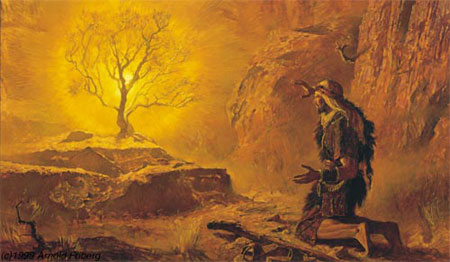
Ever seen a burning bush?

If you ever did, how would you respond?

How about the clear, unambiguous call of God to his Church — to us! — to apply the holy words of Scripture to our lives, to be transformed more and more into the image of Christ, to connect with each other and to minister to one another and to serve each other like family, and to take the good news of God’s mercy and grace and forgiveness into our neighborhoods and communities?

That’s a huge burning bush! That’s an Aggie bonfire towering in front of us, crackling with possibilities and blazing with the fire of God’s call!

The spiritual leaders of the Legacy church body, the elders and ministers, are all firmly convinced that the proper response to this eternal inferno of God’s commission is best made in weekly Small Groups Church.

Last year’s first cycle of SGC began with 692 men, women, and children and ended last month with 778. And we certainly anticipate bigger things in this next cycle that starts in April. With an average of 21 people in each of our 37 groups, there’s no room to grow. We need every former Co-Leader and at least 30 others to sign up this Sunday. If you already have your co-leading partner, please sign up. If you want to Co-Lead but you’ve not yet secured a partner, sign up anyway. There’s time to find your buddy. We need 100 total Co-Leaders to lead 50 groups when we start up again in April.

That’s the challenge. That’s the call. To you.

Now, what’s your objection?

“Nobody will follow me.” Abraham’s servant said that, and the Lord’s angel told him, God will make it happen (Genesis 24:6-7).

I’ve tried it before and failed.” Moses said that, and the Lord said, it’s not about you, it’s about God (Exodus 3:12-4:17).

“It’s too hard for me.” Isaiah threw that excuse out there and he was promptly told, God sees and controls the big picture (Isaiah 6:11-13).

Jeremiah said, “But I’m not a good leader.” The Lord told Jeremiah, God is with you and will provide for you (Jeremiah 1:8).

Ezekiel was brutally honest and said, “I don’t want to go.” The answer came back over and over again, with God, there’s nothing to fear (Ezekiel 2:6).

I’m too old.” That was Zechariah. The angel replied, God will give you signs and proof of his presence (Luke 1:19-20).

Mary said, “I’ve never done this before.” She was told, nothing is impossible with God (Luke 1:37).

Paul said, “I’ve got a rotten past.” Christ told him, God is empowering you for his mission (Acts 22:21).

Ananias offered, “It’s too risky, it’s too dangerous for me,” only to be told, God is taking care of the details (Acts 9:15).

See, the deal is that we usually view God’s call and God’s will and God’s plan for me as all about me. This task is too big for me. It’s beneath me. I might make someone mad. I’m too busy. I’m not gifted. I’m not qualified. I don’t know how. I’ve never done that before.

And God says, you’re right. But it has nothing to do with you. It has nothing to do with whether or not you think you can handle it. God says, “I AM.” I am qualified. I am powerful. I am the God who’s doing this, not you. I just want you to jump into it. I just need you to trust me. Believe in me. Allow me to do this with you and through you for my purposes and my Kingdom.

The call is right in front of you. How do you respond? With every reason and excuse as to why you can’t or shouldn’t act? With reasons and excuses as to why you can’t go to Egypt? Or by throwing yourself completely into his mission, wholeheartedly, in total faith and trust, no reservations, brakes off, full steam ahead, no looking back? By hurling yourself into the project, confident in our Lord who promises to deliver?

Small Groups Church is messy. You put a thousand people in each other’s homes and in each other’s lives, it’s messy. It’s difficult. It’s a real challenge. It’s full of suprises. It’s full of hospital visits and funerals, soccer games and car pools, different dynamics and diverse discussions, some extra dusting and vacuuming.

And lots and lots of wonderful stories.

I beg you to jump into the middle of it — or at the front of it — as a Co-Leader at Legacy. Jump head first, all the way. And allow our Father to do amazing things with you and through you for his people within this church family.

~~~~~~~~~~~~~~~~~~~~~~~~~~~~~~~~~~~~~~~~~~~~~~~~~~~~~~~~~~~~~~~~~~~~~~~~~~~~~~~~~~~~~~

We just got home a little while ago from Scottish Rite in Dallas. They took Whitney’s cast off. (Shew-wee!) Dr. Herring grabbed a pair of pliers and pulled the four-inch pin out of her heel. (Yech!) And then he pronounced her perfectly well and the reconstructive surgery a smashing success. She’ll be weaning herself off the walker as she regains strength and flexibility over the next couple of weeks. Praise God for her healing! Thank you so much for your prayers, your cards, your calls, your visits, all the wonderful ways you’ve encouraged and blessed our oldest daughter over the past two months. God has showered us with his love through you, our dear friends.

~~~~~~~~~~~~~~~~~~~~~~~~~~~~~~~~~~~~~~~~~~~~~~~~~~~~~~~~~~~~~~~~~~~~~~~~~~~~~~~~~~~~~~

Last thing: I’ll never forget — ever — a telephone conversation I had with my sister, Rhonda, back on Super Bowl Sunday 1994. It was about 2:00. I don’t remember what we were talking about, but in the middle of the conversation, I told her I was skipping church to go to a Super Bowl party at a friend’s house.

She was genuinely surprised. “You’re skipping church to watch the Super Bowl?”

“Well, yeah.”

“You’re kidding.”

I said, “Rhonda, come on! You know me!”

And she said, “I thought I did.”

That was the last time I ever skipped church to watch a TV show. I urge you to make the same switch in your lifestyle and in the message you send your kids and your friends starting this weekend. Please don’t skip church this Sunday night to watch a TV show.

Peace,

Allan

« Older posts Newer posts »