Category: Galatians (Page 9 of 11)

God’s Not Done

So, you were baptized! Great news! Praise God! Hallelujah!

What happens between now and the time you’re saved?

Your salvation is a process, right? Lots of wonderful things happen at baptism: you confess that Jesus is Lord and you put all of your faith and trust in him to remove your sins; you commit to follow in Christ’s steps as a loyal disciple; you become one with Jesus as you die and are buried and are raised up with him in baptism; you receive the gift of God’s Holy Spirit living inside you; you’re initiated into the Lord’s Body, the Church of Jesus Christ. All that happens at baptism. Justification. Reconciliation. A righteous standing before God. Peace. Joy.

But that’s not the last step. In as many ways as you can imagine, baptism has never been the last step.

We are being saved.

Being saved means being changed into the image of Jesus. It means being shaped into his character, being formed into his nature. It means we spend our lives “working out our salvation” (Philippians 2:12), we are predestined by God to be conformed to the image of his Son (Romans 8:29), we are to bear the likeness of the Christ from heaven (1 Corinthians 15:49). Paul says he agonizes and prays “until Christ is formed in you” (Galatians 4:19). We are all

“being transformed into his likeness with ever-increasing glory, which comes from the Lord.” (2 Corinthians 3:18)

God is saving us by making us like Jesus. Being saved is becoming like Christ. Acting like Christ. Talking like Christ. Thinking and behaving like Christ. Sacrificing and serving like Christ. That’s our salvation. That’s God’s good purpose and what God is doing with us today.

And that takes time. It doesn’t happen overnight. It’s not an immediate thing.

None of us is done. Our salvation is not complete. None of us. There’s nobody alive God is finished with yet. Until the day you die or the day our Lord returns in glory — whichever comes first for you — until that last day, our God is working in you to give you more humility. He’s renewing your mind to make you more sacrificial for others. He’s transforming your attitude and your actions to better reflect the life, death, and resurrection of Jesus.

If we’re not careful, we can view our baptism as God’s completed work. We can think we’ve already arrived, that we’ve changed enough, that we’ve done enough, that we have nothing else to learn or do until we’re saved. We might think, “I’ve been baptized, so God’s done with me what he wanted to do.” Or, “I’ve been baptized, so God’s got me in his holy holding area until I die.” Or, “I’ve been baptized, so God’s put me in neutral here until I get to heaven.” It might be arrogance, it might be complacency, it might be ignorance — all three are killers!

You need to know that God is not done with you yet. You need to be aware that God is still working on you. I don’t care how long ago you were baptized or how many great things you’ve done in the name of Jesus, God still has things to teach you. He still has things to show you. He is still changing you and he is still very interested in seeing you grow and in using you for his good purposes.

Peace,

Allan

Raised with Christ

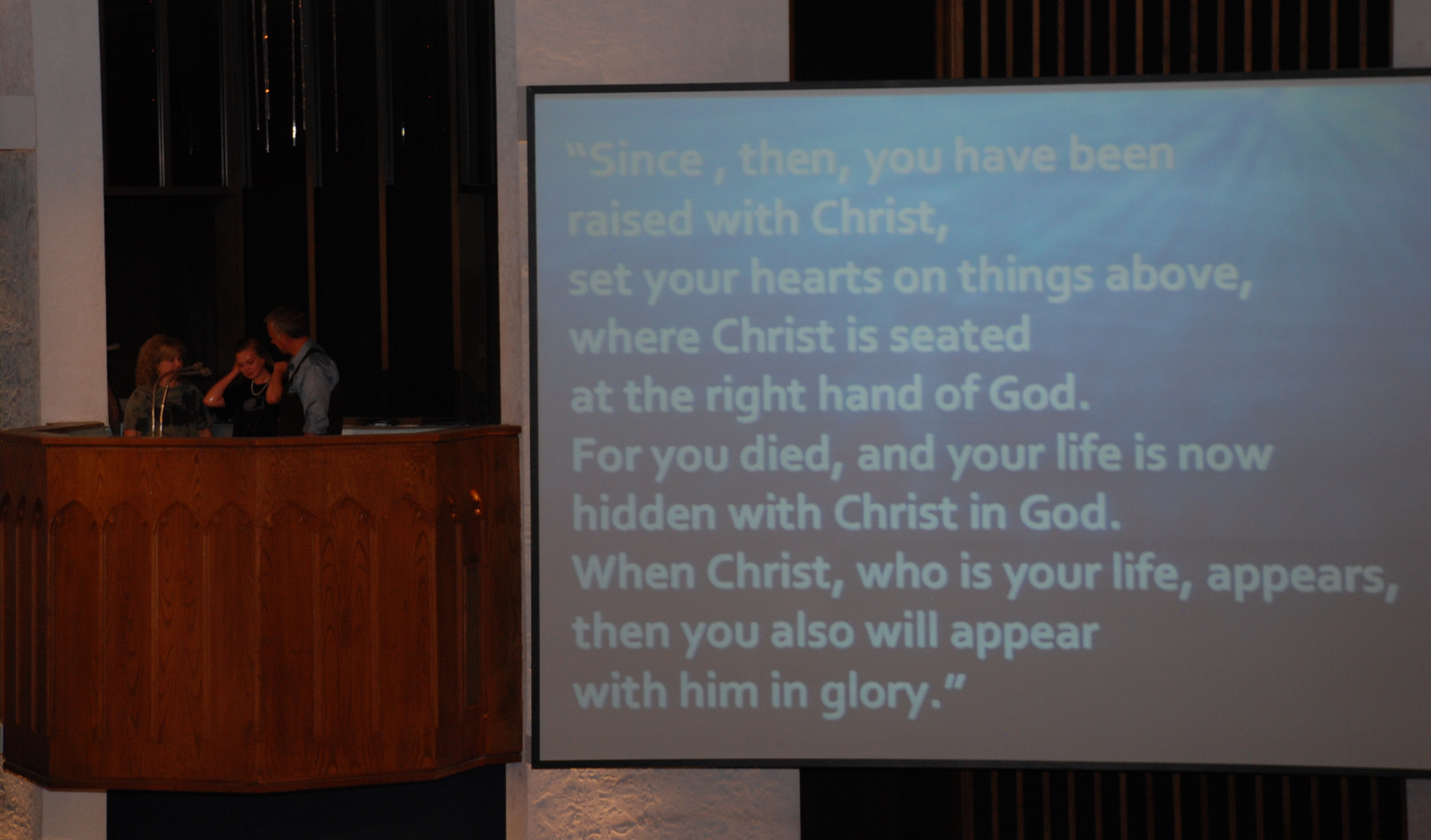
“Since, then, you have been raised with Christ, set your hearts on things above, where Christ is seated at the right hand of God. For you died, and your life is now hidden with Christ in God. When Christ, who is your life, appears, then you also will appear with him in glory.” ~Colossians 3:1-4

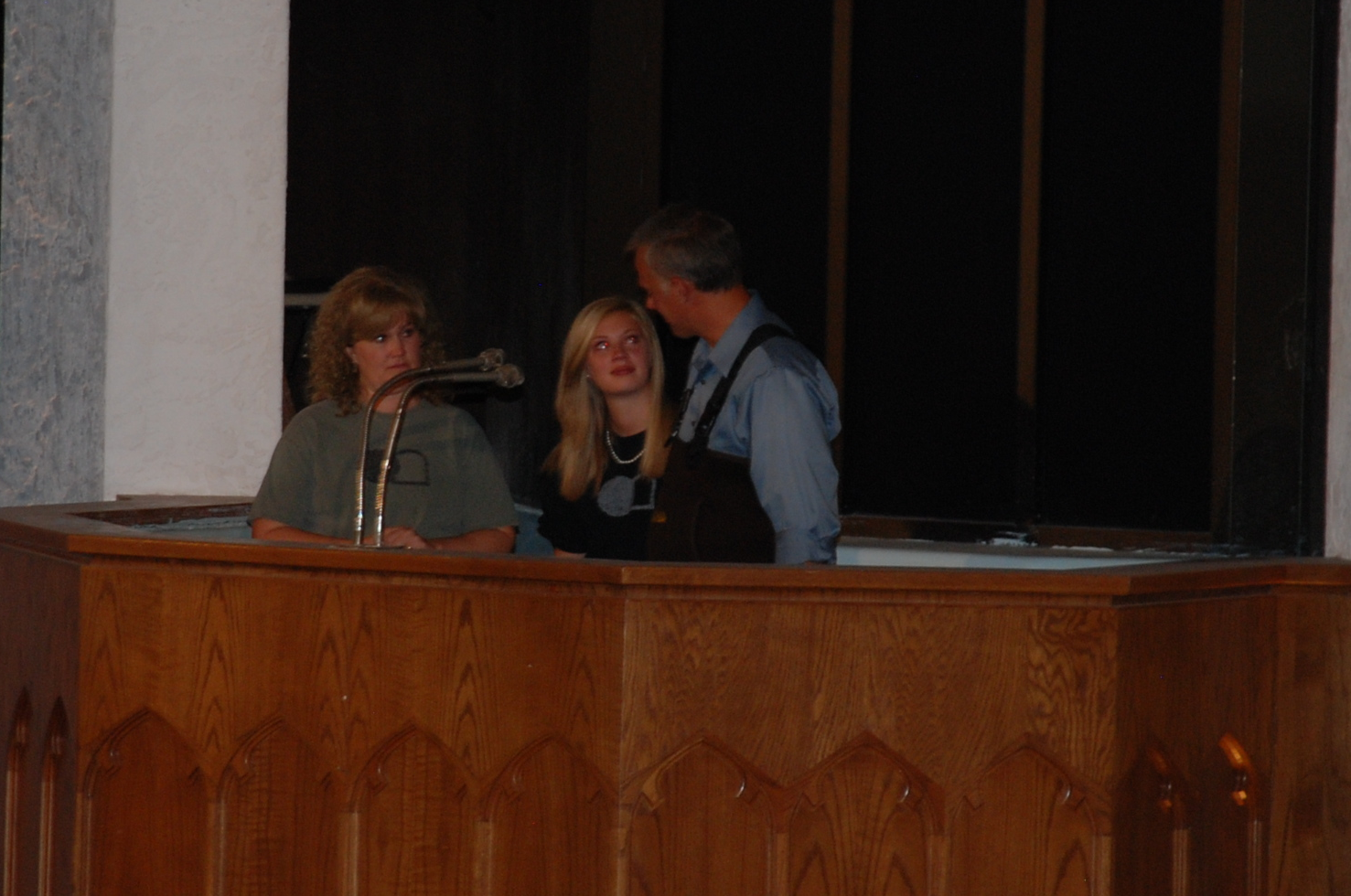
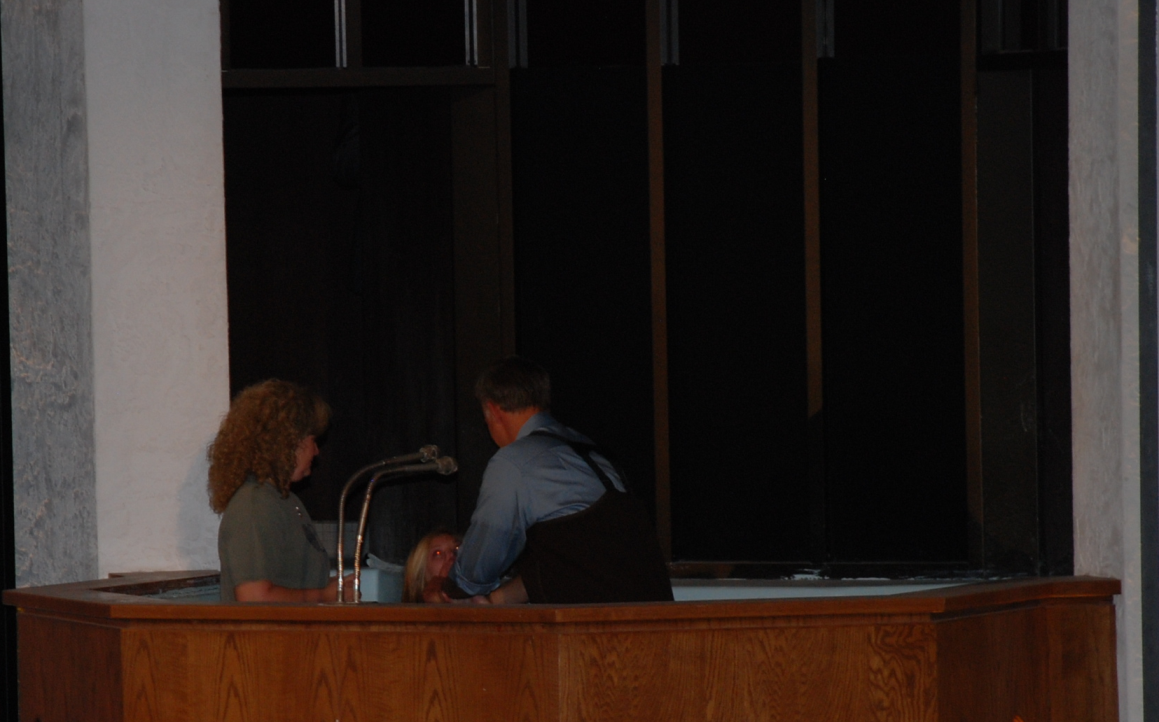
Our youngest daughter, Carley, was baptized into Christ Jesus on Sunday. She publicly renounced the ways of the world and confessed the ultimate lordship of Jesus and her commitment to him. She was buried with him — symbolically, sacramentally; she was raised with Christ — symbolically, sacramentally — to walk in newness of eternal life with our King. She has been forgiven by God of every sin she’s ever committed and will ever commit against his great holiness. She is now indwelled by God himself in the form of his Spirit — symbolized by the first huge breath she took after coming up out of the watery grave. And she belongs exclusively to our heavenly Father. She is his and he is hers. Forever. Amen.

As we talked and prayed with Carley this past week, she asked me almost every night, “Who’s going to do the ‘Since then…?'”

The “Since then…” is the congregational reading of Colossians 3:1-4. It’s a baptismal tradition/liturgy at the Legacy church we initiated with the opening of the new worship center there in 2008. As soon as the newly baptized follower came up out of the water, the congregation would recite those words of blessing and challenge, of affirmation and commission. It was — and still is — a powerful way for the church to participate in the baptism and for the wet Christian to feel the strength of belonging now to a baptized community.

Well, we don’t do that here at Central.

Yes, we clap and cheer and sometimes even stand and shout when someone is baptized. Several people are usually waiting backstage to pray with the newly baptized brother or sister afterward . For teenagers, as many as thirty or forty people will crowd back there to offer congratulations and prayers. But our worship center is built and our baptistry positioned in such a way that congregational participation in a baptism event itself is all but impossible. Our baptistry is some 25-feet up in the air, far removed from the church itself. People on the very front pews are still 75-feet away from the water and are forced to watch the baptisms on the giant screens. Folks scattered around the giant room are even farther away and have no choice but to watch it on the screens. I was dismayed Sunday to walk out into the water in front of our church with my wife and our youngest daughter, and look out into our loving congregation to see 99-percent of them not looking at us, but watching on the screens. And we’re in the same room! Our building has turned baptisms into a spectator event.

But I asked our brothers and sisters to read the “Since then…” to Carley when she came up out of the water. We put the words on the screen. And they did it. It was beautiful. It was powerful. It honored us as a family. And it meant the world to Carley.


Thank you, Central Church of Christ, for loving our daughter and our whole family the way you do. Not a day goes by that we don’t recognize how blessed we are to be with you. Thank you to our small group and Carley’s middle school Muddle families who blessed us so wonderfully at our home Sunday night. You poured truth into our daughter. You affirmed her; you challenged her; you read God’s Holy Word to her and promised to always love her. Thank you. Thank you to the Popes and the Marshalls who drove thirteen hours round trip from Legacy to rejoice with us this weekend. Your friendship is a testament to the faithfulness of our God. And thank you to Carrie-Anne’s mom and my parents who sacrificed a lot to be here this past weekend. You received the Christian faith from your parents, you passed it on to your children, and you are blessing us as we pass it on together to your grandchildren. Thank you.

Carley, you now belong to our God. Paul told the Christians in Galatia that you are a daughter of God by faith when you clothe yourself with Christ by baptism (Galatians 3:26-27). When you were baptized Sunday, you put to death the old Carley. You killed that girl; you buried her. And when you came up out of the water, you were a brand new creature. God has created something brand new inside you Carley, so that by his Spirit you will experience all of life in a brand new way. Death has nothing on you now, precious daughter. And neither does sin.

Our prayer for you, Carley, is that our God will bless you richly with his grace and peace, his protection and provision. Our great desire is to see you become more and more like our Lord. Our eternal hope is that you walk with him faithfully, all the way to the end.

We love you. And we are so proud of you. And we know your life in Christ is going to result in praise and glory to God. May his holy will be done in you and through you, Carley, just as it is in heaven.

Love, like you just can’t believe,

Dad

Religious Freedom

We began our Bible class on Sunday morning by trying to name all the different Christian denominations in the U.S. As you can imagine, the names came fast and furious and I scribbled the words on the white board as quickly as I could to keep up: Methodist. Presbyterian. Catholic. Lutheran. Church of God. Baptist. (What kind of Baptist? OK, four or five different kinds we could think of.) Christian. Disciples of Christ. Unitarian. Non-Denominational/Community. Episcopal. Assembly of God. Then it started to slow down a little. I asked, “No Church of Christ? Why hasn’t anybody said Church of Christ?”

And someone in the back, on the right hand side of the room said, jokingly, “We’re not a denomination!”

Much laughter and frivolity ensued.

OK, Church of Christ. What kind of Church of Christ? One-cuppers. No-classers. Acappella. Instrumental. No kitchens. Etc.,

It took about two minutes to fill the giant board with all the names of all the different versions of Christian churches in the U.S. We kind of started cheating at the end by naming Cowboy Church, Biker Church, and Skater Church. But the point was well made and well illustrated. As Yakov Smirnoff used to say, “Only in America!”

There are more Christian denominations in the United States than in any other country in the rest of the world. More sub-sets of denominations. More splits and plants and branches than anywhere else in the history of this planet. It’s always been that way here. When America was being colonized, there was no official national religion. (There still isn’t, of course; we forget that sometimes.) Unlike the rest of the world, no one denomination could serve as the state church. In the colonies you had Puritans and Baptists, Anglicans and Presbyterians, Methodists and Lutherans, Quakers and German Reformed, all here to establish “the true church.” They had left their own churches and homes, they had fled their own families and nations, because they couldn’t implement their own individual ideas and preferences in their established churches. They didn’t want a Pope or bishop or church board telling them what to do. So they came here where they wanted — and they got! — religious democracy. Here in America, ordinary members were making decisions for the churches. Ministers were not formally educated. It was religion without the creeds and councils. In that age of reason and enlightenment, people figured they could read the Bible for themselves and come to their own conclusions about the right and wrong ways to do church. And they did!

The result of that is what you saw on our white board Sunday morning.

Back then, the idea was that if you read your own Bible with an open mind and good common sense and the conclusions you drew were different from what your church was teaching, you just started another church. What do I mean “back then?” It’s all still the same today!

Religious freedom. Yuk.

“You, my brothers, were called to be free. But do not use your freedom to indulge the sinful nature; rather, serve one another in love. The entire law is summed up in a single command: ‘Love your neighbor as yourself.’ If you keep on biting and devouring each other, watch out or you will be destroyed by each other.” ~Galatians 5:13-15

The American concept of “freedom” is a whole lot different from the Scriptural view of “freedom.” The apostle Paul writes that freedom means we are released from the things of this world — sin, selfishness, ego, pride, unalienable rights — that would keep us from serving others. Scripture says freedom is being loosed from the shackles of self to consider the needs of others more important than our own, to become less so that Christ and his holy will can become more. This nation’s concept of freedom is just the opposite. This nation’s founding documents and ideals, based on the prevailing thoughts at that time and still supporting the prevailing thoughts in our time today, tell us that Americans are free to do what we want, free to choose, free to own, free to pursue personal happiness, free to move, free to make money, free to speak, free to do whatever we want wherever we want, and whenever we want to do it with nobody ever telling me I can’t.

How do you think the freedom the colonists had to start all their own churches based on their own individual understandings of Scripture benefited the Kingdom of God? How might it have hurt? I’m certain there is both good and bad here. What’s good about our religious freedom in this country? How does this same freedom hinder the spread of the Kingdom or the sanctification of Christians? How might things be different — then and now — had American Christians understood and were to understand freedom as the liberty to serve others instead of ourselves?

Peace,

Allan

Through Water to Salvation

“…this water symbolizes baptism that now saves you.” ~1 Peter 3:21

In recalling to his readers how Noah and his family were “saved through water,” the apostle Peter points us to Christian baptism that, in the same way, saves us. Peter’s clear, succint statement is astounding. For a lot of people, it’s scandalous. Peter tells us that baptism has a salvation function.

Paul draws the same conclusion as he looks back on the one foundational and identifying event for Israel: the exodus and the crossing of the Red Sea (1 Corinthians 10:1-4). He sees what happened in Exodus 14 as a baptism “into Moses” and compares it to our baptisms “into Christ” (Romans 6:3, Galatians 3:27). Paul wants us to understand our baptisms as a comparable moment of deliverance and redemption.

Baptism, just like the flood and the Red Sea crossing, is a saving event. Just as God saved Noah through cleansing the old world with water, so God saves us from our old lives through baptism. Just as God delivered Israel by using water to destroy their enemies, Pharaoh and his army, he delivers us by using water to eradicate our enemies of sin and death. Noah and Israel both pass through the waters into a new world, a new creation. Christians pass through the waters of baptism into a new world, eternal life with the Father through the death and resurrection of the Son.

It’s a divine gift. It’s a sacrament of God’s grace. It’s a salvation experience. In baptism our God redeems us, gives us a new identity, and frees us from slavery to sin and death. And it shapes who we are and how think and act as a people of God.

“We were therefore buried with him through baptism into death in order that, just as Christ was raised from the dead through the glory of the Father, we too may live a new life.” ~Romans 6:4

~~~~~~~~~~

What a marvelous joy to welcome into our home overnight Friday our great friends David and Olivia Nelson and their sons, Caleb and Seth. The Nelsons timed their furlough in the States from their missionary lives in Ukraine to coincide with the birth of Seth last month in Lubbock. David and Olivia figured one boy born in Kharkov in Hospital 17 was enough. So we were very blessed that they took a long, winding route from Lubbock to Fort Worth, through Amarillo, to spend almost 24 hours with us last weekend.

After answering several questions Friday night from servers and other customers at Blue Sky about David’s accent, we stayed up way too late passing Seth around, drinking egg nog and Dr Pepper (no kafir, David)  and playing our favorite, Phase 10. Caleb entertained us the next morning by splashing through his pancake breakfast. And then we spent a good long while with our Father in prayer, thanking him for the awesome privilege of serving him in his Kingdom together on opposite ends of his world.

The Nelsons are in Fort Worth now for another month, reconnecting with the church family at Legacy, stocking up on picante sauce and Jello-O and other stuff they can’t get in Ukraine, and being reminded of how much they are truly love and appreciated and admired by everyone who knows them.

I praise our God for the ways he works through and with David and Olivia. I thank him for our rich friendship and partnership in the Gospel. And I acknowledge gratefully that I’m a much better Christian, a more faithful follower of our King, because I know them.

Peace,

Allan

Concerning the Women: Part Two

Acknowledging together that we in the Churches of Christ must do something different if we’re going to remain a viable witness to the Christian faith in our rapidly changing world, we’re spending our time here reviewing and reflecting on Leroy Garrett’s “What Must the Church of Christ Do to Be Saved?”

To paraphrase Garrett, what must we do to escape extinction in the decades ahead, to avoid being regarded as an insignificant Texas-Tennessee sect? What must we do to be loyal to the Scriptures and true to our Stone-Campbell heritage of unity? What’s it going to take for us to, as a movement, advance toward being “truly ecumenical, truly catholic, truly holy, and truly apostolic?”

In the 18th chapter, Garrett returns to the subject of women he addressed in chapter nine:

Bring women into the church.

Although Garrett gets much more into the “women’s role” passages in Corinthians and Timothy here than he did in the previous chapter, his focus in this essay is on Paul’s universal statement (creed?) in Galatians 3:28: “There is neither Jew nor Greek, slave nor free, male nor female, for you are all one in Christ Jesus.”

If that passage means anything it means that gender is not to be made a test of fellowship or ministry, such as, “She can’t do that because she is a woman.” Paul himself may have sometimes fallen short of that ideal of perfect equality, due to the pressures of custom, as in the case of slavery, which he tolerated, and which is forbidden in that same passage, “There is neither slave nor free.” If socio-economic conditions had been different, Paul might not have said what he did about women and slaves, tolerating their unequal treatment.

To put it another way, Paul almost certainly would not say to the 21st century church what he said to the first century church about women and slaves. But still he laid down the principle that applies to all generations because it so reflects the mind of Christ: In the Church of Christ there is to be no distinction between slaves and freedmen, Jews and Gentiles, men and women! We have to recognize that this was the ideal that even he was not always able to effect due to the conditions beyond his control.

Despite Paul’s clear directive here and his similar admonition in Colossians 3:11, the Christian church in America used the Bible for decades to justify slavery. Wherever slavery is mentioned in Scripture as the current conditions in society at the time of the writing, those passages were used by Christians to say, “Well, God didn’t condemn it in that Scripture; it must be OK. Or at least, it’s just the way things are.”

Today the practice of slavery is officially, socially, morally, and publicly condemned in every corner of the United States. Our churches now preach against slavery, loudly abhor the idea of slavery, and lament the behavior of our forefathers who justified it. What changed? Scripture certainly has not changed. Our God has not changed. The evil of slavery has not changed. What’s changed is our society. That’s what’s different now. For an American church today to actually uphold the idea of slavery and teach and practice in favor of slavery is unthinkable. That church would not do very well at evangelizing. That church wouldn’t grow. That church today wouldn’t have much credibility when it came to proclaiming the good news of salvation in Christ Jesus. Who would listen to a church like that?

Regardless of the ways you might interpret 1 Corinthians 11 and 14 or 1 Timothy 2, we all agree that the social conditions that existed then in first century Corinth and Ephesus do not exist today in 21st century America. It’s vastly different. It is certainly not a shame for a woman to speak in public. It’s not a disgrace for a woman to teach in a room full of men. It happens all the time. Women are just as educated as men, just as capable as men, just as qualified as men. Nobody blinks when a woman is named president of a major university or CEO of a global corporation. Your professor or your police officer or your accountant or your doctor is just as likely to be a woman as a man. The cultural conditions to which Paul wrote in Corinth and Ephesus do not exist in America today. It’s different. It’s changed. For an American church today to actually uphold the idea of man’s superiority and teach and practice in favor of denying women leadership and teaching roles is unthinkable. That church would not do very well at evangelizing. That church wouldn’t grow. That church today wouldn’t have much credibility when it came to proclaiming the good news of salvation in Christ Jesus. Who would listen to a church like that?

OK, is that a little strong? Maybe. I hesitated to write it that way, but I think I need to in an effort to at least present the possibility that the two issues are the same in Paul’s eyes. Afterall, in speaking to the Galatians he uses both examples in the same breath.

Garret points out that we are very good at drawing lines according to our own preferences and comforts. Foot washing is both a command and an example in Scripture, but we decline to practice it because it only applied to that biblical culture during that biblical time. Same with the holy kiss. In Acts 15, the church council claims the Holy Spirit himself gave them four commands that had to be followed by all Gentile Christians. We completely ignore the first three! And I’m not so sure we even take the fourth one very seriously.

1 Timothy 2:8 tells men everywhere to lift up holy hands in prayer, without anger or disputing. It’s a command. Is it then, that all men who do not lift their hands while they pray are sinning against God and his Church? No! Of course not. The command is to pray; lifting hands was the customary and cultural prayer posture of the day. Does that mean that it’s OK for the women to be angry and to dispute? No! It’s that the men were apparently the problem in this particular Ephesian church, not the women.

1 Timothy 2:9 tells women to dress modestly, with decency and propriety, not with braided hair or gold or pearls or expensive clothes. Does that mean that all women who braid their hair are sinning against God? No! Of course not. It’s cultural. The command is to dress appropriately for the culture in order to preserve your Christian witness to a lost and dying world.

1 Timothy 2:11 says women should learn in quietness and submission; women are told not to teach or to seize authority from a man; women must be quiet. Does this mean then that a woman who speaks in church is sinning against God?

For way too long we’ve not hesitated to answer “Yes! Of course!” For way too long we’ve interpreted verses 8-10 as cultural and no longer applicable and verses 11-12 as universal and for all time.

A husband’s rule over his wife is part of the curse of sin and death in Genesis 3, not part of the original creation plan of God as found in Genesis 1-2. A husband’s superiority over his wife is a result of sin and death, not a divine facet of God’s eternal will. As children of God and partners of reconciliation with his son Jesus, we are commissioned to reverse the curse, to join our God in overturning the effects of sin and death. We never ever actually labor to impose the curse.

Our task in the 21st century is not to do precisely as they did, but to do for our generation what they did for theirs, bring in the Kingdom of God. And our men and women should be at it today just as their men and women were at it back then, but not necessarily in exactly the same way.

What I want for the Church of Christ down the road is that there will be no social, racial, or sexual lines drawn. None whatever. Liberties and ministries will be shared equally and indiscriminately, according to gifts and talents. We must overcome the mentality that half (or more) of the church is to be subservient to the other half. All because of gender! Christ has made us one and we are all equal — and half of us are not more equal than the other half!

Peace,

Allan

Cease Being Male-Dominated

Leroy Garrett’s book, “What Must the Church of Christ Do to Be Saved?” suggests twenty changes that congregations in our faith heritage must make if we are to remain a viable voice for Christianity in the future. In our increasingly post-denominational, post-Christian world, we’ve got to change some things, Garrett says, or we’re going to fade quickly into complete irrelevancy. Hard numbers and statistics would back up that bold claim. So we’re considering his book, chapter by chapter, and reflecting together on our future as a faithful branch of the Kingdom of God.

In Chapter Nine, Garrett addresses the sensitive issue of the woman’s role in our congregations:

Cease being male-dominated.

If the Church of Christ is to have an effective witness going into the [future], it must make some changes in reference to the place of women in the church. These changes need not be what most of its members would consider radical changes, such as having women as elders or pulpit ministers, but they must be substantial enough to reflect a change in attitude and practice. If there is a concise way to say it, it would be the Church of Christ must cease being male-dominated. Corporate worship is male-dominated, teaching is male-dominated, decision-making is male-dominated. The overall attitude is male-dominated.

It is not evident that we really believe, “In Christ there is neither male nor female,” as Galatians 3:28 urges upon us. If that truth means anything, it means that in the Body of Christ gender is not to be an issue. The Church of Christ must take steps to demonstrate that it really believes that oneness in Christ transcends gender. It means that when a member functions as part of the Body, it will not matter what sex that member is, just as it will not matter what race the member is.

Garrett goes on to suggest several things he says can be done immediately — he calls these “small steps.” He also claims that all of us can do these things at once because they “do not violate any Scripture, and they call only for an end to some of our traditions that have no validity.”

Hmmm……

That’s a huge oversimplification. Huge. However, in Garrett’s defense, he’s not interested in breaking down every single biblical passage on the matter. And, neither am I. Not today and not in this space. For the best exegesis and application of all those important passages, I’d suggest Jay Guin’s studies here.

To continue, Garrett calls for our congregations to equip and empower our women to make the announcements during our worship assemblies and to share in formally welcoming the visitors. Allow the ladies to participate in calling the church to worship. Allow the women to read the Scriptures and pray to our God out loud in our assemblies. Let our sisters serve the communion meal on Sunday mornings. Allow the younger girls to serve as greeters and pass out and collect attendance cards. Enable the women to teach. Allow them to share in the decision-making by serving and chairing church committees. And appoint women as deacons as is the example in Scripture.

Complicated. This is complicated. Not because the Bible is complicated or unclear on these matters, but because we have complicated it almost beyond hope.

Allow me to refer back to one of the things mentioned in yesterday’s post about instrumental music: This, too, is a “salvation issue” in that the ways we draw our lines and judge and accuse others reveal whether we are being Christ-like or not, whether we are acting in the spirit of the Law or the spirit of the Spirit, and whether we are considering the needs of others more important than our own.

As discussed yesterday, the ways we act and react to musical instruments and women’s roles has a lot to do with the issues themselves. But the music issue itself, the actual practice of a praise band versus a cappella, may or may not have as much to do with the truth of the Gospel as this women’s role issue might.

My understanding of the Gospel is that God came to earth as Jesus and suffered and died and was raised again to reverse the curse, to defeat sin and death and Satan and everything else that separates us from God. The barriers have all been obliterated. The things that divide are now gone. The things that separate man from God and the things that separate man from man are all destroyed forever in Christ Jesus. Reconciliation — peace, perfect peace — is the holy result: peace between man and God and peace among all mankind. No more distinctions, no more differences, no more barriers or walls. In Christ, all are one. In Christ, all are equal. That’s why the apostle Paul says what he says in Galatians 3: “There is neither Jew nor Greek, slave nor free, male nor female, for you are all one in Christ Jesus.”

If this is a correct view of the Gospel, then our Church of Christ practices as they relate to the limitations placed on women communicates very clearly that while all are equal in Christ, some are more equal than others.

I’m not interested in pushing and arguing for women to be more visible in our worship assemblies for the sake of satisfying the people who may be complaining or leaving because the women are silenced. I would not push for Garrett’s suggestions in order to fall more in line with our prevailing culture or to simply shake things up just so we can shake things up. I am very interested, however, in practices that more faithfully proclaim the Gospel and in traditions that paint a  more accurate picture of our salvation in Christ. Our current practices of restricting women from reading or praying in our public assemblies not only rob the entire Body of passionate, heart-felt, urgent prayers and dramatic, emotional, intentional readings of the Word that we’ll never get otherwise; these practices also present a distorted portrait of the Good News. The picture that Scripture paints, from Genesis to Revelation and the maps in the back, is of a table. Every culture, every tribe, every language, every tongue all at the same table. All nations, all peoples, communing together with one another and with Christ. No social distinctions, no economic barriers, no differences between the races, and no gender issues. It’s a beautiful picture. It’s the Gospel. But it’s not the picture we’re painting when our women are not allowed to participate at that table in the same ways as our men.

The other thing I would observe is that, for the most part, that list of Garrett’s straightforward suggestions above would be rejected by the majority of our Church of Christ congregations. In the Sunday morning corporate worship assembly, most of us cannot imagine women praying or reading Scripture, making announcements or teaching or interpreting a biblical passage or serving the communion meal. Never. Not in the worship center on a Sunday morning. At the same time though — and please check me on this — the vast majority of us would agree that most, if not all, of those things are permissable and even desired in other church settings. It’s OK for a woman to read out loud a verse or two in the classroom upstairs at 9:30 in the morning, but not in the auditorium downstairs at 10:15. It’s perfectly fine for a woman to pray in our living rooms and around our kitchen tables on Sunday night in our small groups, but never in the worship center. At the youth retreat, around the campfire, at our marriage retreats and family encampments, our ladies are encouraged to lead songs and to share their views of Scripture, to pray and to tell their faith stories. But to do so in our official corporate Sunday morning venues would result in emergency elders meetings and piles of new policies to make sure it never happened again.

Now, honestly, what kind of message is that communicating to everybody? We’ve done this for so long, we’ve distinguished between worship settings for so long, we’ve drawn arbitrary lines around and through this thing for so long that a disturbing thing has happened. Most people my age and older believe that the Sunday morning corporate assembly is the “real” worship time and those other times, when the rules are relaxed, are something else. Definitely not official. Most people my age and younger believe just the opposite. They feel like the “real” times of genuine worship are in our living rooms and around our campfires, on the retreats and mission trips. Sunday morning in the auditorium, when the “rules” go into effect, isn’t real. They see it as us just trying to protect a doctrine that doesn’t exist with rules that are not in the Bible to keep everybody happy. Or from getting mad and leaving.

Just like with the music issue, we have horribly distorted the very idea of Christian worship and fed it to our people for decades. We’ve communicated that some of our worship time is more important than other worship times, some of our assemblies are more pleasing to God than others. Yuk.

I believe that most of our folks are aware of the contradictions and the inconsistencies in our practices. But I honestly believe we’ve spent so much energy and spilled so much ink in our Church of Christ history accusing and withdrawing from those who are different, most of our people are afraid to talk about these things out loud for fear of being labeled. It’s going to take strong leadership. It’s going to take shepherds and ministers who are committed to a more faithful proclamation of the Gospel and a more accurate picture of our salvation in Christ. It’s going to take a trust in God’s Holy Spirit. It’s going to take a strong faith in one another. And it’s going to take a serious and discerning eye on the future of the Churches of Christ. It’ll take all those things in order to have the conversations. But I believe that if the conversations are focused on the Gospel aspect of the issue, by the grace of God we’ll come much closer to believing and teaching and practicing the right things.

Peace,

Allan
« Older posts Newer posts »