Category: Discipleship (Page 26 of 30)

Living the Gospel In Corporate Worship

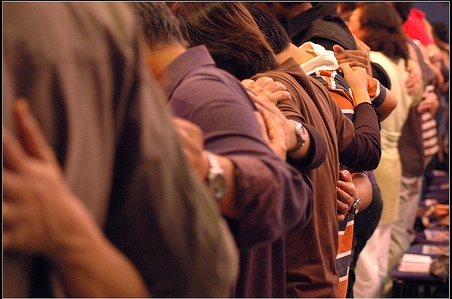
Living the Gospel in WorshipIn speaking against the evils of “worship wars” within God’s Church, John Mark Hicks, Johnny Melton, and Bobby Valentine say arguments and divisions over corporate worship practices are a sign of immaturity. Their book, A Gathered People: Revisioning the Assembly as Transforming Encounter, argues that our Sunday morning assemblies are fundamentally sacramental. They are encounters between God and his people that act to form and transform us more into the image of his Son.

Arguing over the many various styles and practices, they say, denies that basic premise:

We must learn to not only tolerate this diversity but to appreciate it and even learn from it. Diverse worship styles are one of the ways the body of Christ bears witness to the one gospel among diverse cultures and subcultures. As long as we are regulated by the gospel, we should value diversity as it reaches people beyond the limits of our own settings. But this demands maturity. The gospel calls us to put the interests of others above our own. As we walk worthy of the gospel, this calls us to listen to each other and prioritize others’ — including unbelievers. This demands mature discipleship.

The first level of maturation is tolerance. Can we tolerate different tastes and styles even when we do not like them?

A second level of maturation is mutual consideration. Can we not vary our styles out of respect for what touches the heart of another even if it does not touch ours?

The third level is appreciation. Can we appreciate what a particular style does for one even though it is not as meaningful to us?

The fourth level is appropriation. Can we practice what is uncomfortable for us for the sake of the other? The gospel demands that we do because Jesus himself endured great discomfort — to put it mildly — for our sakes. As disciples of Jesus, we must follow him into that kind of discomfort, even suffering. To say that we must “suffer through” a particular song for the sake of another trivializes the cross of Christ but to deny that song to others simply on the basis of our own comfort and tradition is to reject the cross of Christ for narcissism.

I long for the day when all of us — ALL OF US — mature to the point of worshiping together in Christ-like unity and mutual encouragement. What if the teenagers on the third row begin singing How Great Thou Art with great energy and gusto? Not because they love the song. Not because it particularly speaks to them at all. They may actually really dislike the song. But they sing it at the tops of their voices because they look across the worship center and see how that song really impacts an older man. They enjoy singing it because they recognize that the middle-aged woman behind them sang this at her dad’s funeral. They delight in encouraging the others. They understand that their singing is, first, their offering to God, and, second, their offering to their brothers and sisters.

What if the older people stood and sang and clapped to Days of Elijah? Not because they enjoy the song. Not because they think the lyrics are especially moving. They may personally dislike standing and clapping. They may have a list of 40 things wrong with the song. But they see very clearly how that song speaks to the young people. They observe the joy it brings to others around them. They understand this is the song that some of these teenagers rock out to on the way to school in the mornings. So they sing loudly and robustly. To bless God and to bless their younger brothers and sisters.

What if?

What if we all began to grow in the Spirit to the point of understanding that everything we do in our corporate assemblies is an offering to God? Our songs are our offerings to our Father. Your grumbling or non-participation is a clear message to our God and to your brothers and sisters around you that you’re putting yourself first. That’s the only way to say it, right? Is there another way to view it?

Our prayers, our readings from Scripture, our time at the table, are all offerings. These are the things we bring and offer to God. Your brakes-off, full-steam-ahead, all-in participation is a way of acting like Christ. And it’s a sign of your spiritual maturity.

So, sing!

Peace,

Allan

Until I Come Back

“So he called ten of his servants and gave them ten minas. ‘Put this money to work,’ he said, ‘until I come back.” ~Luke 19:13

So the King gives his servants money and says, “Use these resources until I come back.” Put this money to good use. Make something out of it. The servants were to carry on the King’s business while he was gone. Continue doing what he himself would be doing if he were there. Working on his behalf. Taking initiative. Using the knowledge and experience they had acquired in their years of being associated with him as his servants to promote his interests. Here are the resources. Now take care of my business while I’m gone.

First thing the King does when he comes back is to call his servants in and ask them how it went. The first two had obviously been hard at work. They’d turned a pretty good profit using the King’s gifts. And they were praised and rewarded. (Luke 19:15-19)

The third guy’s brought into accounting and he says, “I didn’t do anything. I sat on it. I was afraid of you. I know you have high standards. I know you hate sloppiness. So I didn’t do anything.”

And then seven verses of harsh judgment from the King. “You wicked servant!”

Jesus’ last parable before he enters Jerusalem to face his death is a sobering one: non-participation is not a casual matter. However timid or meek it is, non-participation is disobedience. It’s sin.

This story is hard. It’s unrelenting. Doing nothing is not an option in the Kingdom of God. In the Kingdom of God there are no non-participants. Jesus spends more words and time and space on the judgment delivered to this play-it-safe, do-nothing, overly-cautious, non-participating, non-servant than he does the other nine. Even the ones who signed the petition and sent the delegation saying they didn’t want this King, they only get one verse.

Here’s the deal. And it’s clear: a timid refusal to obey makes us liable to the same judgment as defiant and rebellious disobedience. It’s the same thing.

The story is a call to faithfulness to the King and his business. We’re all accountable to Jesus. Those who claim to follow him are responsible for a ministry of sacrifice and service in seeking and saving the lost. Those who reject him are responsible for not recognizing who he is and not accepting his invitation. This 3rd servant represents the dangers we face as members of the Lord’s Church. He’s associated with the King. He’s a member of the community. He lives with the King, he wears the King’s name, he eats at the King’s table, but he doesn’t trust the King. He’s never walked through that door of faith that responds to grace. So he winds up on the outside with nothing.

Obediently following Jesus, being proactive and taking risks and spending ourselves and our God-given resources in this already-inaugurated Kingdom of God is serious business. The gifts we have from God are not to be guarded or protected or kept safe. They are to be used extravagantly for the King’s business until he comes back.

~~~~~~~~~~~~~~~~~~~~~~~~~~~~~~~~~~~~~~~~~~~~~~~~~~~~~~~~~~~~~~~~~~~~~~~~~~~~~~~~~~

SGCIn the first year of Legacy Small Groups Church we’ve experienced our mighty God at work building faith, encouraging Christian ministry and service, and fostering deeper friendships and relationships in our church family. And I believe our Father wants us to do even more. I believe he’s using Small Groups to transform our entire church family into the image of Christ Jesus.

The Apostle Paul exhorted the Christians in Philippi to practice the same attitude “as that of Christ Jesus” by looking not only to our own interests, “but also to the interests of others.” A union with Christ and fellowship with his Holy Spirit is proved when disciples “consider others better than yourselves.”

I’m convinced that the next big steps in our spiritual growth at the Family of God at Legacy will best be taken by everyone of us — young and old, singles and families, new members and long-time members — meeting weekly in our Small Groups to apply the Word, connect as a family, and evangelize our community.

Our groups start meeting again this Sunday night. For twelve months we’ll be opening up our homes and our lives to each other in the name of our King. Over 750 of us sharing meals and prayers and Christian love and service in 40 homes all over Northeast Tarrant County. Being church, not doing church. Increased unity and and ministry and worship and healing and fellowship and forgiveness. It’s going to that next level as a member of the Kingdom. And taking others with you.

This Sunday night. Jump in.

~~~~~~~~~~~~~~~~~~~~~~~~~~~~~~~~~~~~~~~~~~~~~~~~~~~~~~~~~~~~~~~~~~~~~~~~~~~~~~~~~~~

24 Hours of PrayerAt 7:00 tomorrow morning, the Four Horsemen will be holed up together in some little sideroom at the EastRidge Church of Christ in Rockwall to pray for an hour. My great friends, Dan Miller and Kevin Henrichson, half of the Horsemen, have organized a 24 Hours of Prayer that started at 8:00 this morning. Men at EastRidge are right now in fervent prayer, lifting up nearly a thousand different thanksgivings and requests that have been submitted by that church family.

Jason Reeves and I, the other half, will be the tag-team speakers at the prayer breakfast that wraps up Four Horsementhe event tomorrow morning. I’m honored to be a part of it. Our mighty God is at work anytime men are gathered to pray for extended periods of time. And I love being right in the big middle of it. You pray with a group of three or four men for an hour and it’s like you’ve been in a fox hole with them. You’re bonded to them for eternity. You see their hearts and their spirits as they open up to their Lord. You feel their joys and their pains as they lay bare their souls before God. You learn more about a brother by praying with him than you could ever learn at a two-hour lunch or even a fishing or hunting weekend.

Praying together is huge. Jason and Dan and Kevin and I figured that out a long time ago. The men at EastRidge are learning it right now. And I’m really looking forward to sharing some of that time with them tomorrow morning.

Peace,

Allan

Called To Die

Called To DieMy great friend Jim Gardner posted this on his blog a few days ago. Its very Bonhoefferesque. It reminds of the call of our Savior to follow him when he’s purposefully walking the path to Jerusalem and his horrible death. Deny yourself. Pick up your cross. Get in line behind me and follow me. It’s from a lecture given by Timothy Dolan, the recently appointed archbishop of New York.

“Maybe the greatest threat to the Church is not heresy, not dissent, not secularism, not even moral relativism, but this sanitized, feel-good, boutique, therapeutic spirituality that makes no demands, calls for no sacrifice, asks for no conversion, entails not battle against sin, but only soothes and affirms.” (“Church News,” Times-Dispatch, Richmond, VA, 2-25-09, A-10)

I wonder sometimes about the call of our Christ and whether or not that call is reflected by the practice in and of our churches. I worry sometimes that we’re not really calling our people to much more than showing up regularly for a spiritually-uplifting worship service, guaranteed to contain all the elements they enjoy in just the right order they expect.

Are we, like Christ and the Apostles, calling our people to grow? To change? To be continually converted? Are we calling our people to sacrifice? To give everything up for the sake of others? For the cross? Are we calling our people to faithfully eradicate sin? In our own lives? In our neighborhoods? To wipe out the sin in our churches?

Are we guilty of allowing a culture to develop in our churches in which, if things don’t go our way, we complain to the proper persons until we’re promised “I’ll look into that” or “Let me take care of that.”? Have we created, or at least fostered, a church culture that insists on our “rights,” within the congregational family and the broader community?

Our Lord calls us to die. To give away our lives for his sake. To be last.

Jesus bends over backward to make very clear he’s calling us OUT of our comfort zones, not to them.

I’m re-reading a great little work on the Lord’s Supper by Markus Barth, Rediscovering the Lord’s Supper. And right in the middle of this book he tackles this difficult call. Barth claims — my paraphrase — the Church of Christ ought to reflect the Christ of the Church.

“…Christ became weak, poor, despised, a scandal, and a foolishness to human reason, experience, and social standards, in order to come to those who are weak, poor, despised, who are considered scandalous or foolish, and who are treated as social outcasts. He came to them to be with them and to redeem them….As foolish, scandalous, and outcast as Christ is in relation to the world, so should Christ’s congregation be within the city.”

What changed? When and how did fitting in and looking good and being seen as successful in the eyes of the community become so important?

Wait. I’m on a new topic. Sorry.

The call to die. That’s the thought. Now, how do we do that as a church? Within our congregations and in our communities, how do we follow our Savior and die?

Peace,

Allan

Go and Do

Go & DoThe lawyer in Luke 10 wants to justify himself. His question, “Who is my neighbor?” seeks to create a distinction. He’s suggesting that some people are neighbors and some are not. He implies that God’s people are only called to love God’s people. And we get to decide who those people are! This expert in the Scriptures is saying that, whether due to geography, heritage, ancestry, skin-color, or socio-economic factors, some people are non-neighbors.

That’s what Jesus is reacting to when he tells his story.

A priest walks by and sees the victim by the side of the road and does nothing. A Levite sees this half-dead man and does nothing. Two religious leaders who’ve known and taught the Great Command — Love God and Love Neighbor — for as long as they can remember. They saw and they passed by on the other side.

And then Jesus gives us the emotional twist that both astonishes and convicts.

A Samaritan walks by and sees. Then he went to him. The two verbs here are so important. He saw and he went. And then he verbed this man completely back to health. He gave this victim, this helpless soul, this desperate and dying man created in the magnificent image of God, everything he needed. Look at all the verbs.

He went to him. He bandaged him. He poured on oil and wine. He put the man on his own donkey. He took him to an inn. He took care of him. He took out his money. He gave his money to the innkeeper. He promised to return and reimburse.

And Jesus says, “Now, define ‘neighbor’ for me. Who’s the ‘neighbor’?”

Then our Savior looks this expert right in the eyes and gives him two verbs: Go and Do.

Jesus’ words, Go and Do, totally end the conversation. No more questions. No more answers. No more religious loopholes and religious line-drawing and religious double-talk. No more interpretations of Scripture. No more using God or the Word of God as a way to avoid or dismiss the real hurting men and women we see in our lives.

When we understand the story, we understand that something big is going on and I’m told I can get in on it. Actually I’m told, “Go! Get in on it!”

Go & DoIt’s not “Who is my neighbor” as if some people are and some people aren’t. That’s the wrong question. The question is, “Will I be a neighbor?” Everybody sees all the pain around us. Everybody sees all the hurting people. Everybody sees all the lost. God’s people, though, see and do. We see and render aid. We see and provide help. We see and then we sacrifice and serve in joining our God to make things right.

Go and Do. In Northeast Tarrant County and Nairobi. In our subdivisions and in downtown Fort Worth.

~~~~~~~~~~~~~~~~~~~~~~~~~~~~~~~~~~~~~~~~~~~~~~~~~~~~~~~~~~~~~~~~~~~~~~~~~~~~~~~~~~~~~

TylerStateParkAnother Four Horsemen Campout/Advance in the books. Twenty-four hours at Tyler State Park. 55-degrees warmer than last year. Four hours of sleep. Seven bags of chips. No major injuries. This one, though, to be forever remembered for three things.

1) The Food. All of it provided and cooked by Kevin. Four-inch-thick ribeyes and football-sized baked potatoes. And salad! Salad? Yeah, I know. Followed up by perfectly-prepared eggs, toast, sausage, and bacon Saturday morning and ham and turkey sandwiches Saturday afternoon. No offense to Jason and his water-in-a-jug pancakes from years past. But the food this year was, by far, the best ever.

2) The Raccoon. He stole Kevin’s bag of marshmellows from right underneath his chair while we were all sitting by the fire. He came within a couple of feet, twice, of nabbing my bag of jalapeno potato chips right next to my chair. While we were all sitting there. Jason had a clean shot at him with a football from about four feet, but short-hopped it bad. Choked under pressure. Somewhere, in the deep recesses of Tyler State Park, a raccoon is throwing up 48-jumbo marshmellows. I hope.

3) The Near-Death Experiences. Falling trees. Flying ax handles. Slides down dangerous cliffs (OK, just the hill from the parking lot to the lake). Jumping rocks. It was an adventure.

The best part, though, is always the mutual encouragement, the prayers, the study, and the counsel that’s shared. Every year. We know each other so well that the prayers are always dead-on. I mean, right-between-the-eyes, yes, thanks I needed that, kind of prayers. We pray for each other’s ministries, each other’s churches, each other’s families, and each other’s personal walk with Christ. We ask God to give us all the strength and power to do his will, the courage and boldness to do it his way, and the character and integrity to do it with pure hearts and clean motives, above reproach.

I’m blessed to have three such great friends, such great men of God who love me and take care of me. They know exactly when I legitimately need genuine encouragement and they know exactly when I just need to suck it up and get over it. God continually touches me and speaks to me and blesses me through these great men. They challenge me and push me. They model for me what it looks like to be a disciple of Jesus. I can’t imagine trying to do it without them.

~~~~~~~~~~~~~~~~~~~~~~~~~~~~~~~~~~~~~~~~~~~~~~~~~~~~~~~~~~~~~~~~~~~~~~~~~~~~~~~~~~~~

Gone PecanAnd Terrell Owens is in Buffalo, where in December it’ll be 19-degrees with a 35 mph north wind. The Bills will be 5-9 at that point, they’ll be playing the Ravens, and he’ll be split out wide where he can get a good view of another running play. The 13th play out of their past 15 that have stayed on the ground. Sweet.

As Dan Miller would say, “Life is good.”

Peace,

Allan

Camping Under The Sign

Joyful Journey 

Karl Barth’s commentary on Romans, written in 1919, contains an illustration relating to the passage in Romans 4 about Abraham’s journey of faith. I used the illustration a couple of Sundays ago to shed some light on Philippians 3. Paul writes about pushing and pressing and straining for the prize. He realizes he hasn’t “arrived.” So he presses to take hold of that for which Christ Jesus took hold of him.

Salvation. Christ-likeness. It’s a journey. Nobody’s “arrived.”

If we point back to our religious heritage or ancestry or sit comfortably on our religious traditions, if we find security in our status quo and salvation in keeping things the way they are, we’ll actually find ourselves in serious jeopardy.

Here’s Barth’s story:

“A group of people are headed on a long journey and along the way they find a sign pointing them westward. The signpost is there to convey them to their destination, but instead they stop and create a life for themselves under its painted words. They build a civilization there, celebrating the signpost and telling stories of how they arrived at the marker. Rituals evolve and songs are written. Books are published and liturgies follow. A few travel on and return, confirming that the sign does indeed lead to the place promised. But the second and third generations have built a life around the signpost and have forgotten the purpose of the journey. Their life is built on stories of past travel, not on stories of arriving or the prophetic call to get on with the journey themselves.”

Peace,

Allan

Costly Truth

Costly TruthA little bit of the discussion stemming from Friday’s post, Beware The Shadows, has led me to consider anew how Truth, especially as it applies to God’s vision for his people, is costly. Christianity is risky. Discipleship is costly. Being a follower of Jesus is daring and dangerous. And a good many of us don’t have the stomach for it. Seeking that truth and living it out always comes with a price.

I’m reminded of another Lynn Anderson line in his book Freshness for the Far Journey: “Each of us is as free as all truth-seekers have been from Jeremiah to Sagdluk, provided we, like they, value truth highly enough to maintain the payments.”

Jesus said, “If anyone chooses to do God’s will…” (John 7:17) It’s always a choice. And sometimes it can be a very painful choice. Jesus also said, “How can you believe if you accept praise from one another, yet make no effort to obtain the praise that comes from the only God?” (John 5:44) Making that unpopular choice every single day is essential to Christian ministry. It’s paramount to our faith to tread that less-traveled road.

More from Anderson: “Those who most freely pursue God’s truth do so in spite of the fact that the environment does not encourage them. To be able to stand before His smiling countenance means far more to them than their security or their forum or the affirmation of their fellows.”

To apply this thought more directly to preachers and teachers and elders in God’s Church, I’ll pull an illustration from another portion of this same book: “Part of the reason Mozart ended up in a pauper’s grave was, according to legend, because he said, ‘I will not write what they want to buy. I will write what I hear.’ Such was Mozart’s artistic integrity. Question: Can any preacher of the Word do less? Dare we neglect ‘what we hear’ to live and preach only what ‘they will buy’?

~~~~~~~~~~~~~~~~~~~~~~~~~~~~~~~~~~~~~~~~~~~~~~~~~~~~~~~~~~~~~~~~~~~~~~~~~~~~~~~~~~~

Some of the discussion from another recent post made me dig this up again. Enjoy.

Cowboys Scanner

Peace,

Allan

« Older posts Newer posts »