Category: 1 Thessalonians (Page 4 of 8)

Leadership: Pleasing God First

“We are not trying to please people but God, who tests our hearts.” ~1 Thessalonians 2:4

“We were not looking for praise from people, not from you or anyone else.” ~1 Thess. 2:6

Paul and Silas and Timothy tell the church in Thessalonica that they all ought to follow their model of Christian leadership: We “make ourselves a model for you to follow (2 Thess. 3:7, 9). A critical component of their leadership style is their commitment to pleasing God instead of people. Paul’s ministry — his whole life! — is characterized by this attitude.

“Am I trying to win the approval of people, or of God? Am I trying to please people? If I were still trying to please people, I would not be a servant of Christ.” ~Galatians 1:10

Paul is not one to take a vote or check the opinion polls before doing what he knows needs to be done in his capacity as a Christian leader. President Harry Truman had a similar disdain toward catering to the whims of the people:

“I wonder how far Moses would have gone if he’d taken a poll in Egypt? What would Jesus Christ have preached if he’d taken a poll in Israel? Where would the Reformation have gone if Martin Luther had taken a poll? It isn’t the polls or public opinion of the moment that counts. It’s right and wrong and leadership, men and women with fortitude, honesty, and a belief in what’s right that makes epochs in the history of the world.”

We’ve been entrusted with the Gospel (1 Thess. 2:4) as stewards of God’s Good News. So we are responsible to God, not people. We seek to please God first, not people. This was Peter’s leadership style, too. In Acts 5, Peter tells the Sanhedrin in the face of Jewish persecution, “We must obey God rather than people!”

But there’s such a strong temptation to please people. It’s human nature. We want to please people, not just to be popular, but because we don’t want to make anybody mad. We don’t want to make enemies. We don’t want to come across as mean. We want to keep the peace. Elders want to keep their members. Preachers want to keep their jobs.

Well, hold on. We don’t want to offend or upset our weaker brother. We’re responsible for our weaker brother.

You know, that passage in 1 Corinthians 8 is one of the most grossly misapplied passages in all of Scripture. The weaker brother Paul’s talking about is a brand new Christian. He’s just been baptized. He’s still wet behind the ears, figuratively and literally. He’s from a pagan, idol-worshiping, bacon-loving background. He doesn’t know anything. He hasn’t had time. He’s just a baby. That’s the weaker brother of the Bible. But I’m afraid sometimes it’s the men and women who were born and raised in the faith, baptized 20, 30, or 40 years ago, who are using weaker brother arguments to thwart Christian leadership.

When I was interviewing here at Central almost six years ago, the leadership told me, “We’re a Church of Christ. We’re always going to be a Church of Christ. We’re proud of our Church of Christ heritage and we uphold our Church of Christ traditions. But when those traditions come into conflict with the Gospel, we’re going to go with the Gospel every time.”

Sold! I love that!

Strong Christian leaders keep their eyes on the goal, they’re focused on the big picture. They lead with courage in the will of God, to please him. What’s going to challenge us and mature us? What’s going to lead to Christ-likeness? What’s going to move us toward more sacrifice and service? What’s going to make us more accountable to God and one another?

Well, that makes me uncomfortable. I’m not comfortable with that.

Who said anything about comfortable? That’s why they put crosses up in church buildings, to give you a clue that this is not about being comfortable!

Leaders worth following don’t pay much attention to the polls or public opinion. Pleasing God, not people. Remember, Jesus was OK with letting the rich young ruler walk away.

Peace,

Allan

Chosen and Convicted by God

“Our Gospel came to you not simply with words, but also with power, with the Holy Spirit, and with deep conviction.” ~1 Thessalonians 1:5

A group of disciples, a church, is called out by God, chosen, separated from the world by God for God’s purposes. But how did Paul know these Thessalonians were chosen (1:4)? Because he saw a great change in their lives. He witnessed their work produced by faith, their labor prompted by love, and their endurance inspired by hope. Those whom God chooses, he changes.

Scripture tells us we must not be conformed to the pattern of the world; we should be transformed by the renewing of our minds. We’re changed by the way we see things and process things, by the way we think. And that’s difficult because we are all drinking the same water. We’re all breathing the same polluted air of our Western culture.

Society says we have to assert our independence. We have to emphasize individuality. We have to worry about safety and security. We have to fight for our rights. As Christians, though, we know that living that way leads to broken relationships. It values ideas and positions over people. It forces us to label and exclude those who are different. And it makes me more important than you and our needs more important than theirs. We become increasingly inward-focused. We’re certainly not acting out of faith, love, and hope.

But we’re all called out of the world! Set apart. Chosen and changed by God. If anyone is in Christ — new creation! The old has gone! The new has come! Everything’s brand new! Everything’s changed! The Thessalonians turn away from the idols of the age to serve the true and living God (1:9). Their faith, hope, and love — these three Christian virtues wrapped up in a package that comes only from the Creator — are the evidence of their divine chosenness.

Peace,

Allan

In Spite of Severe Suffering

The early church in Thessalonica is described as a “model” church by the apostle Paul. In the opening lines of 1 Thessalonians, the author says they have become a “model to all the believers,” while explaining why he finds them to be so ideal and receives from them so much joy. There are many reasons listed in the first ten verses of this letter. Among them is this line about their commitment to Christ in spite of the hardships it brings:

“You became imitators of us and of the Lord in spite of severe suffering.” ~1 Thessalonians 1:6

This Thessalonian church was persecuted early and often. Luke tells us in Acts 17 that Paul was run out of town right after he established this church, maybe within just a few weeks. The church was meeting in Jason’s house in Thessalonica. He was arrested along with several other believers. And persecuted. It was serious. And real.

A lot of it had to do with economics. If I’m running a burger joint or a chicken shack here in town, I don’t need you and some group stirring up a bunch of low-fat, vegetarian fanatics. That affects my business, my bottom line. It impacts my way of life. So the makers of idols and religious trinkets rose up and opposed Christianity.

The other part of it was the polytheistic culture of the day. It was dangerous to ignore or offend the gods. If there was a fire in town or a flood or drought or plague or some other disaster, the thinking was, “Our gods have always protected us from these things! These Christians must be ticking off the gods!” So they would torture and kill the Christians.

Now, trust me, I’m aware, there’s nothing easy about this. There are no simple answers. It’s complicated because we’re so compromised.

I wonder sometimes. I just wonder…

I wonder how we can proclaim the sanctity of all life and be opposed to the killing of men and women created in the image of God when our economy and our standard of living is so dependent on wars and rumors of wars. I wonder about the criticism we’ll receive from other Christians when we love and serve members of the LGBT community and the condemnation we’ll receive from the culture when we say pursuing the gay lifestyle is a sin. I wonder about the public rebuke we’re in for when we love and serve immigrants and refugees in the name and manner of Jesus. I wonder about the trouble we’re already in from other Christians for tearing down denominational walls in God’s Kingdom.

Imitating Christ requires hard choices and it results in suffering. Always.

A model church embraces Jesus and his ways, all the way, in spite of that certain suffering.

Peace,

Allan

Giving Central a Break

I know when I’m out of town or on a vacation and somebody else preaches for me, it’s good for Central. I figure the church needs a break. The same can be said as it relates to our church staff and probably the elders: when I’m not there, it’s probably good. I think I can be overly intense and loud. I think I’ve mainly only got one speed and only one volume. And a lot of me for too long of a time is probably too much.

So I haven’t preached at Central in two weeks. We were so blessed to have Rick Atchley preach for us two Sundays ago and then my family and I were gone last Sunday visiting Valerie in Edmond. We missed Central’s annual baby blessing, but, again, I think our church needed a break.

As a church, we’ve also been blowing and going pretty hard since October with our Ignite Initiative. I’ve preached lots of sermons on giving, we’ve talked a lot about vision and mission. It’s been challenging. We’ve all been stretched. God has been faithful and our church has been fabulous. But, in a lot of ways, it’s been tiring. For me, for sure and, I’m assuming, also for Central.

So, my plan has been to start this Sunday on an eight or nine week expository series through 1 Thessalonians. I thought it would be good for all of us to dive into 1 Thessalonians and just relax in it together. I think I feel about Central the way the apostle Paul feels about this church in Thessalonica. When I read this ancient letter to that little church that was meeting in Jason’s house in Thessalonica, I think I could write a similar letter to Central.

1 Thessalonians is different from all the rest of Paul’s letters in the New Testament. In every one of his letters, Paul is responding to a crisis in some church. He’s correcting a false teaching or fixing a bad practice or criticizing some ungodly attitude or behavior. Except in 1 Thessalonians. Instead of rebuking and correcting, Paul writes to these Christians in Thessalonica: Keep doing exactly what you’re doing!

“We instructed you how to live in order to please God, as in fact you are living. Now we ask you and urge you in the Lord Jesus to do this more and more.” ~1 Thessalonians 4:1

This is a very encouraging letter. It’s very positive. It’s inspiring. And I figure it’ll be good for our church to just relax for a couple of months with this easy letter.

But after studying it for the past couple of weeks I’ve noticed it’s not going to be that easy.

The opening ten verses are all thanksgiving and praise, but every sentence is loaded. I have found myself writing a sermon that’s as much challenge and stretch as it is attaboys and praise. What’s wrong with me? I can’t read words like “power” and “deep conviction” without wondering if we feel that in us. I wonder about how well we imitate Christ under the threat of suffering. What does it take to be a “model” church? Have we turned from our idols? What’s wrong with me?

I can’t help it.

I’ll say it again: I feel about Central the way Paul feels about this church in Thessalonica. Central, I believe, is a model church. And we’re serious about this church. We’re reading the Scriptures and we’re fasting and praying. We’re paying more attention to formation. We’re focused on the vision the mission. I’m taking it seriously. And so is the whole church. We’re all walking together.

I just don’t want us to ever settle for surviving — let’s get to thriving! Let’s challenge “what is” for the sake of what could be and should be! If we dig deeper and climb higher and live better and serve others in faith, hope, and love, hell can’t put up gates big enough or strong enough to stop us!

I promise you, Central, this sermon series from 1 Thessalonians will be a bit of a break. Just not as much of a break as I had planned and that you probably deserve.

Peace,

Allan

Resurrection Hope

resurrectionbodies“If only for this life we have hope in Christ, we are to be pitied more than all people.” ~1 Corinthians 15:19

Where is your hope? If your hope is in your health, you’re in trouble because you can’t control that. You can’t count on your health. There are lots of people in your life who can testify to that.

Is your hope in your money or your retirement account or your investments? I pray it’s not. You can’t control your money, either. There’s no guarantee with money. So what if you’ve got a million dollars, how much is it worth when the economy tanks?

Where is your hope? Do you even think about it?

So many of us are talking on the Bluetooth while we’re tapping out a text while we’re ordering at the drive-thru at McDonald’s on the way to a meeting that starts in three-and-a-half minutes. We’re just flying from place to place and going and doing and chasing and getting so frantically, we don’t ever think about the things we’re pursuing. What am I really hoping for?

The truth is we’re all going to die. The truth is that, eventually, you are going to stop breathing, you’re going to die, we’re going to put your body in a box, we’re going to put that box in the ground, we’re going to go inside and eat fried chicken and green bean casserole, and then in about two generations we’re going to forget everything about you. That’s the truth.

(Aren’t you glad you decided to read my blog today?)

There’s got to be more. There had better be more.

“Christ has indeed been raised from the dead, the firstfruits of those who have fallen asleep. For since death came through a man, the resurrection of the dead comes also through a man. For as in Adam all die, so in Christ all will be made alive. But each in his own turn: Christ, the firstfruits; then, when he comes, those who belong to him.” ~1 Corinthians 15:20-23

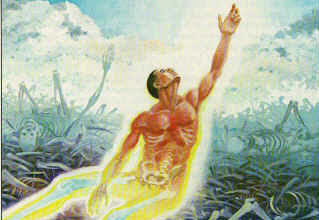
Our hope is in the resurrection of the body. That means, yes, our God has the final word over death. God has the final say. Not crippling disease, not mental illness, not violent crime, not war, not starvation — our Father has the final say. Your life on this earth might be long and happy or your life might be a bitter experience of pain and groaning. Whatever ravages the hostile powers might inflict on your body or the bodies of those you love, the empty tomb of Jesus and the resurrection promise of God fill us with a genuine hope that the body sown in weakness will be raised in power to life.

“By his power God raised the Lord from the dead, and he will raise us also.” ~1 Corinthians 6:14

We put undo hope in things that can’t deliver. We don’t rely on God like we should. We put more trust in ourselves and our stuff. It’s not because we intentionally downplay or reject the promises of God, I think it’s because we don’t slow down enough to allow ourselves time to truly reflect.

“Brothers and sisters, we do not want you to be ignorant about death or to grieve like the rest of people who have no hope. We believe that Jesus died and rose again and so we believe…we will be with the Lord forever.” ~1 Thessalonians 4:13-18

Peace,

Allan

Proclaiming the Kingdom of God

Megaphone2

The Good News is that Jesus is the new King. With the resurrection and ascension of our Christ, all the kingdoms and nations of the world are claimed under his Lordship. That’s what we proclaim. That’s what the Christians were doing in Thessalonica; and it got them in trouble.

“They are all defying Caesar’s decrees, saying that there is another king, one called Jesus.” ~ Acts 17:7

Paul goes to Rome, right under the nose of Caesar himself, right in the middle of the Empire’s capital city and “preached the Kingdom of God and taught about the Lord Jesus Christ boldly and without hindrance” (Acts 28:31).

The whole point is that the world has turned a new corner. A new age has arrived. The entire earth has a new King and people have to be told about it. Because not everybody knows.

Most people today, in a world where Jesus is Lord, are still serving the old kings. And there’s no hope in that. No hope. Most people place their trust and faith in the old kings and old governments, old political systems and old rulers. And there’s no hope.

You see it in the Middle East where dictators rule unjustly and people are treated unfairly. You see it in Africa and parts of Europe where the government refuses to meet the basic needs of their people. No grace. No mercy. No salvation. You see it in the United States where the political system is a gigantic mess. Every politician on both ends of the spectrum and at every position in between says, “Vote for me! Vote for us and everything will be better!” But we don’t believe any of them anymore so they have to dress it up with more hype and noise and spin.

We are sent, each of us, by the authority of Christ Jesus and by the power of his Spirit to spread the news of his good and righteous rule. By our calling as his ambassadors and emissaries, it is our duty and command, all of us, to tell the nations they have a new King. By virtue of his resurrection and our own participation in the new eternal life, it is our great privilege to shout from the rooftops the dawning of the age of the Kingdom of God.

And by the power of the Holy Spirit, we’re up for it. We experience God’s restoration every day. We have received his grace and peace. We can speak of a new creation and we can live a new life because our Lord has already won the war and reigns right now today and forever at God’s right hand.

“Now to him who is able to establish you by the Gospel and the proclamation of Jesus Christ… so that all nations might believe and obey him — to the only wise God be glory forever through Jesus Christ! Amen.” ~Romans 16:25-27

Peace,

Allan

« Older posts Newer posts »