Page 83 of 484

195-1

The biggest fourth quarter collapse in the history of the Dallas Cowboys? Where else but at Lambeau Field against the Packers. Going into yesterday’s contest in Green Bay, the Cowboys were 195-0 when leading by at least 14-points in the fourth quarter. In 63 years of football, the Cowboys had never lost when leading by two touchdowns at some point in the final period. One-hundred-ninety-five games, one-hundred-ninety-five wins.

Until yesterday.

So delicious.

And so predictable. It’s the same problems that have plagued the Cowboys for the past two-plus seasons. These same issues, repeated week after week, don’t matter much against the Lions or the Bears. But you can’t do this against decent teams and expect to win.

Penalties, of course. Dallas continues to lead the league in yellow flags.

The run defense, yes. Green Bay ran for more than 200-yards against the Cowboys. In fact, heading into that fourth quarter, Aaron Rodgers had only attempted eleven passes. If you remain committed to the run game, if you stay patient and keep pounding the ball on the ground, you will beat the Cowboys.

Turnovers, again. Dak’s two picks looked like a result of miscommunication with his intended targets, CeeDee Lamb and Dalton Schultz. Really? A franchise quarterback, a number one wide receiver, and a tight end playing with a franchise tag shouldn’t be having communication issues in November following a bye week.

Clock management, check. Mike McCarthy’s indecision and complete lack of fundamental clock management skills cost the Cowboys dearly on their last drive in the fourth quarter.

The Cowboys’ playoff hopes ended yesterday with that fourth quarter meltdown. Dallas is in third place in its own division with the undefeated Eagles looking to widen the gap tonight against Washington. The Cowboys play the once-beaten Vikings in Minnesota this Sunday and then host the Giants three days later. You might be looking at a three-game losing skid here. Even if they win one of these next two, the division title and the potential first-round bye are gone. If – IF! – the Cowboys qualify for the postseason, they’re facing a wild card game against a division champ.

The biggest fourth quarter collapse in franchise history. That’s noteworthy. Significant, even. Under the leadership of Jerry Jones, the Cowboys keep breaking team records and making franchise history – just not the kind you put on the cover of your media guide.

Peace,

Allan

Accurate Interpretation

I need to offer a disclaimer as we make this shift from viewing the Bible primarily as a collection of God’s commands to reading and understanding the Bible more as the Story of God. This narrative lens is not going to suddenly give us easy answers to all the issues. We’ll actually find there are fewer rules, the lines are not as black and white, and it leads to more questions and more wrestling and more reflection. It’s not a system. It’s not an owners manual. It’s much more art than science. It can be messy. But I believe understanding the Scriptures as a broad, sweeping, epic story of who God is and what he is doing will help us better connect the dots in the Bible, make us better able to see ourselves in the drama so we can play our parts and say our lines, and enable us to more accurately interpret God’s will.

“All Scripture is God-breathed and is useful for teaching, rebuking, correcting, and training in righteousness, so that the child of God may be thoroughly equipped for every good work.” ~2 Timothy 3:16-17

A lot of us have taken passages like the above and developed a theology about the Bible, but not a biblical theology.

We’ll read Jonah and spend four weeks researching whether a human can live inside a fish for three days and never once think about God. The story is about God and what he is doing, not about the whale and what he or she can or cannot do.

We’ll argue about Paul’s words concerning divorce and remarriage and look for legal loopholes instead of dwelling on the covenant loyalty of our God who intends our marriages to reflect and witness to his perfect love and faithfulness.

Esther is not about “you need to be more courageous.” If that’s the point of Esther, it may as well be “you need to be prettier,” too. The point of Esther is that our God is at work to redeem everything and he uses every opportunity – even our darkest moments in exile when we feel weak and powerless and trapped in circumstances beyond our control – to save us and redeem us. We are not forgotten. We are never out of God’s reach or too far away from his salvation. That’s the story.

For a long time, we have read and studied the Bible looking for commands, examples, and necessary inferences. We no longer assume that this method works consistently, if at all, or if it’s even healthy. Does anybody really believe that in the grand, sweeping narrative of Scripture, the strange fire of Nadab and Abihu belongs in a central and controlling place? Reading the Bible as a book of laws to be obeyed or as a constitution to be defended is what led to some Christians affirming that slavery must be okay because the Bible doesn’t explicitly prohibit it.

Reading the Bible as a system of laws, people take every single verse that mentions slavery and notice that none of the verses condemns slavery as sinful or prohibitive. God didn’t say it’s a sin, so it must be alright as long as you don’t violate your conscience. Yes, Christians have done this in the past, and some Christians still do. Yes.

Reading the Bible as the story of who God is and what he’s  doing in Jesus Christ makes it obviously clear that all women and men are created equal in the image of God and that all people belong to each other as complete equals. Slavery is a result of the Fall; it’s sin. Jesus destroyed all the barriers between people at the cross. In Christ, there is no slave or free, male or female, Jew or Greek – we are one and slavery is a reprehensible evil.

That’s the difference. What’s the story?

The beatitudes are not telling us to be better peacemakers or to grow in humility. It’s not that you have to develop these virtues in order to receive the blessings. Why do we try to make mourning/weeping sound good or desirable? Well, it’s mourning over sin, right? I don’t know, the text doesn’t say that. The point of the beatitudes is to express how radically present the Kingdom of God is, even and especially among those who are grieving. People in their brokenness and grief often feel like they’re left out of God’s blessings. But Jesus is telling us, “No! God’s Kingdom is bigger and better than we ever dreamed. And it’s here right now!”

What God is doing is a story. It’s a narrative. When we see the pattern of God’s Kingdom in Creation and how it went wrong, when we understand how everything God is doing through Jesus Christ is to restore our righteous relationships with him, with one another, and with all of nature, we can much more easily, consistently, and accurately interpret his will and purposes for us.

Peace,

Allan

Identity

According to the Bible, knowledge means knowing who God is and what he is doing through Jesus Christ. That knowledge, according to the Bible, leads to relationship, transformation, and mission. But most of the time, we’re primarily reading the Bible for information. We study words and the original languages behind them, we consult sources and resources for understanding the historical context, we dive deep into a fragment of a sentence and don’t come up for air until we’ve discerned the color of ink Luke used when he wrote Acts. And we don’t consider relationship, transformation, or mission.

Understanding the Bible as the Story of God will help us better connect the dots in Scripture, as observed in our last post. And it’ll  help us more easily identify with and see ourselves in the narrative.

Seeing the Scriptures as one grand, sweeping, epic story makes it easier to see ourselves in the narrative. We’re better able to place ourselves in the plot and play our parts and say our lines. We get this from inside the Bible itself, from the rich heritage of God’s people who lived and wrote and faithfully passed on the holy Scriptures.

Twelve generations after the crossing of the Red Sea, God’s people are saying, “Lord, you brought us out of Egypt!” Well, no, your grandparents and great-grandparents weren’t even alive when that happened. You never crossed the Red Sea. Oh, yes, we did; we did cross the Red Sea. We’re in this story.

In Daniel 9, the prophet is confessing sins that his ancestors committed decades before he was born. “We have sinned and done wrong; we have been wicked and rebelled!” No, Daniel, that wasn’t you. You don’t need to confess sins for which you are not personally responsible. Wrong answer. It is me. I did commit these sins. I’m in this story.

This is what the Bible does. It invites you to see yourself. It puts you in the Story.

“We thank God for you, brothers and sisters loved by the Lord, because God chose you as firstfruits to be saved through the sanctifying work of the Spirit and through belief in the truth. He called you to this through the Gospel, that you might share in the glory of our Lord Jesus Christ.” ~2 Thessalonians 2:13-14

The way you see other people and the way you understand the world and respond to what’s happening around you depends on the story you’re living.

You can go to a high school football game and sit by five people on the same bleacher and hear five different views of the same game depending on the role they play in the story they’re living. A scout looking at next week’s opponent says, “We’ve got to play zone against these guys; they’re fast.” A member of the board that owns the stadium thinks, “Four thousand people here, ten dollars per ticket, nachos are six bucks and Cokes are three dollars – we’ve got to figure out how to host a couple of playoff games when the season’s over.” The running back’s mom groans, “Don’t give him the ball; I don’t want him to get hurt.” The running back’s dad says, “Give him the ball! He needs more carries or he’s going to wind up at Texas A&M Commerce!” The running back’s English teacher marvels, “How can that kid memorize an 85-page playbook, yet forget to turn in his essay?”

Knowing the Story and understanding who you are in the Story informs and shapes how you see the game, how you respond to what’s happening on the field, and how you might act or speak to move the plot along and accomplish the purpose of the drama. Your identity is forged by the Story you live and the part you see yourself playing. God’s great Story is our Story.

Jesus says, “You didn’t choose me; I chose you.” The Bible says, “You are no longer foreigners and aliens, but fellow citizens of God’s people and members of God’s household.”

“You are a chosen people, a royal priesthood, a holy nation, God’s special possession, that you may declare the praises of him who called you out of darkness and into his wonderful light. Once you were not a people; but now you are the people of God!” ~1 Peter 2:9-10

Understanding the Story of God helps us bring more purpose and order to our lives and experiences. What is God doing in the world? Where is all this headed? And where are we – where am I – in this Story? Well, you are the light of the world. You bear the holy image of the Lord. You are ambassadors for Christ.

A system of laws and commands compels us to obey and comply. A Story invites us into relationship and mission. Reading the Bible primarily as lists and rules doesn’t foster the intent of God’s revelation in Scripture: to draw us into loving community and partnership with him. Viewing the Bible as God’s Story invites us to join.

Peace,

Allan

Connecting the Dots

We’re making a significant shift at the GCR Church in our hermeneutic, the lens through which we read and interpret the Scriptures. We’re intentionally moving away from viewing the Bible primarily as a collection of commands and laws and toward seeing the Bible as the grand, sweeping, epic narrative of who God is and what he is doing in the world. We’re introducing it to the church over these seven weeks in what we’re calling The Story of God.

The Bible is a story. God reveals himself to us in history, through incarnation, Gospel, mighty acts, relationship, and promise. He could have given us a systematic theology or a constitution if he wanted to. He very easily could have prepared the checklists and the bullet points of what he wants out of his people. But he didn’t reveal the truth of himself or his mission that way. Instead, he chose to give us a story. He gives us poetry and prose, songs and parables – all of it in a narrative form. It’s a story.

The Story of God has a beginning and an end. It has a catastrophe that threatens the story and a plan and a mission to set everything right. It has a main stage and a main character. And from start to finish, it’s beautiful and inspirational. Eternal.

Act One – Creation: The Pattern of the Kingdom (Genesis 1-2)
Act Two – Crash: The Perished Kingdom (Genesis 3-11)
Act Three – Covenant: The Promised Kingdom (Genesis 12-Malachi 4)
Act Four – Christ: The Present Kingdom (Matthew 1-John 21)
Act Five – Church: The Proclaimed Kingdom (Acts 1-Revelation 20)
Act Six – New Creation: The Perfected Kingdom (Revelation 21-22)

We believe reading and understanding the Scriptures as one holy narrative will help us better connect the dots in the Bible, better identify with the story and find our own place in the mission of God, and more accurately interpret God’s purposes and will.

Let’s take that first one today. Connecting the dots.

We connect with one another through our stories. In a room of strangers, we tell stories about our hometown or our first job, trying to find some common ground around which to begin a relationship. You’re from Clovis? I have an aunt who lives in Clovis! Do you know Pam Lewis? That’s how we do it. And that’s how our Lord does it.

Jesus connects all the dots in the story. That’s what he told the religious leaders in John 5: “The Scriptures all point to me; the story is about me.”

In Exodus 24, Moses and the priests, representing all of God’s people, are eating and drinking with God on Mt. Sinai because they have been washed in blood. Moses says “the blood of the covenant.” At the last supper with his disciples, Jesus quotes Moses from Exodus 24 and says, “This is my blood of the covenant.”

The Hebrews sacrifice a Passover lamb on the night of God’s great deliverance. The Gospels say Jesus is the Lamb of God and he was sacrificed on Passover.

The Gospel of John takes the beautiful language of Creation from Genesis 1 and the spectacular imagery of New Creation from Revelation 21 and ties it all together in Jesus. He was with God “in the beginning.” He is the light shining in the darkness.

The story tells us that when you pass through the waters, everything changes. When you walk through the waters of the Red Sea, God is moving you from slavery to freedom. When you cross the waters of the Jordan River, God is moving you from wandering in the wilderness to settling in the land of promise. When you go through the waters of baptism, you pass from death to eternal life.

The Story of God connects all the dots in the Bible and gives us a common language and common touch points and experiences to connect us to the Lord and to one another.

All of life is a story. Everybody is living their story and finding their identity and basing their actions on the story they’re in. Everyone’s looking for the big story, the one Great Story that’s above the others and helps us make sense of all the others. The Story of God is that story. It’s large enough to be bigger than you, it calls you to something and someone beyond yourself. But it’s also intimate enough to involve you personally. God so loved the whole world that he gave his one and only Son. And that Son who came for the whole world also came for you. He knows you by name. Outside the garden tomb: Mary. Inside your fishing boat: Peter, Son of Jonah.

Peace,

Allan

Election Day Reminder

I live in the United States and they have a president here. They have governors and senators and mayors and congresspeople. All the people here are deeply divided. And desperate. And afraid. Angry. Hurt. Confused. Violent. Bitter. Outraged. Torn apart.

I am a citizen of the Kingdom of God. Lots of us are. And we have a King. An eternal King. This beautiful King has destroyed all the barriers that divide. He has assured us of his continuous presence and his faithful promises. He has  commanded us to not fear. He has given us perfect peace. He has healed our wounds.

But somehow a whole bunch of us have become mixed up with these  rival kingdoms and their attitudes and agendas. We are saved by the love of God, forgiven by the blood of Christ, and called by the Holy Spirit to belong to the lordship of Jesus and to live in and proclaim his everlasting Kingdom. But some of us act like the people of this country are going to be healed and peace is going to reign if only everybody would just vote correctly.

The people of this country need a peace that surpasses all understanding and can come only from our Lord. They need healing that only God through the righteous life, atoning death, and glorious resurrection of Jesus can provide. They need forgiveness. They need comfort. Reconciliation. Acceptance. Unity. Compassion. Empathy. Grace. Love.

Christians know our hope does not rest in politicians or parties, platforms or partisan posturing. Our prayers are not answered in Austin or Washington D.C. Our salvation does not come from elections or laws, flags or speeches. But we need to be reminded. Often.

We have a King and his name is Jesus. He is not up for election. He has been crucified and raised to eternal life by the Almighty Creator of Heaven and Earth for the salvation of this world. He has become for us our righteousness, holiness, and redemption. Despite what’s happening all around us, he alone is making everything new. And he calls his followers to practice peace. And healing. And forgiveness. Comfort. Reconciliation. Acceptance. Unity. Compassion. Empathy. Grace. Love.

May our God bless us richly with his peace. And may his people behave in the name and manner of our risen and coming King.

Peace,

Allan

Honored in Edmond

When Brian Simmons contacted me about being honored with the 2022 distinguished alumni at Oklahoma Christian University, my first thought was that all the professors and administrators from the 1980s must be dead. When I was informed that, to the contrary, most all of my teachers and the school’s administrators from that era are very much alive and in favor of the recognition, I was rendered completely speechless.

Wow. What a great honor and blessing. It’s truly incredible on many levels. Overwhelming, really.

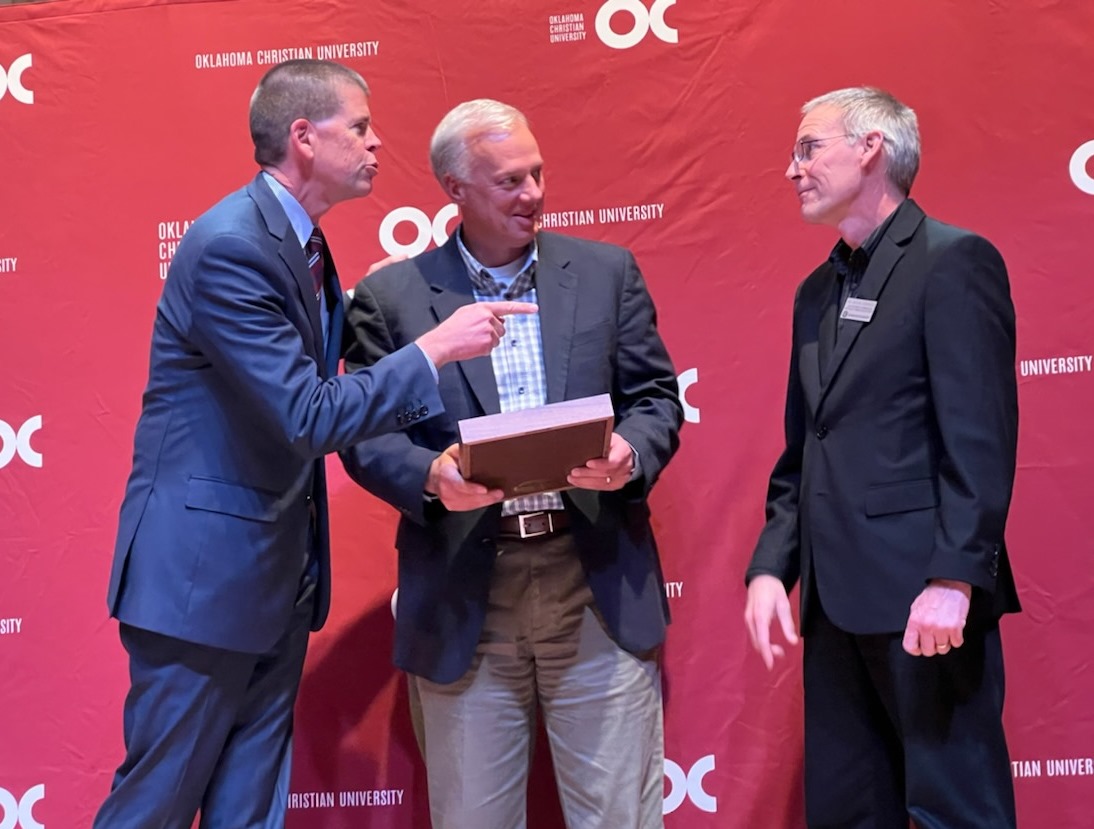
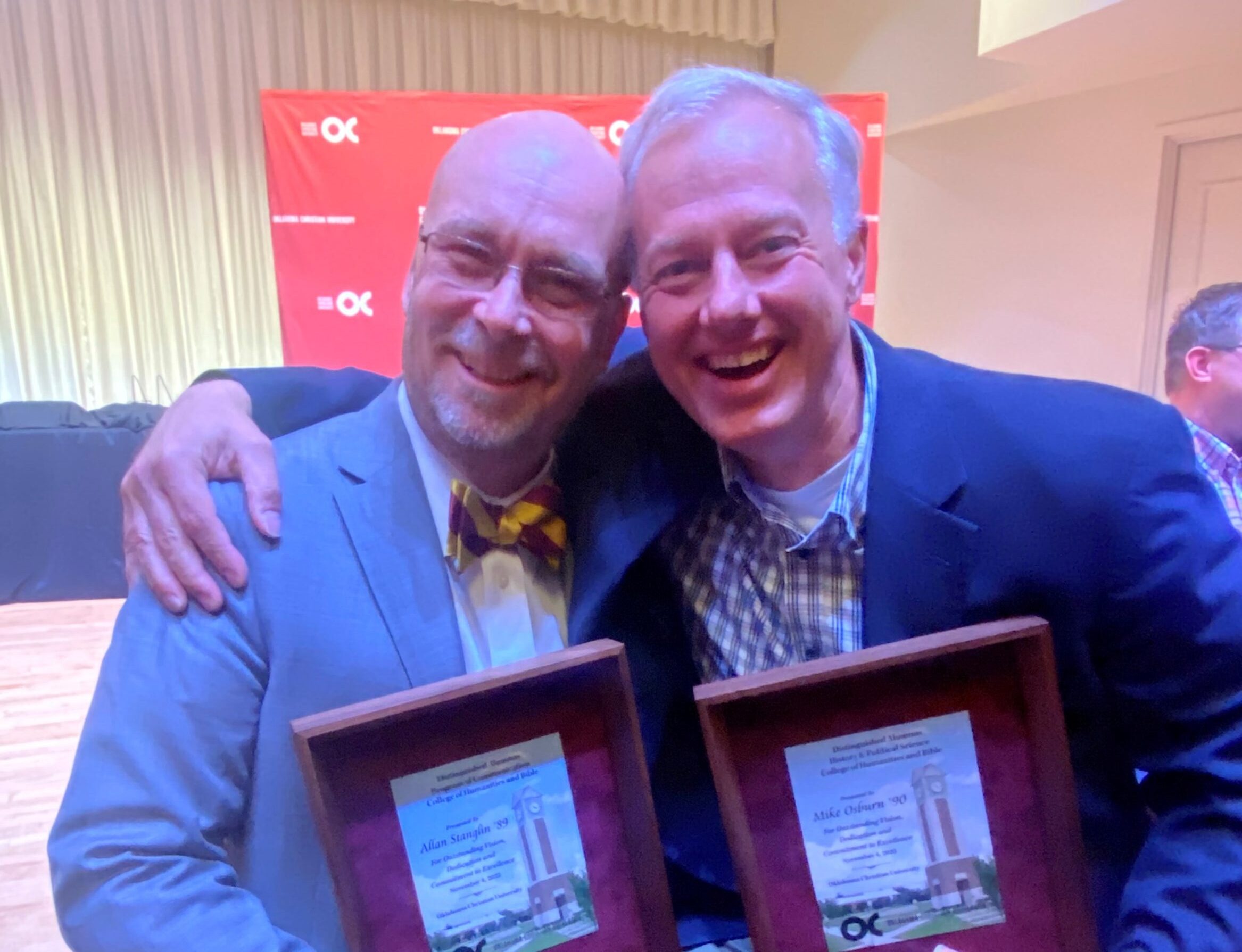
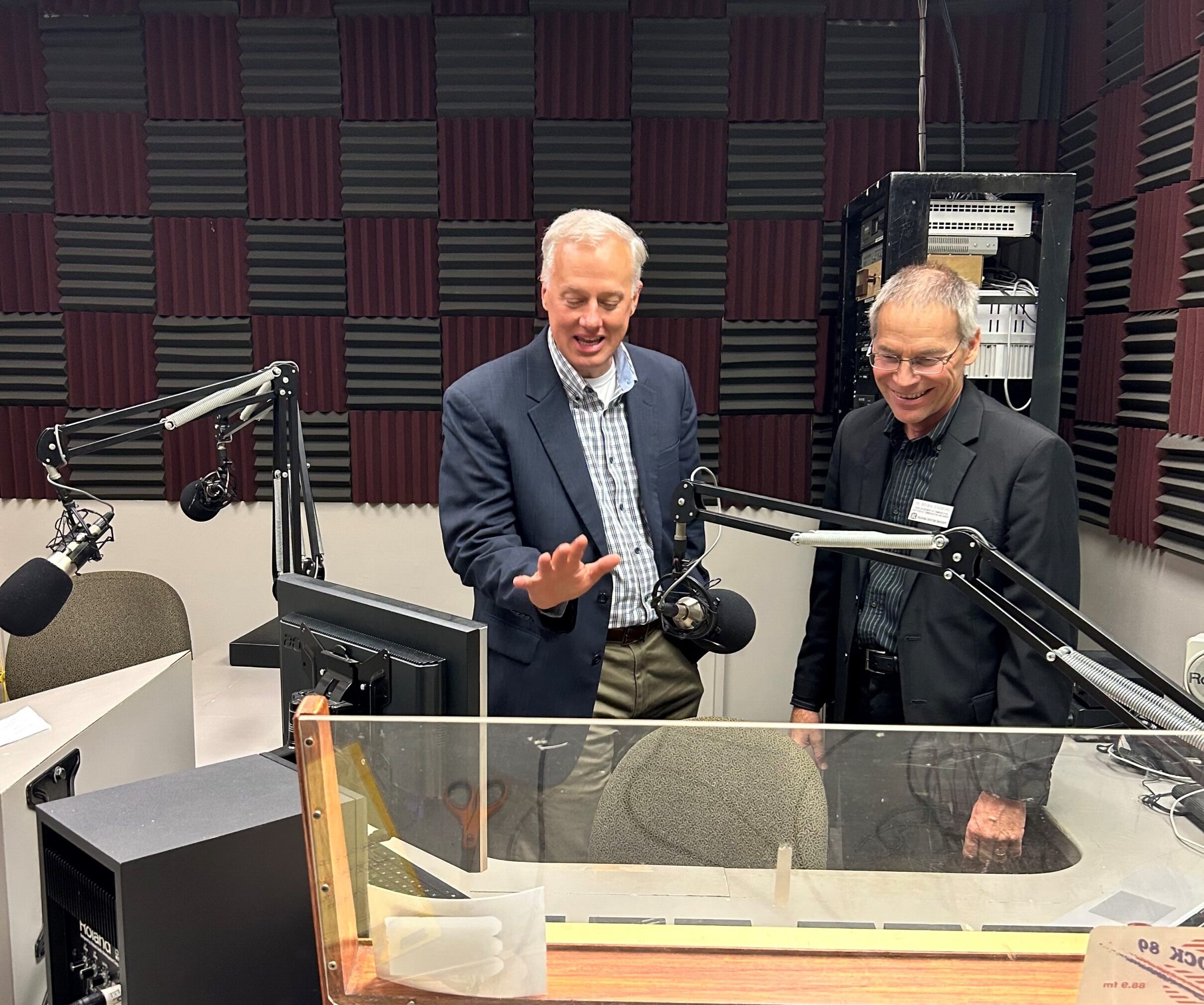
The ceremony was nice, of course. Our daughter Valerie and her husband David made the trip down from Tulsa to be with us. University President John deSteiguer said some really nice things about me. College roommate and great friend Mike Osburn was a fellow honoree, so that was cool. And Dr. Simmons gave me a tour of the KOCC studios.


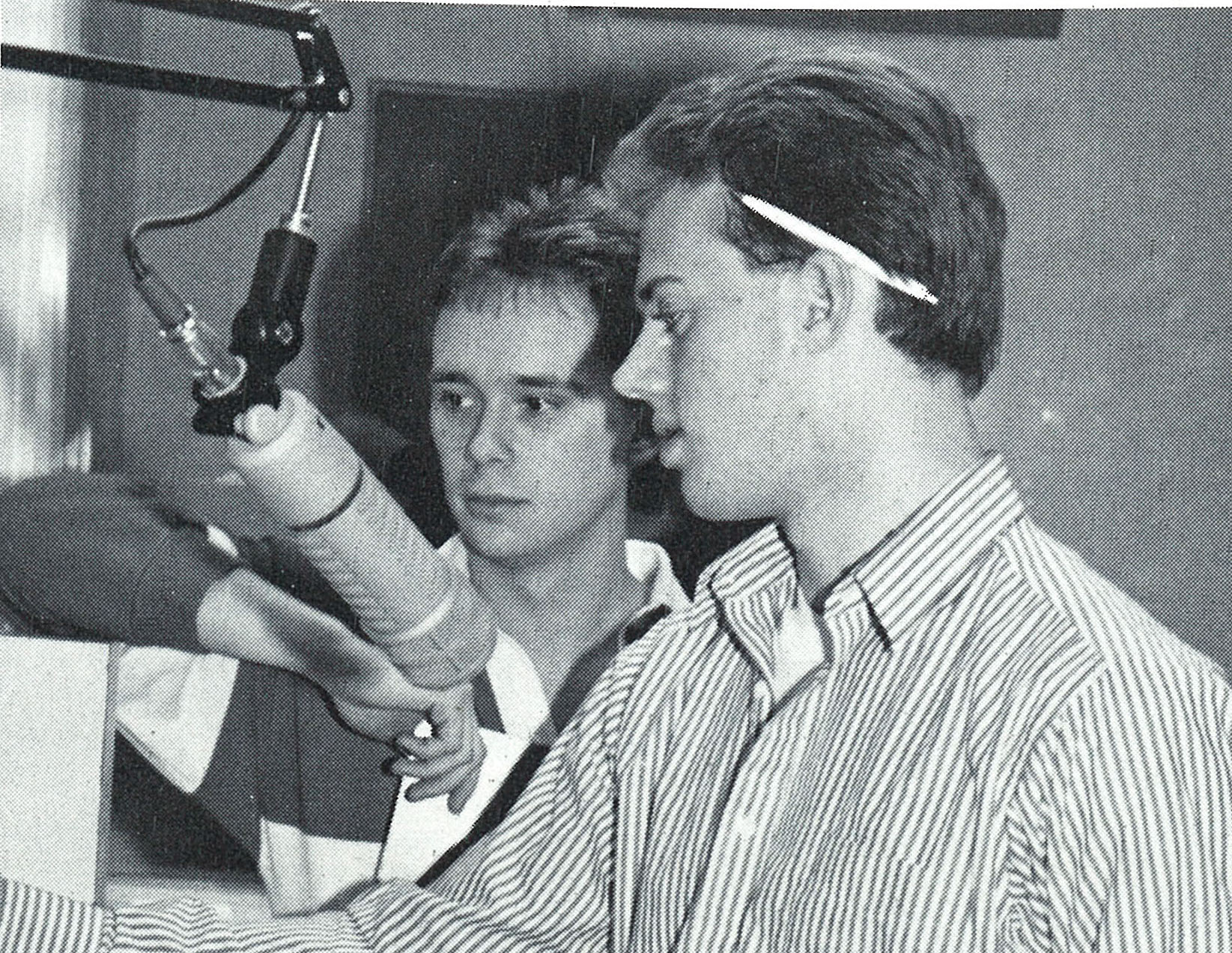
I spent many, many late nights and long hours in those recording and broadcast studios of the campus radio station during my four years at Oklahoma Christian. Brian was a junior Mass Communications major and the radio station manager when I showed up as a freshman. I auditioned for Brian, trying out for the play-by-play position for the men’s and women’s basketball teams. He told me I had a lot to learn and that I could learn most of it by running the boards at the station during the game broadcasts. And he was right. I signed up for almost every single shift that fall of 1985, listening to Stuart Graham from all the various NAIA gyms all over the Sooner Athletic Conference and punching up the underwriting announcements and station breaks at the right time. I produced promotional spots and worked with Brian on intros and outros for the games. I soaked up everything I could from Stuart’s broadcasts – the seamless way he worked up-to-the minute statistics and players’ hometowns into his call, the detailed descriptions of the setting, the way he conveyed excitement without screaming. And when my sophomore year began, I not only had the play-by-play gig, Brian made me the Sports Director, too.


Dr. Simmons is now the chair of the Communications programs at OC and one of Valerie’s and Carley’s all-time favorite teachers, which is really cool. We were privileged to share dinner Friday with Brian and with one of our favorite Mass Comm professors from back in the day, Dr. Philip Patterson. They were both very kind and gracious to me over the weekend and I am thankful to God that he placed both of them in my life at the exact right time.

I must also mention here the annual Delta alumni breakfast which was held Saturday at the beautiful home of Al and Judy Branch. Ozzy was there. David Bates. Scott Williams. Brad Robison. Two Haworths. Two Egglestons. Ted Norton. Odell. All the founding members of our social service club from 1972. Adair, of course. And a whole bunch of younger and younger looking students. We covered it all: the Bush rally, Diet Skipper, pumpkins, Dave Butts and the possum, All-Sports glory, late-night carousings, OC security, float trips to Talequah, creative apartment renovations, summer roofing jobs, and a couple of notable arrests.

This marks the 50th year for my college social service club, Delta Gamma Sigma. The grand 50th anniversary blowout weekend is set for June 9-10, 2023. Which makes no sense. Which is somehow quite fitting. Adair and Bates unveiled the 50th anniversary logo at Saturday’s breakfast and Ozzy revealed the site of the summer bash.  I’m hoping to make it a three or four day deal so I can spend more time with these wonderful old friends. I’m also secretly pushing for the club to disband immediately following the June festivities. I mean, what’s the point now? When’s the last time this group won anything? End it at fifty and call it good!

Peace,

Allan

« Older posts Newer posts »