Category: Discipleship (Page 18 of 30)

I Am Not A Dog!

“First let the children eat all they want,” he told her, “for it is not right to take the children’s bread and toss it to their dogs.” ~Mark 7:27
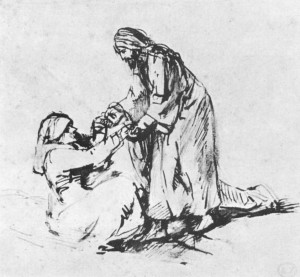
The way Jesus talks to this woman always messes us up. It’s fine for Jesus to be rude to Pharisees and Saducees. They deserve it. We even cheer at Jesus’ harsh words to the religious establishment… until we realize he’s talking to us. But it’s just not like him — it’s not Christ-like — for him to be rude to this woman who’s genuinely coming to him for help. It doesn’t make sense. It offends us.

Now, I do think Jesus is doing something deliberate here. And I think Mark is bending over backwards to show it to us. I believe Jesus is re-stating the salvation plan: first for the Jew and then for the Greek. And as he’s saying it, he’s demonstrating that the “then” is right now! He heals this Gentile woman in this Gentile land. And then our Lord immediately takes off for the Decapolis, ten pagan Gentile cities on the east coast of Galilee. And he heals. And then he feeds four thousand Gentiles in a Gentile desert. What Mark is saying in this section of his Gospel is that now it’s for everybody. The power of the Kingdom of God is for all people. You do not set any limits on the universal reach of the Savior of the World.

But sometimes that wonderful news overshadows the great humility of this desperate woman. And I believe Mark wants us to pay attention to that, too.

Jesus calls her and her people “dogs.” There’s no getting around it. And this woman doesn’t argue. She accepts the Jewish priority as explained by Jesus. She concedes the difference between the children and the dogs. And she humbles herself as a dog in order to accept healing from the Lord.

Her attitude is key. It’s necessary if one is going to be a true disciple of Jesus.

She comes to Jesus empty handed. She makes no claim. She has no merit. No priority. No standing. No privilege. She has nothing to commend herself to Jesus. She is in no way deserving of his mercy and healing. She does not argue that her case is some kind of special exception. She doesn’t lobby for special treatment. She completely accepts his judgment and bows down before Jesus as a beggar.

She’s not saying, “Lord, give me what I deserve on the basis of my goodness.” She says, “Lord, give me what I don’t deserve on the basis of your goodness.”

This willingness to humble oneself is a key requirement for discipleship. And it’s a lesson that Jesus’ own hand-picked apostles had a difficult time learning. Her attitude is the opposite of the apostles’ who are always arguing about who’s going to be the greatest. This woman is not bitter about the privileges of others. She doesn’t resent others’ shares of God’s blessings. She accepts her place and she comes to Jesus, just like we all must, as a sinner, poor and needy. She accepts that she’s unacceptable. Just like me. Just like us.

Martin Luther saw the entire Gospel in this one story. We are truly more wicked than we could ever believe; and we are more loved and accepted by God than we could ever dare to hope.

Pride, though, is our huge problem. Augustine said pride is what changed angels into devils. Pride is what causes us to thumb our noses at the God who insists we are unworthy. “I’m not a dog! I’m not weak! I’m not incapable! I’m not undeserving!” We’re offended. And we walk away from the Savior.

But not this woman. No, sir. This woman understood very well what Romans tells us, what all of Holy Scripture tells us: we are rebels and enemies of God, sinful and diseased, dead and powerless. In all humility she accepted that status, and received from Christ the healing and salvation she and her family so desperately needed. She is the perfect model of what it means to be last of all, to bow low and submit to the gracious King.

Don’t believe for a second you’re not a dog. You are. Don’t change the words in the song from “…such a worm as I” to “…such a one as I.” Don’t. You are an unrighteous, unholy, sinful, dirty human being in desperate need of a Savior. And he has come. And he loves you more than you can possibly begin to imagine.

Peace,

Allan

Do You See Anything?

Yesterday’s Skip-shot in this space has started something. I received a text from Byrnes very early this morning that said:

 “Rangers Subdued by Iron Fister.”

I countered with:

“Colby Serves Up the Cheese in Rangers Loss.”

If you’d like to add a corny headline about last night’s game before this afternoon’s begins, jump in.

~~~~~~~~~

We’re conditioned by our world — actually it’s in our nature and then reinforced by the world — to see the things we want to see and hear the things we want to hear. Anybody with a spouse or any children know this first hand. I’ll tell the girls “maybe” and they run to Carrie-Anne and say, “Dad said we could!” As a preacher, sometimes this works in my favor. Somebody will tell me how wonderful it was when I said such-and-such and I have no idea what she’s talking about. What this lady heard is nowhere near what I was preaching. But it meant something to her. And I still take credit for it. Of course, it certainly can work the other way, too.

In the Gospel of Mark, Jesus keeps asking people if they’re seeing correctly. Jesus asks the blind guy in Mark 8, “Do you see anything?” Same chapter, in the boat before Jesus and his apostles reach Bethsaida, he asks them, “Do you still not see?”

The blind guy in Mark 8 whose vision is blurry, whose eyesight is not perfectly clear, who sees something but not everything, represents everybody in the Gospel. And most everybody we encounter today. We see Jesus. But we don’t see all of him. We only see what we want. We embrace the Jesus who heals and forgives and feeds and loves and accepts and saves. We want to follow Jesus and live like that Jesus. But a Jesus who suffers and dies? Peter refused to see it. Most everybody did. Sometimes we don’t see it. And our picture of the Messiah is woefully incomplete. The Savior we teach is less than whole. The Gospel we preach is only partial truth.

We don’t see Jesus completely until we see his suffering and death. To see Jesus die is to understand who he really is and what he really came to do.

There are only two people in the entire Gospel of Mark who are said to “see.” One is Bartimaeus, the only other blind guy in the whole book, in Mark 10. This is Jesus’ final miracle, his last healing, as he enters Jerusalem to die. Bartimaeus calls out to Jesus, “Son of David!” That’s the Messianic title. The blind guy is the only one who sees. Jesus asks him, “What do you want me to do for you?” And Bartimaeus answers, “I want to see.” And the text tells us that “immediately he received his sight and followed Jesus.” To the cross. To his death.

The other one is the Roman Centurion. At the cross. At Jesus’ death. The crowds were shouting, “Come down from the cross that we may see and believe!” When the soldier “saw how he died,” he confessed Jesus as the Son of God.

If you tell Jesus “I want to see,” what you’ll see is a commitment to trials and ridicule and persecution and suffering. You’ll see a road, a way, that leads to your death. What you’re promised is the same exaltation and glory that he now has as the resurrected Lord reigning at the right hand of the Father in heaven.

Peace,

Allan

The Active Life

The life of a disciple is active, not reactive. It has nothing to do with just talking about faith or teaching religious principles or believing theological ideas or keeping biblical rules. It has everything to do with living one’s whole life in obedience to God’s call through personal action. It doesn’t just require a mind. It requires a body, too.

Ours is a life given to us by God to be lived not in some kind of rigid, cramped, crowded, small, compromised, legalistic way but in a full, wild, joyful, exuberant, cheerful, celebratory way. A way that apprehends and assimilates and then radiates the freedom we have from God in Christ.

Our Father wants his beloved children to operate out of joy and freedom to do what is good and right, not out of fear of making a mistake. Isn’t that one of the great lessons in Jesus’ story about the servants and the talents in Matthew 25?

The Christian life is an active life. Our God calls us to give our whole selves to him. Brakes off; no looking back; full steam ahead! We must act in faith that our God who calls us to live boldly and outrageously for him also promises us that if and when we do mess up in enthusiastic service to our King, he promises forgiveness and consolation and salvation.

Peace,

Allan

“A Fork in the Road”

Lord, I don’t want to be a mile-marker on the road of life, that as people pass me by, maybe they notice, maybe they don’t. It doesn’t matter. They continue on in the same direction as before.

But I want to be a fork in the road.

So that when people meet me they must decide which way to go. Because when they meet me, they don’t just meet me. They meet the Christ who lives in me.

~Jim Eliot, from The Shadow of the Almighty, 1956

WDJD

I like the idea of “What would Jesus do?” I like that concept. But I don’t believe that’s necessarily what the Bible is getting at when it links our beliefs and our behavior. As our theology shapes our practices, I think it’s much more about discovering the character of Christ and acting in concert with that character.

Following the death and resurrection of Jesus, it doesn’t seem like the apostles wondered what Jesus would do if were in their shoes. It wasn’t “What would Jesus do if he were me?” It’s not “What would Jesus do if were here right now?” It looks like the thought of the early Christians and the teachings and example of the apostles was, “Because of what Jesus has done, how should I act?”

“What did Jesus do?”

What decision will I make today that embodies the very character of the God who gave up everything for the sake of the world? What decision right now reflects the integrity of the Christ as he lived and died for the salvation of others? How does my decision today fit in with the eternal purposes of God in Christ?

Forgive one another as God in Christ forgave you. Accept one another as Christ has accepted you. Love one another as God loves you.

It appears to me that the apostle Paul took the truth of the Gospel into account with every single decision he made in life. Every single plan, every move, was made after first considering carefully the Gospel implications. Even something as normal and routine as changing his travel plans was done “in the holiness and sincerity that are from God.” Paul rearranged his schedule “not according to worldly wisdom but according to God’s grace.”

I have conversations from time to time — 20 and 30 minute conversations — about something we’re doing or not doing at our church. Something somebody really likes or something somebody really doesn’t like much at all. Some activity or practice or decision that has this person talking. And I listen to these long, heated, passionate pleas, and not one time does the person mention God. Or Jesus. Not one time does the truth of the Gospel get inserted into the discussion.

The faithfulness of God and the character of Christ must be the determining factor in everything we do as a church of his people and in our own individual ministries and lives.

It’s not so much “What would Jesus do?” It’s more like “Because of what Jesus did, and because of what God is doing through Christ today, what kind of a person am I and what kinds of choices and decisions do I make?

Go Mavs,

Allan

People People

My Jesus is a people person. He absolutely loves a crowd.

Yeah, there were times when our Lord went alone into the desert or climbed a mountain to pray. But it’s much more typical in the Gospels for Jesus to be interacting with people. The eyewitnesses paint a picture of Jesus constantly mixing it up with the multitudes, meeting strangers on the road, hanging out with family and friends. Mostly Jesus is known for eating and drinking with gusto in the homes of sinners and saints, with the prostitutes and the Pharisees, men and women, Gentiles and Jews.

Praying with people. Worshiping with people. Walking with people. Fishing with people. Teaching and debating with people. Laughing and crying with people.

Jesus was a supremely social, communal person. Whatever it was that the Father called the Son to do, he had no interest in doing it by himself. Just a casual glance at Jesus is enough to tell us today that we are fully living as God-created humans, not in our solitude and isolation, but in our relationships and connections with others.

We are people people.

We need God, yes. And we so desperately need one another. You can’t do this faith solo.

Peace,

Allan

« Older posts Newer posts »