Category: Christ & Culture (Page 25 of 45)

I Forgive You

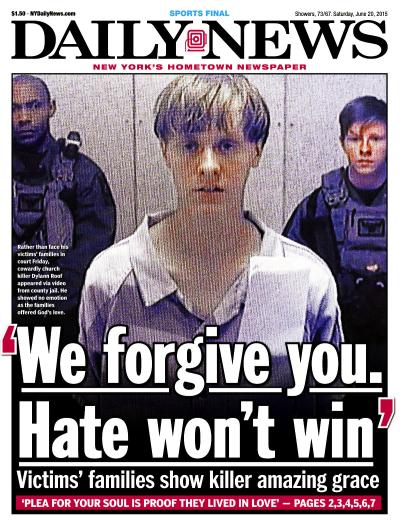
DylannRoofMonitor

They are three of the most powerful words in any language. These three words contain the awesome power to break through seemingly impenetrable walls, to break down unscaleable obstacles, to break in to the most fortified places. These words are able to accomplish what bullets and bombs cannot, what politicians and policies cannot, what violence and force cannot.

“I forgive you.”

Powerful. Whoa!

These are the three short words the family members of the nine Christians killed in Charleston used over and over in court Friday afternoon when confronting their loved ones’ murderer.

Dylann Roof killed Ethel Lance’s mother in that horrible shooting. Yet Ethel told Dylann Friday, “I will never be able to hold her again, but I forgive you. You hurt a lot of people; but God forgives you and I forgive you.”

Felicia Sanders survived the massacre at that mid-week Bible study, left to mourn her daughter who was slain by Roof. She prayed for him Friday, “I forgive you. May God have mercy on you.”

Myra Thompson’s relative told Roof, “I forgive you and my family forgives you.”

When reflecting on the unique scene that played out in that South Carolina courtroom Friday, the President of the United States later observed, “In the midst of darkest tragedy, the decency and goodness of the American people shines through in these families.”

With all due respect, I disagree. To borrow Demi Moore’s line, I strenuously object.

It’s not decency and goodness in Americans that’s shining through, it’s the love of Christ in Christians that is shining through. It’s the glory of a loving and merciful God that is reflected through disciples of Jesus, not citizens of the United States.

DylannRoofForgiveAmericans do not respond to violence with forgiveness, Christians do. American people do not meet hate with love, Christians do. Americans don’t return grace and good for evil, Christians do. Americans respond in vengeance with bullets, seeking revenge by force. Christians react in love with forgiveness, seeking reconciliation by means of peace.

The reason it makes news, the reason it raises eyebrows, the reason it compels commentary and praise is because forgiving enemies and doing good to those who persecute is so decidedly un-American! The reason it stops the presses is because it’s so radically different, it’s so anti-culture, it’s so not what we expect.

It moves mountains, it shakes the earth, it changes everything.

“I forgive you.”

It liberates, it transforms, it saves.

“I forgive you.”

You should give it a try sometime.

Peace,

Allan

A Prayer from Charleston

Bystanders and mourners cast shadows on the walls and the makeshift memorial at the Emanuel African Methodist Episcopal Church in Charleston

To the God who made one human race from the dust of the ground,
who made us after his image that we might reflect his nature
and that we might reflect his character,
we come to you with minds that are confused and hearts that are broken,
in a tongue that is laboring to give birth to words and emotions
too powerful to be constrained by our impotent vocabulary;
so we cry and stomp and tremble, hoping you hear.

Again, Father, our conscience has been pricked by the angry bullets of hate;
the blood of the victims and the tears of their families cry out to you for justice.
We beg for your wisdom, for we do not know where to go or how to get there;
we beg for your courage, because we allow our fear to paralyze us from doing what is right;
we beg for your mercy, for we often turn back from what we set out to do.

We pray for the families of the victims whose loved ones were slain in cold blood,
that your healing love will keep their hearts from becoming frozen
by the pain of bitterness and resentment.
We pray that you will comfort them in the middle of their pain
and give them the resolve to continue
when they will be tempted to give up.

We pray for the shooter, that his heart will soften
and that he will repent and seek your forgiveness.
We pray for the shooter’s family, that you might comfort them
and that we might show mercy toward them.

We pray that this tragedy will serve as another wake up call,
an alarm that will wake us from a racist nightmare of indifference.
Help us, Lord, not to push the snooze button and continue to sleep,
but to wake up and soberly face the struggle before us.
Help us, O God, to work on the problems together,
because many hands make the work light.

Help us work together, because the problems are too big
for any one person or ethnic group alone to fix.
Help us work together, because the humanity that unites us
is stronger than the perspectives that divide us.

Help us to lean on you, because at the root of all evil,
whether passive or purposeful,
is a sinful heart that can only be cleansed and strengthened
by the blood of your Son.

Amen

~ a prayer by Bobby Green, minister for the Metropolitan Church of Christ in Charleston, SC

The Corporate Life

Regular readers here are aware of my deep conviction that salvation is a corporate event. No one is saved alone, no one is a Christian by herself, no one worships or serves in isolation. God draws us to him in community, we are baptized into a community, we are transformed by the Spirit in the context of community. But in an increasingly individualistic society such as ours in the U. S., those ideas are more and more marginalized and rendered almost antiquated. In our culture, an individual’s rights and freedoms now trump those of the community. Almost any community.

Nobody watches broadcast TV anymore; we watch Netflix and DVDs and DVR’ed programs by ourselves where and when we please. Nobody listens to the radio anymore; we program our own playlists and listen with our own ear buds any where and any time we like. And if the civic club or the social group I belong to acts in any way that infringes on my own personal choices, I leave and join a new club. Or I start my own club, even if that club is just a chat-site or a Facebook group. And if any organization is seen by the society as encroaching on anyone’s individual desires, that group faces pressure from the society to relax its standards. Community must bow to the individual.

That means the members of our churches today are more prone to bristle when congregational leadership wants to hold them to high standards of discipleship. They are more likely to take offense and leave when they’re expected to behave in certain orthodox ways. At the very least, they’re bent towards ignoring it when the church calls for disciplined living in a particular community of faith.

That’s not the only reason that church numbers are going down across this country. But it’s a factor.

In an essay for Christianity Today, Andy Crouch calls this the “erosion of corporate identity.” He observes that Supreme Court Justice Ruth Bader Ginsburg, in her dissent in the recent Hobby Lobby case, wrote that “religious organizations exist to foster the interests of persons subscribing to the same religious faith.” Now, you and I both know that’s wrong. We know that Israel was saved and called by God to exist for the sake of the nations. We know that the Church is saved and called to sacrifice and live for the sake of others. But our culture doesn’t behave this way. So communities that try to behave this way are attacked or, at the very least undermined and marginalized by society:

“An individualistic world is scandalized by any community whose boundaries threaten the freedom of the individuals within it. Such a world promotes transactional relationships, overseen by the only form of community that remains: a centralized and powerful nation-state. Rather than existing to protect small- and medium-sized communities, the state views them with suspicion. Or that state redefines them, as did Justice Ginsburg, by reducing them to the most venal of motives.”

Corporate life in the U. S. is withering. Corporate life is what gave our forefathers their sense of belonging and identity and their platform through which to work for the greater good. But it’s fading fast. Small- and medium-sized businesses, civic organizations, and churches are on a rapid decline. Fewer and fewer of us have deep connections to the small communities that used to mediate life. Forty-one percent of children in the United States are born out of wedlock, so even the most fundamental and committed of  communities — the family — is  in trouble.

So, how are we to respond?

I believe we commit ourselves even more to the countercultural, subversive, corporate reality known as the local church. In all of its imperfections and sins, its many problems and issues — we throw ourselves into it with everything we’ve got. God’s Church should make a stronger claim on us than the state. According to our Lord, it makes a deeper claim on us even than our families. And by being stronger and deeper than the family and the state, your church provides a loving and loyal family for those who don’t have one and an eternal identity and community for us all. Yes, the church is going to demand a great deal from you. The church will ask that you humbly sacrifice and serve, that you eagerly give and work, that you commit and defer for the sake of others. But it also gives us the corporate life that we were created to enjoy, the only life that resembles the mutual love and relationship the Father, Son, and Holy Spirit have enjoyed forever and brought us into existence to share.

Peace,

Allan

Quick Hits on Friday

I’m headed to Dallas today with our youngest daughter, Carley, for the Tom Petty and the Heartbreakers concert at American Airlines Center. This is Carley’s birthday present — something she specifically asked for — and I’m all too happy to accommodate. I get to spend awesome alone time with her for the next 30+ hours, I get to share her first big arena concert experience with her, and I can use the opportunity to instill Rock and Roll deeper into her heart and soul. After seeing what has happened to Valerie, I’m concerned that, the longer we live in Amarillo, the chances of Carley eventually turning toward country music increase. I’ve got to do all I can. She’s my last hope.

~~~~~~~~~~~~~~~~~

Adam Gray turned me on to a wonderful little reflection piece by Richard Beck, the head of the Psychology Department at Abilene Christian University, on how he makes theological sense of listening to Barbara Brown Taylor and Stanley Hauerwas on back-to-back days at Summit. As someone who has read and thoroughly enjoyed Barbara Brown Taylor’s books on preaching and is still reading and learning from Stanley Hauerwas’ books on theology and ethics, I have found Beck’s insights to be very, very helpful. You can read Beck’s analysis by clicking here.

~~~~~~~~~~~~~~~~~~~

I will also recommend a wonderful essay in the current issue of Christianity Today by N. D. Wilson. “Called to Be Uncool” is a short piece and a serious call for Christians to stand against the prevailing culture, to resist conforming to the world’s culture, in order to effectively speak a word from the Lord and to live in the name and manner of Christ. The imagery is of cows that turn their backs to the wind so they’re continuously running parallel to the breeze. Wilson writes that we “must be fearless, immune to the pressures of kings and crowds, aligned only with the breath of God.” Whew! It’s good. You can read the entire essay by clicking here.

Have a great weekend.

Peace,

Allan

Citizenship

“Our citizenship is in heaven.” ~Philippians 3:20

The city of Philippi was a Roman colony. It was 550 miles east of Rome, across the sea and in a different world in many respects. But because it was a Roman colony, the citizens of the Philippi region were citizens of Rome. Their official citizenship was in Rome. And they were very proud of that citizenship. So they dressed like Romans. They built their buildings and set up their city administration like Romans. They spoke Latin like Romans; they worshiped the emperor like Romans. They lived in Philippi, but they never considered themselves Philippians — they were Romans. They lived in Macedonia on the Aegean Sea — but their citizenship was in Rome.

When Paul and Silas were in Philippi in Acts 16, the owners of the slave girl accused the missionaries of “advocating customs unlawful for us Romans to accept or practice.” What did they mean “us Romans?” Don’t they know they live in Philippi? Yes, they live in Philippi, but their citizenship is in Rome. Philippi is a Roman outpost. It’s an island of one culture in the middle of another. It’s a city of people holding on to and promoting customs and traditions and practices and even a language that is unfamiliar to its surroundings.

My family and I lived in Memphis, Tennessee for almost a year in 1998. We bought a house in Memphis and Carrie-Anne and I both worked in Memphis. Whitney went to Memphis public school. But I refused to get a Tennessee drivers license. I didn’t get a Tennessee license plate. I flew the Texas flag from our front porch and in my office at work. I wore Dallas Mavericks t-shirts, I listened to Stevie Ray Vaughn everyday, and I absolutely never, ever put cole slaw on top of my barbecue sandwich! I was living in Tennessee, but my citizenship was in Texas.
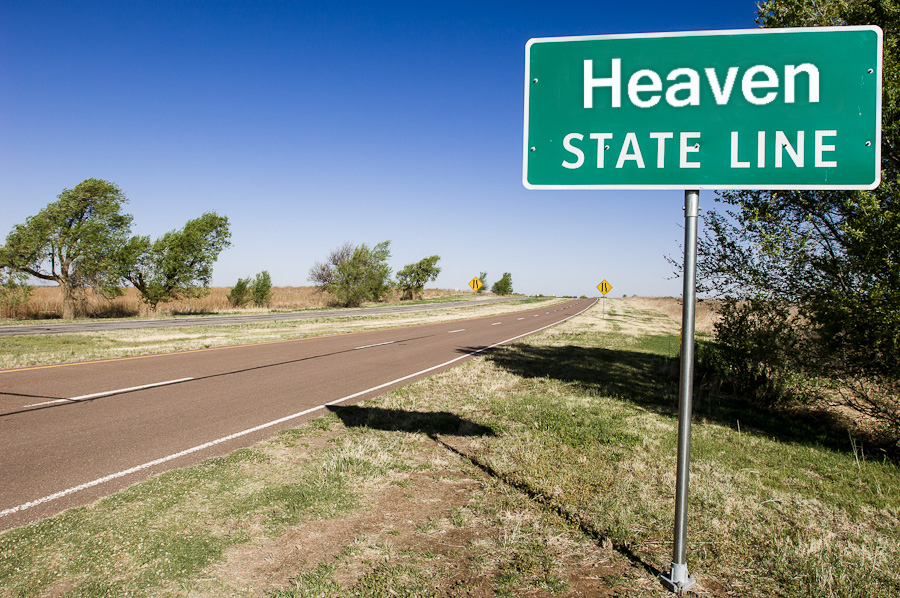
The same thing is happening with the folks receiving this letter from Paul. The apostle writes to the Christians in Philippi and he says, “Our citizenship is in heaven.” You don’t belong to Philippi or to Rome; our citizenship is in heaven.

Here on earth, we are a colony of heavenly citizens. God’s Church is an outpost. It’s an island of one culture in the middle of another. God’s Church is a city of people holding on to and promoting customs and traditions and practices and a language unfamiliar to our surroundings.

And it sets us apart. It makes us different.

In Acts 21, Paul is accused of teaching “all men everywhere against our people and our law and this place.” When given the chance to defend himself, Paul claims that as a citizen of heaven, as a subject of Christ, he “had fulfilled his duty.” The Christians in Thessalonica are arrested in Acts 17 and charged with “defying Caesar’s decrees, saying that there is another king, one called Jesus.” Our Lord is standing in chains before the Roman governor in John 18 when he says, “My Kingdom is not of this world. If it were, my servants would fight… my Kingdom is from another place.”

To confess that Jesus is Lord is to say that Caesar is not. And that makes us different. To claim citizenship in heaven is to declare our allegiance first and foremost to God’s Kingdom, not the Empire. And that sets us apart.

Jesus did not bring a new teaching or a new ethic; Jesus brings a brand new reality. Jesus didn’t give us new ideas about God and humanity and the world; he gives us an invitation to join up, to become part of a movement, a new people that is not of this world. We see something the world doesn’t see; we understand something the world cannot comprehend. We live in and are part of the reality of the eternal power and reign of God in Christ. So we are strangers and aliens in this world because we get it, and nobody else does. We understand that God rules the world, not congressmen and presidents or governors and generals.

We need to slow down and look around and get a handle on what’s really going on. We need to see what’s really happening. That’s hard to do because we’re surrounded by all the unreality. With 24 hour news networks and around the clock talk radio and more ads and campaigns and debates and emails and bumper stickers than any of us can fathom, it’s easy to get caught up in it. If we’re not careful, we can actually start to believe that the Empire and its politics and our role in all that is pretty important. Until we step back and look at it with a heavenly perspective.

The Gospel of Jesus places all of us into an eternal and international community of those who follow the Savior. We live under the rule of our Christ. So our loyalties go far beyond any national thought or national pride. Our allegiance rises high above any national agenda. Our conduct will be different from the world’s because our citizenship is in heaven.

I was nine years old in the summer of 1975 when my dad packed up the blue Chevrolet Impala and took our family of five at the time and my grandmother up to Niagara Falls. Yes, we drove it; lots of ham sandwiches. After a long day of sightseeing in Ontario, I remember vividly ordering hamburgers at a little diner. I can still see the black and white tile on the floor and the pattern and colors of the fabric on the cushions of the booths. We ordered our meals and sat down together in the crowded diner. And after just a minute or two, a lady sitting at the table next to us leaned in toward us and said, “What part of Texas are you from?”

She hadn’t seen our license plates. We weren’t talking about home. None of us was wearing Dallas Cowboys t-shirts or anything that would have overtly given away where we lived. She said she could just tell by the way we talked and the way we acted that we were from Texas.

I remember being kind of proud about that. I think maybe I’m still a little proud about that.

When’s the last time you sat down at a restaurant and someone leaned over and said, “What part of heaven are you from?”

Wherever we go and whatever we do, we ought to stick out as people who live somewhere else. We are a people with customs and practices and a language different from the rest of the world. Our citizenship is in heaven. And it should be obvious.

Peace,

Allan

Can We At Least Think About It?

“Our citizenship is in heaven.” ~Philippians 3:20

The Church gets into trouble, we fail to live up to our responsibilities, when we equate national politics with the politics of God’s Kingdom. When we view earthly power systems as helpful to the cause of Christ, or something to be used, we fall short of our calling. When the colony of Christ, of which we are citizens, views the national agenda and the national methods of achieving that agenda as compatible with the ways and means of our Lord, we’re in trouble.

Consumerism. Materialism. Sex. Violence. Greed. Independence. War. That’s the prime-time lineup on our television stations. That’s what’s on the billboards and the sides of city buses. That’s what’s on the radio and our computer screens. That’s what drives this country’s economy. Those are the values that actually sustain this country and shape this country’s politics. They’re not compatible with the Kingdom of God, they’re competing.

But we don’t see it. Most of us don’t see the Empire as a subtle and seductive force working against God’s agenda. We don’t always view Caesar as actively seeking to destroy the work of our Christ. Because we’re so comfortable in this country, maybe. Because we have more than we’ll ever need, maybe. So we embrace the Empire as an ally, as something good that supports the Kingdom of God. In some cases, we even hold up Empire and Kingdom, God and Country, as if they are the same thing. We’ll talk like Christian values and American values are the same thing. Occasionally, we even give more to the conduct and culture of the Empire than to the conduct and culture of the Kingdom.

Maybe we don’t think about it. Can we at least start thinking about it? Maybe we’re not paying attention. Can we at least start paying attention?

Can we think about why we take off our caps and sing the national anthem at a ball game, but we get nervous if somebody wants to lead a prayer before dinner at Chili’s? Can we at least consider why we’ll stand perfectly still at complete attention with our hands over our hearts for the pledge of allegiance, but the reading of God’s holy Scriptures in the worship center on Sunday appears to be a cue to walk around and talk? Can we at least pay attention to why we’ll take a half-day off work so we can clap and cheer and whistle when someone becomes a citizen of this temporary, worldly Empire; but we duck out of the building when someone’s being baptized to become a citizen of the holy and eternal Kingdom of God in order to save ten minutes getting to lunch?

I get the emails and the articles and the videos from Christians almost every week. Emails calling democracy and capitalism God’s will for the entire world. I got an email last fall equating a single vote for a particular candidate with Christ’s singular sacrifice on the cross for the sins of all mankind. Somebody sent me a slideshow last year that said defending our rights and freedoms by going to war is a great Christian value.

It’s so subtle, I guess. We don’t think about it.

South African Bishop Peter Storey said:

“American preachers have a task more difficult, perhaps, than those faced by us under South Africa’s apartheid, or even Christians under Communism. We had obvious evils to engage; you have to unwrap your culture from years of red, white, and blue myth. You have to expose and confront the great disconnection between the kindness, compassion, and caring of most American people, and the ruthless way American power is experienced directly and indirectly by the poor of the earth. You have to help good people see how they have let their institutions do their sinning for them. This is not easy among people who really believe that their country does nothing but good. But it is necessary; not only for their future, but for us all.”

Can we at least think about it?

Peace,

Allan

« Older posts Newer posts »