Author: Allan (Page 202 of 492)

Why Christmas?


Christmas is a unique holiday. What separates Christmas from all the other holidays is that Christmas is the only Christian holiday that’s also a major secular holiday at the same time. It’s the culture’s biggest holiday, but it’s also religious. So we’ve got millions and millions of people celebrating Christmas, but in two different ways. It’s strange. And it brings a little bit of discomfort.

Christians are noticing that more and more of the public expressions of Christmas are avoiding any mention of the Christ. It’s a Winter Festival and a Happy Holiday, but it’s not a Merry Christmas. It’s a time for family, it’s a time for giving and joy and peace, but not worship. Christians notice that. The background music in the stores is less Joy to the World and more Grandma Got Run Over by a Reindeer. The Culture and Media Institute claim that 98.7% of all Christmas stories on network TV do not mention Jesus. They talk about holiday shopping trends and holiday travel alerts and the economy, the weather, and the food. But only 1.3% of the news stories about Christmas mention Christ. That bothers some Christians.

On the flip side, the non-religious among us complain that the Church is intruding on the season, forcing its beliefs and practices on people who don’t care. A column in last Sunday’s Amarillo Globe News pointed this out. An increasing number of non-Christians are saying that religious expressions during the holidays are offensive and oppressive. They want the songs without the baby in the manger. They want the joy and peace without the religious symbolism.

It can be a little confusing. It can lead to lots of questions. And those questions are all good questions.

Why Christmas? Why is it such a big deal, why is it so emotionally charged? Where did it come from? Why do we spend so much time and energy hanging up lights right after Thanksgiving? What’s the connection? Why do we spend so much money on so many presents? Who started that? Why do we think about the needy more during Christmas? Why do people feel more charitable during December?

Is Christmas a religious holiday or not? And does it really matter?

Can’t we just have Christmas without religion?

Well, I mean, you could. But it doesn’t really work. All those ancient connections are there. It’s the foundation of the holiday. And, yeah, we believe it matters. And we believe it’s all actually really good news!

We’re beginning a three-part series tomorrow morning at Central: “Why Christmas?” If you’re in Amarillo, why not join us at 10:15 Sunday mornings. If you’re not in the greater Amarillo area, I’ll be posting a lot of what we’re preaching in this space in the coming days.

Peace,

Allan

Praying for Israel

I’m not concerned about the politics of the U.S. president’s speech yesterday related to moving the American embassy in Israel to Jerusalem and declaring that city the eternal capitol of that nation. Frankly, I don’t understand the politics. Why does the U.S. insist on being so tangled up with Israel? Is it oil interests in the Middle East? Is it the money from Jewish-Americans who bankroll the re-election campaigns of the politicians? I don’t get it and it’s not my concern.

I’m also not concerned about the distorted theologies out there claiming that if the U.S. looks out for Israel and protects Israel and pursues the political purposes of Israel, then somehow God above will smile on America and we’ll all prosper and maybe Jesus will return. I don’t get it. The promise in the Torah is clear, from Genesis 12 on, that God’s salvation is for all nations, that the Lord is interested in rescuing all peoples. The New Testament tells us over and over again that the Church is Israel, we’re grafted in. It’s bigger than man-made boundaries and worldly politics and armies. The Church is the political entity; our citizenship is in the Kingdom of God. Our Lord is gathering all people to himself in Christ Jesus. He doesn’t love or favor any one nation or people any more or any less than he does the people of Israel.

My concern today is with the people I know and love in that great land.

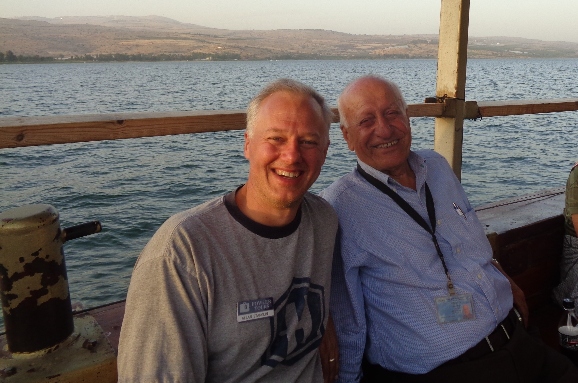
I emailed Anton Farah yesterday, a little ahead of the anticipated violence that has resulted from the U.S. government’s move. Anton is our faithful guide when we take our every-other-year trips to Israel. Anton led 15 of Bill Humble’s 20 trips to the Holy Land and blessed me by introducing me to his dear friend and guide. Anton was born and raised in Nazareth, a Palestinian and a Christian; a wise and humble man, full of grace and dry humor, brimming with knowledge and strength, full of God’s Holy Word and God’s Holy Spirit. I love Anton and his wife and sons.

I told him yesterday I was thinking about him and praying for him in advance of what’s going to be a rough few days. I was praying that God will bless him and the people he loves with peace and protection. I was praying that there would be no violence (D’oh!). I was praying that he and his family would be safe.

He emailed back that he’s in the middle of a seven day tour and is scheduled over the next four days to be in the West Bank, Jericho, Hebron, Arad, and Shechem. He expressed gratitude for the prayers and well wishes and told me he is also praying that there will be safety and no troubles. He’s not scared. He’s been through much worse. He thinks and reacts on a much higher plane.

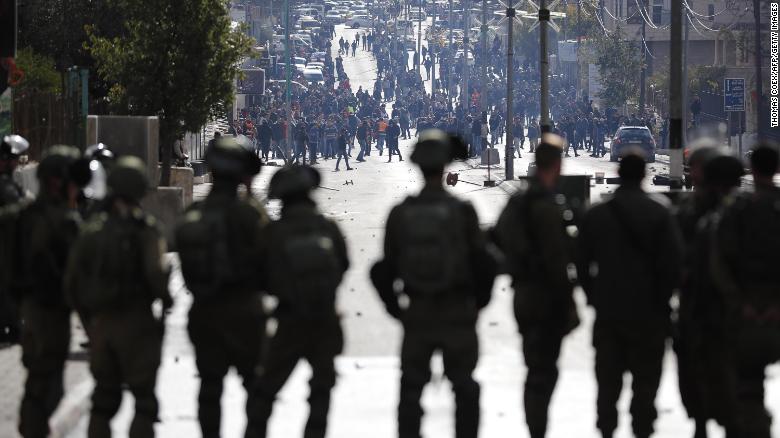
I’ve been checking in on the violence and protests throughout the day. The pictures and videos of protestors starting fires and throwing rocks and the Israeli police answering with tear gas, rubber bullets, and stun grenades are unnerving. It’s so sad. And dark. I don’t have a full grasp of the complicated politics — I’m not sure anyone does. I don’t understand the misguided theology — it’s wrong. But I do know some of the people in Israel — people on both sides of the ancient conflict — and I love them. And God loves them. All of them.

We’re scheduled to take a group of 32 to Israel the first week of June this coming year, the largest group I’ve ever led to the Holy Land! My middle daughter, Valerie, is making her first trip with us to Israel and I can’t wait for her to meet Anton and Kando and Shipley and all the beautiful men and women and children of that country. I can’t wait for her to see and experience all that our God has done and is doing there.

I’m a little concerned that the date for the next signing of the waiver that keeps the U.S. embassy in Tel Aviv is scheduled for that same June. Whether the American president signs the waiver at that time or chooses to actually move the embassy — either way — I’m worried that it’ll spark more violence and our trip will be in jeopardy. I hope not.

In the meantime, I would ask you to pray for the people of Israel. Don’t spend a lot of time praying and talking and tweeting and texting and forwarding emails about the politics or the theology of the current situation over there. Pray for the people. Think holy thoughts about the men, women, and children in Israel.

Pray for peace — not peace on U.S. terms, not peace according to your political party’s definition, not peace that’s brought about by threat and force. Pray for the eternal peace of Jesus Christ, his will, in his way, in his timing, to his glory.

Shalom,

Allan

Where He Leads

For the past several years it’s become clear that the word “evangelical” has very little, if anything, to do with Christianity or religion. It’s not a Christian term anymore. It’s been misused and redefined by the politicians and media in the United States for so long now that it’s become a purely secular word. A national political term.

One of the more obvious manifestations of this is in the way African Americans are left out. Have you noticed that the media will not refer to African Americans as “evangelicals?” Christians of color may have a high regard for the Bible, they may focus on the atonement of Christ through the cross, they may be committed to proclaiming the Gospel, they may believe the Gospel changes lives and changes the world — they may embody every facet of the classic definition of “evangelical.” But because African Americans vote heavily for Democratic candidates, the media will not call them “evangelicals.” The term is strictly political now. “Evangelical” means Republican. “Evangelical” means guns and lower taxes and immigration reform and repealing Obamacare.

There are a lot of reasons this matters so much. One of the main reasons is that our young people now identify traditional Christianity with right wing American politics. This development has been analyzed and discussed in every “unchristian” and “You Lost Me” type of book that’s been written in the past twenty years. Young people are not leaving the Church because they reject Christ Jesus as Lord, they’re leaving the Church because they reject the national politics that appear to go with it.

That’s a problem for all of us. Whatever our national political beliefs and practices — left or right, Democrat or Republican, conservative or liberal — they shouldn’t be wrapped up in God’s Church because they all eventually come into conflict with God’s ways. And our young people see right through it.

I was privileged to be in attendance at Hope Network’s Preacher Initiative in Dallas last month when Dr. Mallory Wyckoff delivered a powerful sermon on the disconnect between what we teach our young people in our churches and what they actually experience in and through us who do the teaching. Her sermon was gut-level honest and penetrating. Eye-opening. Inspiring. The language soared and the message cut straight to the heart of the Gospel.

Mallory has graciously provided me with a manuscript of her sermon, “Where You Lead I Will Follow” from Matthew 23. You can find the entire sermon posted to her website here. But I’d like to share a couple of excerpts in this space.

Mallory began by praising the church and the church people who raised her in the faith. She expressed her admiration and love for those men and women who shaped her as a child of God.

“To be sure, I was loved. I was loved really well. I was made to believe that I had worth, that I could pursue the dreams that surged within, that God would guide me as I took each clumsy step. I was nurtured in the Christian faith from the womb, loved and cared on by my community, educated in their schools, formed in their churches. I attended their youth groups and summer camps, wore their T-shirts and sang their songs. These people invested in me, gave of their time and resources to help me grow into the woman I am now. For all of this and for more, I am grateful.”

Mallory then moved to unashamedly hold the mirror up to the troubling inconsistencies she noticed when she actually began to read the Bible her church told her to read and follow the Christ her church told her to follow.

“[I] observed that Jesus seemed to care an awful lot about the poor and marginalized, giving them food and dignity, binding their wounds and healing their bodies. But when I named the gross inequities between the rich and poor in our country and asked what we might do to overcome this, they called me a socialist…

They told me about the cross of Christ and insisted this was a central feature of our faith. So I spent time reflecting on the cross and observed it as the culmination of Jesus’ consistent refusal to employ violent means. I took to heart his teachings that the swords we live by surely are the ones by which we will die, that we are to love our enemies and, perhaps, this might mean to not kill them. I wondered how I could follow this Christ with any integrity in my heart if I also carried a gun in my hand or on my hip. But when I asked my church about these things, they told me this was unrealistic, that Jesus’ teachings are for individuals but have nothing to say to nation-states, and that I should fear the nation-state taking from me the very weapons Jesus warned against.

They took me to the baptismal font and buried me with Christ beneath the waters, calling on me to live into the newness of life in Christ, proclaiming that my identity is found therein, and I swore my allegiance to Christ. But when I began asking about all of the myriad allegiances we seem to hold in conflict with the lordship of Christ, that perhaps nationalism is the most dangerous kind of idolatry, they told me I was not a good patriot.

They taught me about the early church, a marginalized sect seeking to live into the Kingdom in the midst of empire. They told me stories of the church’s courage, even in the face of persecution and death, and of their commitment to the way of Christ. But when I began wondering about how the empire in which we find ourselves dehumanizes black and brown bodies, they told me I didn’t show enough respect for the flag and for country and for every other symbol that bears Caesar’s image even while the body count for image bearers of God keeps climbing…”

Mallory’s critique comes straight out of Scripture, directly out of the prophets’ mouths and our Savior’s heart. She articulates so well what stirs my own soul and what burdens my shoulders and my mind, but what I have such difficulty describing. She perfectly says what I’m thinking.

Our priorities are out of whack. Our identities are compromised. We’re seeing issues to be argued instead of people to be loved. We think first as Republicans or Democrats, as political conservatives or liberals, and not first as disciples of Jesus. Our positions are solidified and our decisions are made through the lenses of our race, our zip code, our political affiliations, and not first and foremost by our identity as baptized followers of the Christ.

The younger generations coming up behind us see it. And they feel it.

You already know my position on all this. The United States is not going to be changed by votes or parties. It’s not going to be saved by force of numbers or force of rhetoric. It’s going to be saved, along with the rest of the world, by Christ Jesus. And his way is about love and forgiveness, sacrifice and service. And peace. Our Christianity should be defined by those things. Our congregations should be characterized by those things. Our young people need to see that in us first. And last. And every place in between.

Mallory ends her sermon with a genuine humility and grace that are sometimes missing from mine. She expresses her deep love for the ones who’ve gone before and she confesses that she is no better. She sees the hypocrisy and duplicity in her elders, but is self-aware enough to know she’s capable of the same missteps.

“I am neither different from nor better than the ones who taught me to follow Christ and dismissed the places he took me. Like them, I say one thing and do another, unaware of the ones who suffer because of my ignorance. I tell [my daughter] to follow Jesus no matter where he takes her, even and especially when it’s a path I reject or dismiss. I tell her that she will have to differentiate between the heart of God and the ways I do or do not reflect this God. I tell her to follow Christ, wherever he may lead. May we have the courage to follow him, too.”

Thank you, Mallory, for these challenging words. Thank you for your boldness and your grace. May our God bless us all to see more clearly and to follow more faithfully.

Peace,

Allan

College Night at Central

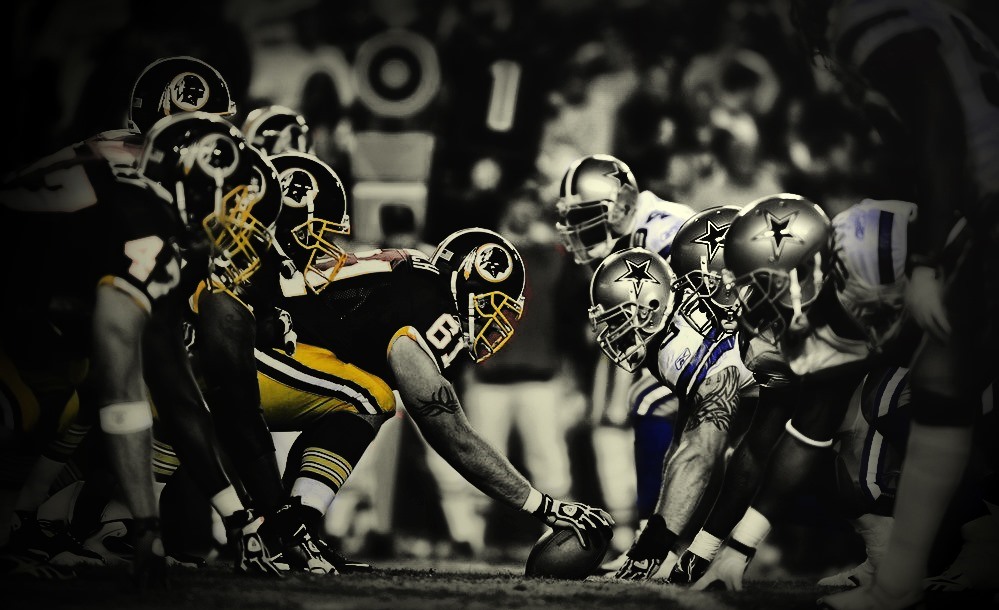
The Cowboys and Redskins are playing tonight in Arlington, both teams at 5-6, both teams more or less playing out the string now, pretty much out of any kind of playoff running. Still, it’s Cowboys-Redskins. And, still, there’s no better day-to-day, week-in-and-week-out drama than Jerry Wayne’s Cowboys. To get you ready for tonight, I highly recommend this excellent piece by ESPN’s Bill Barnwell. It’s a lengthy and detailed analysis of the Cowboys’ problems since Ezekiel Elliot began serving his suspension. Barnwell makes a really strong case that the Cowboys aren’t missing Elliot as much as Dak Prescott is faltering at quarterback. If you ever wanted to make the case that Prescott only looks good because of Zeke, now would be the time to do it — Dak has thrown more interceptions over the past three games than he did his entire rookie season.  But Barnwell expertly outlines how the running game is putting up the same numbers without Elliot as they did with their superstar back. And he accurately spreads the blame around to injuries, receivers, coaching, and offensive line. And Dak.

~~~~~~~~~~~~~~~~~~~~~~~~~~~~~~

One of the many intentionally intergenerational events we hold here at Central is our annual college night.  We bring in recruiters from ACU, OC, LCU, West Texas A&M, Amarillo College, OU, and Texas Tech. And they bring their T-shirts and posters and catalogues. We invite our entire church to show up in their college gear, supporting their schools and interacting with the Central middle school and high school students who are shopping for colleges. And it’s always a fun night. We give away door prizes and play silly trivia games. And we encourage our younger people to talk to our older people about where they went to school.

I enjoy reminiscing about the good ol’ days with fellow Oklahoma Christian alums like Jeff & Michelle and Steve & Connie. It’s fun to talk to our Central teenagers about college life. Their reactions, too, are interesting. It’s almost like they can’t imagine their old preacher really being a teenager and living in a dorm and going to college.

I’m grateful to belong to a church that places such an emphasis on intergenerational relationships. I’m thankful that, even though it’s sometimes hard to determine whether anything’s being accomplished, we keep plugging away at forcing our older and younger people into the same rooms together. It matters.

Thank you to OC recruiter Lauren Bridgeforth for making the trip to Amarillo. And thanks to Adam and Tanner and the Adees for pulling off a fabulously fun evening.

Peace,

Allan

Remarkable Low

The NFL has announced that the Cowboys-Giants game set for prime-time on Sunday December 10 has now been flexed out of the 3:30pm slot to be replaced by Seattle-Jacksonville. Let me repeat: The Cowboys-Giants game has been moved to 12:00 noon on Sunday December 10 in favor of Seahawks-Jaguars.

Let that sink in.

The last time the Giants and Cowboys faced each other at noon on a December Sunday was 2005.

Yes, the Cowboys and Giants play each other twice a year, but their games are a TV exec’s bread-and-butter. This is an intense 60-year division rivalry with two huge fan bases and two of the top media markets in the country. But the game has been moved to noon for Jaguars-Seahawks.

Yes, the Giants are woefully awful this season. Yeah, nobody wants to watch Geno Smith at quarterback for a lame duck coach nobody’s ever heard of. But the now 22-year irrelevancy of the Cowboys is also a factor here that cannot be ignored. Dallas is on its way to yet another .500 or worse season, they won’t make the playoffs, and it’s going to take outsiders — TV executives, NFL brass, jersey sales in Great Britain, whatever — to do what Jerry Wayne won’t: pull the plug on this experiment already!

Yikes.

Allan

« Older posts Newer posts »