Page 305 of 493

Strong in the Lord

“Be strong in the Lord and in his mighty power. Put on the full armor of God so that you can take your stand against the devil’s schemes.” ~Ephesians 6:1

Sometimes it feels like we’re not gaining any ground, much less posting any outright victories. At the end of most days, we look back and can’t really see that the weapons of righteousness, peace, faith, salvation, the Word of God, and prayer are making any difference at all. Sometimes it can seem that way for months. For years. And we might lose patience.

We might be tempted to take up a weapon or two that might work better. Politics, for instance, seems to get results a lot quicker than truth or the Word of God. Money makes things happen far more effectively than righteousness or salvation ever do. Technology communicates much better and faster than loyal love. Threat and force can make things change right before our eyes while peace and faith just seem like fantasy words and wishful thinking.

We don’t always experience the victories. So, we’re tempted to do things in our own ways, by our own powers.

We live in a world dominated by defeat and death. Defeat and death get all the headlines in our world. The death of society. The death of marriage. The death of careers. The death of the family. Death by war, death by starvation, death by murder, death by accident. Death by lethal injection, death by abortion, death by chemicals. The death of the church, the death of the faith, the death of hope.

Our vision for victory in Christ is not some vague wish. Our hope for victory in Jesus is a deliberate, Holy Spirit empowered way of life in a world that’s obsessed with death and defeat.

We see God’s victory together in our born-again baptisms. We experience Gods’ victory together at our Lord’s table. We hear God’s victory together in the reading of our Scriptures. We practice it together in our prayers. We live it together by refusing to let the powers of the world tell us what to do or how to think! We boldly confess and forgive. We courageously welcome the stranger and outcast. We faithfully work for peace and justice. We never stop healing and feeding. We never stop singing and preaching. We never stop giving and giving and giving and giving because we see what God sees.

Be strong in the Lord and in his mighty power, not yours! His mighty power! And the world will know that there is a God in Amarillo!

Peace,

Allan

Happy Birthday Carley Sue!

It just seems like seven or eight years ago; certainly not fourteen! I realize that speaks more to my own rapidly advancing age than anything else. But how in the world are you — our baby, our youngest daughter, our last one — already fourteen?

You are a study in extreme contrasts, Little Bear. You were born screaming at the top of your lungs that Friday afternoon in Wichita Falls and you haven’t stopped screaming since. Good grief, you’re loud, girl. Always have been. I have no idea where you got that. But at the same time, you’ve always exhibited a really quiet and reflective side. I’ve watched you spend hours and hours curled up in a book, writing in your journal, drawing another puppy dog or little girl with big eyes.

You can be so demanding — bottle now! polka-dotted blanket, now! Cheerios, now! mint-chocolate-chip ice cream, now! And, yet, you can be so incredibly selfless and sacrificial — making and giving gifts to family and friends, deferring the choice of TV show or restaurant or souvenir T-shirt to others.

You’re the one, way beyond your sisters, who wants to wrestle and fight, slap box and spar. I never know when you’re going to jump on my back as I’m innocently passing through the living room. When are you going to punch me in the gut next? How many times this week am I going to have to fend off another fake — and pathetic — karate kick or chop to the throat? But at the same time, you’re the one, far and above your sisters, who delights in the cuddles and hugs. Your “burrowing” at night and your insistence on the back scratches, still to this day, are precious to me.

The contrasts in styles and personality, pleasures and peeves, seem much more pronounced during these your middle school years. And I thoroughly enjoy trying to figure them out. You bring me great joy, daughter. I love being with you.

I love that you have Beatles posters on your wall, that you know John Cougar and John Mellencamp are the same guy, and that you recognize within a few notes the difference between a song by the Rolling Stones and one by The Who. I love that you make fun of girls who like Justin Bieber and One Direction. I love that you quote lines from Indiana Jones and It’s a Wonderful Life and that you remember funny stories I’ve shared about my own childhood. I love that you have perfect eyebrows and a sarcastic and sharp sense of humor. I love that you used to have seven thousand Beanie Babies and still get weird and weepy over a particularly cute stuffed animal in a toy store display. I love that you still want to eat lunch with me on your birthday.

More than those wonderful things, I love that you love our God. I love your knowledge and hunger for his Word. I love the way you finish my sentences when I’m quoting Scripture. I love that you want to follow Jesus, to imitate him, to be more like him. I love that you want to help other people in his manner, to worship God in his name, and serve him to his glory. I love listening to you sing. And pray.

You, Carley, are a gift to me straight from heaven. God gave you to us. And we are beyond delighted.

Happy Birthday, Bear.

I love you,

Dad

About Last Night

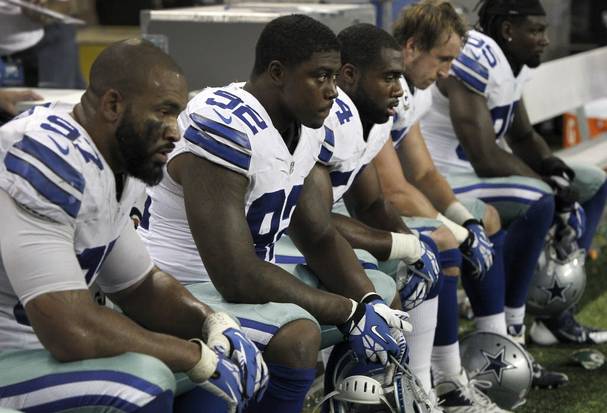
When it comes to the Cowboys, if I can’t say anything ugly I don’t say anything at all. And I don’t mean for this post to be overly ugly or overly critical of last night’s escape over the Giants at the Death Star (the only Ticket Schtick you’ll ever see me use). But after a full day of exulting in the season-opening division win, overly-optimistic Cowboys fans who believe this team is capable of finishing over .500 need to be reminded today of what really happened last night.

Allow me to re-cap in the form of a few questions:

~How in the world, six minutes into the first quarter, do the Giants have three turnovers and the Cowboys only have three points? And zero first downs?

~How in the world do the Giants turn the ball over six times, yet at the two-minute-warning are poised at mid-field, with the ball, trailing by one score?

~How does Romo give up a 91-yard interception return that only results in three points for New York?

~How does Eli Manning throw for 450 yards and four touchdowns and still lose?

~How does the Dallas offense only score two touchdowns and still win?

~How does the Dallas defense give up more yards than all but two teams on the NFL’s opening weekend and still win?

It boggles the mind. So many things had to break just right for Dallas to squeak out that win last night. Believe it or not, it’s the first time in team history that Jason Witten has caught two TD passes from Romo in the same game. I mean, that kind of weird had to go down for the Cowboys to win. But I wouldn’t see it as a changing of fortunes. I wouldn’t view what happened last night as the new rule. I wouldn’t predict anything about the next 15 games based on last night. It was just a case of pure, dumb luck.

Don’t tell me a team causes its own luck. It’s not that I don’t believe it; I know teams cause their own luck. The very best teams are always the luckiest teams, and that’s not a coincidence. But that’s not what we saw last night. Everything about what happened last night goes against NFL logic, against football wisdom, against gridiron history, against NFL numbers and stats. What happened last night was an aberration.

Most of you Cowboys fans already figured next week’s Chiefs game to be an automatic “W.” My word, they were even worse last year than their 2-14 record would indicate. But, another thing that happened yesterday, of all the opening weekend games, was Kansas City posting the largest margin of victory.

What makes you think the Cowboys won’t keep winning a couple of games they should lose and losing a couple of games they should win? Isn’t that what .500 teams do?

Peace,

Allan

Around the Table: Part 1

“They saw God, and they ate and drank.” ~Exodus 24:11

Regular readers of this space know that the communion meal is the one area of our Christian worship, the one part of our history and tradition and liturgy, that really gets me going. It’s the area in which I’ve done the most research and study and the thing about which I’m most passionate. There’s a whole lot going on around the table when disciples of Christ gather to share a meal. And I believe that on Sundays in our churches, we miss most of it.

Here at Central last night, we began an eleven week study of our Lord’s Supper that will take us from Genesis all the way through Revelation. From the Israelites eating on the mountain with God and Christ sharing that last meal with his apostles to the biblical accounts of the early church’s Christian meals to our communion beliefs and practices today, we’re going to explore Scripture and ancient practices, history and context, custom and command. And, by God’s grace, we’re going to arrive at a deeper and stronger communion theology for our congregation.

We opened up the study last night by considering the very first communion meal shared between God and his people in Exodus 24. This is the holy meal that sets the tone for all the communion meals to come. This is the meal Jesus was pointing his disciples back to around the table on that last night. This is the primary model through which all communion meals are informed and formed.

We set it up by looking at a couple of stories in Genesis. In Genesis 31 Jacob and Laban are fighting within their own family. They can’t get along. Jacob takes off with his wives and children and flocks. Laban gives chase, catches up with his daughters and grandchildren and son-in-law, and they begin to argue with one another there in the desert. After both have angrily vented, Laban proposes a peace treaty.

“Come now, let’s make a covenant between you and I, and let it serve as a witness between us… So they took stones and piled them in a heap, and they ate there by the heap.” ~Genesis 31:44-46

A similar thing had occurred in Genesis 26. Isaac and Abimelech were at each other’s throats over land and crops and flocks. There were lies. Their servants were fighting. Finally, Abimelech suggested a peace treaty.

“There ought to be a sworn agreement between us — between us and you. Let us make a treaty with you… Isaac then made a feast for them, and they ate and drank.” ~Genesis 26:28:30

The meal celebrates the reality of the peace. Eating and drinking together expresses in tangible, concrete, and visible ways the reality of the new relationship between the once estranged parties. The treaty brings about the peace; that peace is then experienced at the meal.

Just like with God and his people on the mountain.

In Exodus 19, the Lord announces a covenant for his people and the people accept the terms. “We will do everything the Lord has said!” In Exodus 20, God summarizes the terms of the covenant, which are then itemized in more detail in Exodus 21-23. This covenant is then ratified, or made official, by the sacrifices in Exodus 24:

“They offered burnt offerings and sacrificed young bulls as fellowship offerings to the Lord. Moses took half of the blood and put it in bowls, and the other half he sprinkled on the altar. Then he took the Book of the Covenant and read it to the people. They responded, ‘We will do everything the Lord has said; we will obey.’ Moses then took the blood, sprinkled it on the people and said, ‘This is the blood of the covenant that the Lord has made with you…'” ~Exodus 24:5-8

The covenant is sealed with the blood of the sacrificed animals. Both sides have made pledges, both sides have agreed, and now there’s a brand new relationship. This is it, Moses says. It’s done.

“Moses and Aaron, Nadab and Abihu, and the seventy elders of Israel went up and saw the God of Israel.” ~Exodus 24:9

And God struck the leaders of Israel dead right there on the spot. Yes? Of course! Nobody can see God and live. We know that. The original readers of the ancient text know this. The first hearers of this story knew it. You can’t see God. Duh! You and I have always known that. He is holy, we are not. He is righteous, we are not. He is perfect and transcendent and above all else and we are certainly not. A person cannot see God and live. It just doesn’t work that way.

That’s why the next line in the story is so dramatic. That’s why what happens on the mountain is so extraordinary and shocking; scandalous, even!

“But God did not raise his hand against these leaders of the Israelites; they saw God, and they ate and drank.” ~Exodus 24:11

These high priests and Levites and leaders of God’s people, representing all of Israel, ate and drank a covenant meal with God. They were face to face with the Creator of Heaven and Earth, at his table eating and drinking with him in the reality of a brand new kind of holy relationship. God’s people had been washed by the blood; there were made righteous by the sacrifice. The blood had rendered them perfect in the eyes of God and allowed them to enter into his presence. The sacrifice allowed them to commune with God. They were not killed when they saw him. God did not strike them dead when they came into his holy presence. He welcomed them with a fellowship meal of food and drink. They celebrated the reality of the relationship, the reality of their salvation, by eating and drinking with God.

God never intended an altar. He planned for it, yes, because he knew. But he never intended an altar. He always intended a table. God’s goal is a table. The altar serves the table, the altar makes the table possible. The altar is the atoning work of forgiving sin; the table is the tangible experience of that forgiveness.

Jesus himself, the apostles, all the New Testament writers and readers, and certainly the early church all live in a context of a clear distinction between altar and table. The altar and the table are two different things; there are two completely different forms, entirely different functions between the sacrifice and the meal. Those differences were established and understood by generations and centuries of teaching and practice.

In many ways we have combined the two. Down through the centuries, God’s Church has actually turned the table into an altar. It has destroyed the original form and function of the table. The intent of God’s table and our Lord’s meal has been terribly distorted. The aim of our study is to restore our understanding of the feast, if not our Sunday assembly communion practices.

I’m excited about our study. I’m thrilled already with the early response. By God’s grace, going forward, his Gospel and our salvation in Christ Jesus will be better experienced and more fully expressed around the table here at Central.

Peace,

Allan

God Bless the Newtons

Just a couple of weeks after Judy Newton had been diagnosed with brain cancer, she looked right into my eyes and told me, “Allan, I want to spend whatever time I have left getting closer and closer to God. I want to spend all my time with God. I want to talk to him and hear him. I want to see him. I want to be more present with him and more available to him. I want to understand him and know him better. I want to get closer to God. I want to see God.”

About nine months into the trial, this sweet sister I had only met about a month before she was diagnosed confirmed that it was happening. She told me she was hearing God and seeing God in ways she never had before. She felt closer to our Lord than she ever had. She was filled with an inexpressible peace — and even joy! — that she had never before experienced.

This afternoon Judy Newton, a loving wife, a fabulous mother of two, a beloved third grade teacher at Bivins Elementary, and a valuable member of our praise team here at Central, passed from this life to the next. Surrounded by her family, forgiven by her Savior, and wrapped in the loving arms of her God.

I can confidently say today that all of us who have known Judy through this trial have also seen God. We’ve seen God through Judy. We’ve all seen God in Judy. We’ve heard his voice. We’ve felt his presence. We’ve experienced his peace and joy through our sister, Judy. God has revealed himself to us in powerful ways through his precious daughter, Judy. He showed us.

Of course, we’ve witnessed it and participated in it by walking through this with their whole family. We’ve seen God’s glory in the great faithfulness of her husband, Lanny. We’ve seen God’s glory in their daughter Aleisha’s sacrificial service to her mother. We’ve seen God’s glory in the compassion and tenderness shown by their son, Zach. Judy’s faith never wavered. Her commitment to her God never waned. Her determination to trust her Lord, to see his work in everything and everyone around her, was astonishing.

Judy wanted so badly to see God. She wound up showing God to all of us.

“Where, o death, is your victory? Where, o death, is your sting? Thanks be to God! He gives us the victory through our Lord Jesus Christ! ~1 Corinthians 15:55-57.

Peace,

Allan

Singing as Discipline: Part Two

Finally, the opening night of the Texas high school football season! Fight songs and Frito-Pie, pep rallies and pom-poms, booster club cookouts and homemade signs, game programs filled with local ads wishing the kids luck and hot chocolate in the Thermos, shoe polish on the car windows and new paint on the bleachers, touchdowns and tackles, clapping for the other school’s band, great catches and dramatic picks, momentum, crossing your fingers before the 34-yard field goal, and “why don’t we throw (or run or blitz or stunt or screen or fake or trap or zone) more?” Amarillo High’s Golden Sandies open up at home tonight against Odessa. We’ll be tailgating with some of our best friends in the Bivins Stadium parking lot at 7:00 and in our seats on the 30-yard line in plenty of time for the 8:00 kickoff.

“Blow, Sand, Blow!”

~~~~~~~~~~~~~~~~~~~~~

I shared with you last time the first half of an interesting article by Sean Palmer regarding our corporate singing when we gather as God’s saved people. His question — and it’s a good one — is “what would church look like if we re-framed corporate singing as a spiritual discipline?” You can click here to read the article in its entirety.

To re-cap the first part of his article upon which we reflected in the last post, our corporate singing is viewed by many of us as an individual pursuit. It’s funny because we can’t do corporate singing by ourselves. It has to be done together, as a group. But we think and act like we want all the songs picked out and sung just for us. We enjoy, celebrate, bemoan, criticize, and judge our worship assemblies based mainly on what we personally like. And that’s wrong, wrong, wrong, for a whole long list of reasons.

Allow me to give you today Palmer’s second half of the article with my own comments sprinkled in. These are five things he believes would change in our churches, five things that would result for all of us, he thinks, if we were to view our singing together as a spiritual discipline.

1. We wouldn’t expect immediate results. No faithful practitioner of spiritual disciplines expects to walk in, practice a discipline for an hour, and leave humming a tune and tapping their toes. In the realm of spiritual practices, we know that a blessing is found in the practice itself. You could practice contemplative prayer for years without any tangible outcome, uplifting feeling, or goosebumps. But you come to love and enjoy practicing the presence of God.

Randy Harris says his second great fear about practicing contemplative prayer is “What if something happens?” His number one greatest fear about contemplative prayer is “What if nothing happens?” The point of a spiritual discipline is to enter the practice in complete submission to God, giving yourself entirely to him, and inviting him to do with you exactly what he wants. It’s to be present to God, present with God, available to be used by God as he wishes. Isn’t it enough — isn’t it everything! — to bask joyfully in the glory that is communion with Christ and his saints? I’m singing with God’s people in the holy presence of God, for cryin’ out loud! Does it matter that it’s not my favorite song? This “audience of one” idea is not good for our worship theology. God is not an audience in our worship. We’re not performing anything for God. He’s not sitting back on his heavenly throne just soaking up our praise and prayers. Our God is active in our worship. He is moving us and changing us and blessing us and speaking to us and growing us together in our worship. Maybe I won’t see it or feel it at the moments. Maybe it’ll take months or years. But it’s enough to just sing with my brothers and sisters in the knowledge that I’m being transformed.

2. We could sing on behalf of others. There are songs I hate, like “Amazing Grace.” I’ve never liked it. But I know “Amazing Grace” is tremendously meaningful for others. A friend recently shared with me the place of the song “Amazing Grace” in the recovery movement. The song means a great deal for members of AA and other recovery groups. Those folks are in my church. As a spiritual discipline, I can sing that song — though I despise it — on their behalf. I sing, therefore, not because it’s efficacious for me, but for those around me.

To me, this is the most powerful and practical and understandable of Palmer’s five reasons. This is the logic I have used for years when I speak or write about the evils of personal preference tainting our holy worship of God. The really unfortunate thing here is that he uses the words “hate” and “despise” to describe his own feelings about the classic hymn “Amazing Grace.” How can you be a Christian and not like “Amazing Grace?” Seriously.

We’ll know that Christ is being formed in us when we can joyfully sing other people’s songs. Maybe a younger person doesn’t care for “How Great Thou Art.” It’s too slow and the language is weird. But that younger person realizes how much that song means to all the older people in the room. He loves these older brothers and sisters. They are his Christian family. And this song really moves them. It reminds them of faithful friends, of long gone relatives, or of sweet moments in other locations. They absolutely love this song. It’s one of their favorites. So, the younger person sings it with all of his heart, soul, and strength. He sings this song he doesn’t really like for the sake of all the people in the room who totally love it. He sings it at the top of his lungs with gusto and enthusiasm, because he knows it brings so much joy to so many other people around him. He’s blessing them. In the same ways, an older person may not be really fond of “Mighty to Save.” It’s too long and the tempo is weird. But that older person realizes how much that song means to all the younger people in the room. She loves those younger brothers and sisters. They are her Christian family. And this song really moves them. It reminds them of the summer camp or the youth retreat, of a mission trip or some other really transformative event in their lives. They absolutely love this song. It’s one of their favorites. So, the older person sings it with all of her heart, soul, and strength. She sings this song she doesn’t really like for the sake of all the people in the room who totally love it. She sings it at the top of her lungs with gusto and enthusiasm, because she knows it brings so much joy to so many other people around her. She’s blessing them.

Serving other people, meeting the needs of others, considering them more important than you, is very Christ-like. It’s extremely Christ-like. In fact, it’s the very essence of who Jesus is. Our King came to this earth not to be served, but to serve. I wonder why we can’t come to a worship assembly for 75-minutes with the same attitude.

3. We could be less manipulative. I hate to be the one to tell you, but many worship experiences are designed to manipulate your feelings. That’s not all bad. Church leaders should want you to do something at the end of a service, and music is frequently used to disarm congregants toward that end. Anecdotally, Christian Rich Mullins was approached by a fan. The fan said, “I was really moved during that song going into the third verse. I felt the Spirit.” Mullins responded, “That wasn’t the Spirit; that was when the kick-drum came in.” Perhaps as a spiritual practice, all of us would be more open to simply allowing God to move in our midst rather than modulating up the last chorus, jumping around, turning up the volume, and hosts of other tricks we invent to gin up the congregation.

It’s a weird cycle for worship leaders and preachers and those charged with planning worship assemblies.And a trap. Most of us, by nature, are people-pleasers. We enjoy the pats on the back and the words of affirmation and appreciation for our hard work and our wonderfully executed sermons and song-leading. And we can be overly focused at times on getting things to feel and move just right. I’m guilty of this. I’m one of the worst. More energy! More volume! More drama! More interaction and participation! More, more, more! In moments of serious personal reflection, I sometimes wonder if our God is saying less, less, less.

4. We could hear the God of the desert. Perhaps God doesn’t want us to sing the songs we love. Might it be possible that some of us have come to praise our worship and worship our praise when the call of God is for us to go into the desert, to experience emptiness in an area of life on which we have come to overly depend? If so, could all of the church-hopping and in-fighting over music over the last twenty years been our avoidance of entering the space in which God wants to lead us? Could it be possible that one of the reasons we’re not experiencing greater engagement with God is because we have abandoned his voice and chosen a tune we like? We must never forget, before Jesus begins his life of impact, he goes into the desert.

To treat singing in a worship assembly as a spiritual discipline would be to faithfully sing the songs that are given to us at that time. It would be to ask God to lead us where he wants us to go in our singing. It would be submitting to his voice and his will in our worship. I try to personally find the voice of God in every word that is said to me by a brother or sister in Christ. I believe God speaks to us through other faithful people. He communicates with us and teaches us this way. So, even if I’m being hollered at by a church member who wants to wring my neck (hasn’t happened in a while; whew!), I try to assume there’s some truth to what he is saying to me. Somewhere in his criticism is a nugget of something I really need to hear and pay attention to. Shouldn’t we also view our corporate singing the same way? Somehow, as I sing this song I don’t really like, God is speaking to me. Somewhere in this lousy song with the simple notes and shallow lyrics is a bit of eternal truth about our holy Creator. Shouldn’t I sing that song with the intention of listening for that? Shouldn’t the assumption always be that God is doing something here?

5. We could actually praise God. We have to ask ourselves serious questions about the nature of who we worship when we walk out of common worship upset with God-directed music and lyrics, regardless of whether or not the praise team was “singing our tune.” If corporate singing were a spiritual discipline, God would be at the center of it. And in God’s presence, humankind has always simply bowed.

Peace,

Allan

« Older posts Newer posts »