Page 281 of 497

We Use the Same Book

I was reminded again last weekend that our God is a God of reconciliation and that our Lord’s great prayer is that his people be unified. Further, I was awakened all over again to the great joy we feel when one of the last holdouts of Christian one-ness, our denominationalism, is put aside for the sake of unity and faithful witness.

At the ACU preacher’s workshop in Abilene, I found myself in energetic conversation with Ken Holsberry, the preacher at the Edgemere CofC in Wichita Falls. The severe drought in their city, which made them a national punch line of sorts when they began treating toilet water for use as drinking water, has led to a cooperative prayer and ministry partnership between them and other Christian churches. Edgemere has helped orchestrate a couple of prayer services at a downtown theater and a community worship service at gigantic Memorial Stadium in collaboration with a Presbyterian, a Baptist, and a community church congregation.

Wes Crawford, the preacher at the Glenwood CofC in Tyler, reminded me that in the tiny town of Stamford, Texas, the small churches there have gone in together to pay for a youth minister. The CofC, the Baptist, Presbyterian, and Methodist churches are funding a collaborative youth group that worships and learns, plays and ministers together. They’ve been doing it for years.

And it’s fun. It’s exciting. It just feels right — it feels like the Gospel — to put aside our differences, to tear down the walls that divide us, to come together as children of God and disciples of his Son to better witness to an unbelieving world.

Those of us who haven’t quite figured out how to transition from “We’re the only ones who’ve got it right” to “By the grace of God, all those who follow Christ are brothers and sisters in the Lord” focus mainly on our differences. Those who want to make the move but don’t know where to start, also, I think, are hung up on the differences.

The differences are minor and few. The things we have in common as those redeemed by the love and grace of God are many and huge.

I would suggest just starting with the Bible. You know, we all use the exact same Book. Methodists, Presbyterians, Baptists, all the grace churches and community churches, Disciples of Christ, and Christian churches, and the Churches of Christ — we all use the exact same Old Testament and New Testament Scriptures as the authority and guide in the ways we submit to God and follow his Christ.

Bonhoeffer points to the Bible as the great starting point for Christian unity:

“It is really the biblical text as such that binds the whole Christian community into a unity. It assures us of our being bound together in one family of brothers and sisters not only with the Christian community of all past and future ages but with the whole church of the present. As such, the biblical text is of enormous unifying, ecumenical significance. This consciousness of being bound together into one family is clearly strengthened among hearers of the biblical text, since this is an awareness that every deep insight and experience they encounter in this text is the agelong substance of Christian thought and life and so is heard and learned with gratitude and profound awe.”

When you listen to a Methodist preacher and then think, “Why, that could have been a Church of Christ sermon!” don’t be so surprised. When a Baptist minister talks about faith and grace and good works, don’t be shocked. When the Presbyterian guy speaks passionately about the death, burial, and resurrection of Jesus, don’t be caught off guard. We’re all using the same book. We all hold it tightly and defend it fiercely as the revealed and holy Word of the Creator of Heaven and Earth. And, in a run-down of the many things all Christian churches and all disciples of Jesus have in common, this one’s very near the top of the list.

Peace,

Allan
Reversed!

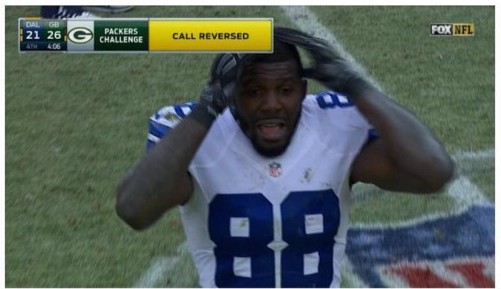
It could have gone either way. I think I could argue for an hour on either side of the call. According to the strict interpretation of the rule, it was an incomplete pass, but only if you determine that Bryant was in the act of falling down, and not in the act of stretching for the end zone. My regret, of course, is not that the Cowboys lost. Come on, what’s more fun than another crazy, punch-in-the-gut, let it get away, last second, I’ve never seen anything like that before, reversal of fortune loss for Dallas? It’s delicious. My regret is that it was determined by a video replay.

It would have been a whole lot more fun for Dallas to be awarded first and goal at the one yard line, as originally, humanly ruled on the field. The Cowboys score and then Aaron Rodgers has the ball with four minutes left to win the game for the Packers. On the field. Between the players. Either way it ends, that would have been a lot of fun. I regret that the video replay is so intrusive on the game. I appreciate that, much more often than not, the replays get it right and make things right that were wrong. But is the intrusive nature of the beast worth it? That controversial reversal determined the outcome of the game.

We all know replay isn’t definitive. It’s not always right. It’s actually quite subjective. So, again, is it worth it?

We’ll never know. We’ve all swallowed the lie that because we have the technology we must use the technology. For most people in most all circumstances now, it’s some kind of moral sin to choose not to use the technology that’s available. And, yeah, that’s regrettable on many fronts. There were 22 football players on the field, hundreds of players and coaches and media on the sidelines, and thousands of fans in the stands. Not one person thought Bryant didn’t catch that pass. Only a couple of people in New York who watched it in ultra slow motion from four different angles considered it incomplete. Only after making the very subjective call that the receiver was falling, and not lunging for the goal line.

As video killed the radio star, replay is taking the human element right out of our football games.

That’s the regrettable part. Not that the Cowboys lost.

Peace,

Allan

Weird Stories

Jesus told some weird stories. Yes, the ones about searching for the lost in Luke 15 are wonderful and warm and we really like the one about the Good Samaritan. But, admit it, a lot of Jesus’ parables are strange. A dishonest businessman is praised for cheating his boss. God is compared to a thief who breaks into your house in the middle of the night and robs you blind. This is the Kingdom of Heaven? We’re told by our Lord to pray like the old lady pounding on the door of the mean judge who has no regard for anybody but himself. The Kingdom of God is compared to a shady real estate deal.

What?

Sometimes I think these parables are told by our Lord in order to move us — story by story — from the safe and secure world of church and Scripture and programs and formulas. Where we think we’ve got it all figured out. Jesus moves us from this world we know so well into a place where things are strange and don’t always turn out as expected. And he does it for a reason. The stories force us to re-evaluate the way we see the world and the people in it.

Think about it.

The Kingdom of God dawns on you while you’re lying in the ditch, moments from death, and your very last hope for rescue is the guy from church who just passed by on the other side. But, wait! Now you see it! Your true salvation, your genuine hope for rescue, actually comes from a lousy foreigner whom you despise!

His stories remind us that we don’t totally get Jesus like we think we do. On the other hand, the parables show us that the Kingdom of God is a wild and wonderful adventure when Jesus totally gets us.

Peace,

Allan

Returning to the Lord

The first Sunday in January is a good time for a congregation of God’s people to renew our dedication to the Lord. It’s the perfect day to start over, to renew vows, to make fresh commitments. And in Scripture, a lot of the time, when God’s people seek renewed relationship with the Lord, they begin with corporate confession and repentance.

Using biblical texts from 1 Samuel 7, Ezra 9, and Daniel 9, we spent this past Sunday together at Central confessing our corporate sins as a 107-year-old body of believers. We talked about the sins of pride and racism, legalism and sexism, self-reliance and apathy, consumerism, materialism, sectarianism. We haven’t committed all these sins ourselves. Our leadership and our church today are not guilty of all those sins. But in the history of our congregation and in the history of Churches of Christ, we have all been guilty of all of it. Some of these sins we still commit. All of them still impact us to some degree. So, in the manner of God’s people as described in Scripture, we confessed.

One of our shepherds, Tim McMenamy, worded a heart-felt, gut-wrenching prayer of confession from his knees on behalf of the church, recalling the sins of our past and the sins of our present. Another of our elders, Steve Rogers, led a prayer of corporate repentance from his knees, making vows to God on behalf of the congregation that we would renounce the sins of our past and present and seek only the Lord and his ways. And then we offered the church some time to confess their own sins, sins in their families, sins from their distant past, or sins that have them ensnared in the present. Our elders and ministers and our spouses were positioned all around the worship center to graciously receive and pray for our people. We lifted them up to God and begged him to provide his promised forgiveness and righteousness and peace.

It was different. It was very quiet in there. And powerful. Only a few, it appeared, actually took advantage of the opportunity. But those who did experienced those blessings of forgiveness and righteousness and peace.

Immediately after the service concluded, several people came to me to thank me for the special focus of the morning and for the way the assembly had been planned. And I think I must have expressed — non-verbally — some disappointment in the visible response from our congregation during the time of confession and repentance. One of my many, many faults — one I should probably confess regularly before the church — is my sin of impatience. I’m terrible with that. I don’t very much of the time practice what I preach there. And I do a lousy job of hiding it. But, good grief, of all people the preacher should know that God is at work in powerful ways that we don’t always get to see.

And Clay Harper reminded me of that Monday.

Clay called me on the carpet for my disappointment. That’s what good and faithful Christian brothers do; that’s what happens in genuine Christian community. And then he reminded me of the truth I had preached the day before, that God answered the prayers and provided the promised blessings regardless of how engaged the people were in what was happening.

In Samuel, the people approached the prophet looking for ways to fix their relationship with God. They begged him to intercede for them and participated fully as a congregation in the prayers of confession and repentance. In Ezra, the leaders of the people came to the prophet and the people (a lot of them, but maybe not all of them) eventually followed and participated in the confession and repentance, some of them under the threat of loss of their property. In Daniel, it doesn’t look like anybody else is there. The prophet prays confession and repentance to God on behalf of the people, but there’s no indication anybody has any idea he’s doing it.

More than likely, we have people in our church family located at every point on that continuum. From begging to make things right with God and willingly putting away their idols and sins, to almost being forced to confess and repent and reluctantly participating, to not taking part in the exercises at all, we’ve got folks all over the map there. All those different reactions and responses were present in our assembly Sunday.

The good news is that in all three scenarios in Scripture, God answered the prayers immediately, while the prayers were still being prayed, and provided the forgiveness and peace.

In Samuel, while the people are in the middle of confessing and repenting, God answered. God showered his people with victory. He destroyed their enemies right there on the spot and blessed them with peace. Same thing in Daniel. While he was in the middle of his prayer of corporate confession and repentance, God spoke to Daniel about forgiveness of sin, about everlasting righteousness, and peace. In Ezra, God provided his grace immediately and withdrew his anger.

I don’t know where you are with confession and repentance before God. I think if you’ve made some New Year’s resolutions to our Lord, they have to begin with confession and repentance. I don’t know where your church is with that. I don’t know how your elders might feel about corporate confession in a church assembly. I don’t know how many in your family or your congregation would enter in to that kind of exercise willingly, how many would have to be dragged into it kicking and screaming, and how many just wouldn’t participate. I don’t know.

But I do know this: the common thread in all three stories of corporate confession and repentance in Scripture is that God answered. He responded immediately, as soon as the prayers began. He did it consistently then and he’s doing it faithfully right now. Why don’t you and/or your church give it a try?

~~~~~~~~~~~~~~~~~~~~~~~~~

Congratulations to Central’s own Joe Bain who will be inducted tomorrow into the Panhandle Sports Hall of Fame here in Amarillo. Coach Bain was the boys track coach at Amarillo High School for 30 years, winning 15 district championships, including one in his last season in 2006. He also served as a long time assistant coach for the Golden Sandstorm football team under Larry Dippel, coaching the defensive backs in 1992 when the Sandies advanced to the state semi-finals.

Coach Bain poured his heart into hundreds of young men in this region, constantly encouraging them, consistently challenging them to be better, always leading to greatness by the example of his own deep character and integrity. Lots and lots of young men are thanking Coach Bain this week for the tremendous influence of godliness he had on their lives. And at least one older guy who only just met Coach Bain three years ago is thanking him for that same leadership and influence he has on my life right now.

Peace,

Allan

Um… Awkward

Just when long-suffering Cowboys fans finally had something to be proud of. Just when a dramatic comeback win in the playoffs had eased the stigma of so many mediocre years and embarrassing finishes. Just when it appeared the dark cloud hovering over the Cowboys was beginning to lift and a bright shining ray of hope was beginning to break…

…the cameras showed us this in Jerry Wayne’s box.

Thank you so much to the Fox Sports camera crew and production staff for catching and broadcasting Chris Christie’s failed high-five / man hug / Jones family noogie. It provided an immediate and much needed boost after I watched Dallas hand the game to Detroit for three hours and the Lions hand it right back. Thank you to every web-site, news and sports media outlet, and blogger for posting the pictures and videos from the owners box. It brings everything back into focus: no matter what they might happen to accomplish on the field, as long as Jerry Wayne is running that team, it must really be embarrassing to root for the Cowboys.

Peace,

Allan

Ordained by the Community of Christ

Larry Lemmons of channel 7, the ABC affiliate here in Amarillo, produced a nice piece on the “4 Amarillo” churches that aired on Christmas night. You can view the three minute video by clicking here.

~~~~~~~~~~~~~~~~~~~

Worshiping with the Legacy church last Sunday got me to thinking all this week about my ordination as a proclaimer of God’s Word. Yeah, I believe with all my heart that our God has been preparing me my whole life to preach the gospel. Yes, I went to seminary and studied Greek. And, of course, I do feel ordained by the Lord to do what I’m doing. But I don’t think those things alone give anyone the right to preach. I’m beginning to understand more and more that the community of faith must ordain its preacher in order for the relationship between proclaimer and listener, preacher and congregation, to work.

So, who ordained me? The elders hired me and prayed over me. But how does a preacher really become ordained to minister with a particular church family? It has become clear to me this week, especially since seeing all those wonderful people at Legacy and visiting with all those dear friends. It’s both a one time event and a lifetime progression. It’s both formal and relational.

At Legacy, Tom ordained me when he asked me to baptize his daughter Sarah. She was the first person I baptized at Legacy. I asked him why he wanted me to do it and he replied, “She needs to be baptized by the preacher; and you’re our preacher.” A similar thing happened with Brooklyn, who greeted me this past Sunday with happy tears in her eyes. Don ordained me when, after a particularly tough sermon in which I challenged a couple of long-held practices of ours, he told me, “Allan, you are my friend, you’re my brother, and you’re my preacher!” Louise ordained me from her wheelchair when she promised me, “I pray for you every single morning.” And I believed her. Jim and Elvera ordained me when they asked me to marry them. This widow and widower had more than 90 years of marriage experience between them when they asked me to preside over their wedding. Dan ordained me when he walked in to my office one day and asked if I could help him with some specific spiritual questions he had. He’s older than me, been a Christian much longer than me, but he said he needed my wisdom. Paul and Jean ordained me when their son was killed in that car accident. Alene ordained me when she asked me to do Bob’s funeral.

I think ordination is both positional and relational — it must be both. Tom didn’t really know me when he asked me to baptize Sarah, but he trusted it was the right thing to do because I was the preacher. Louise didn’t really know me at the time, but she vowed to pray for me every day. Don and I had disagreed about several things during my first couple of years at Legacy, but when he called me his preacher, it was a sign of love and respect that had taken some time. Brooklyn’s ordination of me was in relationship. So was Jim and Elvera’s. Paul and Jean’s was through a shared experience of tragedy. Alene’s affirmation and trust was forged in hours of prayer together.

It’s both. I think the congregation has to say — collectively and individually — this is my preacher, given to us by God, and we’re going to support him and love him and trust him because he’s been placed here with us by Christ. In the same way, the preacher must make the same commitments: these are my people, my church family, given to me by God, and I’m going to support and love and trust these people because Christ has brought us together for his purposes. It’s both formal and relational.

It’s been very helpful to me this week to recognize the many ways I’ve been ordained. Here at Central, Eldrena anointed me with oil one hour before I preached my first sermon here. John Todd and Kami ordained me by bringing us dinner and providing a microwave for our apartment the first night we spent in Amarillo. Lanny ordained me by asking me to perform Judy’s funeral. Nick and Sara ordained me by asking me to do their wedding. Jim and Becky ordained me through some tough conversation and prayer in their kitchen. Wesley ordained me by reflecting on our sermons with emails and cards. Every week I’m ordained by these faithful Christians at Central in living rooms and hospital wards, at lunch and in my study, through phone calls and emails.

And I could keep going. All the dozens of people throughout my childhood and teenage years who told me how wonderful my prayer or my sermonette or my devo talk or my communion meditation or my song leading was, even when it really wasn’t very good at all. The Room 208 class in Mesquite. Kevin’s pushing me to leave radio and pursue preaching and putting his money where his mouth was. Jason and Dan encouraging me through that stressful transition. Donna Steward asking me to baptize her gardener, my first. Lee Ann Clark asking me to do her mother’s funeral, my first. God himself ordaining me by thrusting me into pastoral situations whether I was ready or not: praying over an unconscious Berrilyn Daniel at that WinterFest, moving David Griffin out of that horrible situation in south Marble Falls.

Play with the semantics all you want: God ordains and the congregation affirms, the elders ordain and the church family confirms, whatever. But I know now that it’s both a one time event and a lifetime progression. It’s both formal and relational. And a preacher in God’s Church couldn’t do the job with it being any other way.

Peace,

Allan

« Older posts Newer posts »