Page 100 of 485

He Touched the Coffin

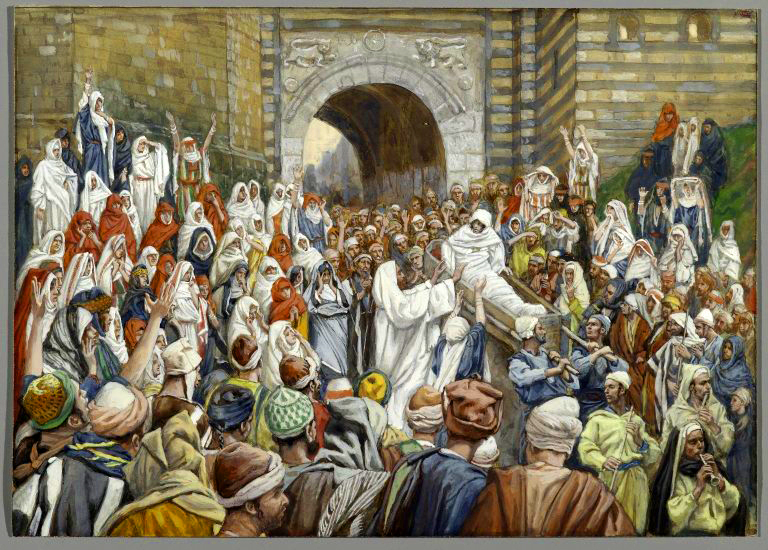
Jesus is walking to the little town of Nain. This little village is so small, so insignificant, so completely unimportant to anybody, that most scholars have no idea where it was located. This was a nothing town full of nobody people. But in Luke 7, Jesus is going there. That means something, yes?

“As he approached the town gate, a dead person was being carried out – the only son of his mother, and she was a widow.” ~Luke 7:12

In that part of the world, at that time and place, it was over for this poor woman. If you’re a woman in that setting and your husband dies and then your only son dies, it’s a death sentence for you. This is a picture of utter despair and hopelessness.

“When the Lord saw her, his heart went out to her and he said, ‘Don’t cry.'” ~Luke 7:13

Death is the ultimate sign that things are messed up. Any kind of sickness, too. Sickness reminds us that death is coming, eventually. We don’t know when or where or how, but we do know death is in the cards for all of us. Sickness reminds us of that. Sickness and death are connected. Death reminds us that this world is broken and things are not the way God created them and intended them to be.

“Then he went up and touched the coffin, and those carrying it stood still. He said, ‘Young man, I say to you, get up!’ The dead man sat up and began to talk, and Jesus gave him back to his mother. They were all filled with awe and praised God… They said, ‘God has come to help his people!'” ~Luke 7:14-17

It’s important that Jesus touched the coffin. He touched the coffin and everything got still. Jesus touched the coffin and stopped death in its tracks. Where death was going, where death was taking this poor woman, what death had planned for this family – all of that was stopped cold as soon as Jesus touched the coffin.

According to the Law, when Jesus touched the coffin, it made him unclean. It tarnished him, it defiled him. According to the Law, it made Jesus an outcast, it separated him from the community of God’s people and, in some sense, for a while, it separated him from God. But he still did it. Jesus touched the coffin.

Jesus is willing to identify with the situation. He purposefully walks to the awful circumstance, he doesn’t back away. He touches the coffin, he goes to the problem, and he takes it into himself. He becomes one with your death. Whatever is killing you or threatening to kill you, whatever is stealing your joy, whatever is hijacking your hope, our Lord Jesus resolutely walks to it and touches it. He identifies with it, he identifies with you, he touches you, and he stops whatever is going on.

God in Christ has the amazing power to reverse the curse. God in Christ has the power and authority to fix everything that’s broken in your life and to make right everything in your world that’s gone wrong. And, praise the Lord, he has the desire, the willingness, and the grace to do it. For you.

At great cost to himself, yes. But he has that same grace for you.

Peace,

Allan

The Loser Wins

“God plays a game with the soul called ‘The Loser Wins;’ a game in which the one who holds the poorest cards does best. The Pharisee’s consciousness that he had such an excellent hand really prevented him from taking a single trick.”

~ from The Spiritual Life, by Evelyn Underhill

The Table is a Party

If you ever find yourself contemplating the original form and intent of the Lord’s Supper, if you ever dare to attempt any kind of communion reform in your church, you might consider an exchange Jesus had with the religious leaders at Levi’s house at the end of Luke 5. I think this passage is very helpful in restoring the communion aspect of communion.

The Gospel tells us Jesus is attending a “great banquet” at the tax collector’s house. Jesus and his disciples were eating and drinking with a large crowd of tax collectors and “others.” A group of religious leaders corner a couple of these disciples to complain and to ask a question:

” Why do you eat and drink with tax collectors and ‘sinners?'”

Jesus answers the Pharisees with his line about coming for the sinners, not the righteous. But the teachers of the Law press him further.

“They said to Jesus, ‘John’s disciples often fast and pray, and so do the disciples of the Pharisees, but yours go on eating and drinking.'”

We know John’s disciples are religious, they’re saying. We can tell. Just look at them! They’re miserable! Look at our disciples, the sour look on their faces. They’re mad about something, they’ve got to be religious. But your disciples, Jesus, are always eating and drinking and whooping it up. They’re always at a party. What gives?

Jesus answers, look, when the groom shows up, the wedding guests party! God himself has come to the banquet and he’s sitting at your table! Now is not the time to fast! This is not the time to be miserable or by yourself! Now is the time to celebrate! God’s promises are coming true! God is right now dwelling with his people! Now is the time to eat and drink and rejoice!

I know there is a time for silent introspection. Yes, there is a time and a place for private reflection and alone time with God. But it’s not at the table. It’s not at the Lord’s Supper. When we are eating and drinking together, with each other and with our risen Lord, on his day, at his table, where he isĀ  present and serving the meal – the Bible says that’s a party.

Peace,

Allan

A People People

The dinner parties with Jesus remind us that we are living the way God created us and saved us to live, not in solitude or isolation, not by ourselves, but in community. We are saved by God and called by him to live in deep connection and relationship with others.

Think about it: Every single time anybody asked Jesus, “What’s the single most important command?” he refused. No, no, there’s not one important command, it’s two! Love God with everything you’ve got and love your neighbor the same way. Jesus made it clear that you can’t do one without the other.

We need God, yes. And we so desperately need each other. Jesus Christ is a people person and the Kingdom of God is a community of people people. The research bears this out. Especially in light of the global pandemic, the studies are showing that people are much healthier – physically, emotionally, mentally – when they live and work and play in tight connections with other people. You’re going to live longer, you’ll have fewer issues, if you do life with other people. It has very little to do with diet or exercise or health habits. According to the data, you’re better off eating donuts with a group of close friends than eating broccoli by yourself! Now, that’s a theology I can embrace!

That’s what Jesus is showing us with these dinner parties. The Kingdom of God is lived and practiced and experienced in community with other people.

Peace,

Allan

A People Person

When we follow Jesus through the Gospels, it’s impossible to miss that Jesus is basically just moving from one dinner party to the next. On every page of the Gospels, Jesus is either at a dinner party, just leaving a dinner party, or about to go to a dinner party. We notice early on in the story that Jesus is not a silent, high-minded, stoic priest lighting candles in a dark sanctuary; he is a rowdy rabbi who does his best teaching and pastoring among a big group of people at a party.

Of course, he was criticized for it. He was called a glutton and a drunk. One of the main things Jesus was known for was his very public eating and drinking.

Yes, there were times when Jesus went alone to the desert or up on a mountain to pray. But it’s much more typical in the Gospels for Jesus to be eating and drinking with big groups of people. Eating and drinking with five thousand folks in the wilderness. Having dinner with two strangers in Emmaus. Dining with his twelve closest friends in an upper room. Feasting with Levi and his friends at Levi’s house. Preparing a picnic on the beach. Jesus was all the time eating and drinking with sinners and saints, with prostitutes and Pharisees, with men and women, with Jews and Gentiles.

These big meals are illustrative of our Lord’s character as a people person. Jesus was with people all the time. Praying with people. Worshiping with people. Walking with people. Fishing with people. Teaching and debating with people. Laughing and crying with people. Attending weddings and funerals with people. Jesus was very deliberate about this, very intentional.

John 4 says Jesus had to go through Samaria. Well, no, nobody has to go through Samaria. Most people like Jesus went out of their way to avoid Samaria. But Jesus purposefully goes to meet that woman at the well and he stays in her village with her and her people for two days. And at the end of those two days, everyone in Sychar declares that Jesus truly is the Savior of the world!

Our Lord Jesus is a people person. He is a supremely social and communal person. Whatever the Father sent the Son to do, Jesus had no interest in doing it by himself. Jesus is a people person. And if you’ve seen Jesus, you’ve seen the Father.

Remember, Exodus 24. The very first communion meal. God has come down to his people on the mountain. He comes to be near them, to be with them. Moses is sprinkling blood on the people to cleanse them: “This is the blood of the covenant that the Lord has made with you!” Then they go up on the mountain and they see God. The Bible says it twice because it is so astonishing. “They saw God and they ate and drank.”

But as good as that was, it wasn’t good enough for God. It wasn’t close enough. Or near enough. It wasn’t physical.

So our God decides to come to us in the physical flesh and blood of Jesus. And now, through Jesus, God himself is eating and drinking with everybody! All the time! At Zacchaeus’ house with all his friends. At Mary and Martha’s house with the community in Bethany. God in Christ is now eating and drinking with everybody, together, in person!

And Jesus says, “This is the Kingdom of God! The Kingdom of God is like a wedding banquet, like a giant feast! It’s just like this!”

You might read the Bible differently – the whole Bible – when you realize that our God’s eternal goal is to eat and drink with his people. To be so close to us, to have all the barriers to relationship between you and God removed so that you and we can eat and drink together in perfect community – you might understand the Kingdom better when you understand the goal.

Peace,

Allan

Coopers!

Our great friends Dale and Karen made it out here to Midland Monday night and it just absolutely made our whole week! We spent six years together with the Coopers in our covenant group at the Central church and they have been a vital part of our family for even longer than that. Surrogate grandparents to our three daughters and an inexhaustible source of strength and encouragement for Carrie-Anne and me, Dale and Karen are two of the kindest and most generous people we’ve ever known.

We didn’t have much time – they were only here in town for a few hours – but we managed to eat a mountain of onion rings and fried catfish at Clear Spring and catch up on our kids, our churches, our jobs, and Dale’s recent retirement. We reminisced about those early covenant group meetings in which we cried and prayed together around our dining room table, serving breakfast and praying with the residents at League House on those monthly Saturday mornings, climbing up and down Masada together on our trips to Israel, building the arch for Valerie’s wedding, chicken-and-dog-and-house-sitting while they went on another rock-and-roll cruise, Dale’s over-the-top July 4th fireworks extravaganzas, and baseball. Lots of baseball. We stayed up talking and laughing Monday night as long as we could, until we started to fall asleep on the couches.

And we set plans to spend the weekend of March 4-6 together when our sticky buddy, Evie Granado, comes to West Texas to dominate everybody’s faces. Can’t wait.

Peace,

Allan

« Older posts Newer posts »