Category: John (Page 22 of 30)

Back To Work

Yesterday was really more of a catch-up day. Today, I really am back to work. Today I’m in my study. Working. While you’re slaving away at the office or the construction site or the airport or the hospital, I’m at the church building doing God’s work. Right?

WRONG!

We are all doing God’s work, together, seven days a week.

Sometimes we speak in ways that make what I do as a preacher “full-time Christian work” and what you do as a member of the Body of Christ “part-time Christian work” or “weekend Christian work.” You must know that you are a full-time Christian banker or plumber or homemaker. You are a full-time Christian truck driver or repair man, administrator or salesperson. When we are at our work, we are at the same time at God’s work. Just like our Lord Jesus.

You realize that most of what Jesus did he did in a secular workplace: in a farmer’s field, in a fishing boat, at a wedding feast, in a cemetery, at a public well, on a country hillside, in a court room, at dinner with friends and family. Sometimes in the Gospels, Jesus shows up in a synagogue or at the temple. But he mostly spends time in the workplace.

John identifies Jesus as a worker 27 times in his Gospel. He quotes our Lord as saying, “My Father is still working, and I also am working.”

You work does not take you away from God; it continues the work of God. God is always in his workplace, your workplace, working. And once we recognize that, we more easily see ourselves — all of us — working in our workplaces in the name of Jesus to his eternal glory and praise.

Peace,

Allan

A Den of Robbers

“Is it not written, ‘My house will be called a house of prayer for all nations’? But you have made it ‘a den of robbers.'” ~Mark 11:17

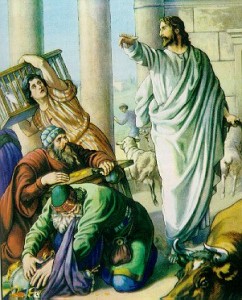
What made Jesus so mad that day at the temple? What riled him to the point of flipping tables and scattering coins and driving out doves and sheep? We generally speculate that pilgrims and travelers were being ripped off. Religious officials were probably cheating worshipers on the exchange rate between their Roman coins and the temple-approved currency. Sellers of cattle and sheep were overcharging and taking advantage of those who had come so far to sacrifice and whose animals had been harmed or blemished in some way along the journey.

Those things may very well be true. And if they were, that would surely upset our Lord. The only problem is that none of those things are attested to in Scripture. We have no scriptural evidence that anybody was being cheated out of money. The Gospels don’t speak or even hint at any economic wrongdoing.

We get the idea, I think, from Jesus’ statement about the temple being turned in to a “den of robbers.” But I believe we’ve missed the point. Jesus is not talking about money or possessions here. He’s quoting the Prophets. And if we go to the passages he quotes, it’s pretty clear what’s got him so angry.

Isaiah 56 is about God’s holy provision for those outside the nation of Israel. God loves the whole world, not just the Jews. And he’s going to take care of them, too. Isaiah 56 promises the “foreigner who has bound himself to the Lord” that he will never be excluded from God’s people. Eunuchs who keep God’s commands will always have a place “within my temple and its walls.” All foreigners who love the Lord:

“these will I bring to my holy mountain
and give them joy in my house of prayer.
Their burnt offerings and sacrifices
will be accepted on my altar;
for my house will be called
a house of prayer for all nations.” ~Isaiah 56:7

God has provided a place at his temple for Gentiles to gather and worship. God has promised covenant to these Gentiles and has sanctified a place for them to participate in the community life of God’s people. Gentiles, too, can experience the glory of God. Gentiles, too, can make sacrifices to God in faith that he will accept the offerings and forgive them of their sins. Gentiles, too, have a place in the Kingdom of God.

But it’s in these very temple courts — the Gentile courts, the Court of the Gentiles — where religious leaders are setting up shop and selling animals. They would never allow the inner parts of God’s temple to be turned in to a noisy, smelly, chaotic mess. They would never do anything to disrupt the expressions of praise and sacrifice from their own people in their special places. But these Gentiles? Yeah, let’s sell the animals there.

They are interfering with the divine provision of God. They are compromising God’s promises to the world. They’re messing with God’s plan. They’re depriving people of the space God has given them in which to worship. It’s a house of prayer for all nations, not just for people who look like me and talk like me and dress like me and behave like me. It’s not just for people who worship and sing and pray just exactly like us. It’s for everybody!

No wonder Jesus was so angry.

So, what’s it like at your church? Are the Hispanics relegated to an upstairs classroom in the back of the building? And is that classroom cluttered with leftover chairs and three ice chests from the youth trip? Where do the deaf worship in your church? Is it just understood that the homeless and the jobless and the “unchurched” won’t fit in? So nobody really tries?

Forget about the actual physical space for a minute. Do the ones who are not just like us — the new members, the move-ins, the poor, the young people, the old people, the divorced, the minorities — have a forum in your church to express their praise to God? Are they stared at, talked about, isolated, and discouraged from worshiping God? Or are they smiled at, hugged on, sung with, and encouraged to worship? Sometimes our haughtiness and complaints, our snide comments and dirty looks, our letters and threats rob our own brothers and sisters in Christ of their God-sanctioned forum and venue for giving him thanksgiving and praise. As Jesus says in John 2:16, “How dare you!”

“Accept one another, then, just as Christ accepted you, in order to bring praise to God.” ~Romans 15:7

Peace,

Allan

Get These Out Of Here!

“Get these out of here! How dare you turn my Father’s house into a market!” ~John 2:16

If Jesus were to walk into your church building tonight would he praise God for what is happening there or would he start flipping over pews? If Jesus walked into my church building on Sunday would he see empty ritual and dead tradition or would he recognize a living and vibrant people being transformed by a genuine relationship with God? What if he wandered into your elders’ meeting? What if he showed up to watch you prepare a sermon? Would Jesus be pleased to go through all the church policies in the secretary’s file cabinet? Or would that cause him to wince in pain?

When Jesus disturbs things in the Jerusalem temple, he is acting out his prophetic message. It’s not the power of the whip that makes his message succeed. It is his moral power, the power of the truth, that strikes the hearts of the people and so captures Christian readers today. Those who confront Jesus after the episode appear to know that Jesus is right and that the temple has become something other than what God had always intended. The purpose of the holy temple has been compromised. Maybe they sense something of God’s divine and righteous anger at work in Jesus.

Jesus is pointing out the problems with the institution of the temple. He is confronting its misdirection and its brokenness. In the process, he points out very clearly that the real activity of God, the real temple, is Christ Jesus himself. In other words, the focal point of the people’s religion has to be replaced by something — no, someone! — new.

The local church — my local church, your local church — is a fallen institution. It’s filled with sinners, filled with people just like you and me. Yes, the church aspires to goodness. But, admittedly, sometimes we succomb to programs and agendas that have very little to do with the Kingdom of God. Sometimes life in our churches can be driven by petty financial interests or social comforts and desires. We sometimes play religious politics, church leaders acting as representatives of their particular constituents, when deciding church policy. We may give in to pressures to be more modern and contemporary. We may bow to petitions to defend empty traditions and dead habits.

If Jesus walked in for a visit would he be outraged over the things we argue about? Would he be appalled at the ways we sing? Or don’t sing? Would he question some of the lines we draw or challenge some of the rules we keep? Honestly, we have plenty of religious customs and practices — even doctrines — that have everything to do with tradition and habit but may have little to do with our risen Lord. We must be willing to allow Jesus to step into our church worlds and openly critique the things we do and the ways we do them. Could the things we cherish and defend stand up to Jesus’ prophetic viewpoint?

I truly believe that everything we do in our churches and in our individual lives as disciples of Christ must have as its foundation the very Gospel we preach and teach. The root of our words and deeds must be connected to the life, death, and resurrection of Jesus. Our traditions and rituals must be born out of and give expression to the Lord who welcomes and forgives and loves and sacrifices. The One who invites all to his wedding feast, the One who gives in abundance the riches of heaven must be the informing and driving force behind every single thing that happens in church.

It’s OK to review and evaluate our habits. It’s allright to challenge our traditions. If they stand up to Christ’s critique, then affirm them. Teach them and practice them in all holiness and sincerity. But by all means be able to explain to your people and your community the hows and whys. If they can’t meet the Gospel standard, then discard them. Destroy them and abolish them in faith and trust in God. And be able to explain the hows and whys based on a true understanding of what Jesus came to this earth to do. And what he came to this earth to change.

~~~~~~~~~~~~~~~~~~~~

You’ve got to watch this 90-second video they’re showing at American Airlines Center to pump up the Mavs fans during these NBA Finals. The video features the most accomplished athletes in the history of DFW talking to Mavericks fans about what it means to win it all. An intense Emmitt Smith. A relaxed Daryl Johnston sitting in front of a couple of Super Bowl trophies. A no-nonsense Troy Aikman. An overly-animated Tony Dorsett with his Heisman Trophy. A blank-stare, monotone, can-we-just-get-this-over-with Nolan Ryan with the A.L. Championship hardware. Mike Modano. Gary Patterson with TCU’s Rose Bowl trophy. Roger Staubach in front of a portrait of downtown Dallas. And Ron Washington from the Rangers dugout in Arlington.

You must watch the video all the way through, all the way to the end.

Classic.

Peace,

Allan

Ordering Jesus Around

The royal official in John 4 orders Jesus to do what he wants. He commands Jesus. This ruler has a sick son, a son who is dying in Capernaum, and he tells Jesus, “Come down before my child dies.” He’s ordering Jesus. He’s telling Jesus what to do.

And Jesus complies.

Ah, see, you didn’t think it was going this way, did you?

This royal official is a man of means and a man of power. This man is well connected. He’s got pull. This man spends most of every day ordering people around. And when he finds out there’s a healer out there who can take care of his boy, he rushes to command Jesus to do just that.

And Jesus agrees. He does it. Boom! Right there on the spot. The boy is healed immediately.

The royal official had no idea who Jesus really was. He didn’t know. He had completely misunderstood Jesus’ mission, his purpose for living on earth. Jesus was a man who could meet the ruler’s immediate and personal needs. This person was only thinking of himself and his family.

And it seems that Jesus was OK with that.

Please know that people are going to come to you, also, to command you and order you around to meet their own felt needs. People are going to misunderstand you and your mission. They’re not going to care a whole lot about your call to ministry or your obligations to our Lord and the big picture concerns of his Kingdom. Your Kingdom priorities and your Kingdom goals won’t matter to some of the people who will direct you to do what they want you to do no matter what. Sometimes people will approach you in order to use you; they will come to you intent on exploiting you so they can continue living their comfortable lives.

Our job, as I understand it, is to show them the love of Christ and share with them his compassion. We’re called by our Savior to give these people his blessings and his mercy and grace. We offer to them out of the abundance of what we’ve been given by God. Jesus loves people. And his greatest desire is to help them, to take care of them, even when they come to him to misuse him.

This is not a call to promote unhealthiness or immaturity in God’s Church. Sometimes the people who have been disciples of Jesus the longest are the very ones who will exploit you and your ministry in their own selfish interests and for their own self-serving purposes. Catering to them is not what I’m talking about.

The story at the end of John 4 is about compassion and the love of Jesus for those who don’t know any better. Jesus took orders from a guy who didn’t even know who he was. I suppose I can, too.

Peace,

Allan

Take Heart!

“In this world you will have trouble. But take heart! I have overcome the world.” ~John 16:33

Jesus tells us plainly — from the mountain, around the table, along the way — that this world is openly hostile to the things of God. For disciples to live in the world means we have to experience struggle and conflict and even battles. The world’s values and vision and morals and ethics are opposed to ours in Christ. And living here isn’t easy.

Not for Christians.

Living right here right now is hard.

I spent an hour with Quincy this morning in our prayer room, lifting up dozens of requests to our Father in Jesus’ name. The things my brothers and sisters have written on those requests tell me that we have struggles and battles. I’ve spent more than a few cumulative hours over the past four or five days in my study counseling with people, praying with people, crying and agonizing with people. There’s nothing easy about this.

Jesus never pretended that it would be. He knows it’s tough. He lived it, remember? And he reminds us that while we’re having this trouble, we can also be filled with courage and strength and hope because he has overcome all of it.

Jesus tells us, “I have faced your enemy and I have conquered him. I have fought your battles on the same fields of human experience where you fight, and I’ve won. I’ve already done it for you. And I’m doing it right now in you and for you.”

If we abide in him, if we stay connected to him, his eternal victory belongs to us.

Wow. That’s really good news.

Peace,

Allan

Watch and Pray

What does Christ want us to see in the Garden of Gethsemane? Why did he tell his disciples to watch and pray? Why did he take them with him that night? Why was it so important that they stay awake?

Jesus makes it very clear that night in the garden: he does not want to die. Jesus is sorrowful and troubled. He’s distressed. He’s in agony. He’s facing the most severe test of his life. God is handing him the cup of suffering and death and asking him to drink it. And Jesus doesn’t want to. He shudders in horror at the mission before him. He dreads all of it. His Father is in the process of making him who had no sin to be sin for us. Jesus is walking through the valley of the shadow of death. And he wants another way. And he asks for it.

What an amazing scene. Jesus is in great agony. He cries out to his God, “Deliver me!” He prays out loud to his Father, “Rescue me!” He begs, “Save me from this horrible assignment. Let’s do this another way.”

No dove descends. No thunderous voice from heaven assures, “This is my Son.” Only silence. Silence. God has already spoken. Now it’s up to the Son to obey.

And he does. “Not my will, but yours be done.” Jesus overcomes the silence, he fights off the temptation to do what he wants and, through open and honest prayer, he obeys his Father.

“Watch and pray.” “Stay here and keep watch with me.”

Jesus tells his disciples, “Do this with me. Experience this with me. Watch me. If you’re really going to follow me, you’re going to need to know how to do this.”

Jesus wants us to be awake and present and obedient to the way of the Son and the will of the Father. He wants us to accept trial. He wants us to undergo testing. He wants us to say “no” to the temptations to abandon the cross aspects of our calling. Afterall, it’s so much easier to turn our backs on the crown of thorns and just go to church. It’s so much easier to just settle into our pews and into the comforts of our status quo and potlucks and baby blessings.

If we’re going to follow Jesus as his loyal subjects — and we are! — then we’re going to follow him into the garden. It’s in the garden with Jesus, praying these agonizing prayers, where we really express our trust in God. We trust God in the darkness of our sufferings because God walked through the darkness himself.

God wants us to be in fellowship with the sufferings of his Son and the sufferings of his world. Fervent and faithful prayer is where God equips us and empowers us to do it. A stiff upper lip isn’t going to do it. A fierce resolve won’t cut it. New Year’s resolutions won’t work. It happens through open and honest prayer; raw, from the heart, transparent communication with the Father.

After a night of agonizing prayer, Jesus is ready. “Shall I not drink the cup the Father has given me?”

Watch and pray.

Peace,

Allan

« Older posts Newer posts »